
Written by: Cellular Institute Editorial Team
Medical reviewer: Dr. Matilde Rodríguez – CP 12651081
Laboratory reviewer: Biotecnóloga Diana Navarrete – CP 15029468
Quick Answer
Stem cell therapy for multiple sclerosis is an area of growing clinical interest, particularly for patients who have experienced ongoing disease progression or intolerable side effects from conventional disease-modifying therapies. Some MS patients may be appropriate candidates for certain regenerative protocols, but candidacy depends heavily on disease type, progression stage, current medications, overall health, and individual medical history. No regenerative therapy offers a cure for MS. A qualified physician must evaluate each patient individually before any protocol can be considered.
What MS Patients Should Know First
Living with multiple sclerosis means navigating a condition that is unpredictable, progressive in many cases, and deeply personal. When disease-modifying therapies stop working well, or when side effects become difficult to tolerate, many patients begin searching for additional options.
Stem cell therapy has entered that conversation for good reason. Researchers and clinicians continue to explore how certain stem cell approaches may support immune modulation and neuroprotection in MS patients. However, the science is still evolving, and not every approach carries the same evidence base or quality standard.
Before making any decision about traveling abroad for treatment, MS patients deserve honest information about what this therapy may and may not offer, who tends to be a more appropriate candidate, and how to evaluate a clinic responsibly.
How Stem Cell Therapy May Support MS Patients
Multiple sclerosis involves the immune system attacking the protective myelin sheath around nerve fibers. Over time, this damage can disrupt nerve signaling and contribute to the neurological symptoms patients experience.
Mesenchymal stem cells, the type most commonly used in regenerative medicine protocols for autoimmune and inflammatory conditions, carry immunomodulatory properties. This means they may help shift the immune environment in ways that reduce inflammatory activity rather than simply suppressing the immune system broadly.
In addition, some research suggests that mesenchymal stem cells may support neuroprotective signaling, potentially creating a more favorable environment for the nervous system. It is important to understand that these effects vary significantly from patient to patient. Stem cell therapy does not rebuild damaged myelin or restore lost nerve function in every case. The goal in appropriately selected candidates is to support the body’s own regulatory and repair processes, not to replace what MS has already affected.
At Cellular Institute, protocols for autoimmune-related conditions are designed under physician supervision and may include complementary approaches such as exosome therapy to support cell signaling, and EBOO therapy in Cancún to help address systemic inflammation that may compound neurological burden. Each protocol reflects the patient’s individual clinical picture.
What Affects Quality and Safety in Stem Cell Therapy
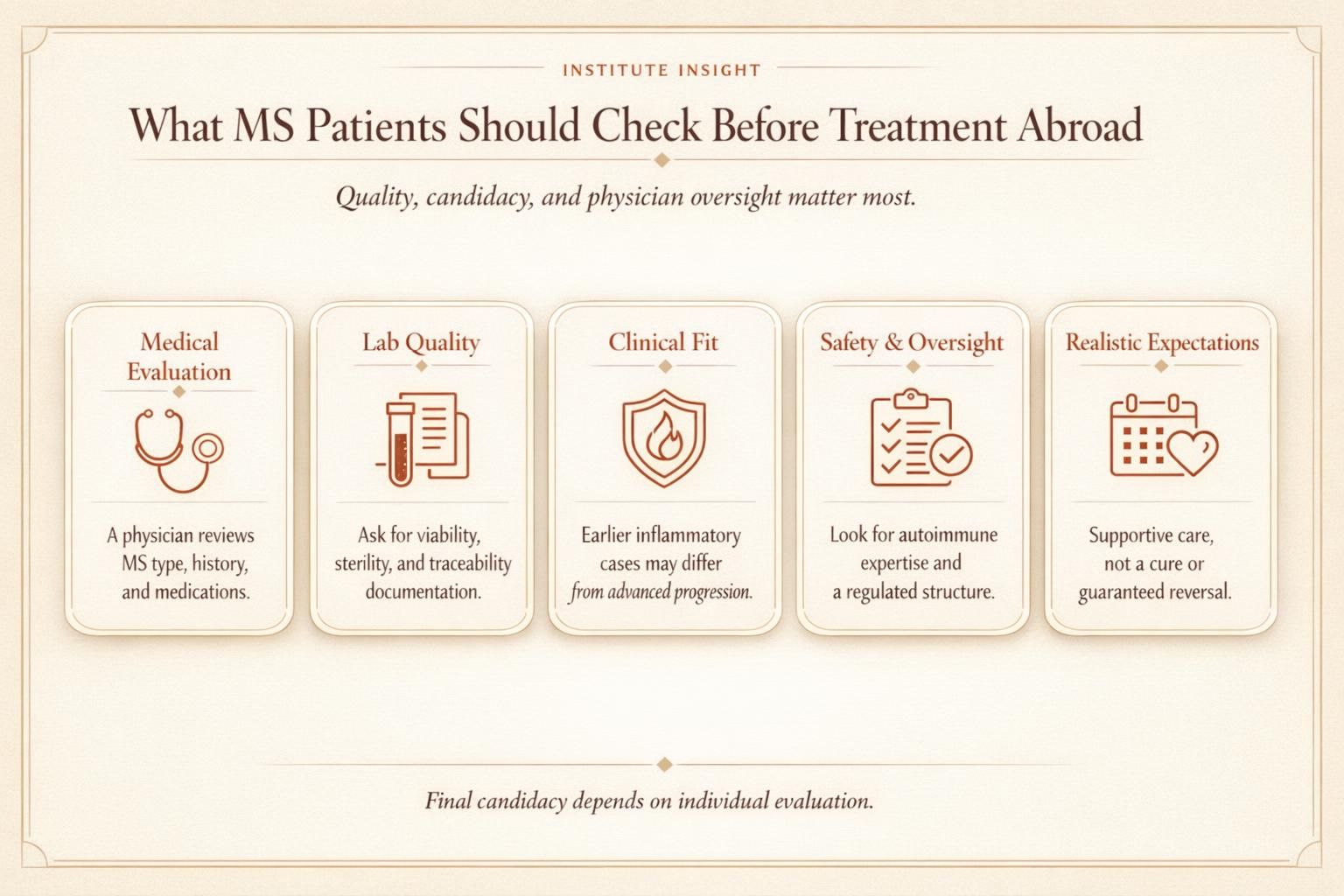
Not all stem cell therapy is equal. The quality of the biologic product, the sourcing process, laboratory standards, delivery method, and physician oversight all affect what a patient may experience.
Patients researching clinics abroad should understand that quality begins in the lab, long before any therapy reaches the patient. At Cellular Institute, biologic products are prepared through our affiliated lab ecosystem, Cellgenic. This process emphasizes traceability, viability, sterility, and xeno-free processing standards. Patients can review certified stem cells documentation, and our lab quality and transparency standards are built around a higher level of clinical accountability than many single-procedure providers offer.
Many clinics outsource their biologic products with limited visibility into origin, processing, or cell viability. This gap in transparency creates real risk for patients who assume all stem cell products are equivalent. They are not.
Our immunology team, including Dr. Roni Moya, Immunologist, plays an important role in evaluating autoimmune-related cases before any protocol begins. MS involves immune system dysregulation, and a physician who understands the immune landscape is essential to designing a responsible, personalized plan.
Who May Be a Candidate for Stem Cell Therapy in MS
Candidacy is not universal. Patients who tend to be more appropriate for regenerative medicine evaluation in MS contexts often share certain characteristics.
- Relapsing-remitting MS: Patients in earlier or more active phases of the relapsing-remitting form may carry a different risk-benefit profile than those in later progressive stages.
- Active inflammation: Protocols designed to support immune modulation may be more relevant when inflammatory activity is still a primary driver of progression.
- Intolerance to disease-modifying therapies: Patients who cannot tolerate standard medications due to side effects may benefit from exploring complementary regenerative options under medical supervision.
- Stable overall health: Candidates generally need to meet baseline health requirements that a physician evaluates through labs and medical history review.
- Realistic expectations: Patients who understand that regenerative protocols may support stabilization and immune balance, rather than reversing established neurological damage, tend to approach the process more appropriately.
Who May Not Be a Suitable Candidate
Certain situations make stem cell therapy a less appropriate or higher-risk consideration for MS patients.
- Advanced primary progressive MS with significant neurological disability may not respond in the same way as earlier or more inflammatory presentations.
- Active infections, uncontrolled systemic illness, or certain medication interactions may increase risk and require medical clearance first.
- Patients who expect a cure or a guaranteed halt of disease progression may not be appropriately prepared for the realistic outcomes regenerative medicine can support.
- Patients currently on immunosuppressive medications may need careful coordination between their existing neurologist and the regenerative medicine team.
This is why candidate evaluation is not optional. It is the foundation of responsible care.
How Cellular Institute Approaches MS-Related Regenerative Protocols
Cellular Institute does not offer a single injection and send patients home. The team builds a physician-guided protocol around the individual patient’s condition, history, goals, and clinical presentation.
For MS patients considering treatment, this may include a comprehensive intake evaluation, physician review of neurological history and imaging, immunological assessment, and a personalized combination of regenerative tools. Complementary modalities such as recovery technologies including hyperbaric oxygen therapy and PEMF may support the overall protocol and help the body respond more effectively to regenerative interventions.
Cellular Institute operates within Mexico’s medical regulatory framework under a COFEPRIS-recognized structure. The clinic is part of a broader regenerative medicine ecosystem that includes ISSCA and Global Stem Cells Group, bringing over 15 years of experience in regenerative medicine education, protocol development, and physician training to every patient interaction.
International patients traveling from the United States or Canada can learn more about what the experience involves through our guide to medical tourism in Mexico, which covers logistics, coordination, costs, and what to expect when traveling for care.
Questions to Ask Before Choosing a Clinic Abroad
Choosing a clinic for stem cell therapy when you have MS is a serious decision. The following questions can help you evaluate any provider responsibly.
- Does the clinic require a thorough medical evaluation before accepting you as a patient?
- Where do the stem cells or biologics come from, and can the clinic provide documentation of viability, sterility, and traceability?
- Does a physician with relevant expertise in autoimmune or neurological conditions oversee the protocol?
- What does the full protocol include beyond the injection itself?
- Does the clinic have a COFEPRIS-recognized or equivalent regulatory structure?
- What follow-up support does the clinic offer after you return home?
- Are patient expectations discussed honestly, including what the therapy may and may not support?
Our article on how to choose a stem cell clinic in Mexico walks through this evaluation process in detail and can help you avoid common mistakes patients make when comparing providers based on price alone.

Frequently Asked Questions
Can stem cell therapy stop MS progression?
Stem cell therapy cannot guarantee that MS will stop progressing. Some patients in appropriately selected cases report a period of stabilization or reduced inflammatory activity, but outcomes vary significantly by individual. No regenerative therapy offers a cure or a guaranteed halt of neurological disease. A physician must evaluate your specific case to discuss what may or may not be realistic for your situation.
What type of stem cells does Cellular Institute use for MS-related protocols?
Cellular Institute works with mesenchymal stem cells, which carry immunomodulatory and anti-inflammatory properties relevant to autoimmune conditions. Biologic products are prepared through Cellgenic with documented viability, sterility, and traceability standards. The specific protocol depends on the patient’s individual evaluation.
Is it safe to travel to Cancún for stem cell therapy?
Many international patients travel to Cancún for regenerative medicine each year. Cellular Institute provides coordinated medical tourism support, including patient coordination, physician-supervised care, and structured follow-up. Patients can also review guidance on stem cell therapy safety in Mexico before making a decision. Safety begins with choosing a clinic that operates within a regulated medical framework and requires proper candidate evaluation.
How much does stem cell therapy for MS cost in Mexico?
Costs vary depending on the complexity of the protocol, the number of sessions, the biologics involved, and any complementary therapies included. Patients researching options can review our guide to stem cell therapy cost in Mexico for a more detailed breakdown of what pricing typically includes and what to compare when evaluating clinics.
Final Thoughts
MS patients researching stem cell therapy abroad deserve clear, honest information rather than inflated promises. The science behind regenerative medicine for autoimmune and neurological conditions continues to develop, and carefully evaluated patients may find that a personalized protocol supports their immune health, reduces inflammatory burden, and contributes to a more stable clinical picture.
What matters most is choosing a clinic that takes the medical evaluation seriously, uses high-quality biologic products with documented standards, and designs a protocol around you as an individual rather than offering a one-size-fits-all injection.
If you are ready to explore whether you may be a candidate, we encourage you to schedule a discovery call with the Cellular Institute team. Our patient coordinators and physicians are here to answer your questions honestly and help you understand what a physician-guided regenerative experience in Cancún may look like for your situation.
Medical Disclaimer
This article is for educational purposes only and does not replace medical advice, diagnosis, or treatment. Regenerative therapies are not appropriate for every patient, and outcomes vary. A licensed physician must evaluate your medical history, goals, and candidacy before any treatment can be recommended.