
Written by: Cellular Institute Editorial Team
Medical reviewer: Dr. Matilde Rodríguez – CP 12651081
Laboratory reviewer: Biotecnóloga Diana Navarrete – CP 15029468
Quick Answer
Both Panama and Cancún attract patients from the US and Canada seeking stem cell therapy. Each destination offers a different combination of regulatory context, travel logistics, clinic infrastructure, and patient experience. For many North American patients, Cancún offers a shorter flight, lower overall travel cost, a more developed medical tourism infrastructure, and access to clinics with vertically integrated biologics and physician-supervised protocols. That said, the destination alone does not determine quality. The clinic, the biologic product, the medical team, and the protocol design matter far more than geography. A licensed physician must evaluate your history and goals before any treatment can be recommended.
Why Patients Are Comparing These Two Destinations
Latin America has become a growing hub for regenerative medicine. Patients who cannot access stem cell therapy in the US — due to regulatory restrictions or cost — often look south. Panama and Mexico both appear frequently in online searches. Both have established medical communities. Both attract international patients.
But the comparison goes deeper than geography. Patients want to know which destination offers stronger medical oversight, more transparent biologics, better travel logistics, and a more complete patient experience. These are the right questions to ask.
Travel and Proximity: A Practical Difference
For most patients in the US and Canada, Cancún wins on proximity. Direct flights to Cancún International Airport depart from dozens of North American cities. Flight times typically range from two to four hours from major US hubs. Airfare tends to be competitively priced, and the airport is one of the most traveled in the Western Hemisphere.
Panama City is accessible from the US, but connections are less frequent from many mid-sized cities. Travel time is longer for patients in the central or western US. Layovers are more common. For patients who are already managing a health condition, minimizing travel fatigue matters.
Cancún also offers a well-established hospitality ecosystem. Patients can combine treatment with a comfortable recovery environment, which many find helpful during the days following therapy.
Regulatory Environment: What Patients Should Understand
Neither Panama nor Mexico operates under the same regulatory framework as the United States. This is important to understand clearly. In both countries, stem cell therapy exists in a space that allows clinical application outside the strict FDA approval process that governs the US market. This is why international patients travel to these destinations.
In Mexico, the regulatory body is COFEPRIS. Clinics operating within Mexico’s medical regulatory framework are expected to hold appropriate licensing for tissue handling, cell application, and clinical practice. Patients should always ask any clinic — in any country — about its licensing structure, the regulatory documentation supporting its biologic products, and how it handles safety monitoring.
Cellular Institute operates within a COFEPRIS-recognized structure and works with certified stem cells that meet documented quality standards. This level of regulatory alignment and product documentation is not universal. Patients should ask specific questions before booking anywhere.
Biologic Quality: The Factor Most Patients Overlook
Where the cells come from, how they are processed, and what documentation exists to confirm their quality may be the most important factor in any stem cell therapy decision. Most patients focus on price or destination. Fewer ask about the lab.
Not all clinics operate with the same standards. Some outsource their biologic products with limited visibility into sourcing or handling. Others work with in-house or closely affiliated lab ecosystems that support traceability, viability testing, sterility documentation, and xeno-free processing standards.
Cellular Institute works with Cellgenic, its affiliated biologics partner, to support a more controlled and transparent process. Lab quality and transparency are central to how the clinic approaches every protocol. Patients can ask about certificate of analysis documentation, cell viability standards, and how products are handled from source to clinical application.
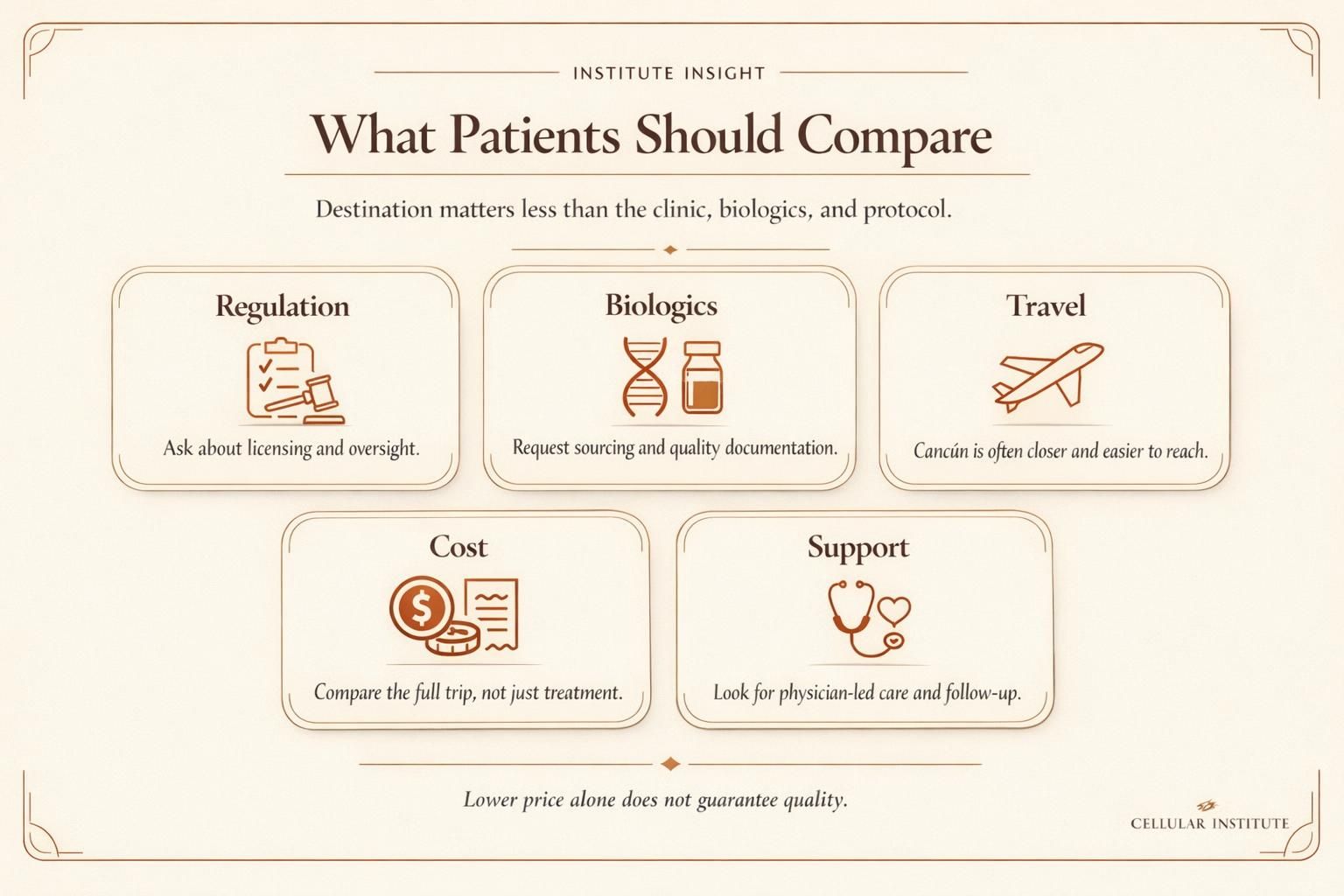
Whether you are evaluating a clinic in Panama or Cancún, ask these questions. The answers will tell you more than the destination ever could.
Cost Comparison: What Goes Into the Total
Stem cell therapy costs vary widely between clinics in both Panama and Mexico. Published prices rarely reflect the full picture. Patients need to account for airfare, hotel accommodations during treatment, post-treatment recovery stays, coordination fees, and whether complementary therapies are included in the protocol.
For most North American patients, the total cost of a Cancún trip — including flights, accommodation, and treatment — tends to be competitive with or lower than a comparable Panama trip. Cancún’s hospitality market is large, which creates more options at different price points. To understand what treatment alone may cost, our detailed breakdown of stem cell therapy cost in Mexico covers what patients should expect and what drives pricing differences between clinics.
Be cautious of unusually low prices in either country. In regenerative medicine, price often reflects the quality of the biologic product, the depth of the medical evaluation, and the level of physician involvement in protocol design.
The Patient Experience: More Than a Procedure
Many patients evaluating Panama vs Cancún focus heavily on the therapy itself. But the experience around the therapy matters just as much. How does the clinic coordinate your arrival? Is there a bilingual patient coordinator? What happens on treatment day? What support exists for recovery?
Cellular Institute approaches medical tourism in Mexico as a complete patient journey. This includes airport coordination, clinical evaluation, personalized protocol design, treatment administration under physician supervision, and access to recovery technologies such as hyperbaric oxygen, red light therapy, and PEMF. These are not add-ons. They are part of a structured regenerative medicine experience designed to support the patient before, during, and after therapy.
Patients who want to understand what a full treatment trip looks like can explore what to expect by reading about regenerative medicine in Cancún before making any decisions.
Physician Oversight: A Non-Negotiable Standard
Regardless of destination, physician-led care should be a baseline requirement. A qualified physician should review your medical history, evaluate your candidacy, identify any contraindications, and design a protocol based on your specific health context. Regenerative medicine is not a one-size-fits-all service.
At Cellular Institute, Dr. Rafael Moguel, Medical Director, leads the clinical team with a background in cardiology and regenerative medicine. Protocols are designed around each patient. Evaluation precedes every treatment recommendation. Results vary by patient, and the medical team communicates that clearly from the start.
When comparing clinics in Panama or Cancún, ask whether a physician reviews your records before you arrive, who administers the therapy, and what the follow-up process looks like after you return home.
What to Ask Before Choosing Any Clinic
- Where do the biologic products come from, and what quality documentation is available?
- Does the clinic operate within a recognized regulatory framework?
- Will a physician evaluate my candidacy before treatment?
- Is the protocol personalized to my history and goals, or is it standardized?
- What complementary therapies or recovery technologies are included?
- What does follow-up look like after I return home?
- What is included in the quoted price, and what costs extra?
Our guide on how to choose a stem cell clinic in Mexico walks through these questions in detail and helps patients identify red flags early in the research process.

Frequently Asked Questions
Is stem cell therapy in Cancún regulated by the Mexican government?
Mexico’s health regulatory body, COFEPRIS, oversees licensing for clinical facilities and tissue handling in the country. Clinics operating responsibly within Mexico work within this framework and should hold appropriate documentation. Patients should always ask any clinic about its regulatory structure and product documentation before booking.
How does travel to Cancún compare to Panama for US patients?
For most US and Canadian patients, Cancún is closer, easier to reach with direct flights, and less expensive to travel to overall. Panama City is accessible but requires longer travel times and more frequent connections from many North American cities. For patients managing health conditions, shorter travel is often a meaningful factor.
What makes a stem cell clinic higher quality, regardless of country?
Quality comes down to the biologic product, the physician oversight, the protocol design, and the follow-up structure. Patients should ask about cell sourcing, processing standards, quality documentation, physician credentials, and how the protocol is personalized. A lower price does not indicate better value if these elements are missing.
Does Cellular Institute offer a consultation before I travel?
Yes. Cellular Institute offers a discovery call for prospective patients to speak with a patient coordinator, share their health history, and understand whether they may be a candidate. This step happens before travel is ever discussed. A physician evaluation follows as part of the intake process.
Final Thoughts
The question of stem cell therapy in Panama vs Cancún is really a question about what you are looking for in a clinical experience. If proximity, travel cost, regulatory alignment, biologic transparency, physician-guided protocols, and a complete patient journey all matter to you, Cancún — and specifically Cellular Institute — offers a strong answer to each of those priorities.
We are not a procedure provider. We are a regenerative medicine platform built around the full patient experience. From evaluation and protocol design to treatment, recovery, and follow-up, every step is guided by a physician and supported by a team that understands what international patients need.
If you are ready to explore whether you may be a candidate, we invite you to schedule a discovery call with our team. There is no pressure. Just a conversation about your goals and what may be possible.
Medical Disclaimer
This article is for educational purposes only and does not replace medical advice, diagnosis, or treatment. Regenerative therapies are not appropriate for every patient, and outcomes vary. A licensed physician must evaluate your medical history, goals, and candidacy before any treatment can be recommended.