
Written by: Cellular Institute Editorial Team
Medical reviewer: Dr. Matilde Rodríguez – CP 12651081
Laboratory reviewer: Biotecnóloga Diana Navarrete – CP 15029468
Quick Answer
Patients from the United States and Canada are traveling to Mexico for MUSE stem cell treatment primarily because of cost differences, access to physician-guided regenerative protocols, and the quality of care available at advanced clinics in Cancún. Mexico offers a regulated medical environment where experienced physicians can offer regenerative therapies that remain inaccessible or cost-prohibitive in North America. However, not every patient qualifies, and a thorough medical evaluation must come before any treatment decision. Results vary by patient, and responsible expectations matter.
What Is Driving Patients to Mexico for MUSE Stem Cell Treatment?
MUSE cells, or multilineage-differentiating stress-enduring cells, represent an emerging area of regenerative medicine research. These cells belong to a naturally occurring population found in various adult tissues and have attracted scientific interest for their potential role in supporting tissue repair and cellular recovery.
In the United States and Canada, access to this type of advanced regenerative therapy remains limited. Many patients encounter long waitlists, restricted clinical trial access, or costs that reach tens of thousands of dollars per treatment cycle. Mexico, and Cancún specifically, has emerged as a serious destination for patients who want access to evidence-informed regenerative protocols under qualified physician supervision.
The decision to travel is rarely impulsive. Most patients arrive after months of research. They have already explored their options at home. They come to Mexico looking for quality, not just a lower price.
Cost Comparison: Mexico vs. the United States and Canada
Cost plays a major role in this conversation. In the US, advanced regenerative therapies can range from $15,000 to $50,000 or more depending on the protocol, the clinic, and the number of sessions. Insurance rarely covers these treatments.
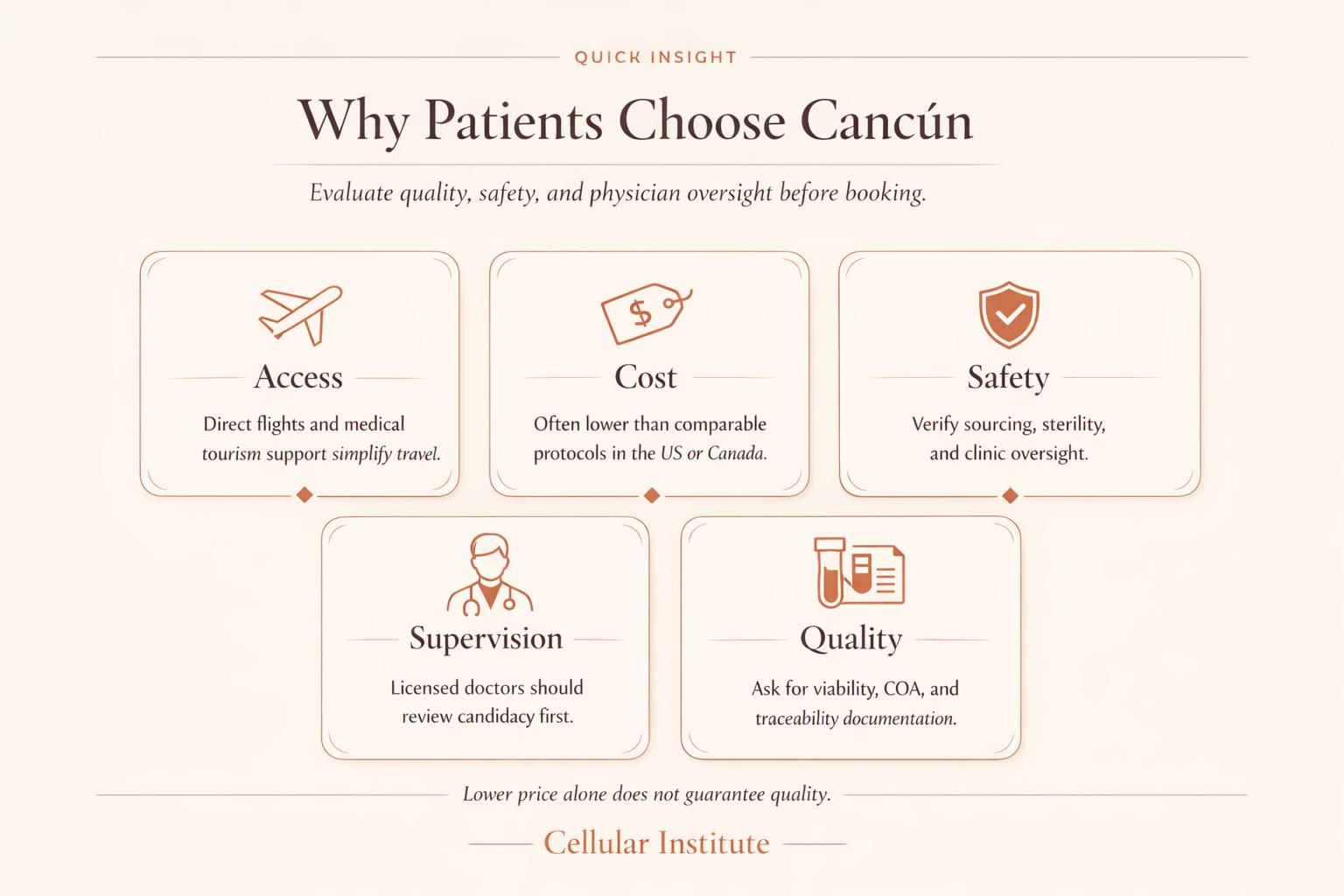
In Mexico, patients can often access comparable or more comprehensive protocols at significantly lower costs. However, price should never be the only factor. A low-cost provider with poor quality control, unverified biologics, or no physician oversight creates risks that no savings can justify.
The right question is not which clinic is cheapest. The right question is which clinic offers the best combination of quality, medical oversight, biologic transparency, and patient support for the investment. You can explore a detailed breakdown of stem cell therapy cost in Mexico to understand what responsible pricing typically looks like.
What Patients Should Know About Clinic Quality and Safety
Not all regenerative medicine clinics operate at the same standard. This matters significantly when evaluating MUSE stem cell treatment in Mexico. Patients should ask specific questions before committing to any provider.
- Where do the cells come from? Source, donor screening, and processing standards all affect biologic quality.
- What quality documentation exists? Certificates of analysis, viability data, and sterility testing are baseline expectations at serious clinics.
- Who oversees the protocol? A licensed physician should evaluate every patient, review medical history, and guide the clinical plan.
- Is the clinic operating within Mexico’s regulatory framework? COFEPRIS-recognized structures and licensed medical oversight matter.
- What does the full patient experience include? A responsible clinic supports patients from arrival through follow-up, not just during the treatment session.
Understanding stem cell therapy safety in Mexico helps patients ask better questions and recognize the difference between a serious medical provider and a clinic driven only by volume.
What Affects the Quality of MUSE Stem Cell Treatment?
Biologic quality starts long before the patient arrives at the clinic. The sourcing of cells, how they are processed, how they are stored, and what documentation accompanies them all affect the clinical value of the therapy.
At Cellular Institute, biologic preparation flows through a carefully controlled process supported by the Cellgenic lab ecosystem. This means greater traceability, xeno-free processing standards, quality control documentation, and a clearer connection between the lab and the clinical team. Patients can review lab quality and transparency details directly to understand how this process works.
Many clinics outsource their biologics with little visibility into product origin or handling. That gap in traceability is a meaningful clinical risk. When quality documentation exists and the lab team can stand behind the product, the patient’s confidence in the protocol has a much stronger foundation.
Who May Be a Candidate for MUSE-Based Regenerative Protocols?
MUSE cell therapy and broader regenerative protocols may be appropriate for patients dealing with conditions related to tissue repair, neurological support, inflammatory burden, or chronic recovery challenges. Commonly evaluated candidates include those with:
- Chronic joint or musculoskeletal conditions that have not responded to conventional approaches
- Neurological conditions where supportive regenerative tools are being explored
- Systemic inflammation that may benefit from a multimodal regenerative approach
- Recovery optimization goals following injury or illness
- Longevity-focused health strategies that include cellular health support
Candidacy requires a formal medical evaluation. A physician must review lab work, medical history, current medications, and overall health status before any protocol begins.
Who May Not Be an Appropriate Candidate
Regenerative therapies are not appropriate for every patient. Individuals with active malignancies, certain autoimmune conditions in acute phases, recent infections, or specific cardiovascular concerns may face contraindications. This is exactly why physician evaluation is non-negotiable. A responsible clinic will not simply sell a treatment. It will evaluate whether the patient is medically appropriate for that treatment.
How Cellular Institute Approaches MUSE Stem Cell Treatment in Cancún
Cellular Institute approaches regenerative medicine as a complete clinical experience, not a single-session injection. The team begins with a full medical evaluation led by qualified physicians. From there, the protocol reflects the patient’s specific goals, health history, inflammatory status, and recovery capacity.
Dr. Rafael Moguel, Medical Director, oversees the clinical direction of the program. His background in cardiology and regenerative medicine ensures that patients receive a thorough evaluation before any protocol begins. The team also includes specialists in immunology, orthopedics, and laboratory science who contribute to each patient’s individualized plan.
Complementary therapies may support the regenerative protocol. These can include exosome therapy, advanced recovery technologies such as hyperbaric oxygen, red light therapy, and PEMF, as well as peptide therapy and EBOO for inflammation and blood optimization. Each addition is clinically considered, not automatically included.
Patients also receive full medical tourism coordination. Cancún is accessible from most major US and Canadian cities with direct flights. The team supports international patients with airport logistics, accommodation guidance, and bilingual communication throughout the process. If you are planning a treatment trip, the guide to regenerative medicine in Cancún offers practical information to help you prepare.
Questions to Ask Before Choosing a Clinic in Mexico
Patients who are ready to move forward deserve clear answers to direct questions. Before committing to any provider, ask:
- Can you provide documentation of cell viability, sterility, and sourcing?
- Who is the physician supervising my protocol, and what is their training?
- Is the clinic operating under COFEPRIS-recognized licensing?
- What does the full treatment visit include beyond the injection itself?
- How do you handle patient follow-up after the visit?
- What complementary therapies are available to support the protocol?
- What does the patient coordination process look like from arrival to departure?
Learning how to choose a stem cell clinic in Mexico gives patients a structured framework for making this comparison with confidence.
Frequently Asked Questions
Is MUSE stem cell treatment available in Mexico?
Regenerative medicine clinics in Mexico, including Cellular Institute in Cancún, offer advanced stem cell protocols that may incorporate MUSE cell biology as part of a broader regenerative approach. Availability and protocol design depend on the individual patient’s evaluation and medical candidacy. Physician consultation is required before any treatment plan begins.
How does the cost of MUSE stem cell treatment in Mexico compare to the US?
Patients often find that comprehensive regenerative protocols in Mexico cost significantly less than comparable programs in the United States or Canada. The exact difference depends on the scope of the protocol, the clinic, the biologics used, and the complementary therapies included. Price comparisons should always account for the full scope of care, not just the injection itself.
Is it safe to travel to Cancún for medical treatment?
Cancún is one of the most visited international destinations in the Western Hemisphere and has well-developed infrastructure for medical tourism. The hotel zone and medical district where Cellular Institute operates are considered accessible and safe for international patients. Patients are encouraged to research travel logistics and coordinate with the clinic’s international patient team before arrival.
What should I expect from the treatment process at Cellular Institute?
The process begins with a medical evaluation to assess candidacy and design a personalized protocol. Treatment sessions are physician-supervised and may include complementary therapies alongside the primary regenerative therapy. The clinic team coordinates logistics, patient communication, and follow-up support. Most international patients complete their visit over several days, though the exact timeline depends on the protocol.
Final Thoughts
Patients from the US and Canada are choosing Mexico for MUSE stem cell treatment because serious, physician-guided regenerative medicine has become genuinely accessible here. Cancún, in particular, offers a combination of advanced clinical care, qualified medical teams, in-house biologic quality standards, and international patient support that few destinations can match.
The decision to travel for treatment deserves careful thought. Quality, transparency, and physician oversight matter far more than price alone. Cellular Institute’s approach to regenerative medicine in Cancún is built around exactly these principles.
If you are exploring MUSE stem cell treatment in Mexico and want to understand whether you may be a candidate, the next step is a conversation with a qualified physician. Schedule a discovery call with the Cellular Institute team to start that conversation and learn what a personalized protocol could look like for your specific situation.
Medical Disclaimer
This article is for educational purposes only and does not replace medical advice, diagnosis, or treatment. Regenerative therapies are not appropriate for every patient, and outcomes vary. A licensed physician must evaluate your medical history, goals, and candidacy before any treatment can be recommended.