

Written by: Cellular Institute Editorial Team
Medical reviewer: Dr. Matilde Rodríguez – CP 12651081
Laboratory reviewer: Biotecnóloga Diana Navarrete – CP 15029468
Quick Answer
Each year, thousands of patients from the United States and Canada travel to a stem cell clinic in Mexico to access regenerative therapies that remain largely unavailable or unaffordable at home. Mexico has developed a growing infrastructure of physician-led, COFEPRIS-recognized clinics offering personalized regenerative protocols under real medical supervision. That said, not every clinic operates at the same standard. Candidate evaluation by a licensed physician is required before any protocol can be recommended, and results vary by patient.
Why Domestic Access Remains Limited
In the United States and Canada, most stem cell therapies outside of bone marrow transplantation remain in clinical trial phases or face strict regulatory restrictions. Patients dealing with chronic joint pain, inflammatory conditions, neurological concerns, or early aging often find that conventional medicine offers limited options beyond medication or surgery.
Many of these patients are not looking for an experimental gamble. They are looking for a serious, medically supervised option that their home country has not yet made broadly accessible. That gap in access is one of the primary reasons Mexico has emerged as a destination for regenerative medicine in Cancún.
What Mexico Offers That Many Patients Cannot Find at Home
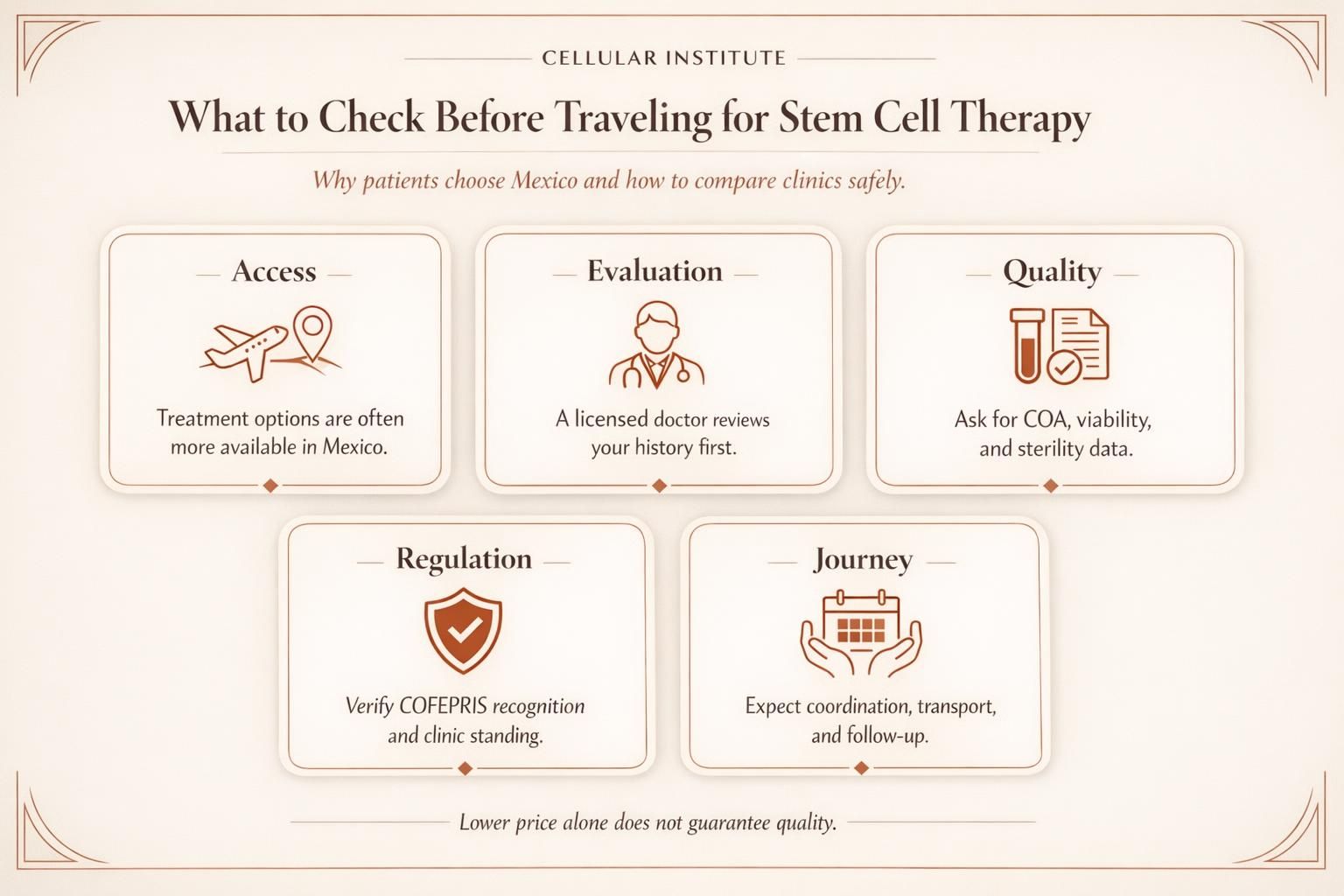
Mexico operates under a different regulatory framework. COFEPRIS, the country’s federal health regulatory authority, recognizes specific licensing structures for tissue handling, cellular therapies, and clinical application. This framework allows properly licensed clinics to offer therapies that remain restricted in the US and Canada.
This does not mean every clinic in Mexico meets a high standard. It means that reputable, physician-led clinics in Mexico can legally offer regenerative protocols that are genuinely difficult to access elsewhere. Patients should always ask about a clinic’s regulatory standing before booking treatment.
Cancún, in particular, has become a hub for medical tourism because it combines strong international flight connections, a premium hospitality infrastructure, and a growing cluster of advanced medical providers. For patients traveling from North America, the logistics are often straightforward.
What Makes a Reputable Stem Cell Clinic in Mexico
Not all clinics that market stem cell therapy operate at the same level of quality, safety, or clinical rigor. Patients researching options should look beyond price and marketing language. The following factors separate responsible providers from lower-quality alternatives.
Physician-Led Protocols
A reputable clinic evaluates each patient individually before recommending any protocol. The physician reviews medical history, current conditions, labs, and goals. Treatment is not offered as a standardized package. It is designed around the patient’s specific situation.
Biologic Quality and Lab Transparency
The quality of the stem cells or biologic products used in therapy matters significantly. Patients should ask where the cells come from, how they are processed, and what documentation is available. At Cellular Institute, biologic preparation happens through an affiliated lab ecosystem that prioritizes traceability, viability, sterility, and xeno-free processing standards. The team includes Biotechnologist Diana Navarrete, who supports laboratory review and quality oversight. Patients can learn more about this standard through the clinic’s lab quality and transparency documentation.
Certified Stem Cells
Ask whether the clinic uses certified stem cells with documented quality standards. A certificate of analysis, viability data, and sterility testing are all reasonable things to request. Clinics that cannot provide this documentation warrant additional scrutiny.
Regulatory Recognition
Ask whether the clinic operates within Mexico’s medical regulatory framework under COFEPRIS. A clinic that cannot answer this question clearly may not be operating at the standard you deserve.
What the Patient Experience Looks Like
Traveling to Mexico for treatment feels very different from receiving care at a local clinic. For many patients, that difference is positive. Medical tourism in Cancún, when done through a well-organized provider, typically includes bilingual patient coordination, airport transportation support, pre-trip medical evaluation, concierge-style logistics guidance, and structured follow-up after treatment.
Cellular Institute approaches the patient journey as a complete regenerative medicine experience, not a single procedure. Depending on the protocol, patients may receive stem cell therapy alongside complementary modalities. These might include exosome therapy for cell signaling support, EBOO for systemic inflammation management, peptide therapy for recovery and optimization, or advanced recovery technologies such as hyperbaric oxygen, red light therapy, and PEMF. The goal is to design a protocol that supports the body across multiple systems, not just one target area.
You can read a deeper overview of medical tourism in Mexico to understand what the trip planning process typically involves for international patients.
How to Compare Clinics Before You Book
The most important thing a patient can do before choosing a clinic is ask the right questions. Price alone does not reflect quality. A lower cost may reflect lower cell counts, outsourced biologics, minimal physician involvement, or a lack of follow-up support.
Consider reading our guide on how to choose a stem cell clinic in Mexico before making any decision. It outlines the specific questions patients should ask and the red flags to watch for when comparing providers.
You may also want to review information on stem cell therapy safety in Mexico to understand what responsible clinical standards look like in this context.
Who May Be a Candidate
Regenerative medicine protocols may be appropriate for adults dealing with chronic joint discomfort, inflammatory conditions, post-injury recovery, neurological support needs, immune health concerns, or longevity and optimization goals. Each patient requires individual evaluation before candidacy can be confirmed.
Patients who approach treatment with realistic expectations, a willingness to follow physician guidance, and an understanding that results vary are generally the most appropriate candidates for a regenerative medicine journey.
Who May Not Be a Candidate
Regenerative therapies are not appropriate for every patient. Active malignancies, certain autoimmune conditions in acute flare, uncontrolled systemic infections, and other medical contraindications may affect candidacy. A thorough medical evaluation is always the starting point, not an optional step.

Frequently Asked Questions
Is it safe to travel to Cancún for stem cell therapy?
Cancún is one of Mexico’s most visited international destinations and has a well-developed infrastructure for medical tourism. When patients travel with a structured, physician-led provider that includes coordinated logistics and clinical oversight, the experience can feel very organized and supported. That said, patients should research both the clinic and travel safety independently before booking. The quality of the clinic matters as much as the destination itself.
How much does stem cell therapy cost in Mexico compared to the US?
Stem cell therapy in Mexico is generally more accessible in cost than comparable protocols in the United States, though pricing varies widely by clinic, protocol complexity, cell type, and complementary therapies included. Our detailed guide on stem cell therapy cost in Mexico breaks down what patients can expect to pay and what factors influence pricing.
What types of stem cell treatments are available in Mexico?
Reputable clinics in Mexico may offer mesenchymal stem cell therapy using umbilical cord-derived or adipose-derived cells, exosome therapy, combination regenerative protocols, and complementary modalities such as EBOO, peptide therapy, and recovery technologies. Protocols are typically personalized based on patient evaluation.
How do I know if a clinic is legitimate?
Look for clear physician credentials, regulatory documentation, biologic quality transparency, honest communication about expected outcomes, and a structured patient support process. Clinics that overpromise, avoid questions about cell sourcing, or offer one-size-fits-all packages without medical evaluation deserve careful scrutiny.
Final Thoughts
The growth of medical tourism for regenerative medicine reflects a real and understandable need. US and Canadian patients want access to physician-guided options that their home healthcare systems have not made broadly available. Mexico, and Cancún in particular, has developed the infrastructure to support that demand at a high level of quality.
Choosing the right clinic is the most important decision in this process. The therapy itself is only part of the equation. The biologic product quality, physician oversight, personalized protocol design, patient coordination, recovery support, and follow-up care all shape the outcome.
At Cellular Institute, we approach every patient as an individual. Our team evaluates your history, goals, and medical context before any recommendation is made. We do not sell injections. We design a complete regenerative medicine experience around you.
If you are exploring whether regenerative medicine may be appropriate for your situation, we invite you to schedule a discovery call with our patient coordination team. This is a no-pressure conversation to help you understand your options and ask the questions that matter most.
Medical Disclaimer
This article is for educational purposes only and does not replace medical advice, diagnosis, or treatment. Regenerative therapies are not appropriate for every patient, and outcomes vary. A licensed physician must evaluate your medical history, goals, and candidacy before any treatment can be recommended.