

Written by: Cellular Institute Editorial Team
Medical reviewer: Dr. Matilde Rodríguez – CP 12651081
Laboratory reviewer: Biotecnóloga Diana Navarrete – CP 15029468
Quick Answer
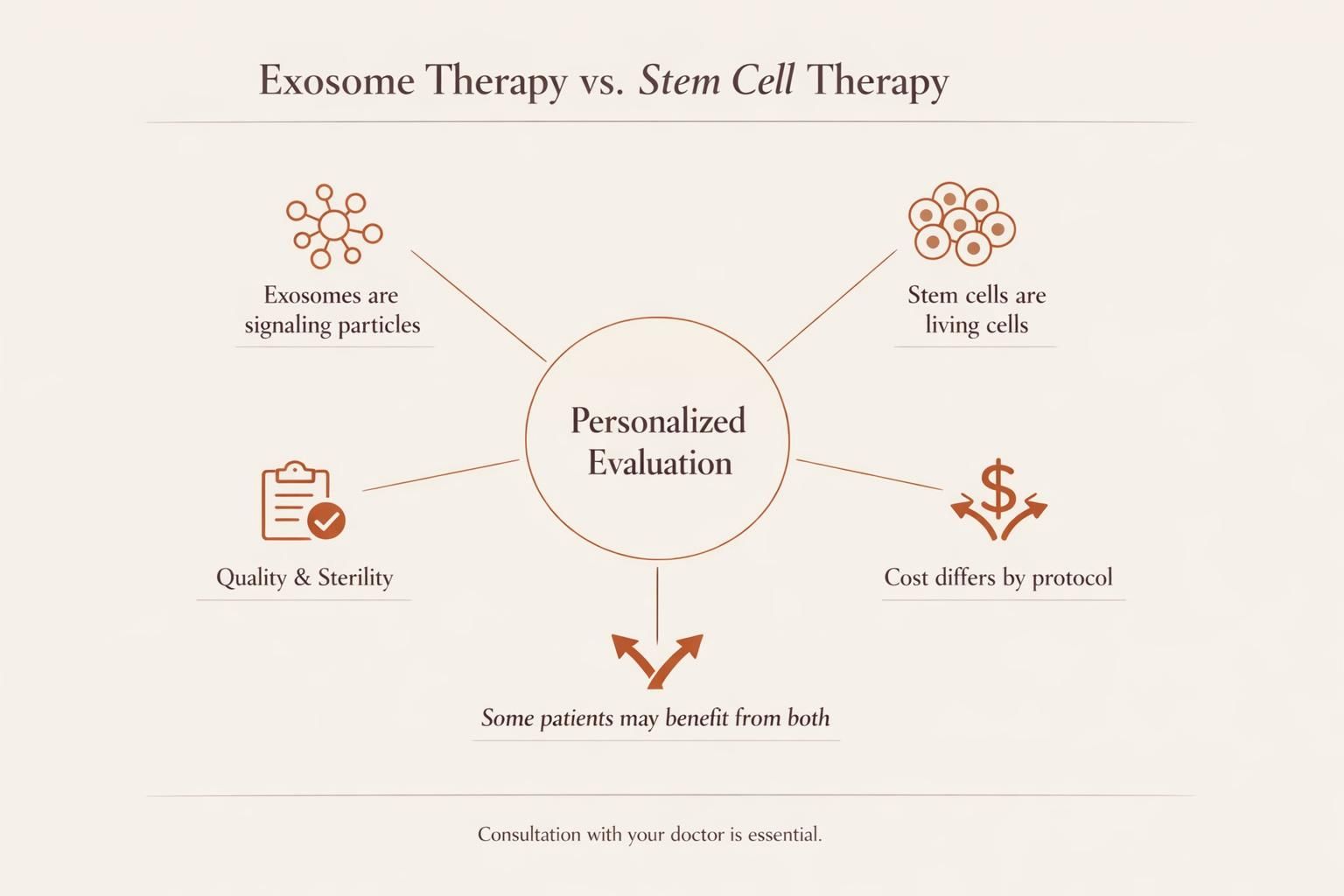
Exosome therapy and stem cell therapy are both advanced regenerative approaches, but they work differently and may be appropriate for different patients. Stem cells are living cells that can differentiate and potentially support tissue repair directly. Exosomes are tiny signaling particles released by cells that carry biological instructions to surrounding tissues. Neither therapy works for every patient, and a qualified physician must evaluate your medical history and goals before recommending either option. This guide helps you understand the key differences so you can ask better questions during your consultation.
What Patients Should Know
When patients research regenerative medicine, they often come across both of these terms and feel uncertain about which path makes more sense. The confusion is understandable. Both therapies come from the same field of science, and some clinics use the terms loosely or interchangeably. They are not the same thing.
What Stem Cell Therapy Involves
Stem cells are undifferentiated cells with the potential to develop into specialized cell types. In regenerative medicine, physicians commonly use mesenchymal stem cells (MSCs) sourced from tissue such as umbilical cord or Wharton’s jelly. These cells can interact with the local environment, modulate immune responses, and may support tissue repair and regeneration processes.
Physicians deliver stem cells through intravenous infusion, targeted injections, or a combination of both, depending on the patient’s condition and goals. You can learn more about the types of stem cell treatments in Mexico to better understand the delivery options available.
What Exosome Therapy Involves
Exosomes are not cells. They are extracellular vesicles, meaning tiny particles that cells naturally release to carry proteins, RNA, and signaling molecules to other cells. Think of them as biological messages that tell nearby tissues how to respond, regulate inflammation, or initiate repair. In clinical use, exosomes sourced from MSCs carry many of the same signaling properties as the cells themselves, without introducing living cells to the body.
Our exosome therapy page outlines how we apply this technology within personalized regenerative protocols.
How Each Approach May Work in a Regenerative Protocol
Both therapies may support the body’s natural repair processes, but through different mechanisms. Stem cells can potentially engraft, secrete growth factors, and directly participate in tissue responses. Exosomes work by delivering concentrated biological signals that may reduce inflammation, support cellular communication, and encourage repair without the complexity of introducing living cells.
At Cellular Institute, the medical team rarely thinks of these as competing options. In many cases, a physician may recommend combining stem cells with exosomes as part of a layered protocol. The goal is always to design a strategy that fits the individual patient, not to apply a one-size-fits-all approach. This broader perspective on regenerative medicine in Cancún is central to how we structure care.
Conditions Each Therapy May Support
Both therapies appear in clinical and research settings across a wide range of conditions. Neither therapy should be positioned as a cure, and outcomes vary significantly between patients.
- Stem cell therapy may be considered for orthopedic conditions, joint degeneration, autoimmune-related inflammation, neurological support, post-injury recovery, and longevity optimization protocols.
- Exosome therapy may be considered for inflammation modulation, neurological support, aesthetic rejuvenation, post-treatment recovery support, and as a complement to stem cell protocols.
Physicians evaluating candidates consider the patient’s age, inflammatory burden, condition severity, overall health status, and treatment goals. Dr. Roni Moya, Immunologist, plays an important role in evaluating immune-related factors that influence protocol design at Cellular Institute.
What Affects Quality and Safety
One of the most important things patients overlook when comparing exosome therapy vs stem cells is product quality. Not all biologics are equal. The source, processing method, storage, sterility, and viability of the product matter enormously.
Patients should ask any clinic the following before committing to treatment:
- Where do the cells or exosomes come from?
- How are they processed and stored?
- Is there a certificate of analysis (COA) available?
- What viability and sterility standards does the lab meet?
- Does the clinic use xeno-free processing methods?
At Cellular Institute, biologic products go through a quality-controlled process supported by our affiliated lab ecosystem through Cellgenic. Biotechnologist Diana Navarrete oversees laboratory review to help ensure traceability, viability, and sterility documentation. You can review our lab quality and transparency standards to understand what that process looks like.
For patients evaluating stem cell quality specifically, our certified stem cells page explains the quality and safety standards that govern our biologic sourcing.
How Costs Compare
Cost is a real part of this decision for most patients. Stem cell therapy tends to carry higher costs because it involves living cells that require careful sourcing, processing, and handling. Exosome therapy is often less expensive, though pricing varies widely depending on concentration, source quality, and clinical protocol.
Patients traveling to Mexico for regenerative medicine typically find that costs are significantly lower than comparable protocols in the United States or Canada, without necessarily sacrificing quality at a reputable clinic. Our detailed breakdown of stem cell therapy cost in Mexico gives patients a realistic picture of what to expect.
Be cautious of clinics offering unusually low prices without transparency about product origin or clinical oversight. Price alone does not indicate value. The quality of the biologic, the protocol design, and the medical supervision matter just as much as the number on the invoice.
Who May Be a Candidate
Candidates for either therapy typically include patients who:
- Are managing chronic inflammation or degeneration that has not responded well to conventional care
- Are exploring regenerative support for orthopedic conditions, immune health, or longevity optimization
- Have completed a medical evaluation confirming they are appropriate candidates
- Are committed to a complete protocol that may include complementary therapies such as recovery technologies, peptide therapy, or EBOO therapy
Who May Not Be a Candidate
Not every patient qualifies for regenerative therapy. A physician may advise against treatment for patients with active infections, certain malignancies, severe organ dysfunction, or other contraindications. This is why a proper medical evaluation comes before any protocol recommendation. Responsible candidacy screening protects patients and improves the likelihood of a meaningful outcome.
How Cellular Institute Approaches This Decision
Cellular Institute does not treat exosomes and stem cells as competing products to upsell. The medical team evaluates each patient individually and designs a protocol based on clinical reasoning. Some patients may benefit most from stem cells. Others may respond well to exosomes. Many benefit from both, combined with supportive technologies such as hyperbaric oxygen, red light therapy, PEMF, and peptide therapy.
Our team includes specialists across regenerative medicine, orthopedics, immunology, and aesthetics. Dr. Rafael Moguel, Medical Director, leads clinical oversight and helps ensure that each protocol reflects the patient’s complete health picture, not just a single symptom or condition.
International patients also receive full coordination support throughout their visit to Cancún. If you are weighing medical tourism as part of this decision, our guide to medical tourism in Mexico offers practical information on what to expect.
Questions to Ask Before Choosing a Clinic
- Does the clinic require a medical evaluation before recommending a protocol?
- Can they show product documentation, including COA, viability, and sterility records?
- Is the protocol personalized or standardized?
- Who oversees treatment? Is a licensed physician involved?
- What complementary therapies are included, and why?
- What follow-up support does the clinic provide after treatment?
For a deeper look at how to evaluate your options, our guide on how to choose a stem cell clinic in Mexico walks patients through the key factors that separate responsible providers from low-quality operators.

Frequently Asked Questions
Is exosome therapy safer than stem cell therapy?
Both therapies carry potential risks, and neither is appropriate for every patient. Exosomes do not introduce living cells to the body, which some researchers consider a simpler biological profile. However, product quality, sterility, and clinical oversight matter for both approaches. A physician evaluation helps determine which option may be safer and more appropriate for your specific situation.
Can exosomes and stem cells be used together?
Yes. In many personalized protocols, physicians use both in combination. Stem cells may support direct tissue interaction, while exosomes contribute targeted signaling. Whether this combination makes sense depends on the patient’s goals, condition, and overall health status. The medical team makes this determination during the evaluation process.
How do I know if the exosomes or stem cells a clinic uses are high quality?
Ask the clinic for documentation. Reputable providers can supply a certificate of analysis showing viability, sterility, and sourcing information. Ask where the biological products come from, how they are processed, and whether xeno-free standards apply. Transparency in the lab process is a strong indicator of a clinic’s overall quality standards.
How long does it take to see results from either therapy?
Results vary significantly by patient, condition, and protocol design. Some patients notice changes within weeks. Others experience a more gradual progression over several months. There are no guaranteed timelines, and responsible clinics set realistic expectations during the evaluation and consultation process. For more on this topic, our article on how long stem cell therapy results may last provides helpful context.
Final Thoughts
The question of exosome therapy vs stem cells rarely has a single correct answer. Both are legitimate tools within advanced regenerative medicine. The right choice depends on your health history, your goals, the quality of the biologic products a clinic uses, and the medical reasoning behind the protocol recommendation.
At Cellular Institute, we believe that the therapy is only one part of the story. The evaluation, the protocol design, the lab quality, the physician oversight, and the recovery support all shape the outcome. We invite you to explore what a physician-guided regenerative experience might look like for your specific situation.
If you are ready to take the next step, schedule a discovery call with our patient coordination team. We will help you understand your options, answer your questions, and determine whether you may be a candidate for a personalized regenerative protocol at Cellular Institute in Cancún.
Medical Disclaimer
This article is for educational purposes only and does not replace medical advice, diagnosis, or treatment. Regenerative therapies are not appropriate for every patient, and outcomes vary. A licensed physician must evaluate your medical history, goals, and candidacy before any treatment can be recommended.