

Written by: Cellular Institute Editorial Team
Medical reviewer: Dr. Matilde Rodríguez – CP 12651081
Laboratory reviewer: Biotecnóloga Diana Navarrete – CP 15029468
Quick Answer
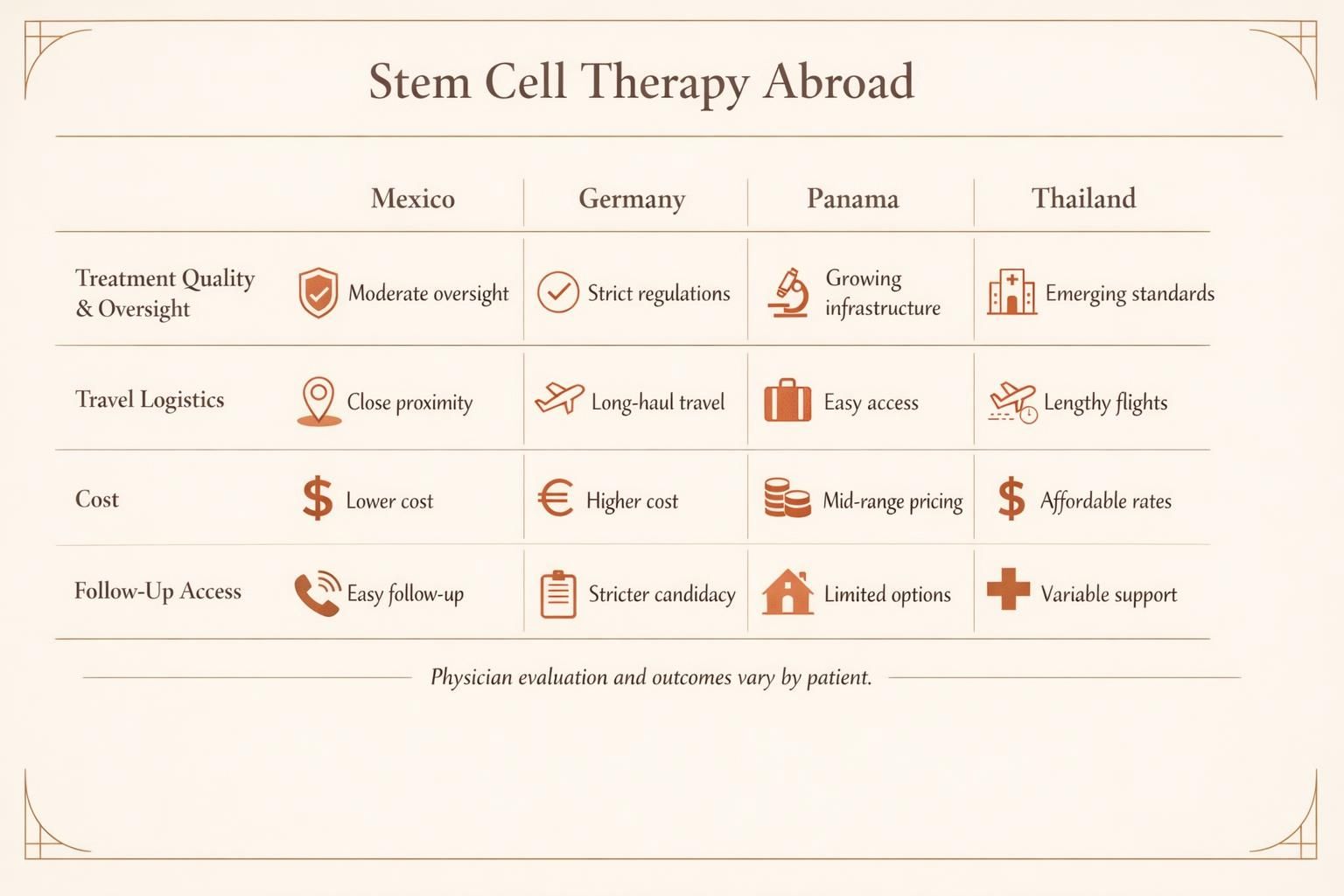
For most American patients, Mexico offers the strongest combination of clinical quality, geographic proximity, cost efficiency, bilingual coordination, and follow-up accessibility. Germany offers advanced research infrastructure but at significantly higher cost and stricter candidacy requirements. Panama provides a solid regional option with growing clinical experience. Thailand attracts patients with competitive pricing, but the travel distance creates real logistical challenges for follow-up care. Every patient is different, and physician evaluation is required before any destination or protocol can be recommended.
Why American Patients Are Looking Abroad
The FDA currently restricts most stem cell therapies in the United States to clinical trials or a limited set of approved applications. This means many patients living with chronic conditions, orthopedic challenges, inflammatory issues, or longevity goals cannot easily access regenerative medicine at home.
As a result, more Americans travel abroad each year to explore physician-guided regenerative protocols. Choosing the right country, however, requires more than a quick price comparison. The quality of the biologic product, the regulatory environment, the medical team, travel logistics, and follow-up care all play a role in the outcome.
Comparing the Four Most Popular Destinations
Mexico
Mexico has become the leading destination for American patients seeking regenerative medicine in Cancún and other major cities. The reasons are practical and clinical.
Mexico sits within a two-to-four hour flight from most U.S. cities. No jet lag, no 20-hour travel days, and no complicated visa requirements. Most reputable clinics in tourist-friendly destinations like Cancún offer bilingual coordination, helping English-speaking patients navigate the process without language barriers.
From a regulatory standpoint, Mexico’s federal agency COFEPRIS oversees healthcare, including standards related to tissue handling, cell processing, and clinical application. Serious clinics operate within this framework and can provide documentation to support it. Patients should always ask about regulatory structure before booking.
Cost also tends to be significantly lower than in Germany or the United States, without sacrificing clinical quality at established providers. For patients exploring stem cell therapy cost in Mexico, the savings compared to European destinations can be substantial.
Follow-up care is easier to manage when the destination is close. Patients can return for additional sessions, complementary therapies, or re-evaluation without the burden of intercontinental travel.
Germany
Germany carries a strong reputation for advanced medicine, and some clinics offer specialized autologous cell therapies within strict regulatory frameworks. For certain patients, particularly those seeking highly specialized orthopedic or neurological applications, German providers may offer relevant expertise.
The tradeoffs are significant, however. Costs are substantially higher. The candidacy evaluation process tends to be more restrictive. Language barriers can create friction for American patients without German-speaking support. Travel from most U.S. cities involves a transatlantic flight, adding recovery time and logistical complexity. Follow-up visits require additional international travel, which makes ongoing optimization difficult to sustain.
Germany may appeal to patients with very specific conditions and the resources to support European-level pricing and travel. For most Americans pursuing regenerative protocols, it is rarely the most practical choice.
Panama
Panama City has developed a growing medical tourism infrastructure, and several clinics offer stem cell therapies to international patients. Travel from the U.S. East Coast is relatively manageable, and the country uses the U.S. dollar, which removes currency conversion concerns.
The clinical landscape in Panama is less established than in Mexico for regenerative medicine. Patient volume, physician specialization in regenerative protocols, and in-house biologic manufacturing are areas where the country has less depth. Patients should research individual clinics carefully and ask detailed questions about cell sourcing, product quality, and protocol personalization.
Panama can be a reasonable option for some patients, but it requires the same level of due diligence as any destination. Quality varies significantly between providers.
Thailand
Thailand attracts patients with competitive pricing and a well-developed medical tourism industry in cities like Bangkok. Some clinics have long histories of treating international patients, and English-speaking staff are available at established providers.
The primary challenge for American patients is distance. A round-trip flight from the United States to Thailand typically takes between 20 and 30 hours. This creates real difficulties for post-treatment recovery and follow-up visits. Regenerative medicine protocols often benefit from ongoing support, complementary therapies, and clinical re-evaluation. Managing this relationship across 12 time zones is significantly harder.
Cell sourcing standards, regulatory oversight, and biologic quality documentation also vary widely across Thai providers. Patients considering Thailand should ask the same hard questions about product origin, processing standards, viability, and physician oversight that apply everywhere else.
What Should Patients Actually Evaluate?
The destination matters, but the clinic matters more. A great country with a poor clinic does not produce good outcomes. Patients should evaluate the following factors regardless of location.
Biologic Product Quality
Where do the cells come from? How are they processed? What quality documentation does the clinic provide? Clinics with in-house or affiliated laboratory infrastructure offer greater traceability and transparency. At Cellular Institute, biologic preparation connects to the Cellgenic ecosystem, which supports quality control, sterility, viability standards, and product documentation. Our certified stem cells reflect a commitment to standards that many outsourced providers cannot match.
Physician Oversight
Regenerative medicine should always involve physician evaluation and clinical reasoning. A protocol designed around your health history, goals, and inflammatory status performs very differently from a standardized package. Physician-guided care means someone qualified reviews your candidacy before treatment begins. Learn more about how to choose a stem cell clinic in Mexico using the right clinical criteria.
Regulatory Framework
Ask clinics about their licensing structure, how they document cell handling, and what oversight applies to their treatments. Clinics operating within a recognized regulatory framework signal a higher level of accountability. Understanding stem cell therapy safety in Mexico starts with knowing what questions to ask.
Complementary Protocol Options
Stem cell therapy alone is rarely the complete answer. The best outcomes tend to occur when regenerative medicine is part of a broader protocol. At Cellular Institute, patients may have access to exosome therapy, EBOO therapy, peptide therapy, hyperbaric oxygen, red light therapy, and PEMF as part of an integrated approach. These recovery technologies support the body’s response before, during, and after treatment.
Post-Treatment Follow-Up
The closer the clinic is to home, the easier it is to maintain the relationship. Proximity supports re-evaluation, protocol adjustments, and access to complementary therapies when needed. This is one of Mexico’s strongest advantages for American patients.

Frequently Asked Questions
Is Mexico a safe destination for stem cell therapy?
Mexico has a regulated healthcare system under COFEPRIS, and established clinics operate within this framework. Safety depends significantly on the clinic you choose, not just the country. Patients should research the provider’s licensing, biologic sourcing, physician qualifications, and quality documentation before making a decision. Our guide on safe stem cell clinics in Mexico outlines seven signs to look for when evaluating a provider.
Why is Germany rarely the best choice for Americans?
Germany offers advanced medical infrastructure, but costs are substantially higher, candidacy criteria are stricter, and follow-up care requires repeated international travel. For most American patients, the practical and financial barriers outweigh the benefits when compared to high-quality clinics in Mexico.
What makes Mexico better than Thailand for American patients?
The primary advantage is proximity. Mexico is two to four hours from most U.S. cities, while Thailand requires 20-plus hours of travel each way. This proximity makes follow-up care, protocol adjustments, and additional sessions far more manageable. Travel fatigue also affects post-treatment recovery, and shorter trips reduce that burden.
How do I know if I am a candidate for stem cell therapy abroad?
Candidacy depends on your medical history, current conditions, goals, inflammatory status, and overall health. A physician must evaluate these factors before any protocol can be recommended. No clinic should offer treatment without a proper medical evaluation first. Results vary by patient, and responsible expectations are part of the process.
How Cellular Institute Approaches This
Cellular Institute is not a procedure-focused injection clinic. The team designs personalized regenerative protocols around each patient’s health profile, goals, and clinical context. Dr. Rafael Moguel, Medical Director, leads a physician team that evaluates candidates before any treatment recommendation is made.
The clinic’s connection to the Cellgenic lab ecosystem means biologic products meet documented quality standards for viability, sterility, and traceability. Patients receive support from bilingual coordinators, airport logistics, and a structured recovery environment in Cancún. International patient coordination is a core part of what makes medical tourism in Mexico a manageable and well-supported experience at this clinic.
The broader ecosystem behind Cellular Institute includes ISSCA and Global Stem Cells Group, reflecting more than 15 years of experience in regenerative medicine education, physician training, and protocol development. This is not a trend-based wellness center. It is a serious medical platform built around science, safety, and long-term patient support.
Final Thoughts
Choosing the best country for stem cell therapy is really about choosing the right combination of clinical quality, physician oversight, biologic transparency, proximity, and post-treatment support. For most Americans, Mexico delivers on all of these factors when the right clinic is selected.
Germany, Panama, and Thailand each have roles in the global regenerative medicine landscape, but they carry tradeoffs that matter at the decision stage. Distance, cost, regulatory context, and follow-up accessibility all affect the real-world patient experience.
If you are exploring whether regenerative medicine may be appropriate for your situation, the next step is a conversation with a qualified medical team. Schedule a discovery call with Cellular Institute to learn more about candidacy, protocol options, and what the experience in Cancún looks like for international patients.
Medical Disclaimer
This article is for educational purposes only and does not replace medical advice, diagnosis, or treatment. Regenerative therapies are not appropriate for every patient, and outcomes vary. A licensed physician must evaluate your medical history, goals, and candidacy before any treatment can be recommended.