
Written by: Cellular Institute Editorial Team
Medical reviewer: Dr. Matilde Rodríguez – CP 12651081
Laboratory reviewer: Biotecnóloga Diana Navarrete – CP 15029468
Quick Answer
Plasma exchange and NAD+ therapy target aging and cellular decline through very different mechanisms. Plasma exchange filters aging factors from the bloodstream. NAD+ therapy replenishes a coenzyme that supports cellular energy and repair. Neither replaces the other, and neither works for everyone. A physician must evaluate your health history, goals, and current biomarkers before recommending either approach as part of a personalized longevity protocol.
Why Patients Are Comparing These Two Treatments
Longevity medicine has moved well beyond basic supplementation. Today, health-conscious patients are researching plasma exchange vs NAD therapy as serious interventions with real biological mechanisms. Both approaches appear in peer-reviewed research. Both attract patients who want to do more than just feel better day to day.
The question is not which one is better in general. The real question is which one may be more appropriate for your specific goals, health status, and overall protocol. In many cases, the answer may involve both, integrated thoughtfully under physician supervision.
What Is Plasma Exchange?
Plasma exchange, also called therapeutic plasma exchange or plasmapheresis, removes a portion of the patient’s plasma and replaces it with fresh plasma or a substitute solution. The goal is to reduce circulating pro-inflammatory proteins, aging signals, and other bioactive factors that accumulate over time.
Research from institutions such as the Buck Institute has examined how plasma exchange may affect biological age markers. Early findings suggest that removing aged plasma may support a more favorable inflammatory environment and positively influence certain epigenetic markers. This research is ongoing, and results should be interpreted with caution. This is not a standardized treatment with established longevity dosing protocols.
Plasma exchange requires intravenous access, clinical monitoring, and physician oversight throughout the procedure. It is not a simple infusion. Patients should expect a structured clinical experience with proper evaluation before and after the session.
What Is NAD+ Therapy?
NAD+ stands for nicotinamide adenine dinucleotide. It is a coenzyme found in every cell of the body. NAD+ plays a central role in energy metabolism, DNA repair, and cellular signaling. Levels naturally decline with age, and this decline may contribute to reduced cellular function and recovery capacity.
NAD+ therapy typically involves intravenous infusions of NAD+ precursors or the compound itself. Proponents suggest it may support mitochondrial function, cognitive clarity, energy levels, and recovery. Research in this area is growing, though large-scale human trials are still limited. Patients should approach NAD+ therapy with realistic expectations and physician guidance.
NAD+ infusions are generally well-tolerated, though some patients report temporary discomfort during administration. Session length and dosing vary by provider and patient profile.
Key Differences: Plasma Exchange vs NAD Therapy
These two interventions differ in mechanism, complexity, cost, and clinical application.
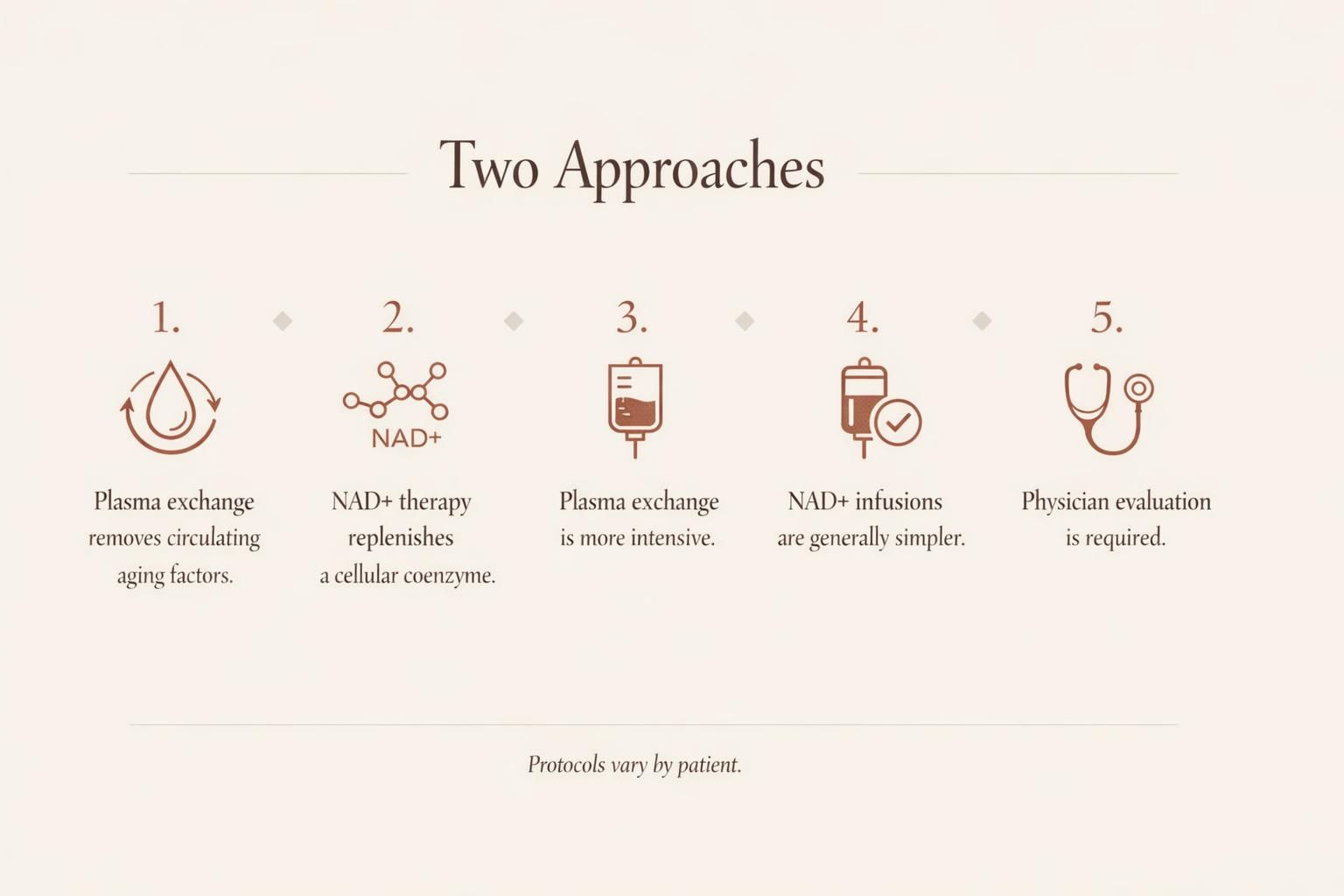
- Mechanism: Plasma exchange removes circulating aging factors. NAD+ therapy replenishes a cellular coenzyme that declines with age.
- Procedure complexity: Plasma exchange is a more intensive clinical procedure. NAD+ infusions are simpler and shorter in most cases.
- Evidence base: Both have emerging research. Plasma exchange has received attention from notable longevity research institutions. NAD+ has a broader body of preclinical and early clinical literature.
- Cost per session: Plasma exchange tends to carry a higher cost per session due to equipment, plasma sourcing, and clinical requirements. NAD+ infusions are generally more accessible in terms of per-session pricing.
- Frequency: Plasma exchange protocols vary widely. NAD+ infusions may be used as standalone sessions or as part of ongoing longevity maintenance programs.
- Who benefits most: Plasma exchange may appeal to patients focused on reducing systemic aging signals. NAD+ therapy may suit patients targeting energy, cognitive function, and cellular repair support.
Can These Treatments Be Combined?
In a well-designed longevity protocol, plasma exchange and NAD+ therapy may complement each other. Plasma exchange may create a cleaner biological environment by reducing pro-aging circulating factors. NAD+ therapy may then support cellular energy systems within that environment. However, combining interventions requires careful clinical judgment.
At Cellular Institute, our medical team evaluates each patient individually. Dr. Rafael Moguel, Medical Director and our broader physician team assess biomarkers, health history, and patient goals before recommending any protocol. We do not apply one-size-fits-all approaches to longevity medicine.
Combining treatments also raises questions about timing, sequencing, and recovery. These decisions belong in the hands of experienced physicians, not marketing materials.
How Cellular Institute Approaches Longevity Protocols
Cellular Institute offers a comprehensive platform for regenerative medicine in Cancún that integrates multiple evidence-informed modalities. Our longevity protocols may include advanced blood therapies, cellular therapies, recovery technologies, and systemic support, all designed around the individual patient.
For patients interested in blood-based detox and inflammatory burden reduction, our EBOO therapy in Cancún offers another powerful option for supporting circulation and oxidative balance. EBOO uses extracorporeal blood ozonation and oxygenation to address systemic inflammation through a different mechanism than plasma exchange.
We also incorporate peptide therapy into many longevity protocols. Peptides may support cellular signaling, metabolic function, recovery, and healthy aging when used as part of a physician-guided plan.
Our recovery technologies, including hyperbaric oxygen therapy, red light therapy, and PEMF, help patients optimize the cellular environment before and after more intensive interventions.
Who May Be a Candidate for These Treatments?
Plasma exchange may be worth exploring for patients who have significant interest in biological age reduction, systemic inflammation, and longevity optimization. Candidates typically present with a solid general health baseline and specific goals around aging and performance.
NAD+ therapy may appeal to a broader range of patients, including those managing fatigue, cognitive changes, post-exertional recovery challenges, or general interest in cellular health support.
Neither therapy is appropriate for everyone. Physician evaluation is always required. Patients with certain cardiovascular, renal, or immune conditions may need additional assessment before starting either approach.
Who May Not Be a Candidate?
Patients with active infections, uncontrolled chronic conditions, bleeding disorders, or those on certain medications may not be suitable candidates for plasma exchange. NAD+ therapy may also require evaluation in patients with specific metabolic or cardiovascular considerations. Our medical team conducts thorough candidate evaluations before any recommendation is made.
Questions to Ask Before Choosing a Treatment or Clinic
- Does the clinic require a medical evaluation before recommending plasma exchange or NAD+ therapy?
- Is the protocol personalized based on your labs, goals, and health history?
- What physician oversight is provided during the procedure?
- Does the clinic offer complementary modalities to support the protocol?
- What follow-up support does the clinic provide after treatment?
- Is the clinic transparent about evidence, limitations, and realistic expectations?
Knowing how to choose a stem cell clinic in Mexico applies equally to longevity clinics. The same principles of quality, transparency, physician oversight, and personalized care determine whether a clinic is worth trusting.

Frequently Asked Questions
Is plasma exchange the same as plasmapheresis?
The terms are often used interchangeably in longevity medicine. Therapeutic plasma exchange removes a portion of plasma and replaces it with a substitute. Plasmapheresis can refer to a broader category of plasma-based procedures. A physician can clarify which specific protocol a clinic offers and how it differs from general plasmapheresis.
How many NAD+ infusion sessions do patients typically need?
This varies by patient and goal. Some patients begin with an initial series of sessions and then move to a maintenance schedule. Others use NAD+ as part of a broader protocol. Your physician should guide the frequency and duration based on your individual response and health profile.
Does plasma exchange lower biological age?
Early research, including studies from respected longevity institutions, suggests that plasma exchange may positively influence certain biological age markers. However, this research is still emerging. Results vary, and no provider can guarantee a specific biological age reduction. Responsible clinics present this evidence honestly and help patients set appropriate expectations.
Can I combine plasma exchange or NAD+ therapy with stem cell therapy?
Many patients explore multi-modality protocols that include cellular therapies alongside blood-based interventions. Whether combining these approaches makes sense depends on your health status, goals, and physician evaluation. At Cellular Institute, we build individualized protocols that may incorporate several complementary modalities when clinically appropriate.
Final Thoughts
Both plasma exchange and NAD+ therapy represent genuine areas of interest in longevity medicine. Each targets aging through a distinct biological pathway. Neither is a standalone solution, and neither replaces a comprehensive, physician-guided approach to health optimization.
The most important factor is not which therapy is more popular. It is whether the therapy fits your biology, your goals, and your overall protocol. At Cellular Institute, we take that evaluation seriously.
If you want to explore how plasma exchange, NAD+ therapy, or other advanced longevity modalities might fit your goals, we invite you to schedule a discovery call with our patient coordination team. We will help you understand your options and determine whether you may be a candidate for a personalized protocol.
You can also explore more patient education resources on our Cellular Institute blog to continue your research before your first conversation with our team.
Medical Disclaimer
This article is for educational purposes only and does not replace medical advice, diagnosis, or treatment. Regenerative therapies are not appropriate for every patient, and outcomes vary. A licensed physician must evaluate your medical history, goals, and candidacy before any treatment can be recommended.