

Written by: Cellular Institute Editorial Team
Medical reviewer: Dr. Matilde Rodríguez – CP 12651081
Laboratory reviewer: Biotecnóloga Diana Navarrete – CP 15029468
Quick Answer
Stem cell therapy for degenerative disc disease is not a guaranteed solution, and it does not work for every patient. However, for appropriately selected candidates, regenerative protocols may support disc hydration, modulate inflammation, and promote tissue repair in ways that conventional treatments have not achieved. Physician evaluation is required to determine whether this approach may be appropriate for your specific condition, history, and goals.
What Patients with Chronic Back Pain Should Know
Degenerative disc disease affects millions of adults in the United States and Canada. The condition involves the gradual breakdown of the intervertebral discs that cushion the vertebrae of the spine. As discs lose hydration and structural integrity, patients often experience chronic pain, nerve compression, limited mobility, and a significant reduction in quality of life.
Many patients cycle through the same treatments: physical therapy, anti-inflammatory medications, epidural steroid injections, and rest. Some find temporary relief. Others continue to decline. For patients who have not responded to conservative care, spinal fusion or disc replacement surgery often becomes the next recommendation.
Surgery carries real risks. Recovery can be lengthy. Adjacent segment degeneration may develop over time. These realities lead many patients to ask whether a regenerative medicine approach could offer a less invasive path forward.
How Stem Cell Therapy May Support Disc and Spine Health
Mesenchymal stem cells, often sourced from umbilical cord tissue or other ethically obtained sources, carry anti-inflammatory and regenerative signaling properties. Researchers and clinicians have explored their potential to support intervertebral disc health through several mechanisms.
- Inflammation modulation: Chronic inflammation accelerates disc degeneration. Stem cells may help regulate the inflammatory environment around damaged tissue.
- Disc hydration support: Healthy discs contain a gel-like nucleus that gives them shock-absorbing capacity. Regenerative signaling may support the cellular environment that maintains disc hydration.
- Tissue repair signaling: Stem cells communicate with surrounding cells through bioactive molecules. This signaling may encourage the body to support its own repair processes.
- Pain modulation: Some patients report reduced pain perception, which may relate to decreased inflammatory burden rather than structural repair alone.
It is important to state clearly: stem cell therapy does not rebuild severely degenerated discs or reverse advanced structural damage. The evidence is early-stage and still evolving. Responsible expectations and honest physician communication matter here.
Our team includes Dr. Wajid Burad, Orthopedist, who evaluates musculoskeletal and spinal conditions within a regenerative medicine framework, helping patients understand whether their case may benefit from this approach.
What Affects Quality and Safety in Stem Cell Therapy for Back Pain
Not all stem cell products are the same. This is one of the most important things patients must understand before choosing a provider.
The quality of the biologic product depends on how cells were sourced, processed, tested, and stored. A clinic that cannot answer questions about cell viability, sterility testing, passage number, or product documentation should raise concern.
At Cellular Institute, biologics are supported through Cellgenic, our affiliated in-house lab ecosystem. This structure allows for greater traceability, xeno-free processing standards, viability testing, and quality documentation. Patients can ask about the certificate of analysis for their specific product.
Learn more about our commitment to lab quality and transparency and what that means for the therapy you receive.
Delivery method also matters. Intradiscal injections, epidural approaches, and intravenous delivery each carry different risk profiles and potential mechanisms of action. A physician must evaluate which route is appropriate for your anatomy, condition severity, and overall health status.
Who May Be a Candidate for Stem Cell Therapy for Degenerative Disc Disease
Candidacy depends on multiple clinical factors. Patients who may be worth evaluating include those who:
- Have mild to moderate disc degeneration confirmed on imaging
- Have not responded adequately to at least several months of conservative care
- Are not yet at a stage requiring emergency surgical intervention
- Do not have active infection, cancer, or uncontrolled systemic disease
- Understand that results vary and approach treatment with realistic expectations
Who May Not Be a Candidate
Some patients may not be appropriate candidates for regenerative approaches to spine care. These may include patients with:
- Severe structural instability requiring surgical stabilization
- Active spinal infection or tumor involvement
- Advanced neurological compromise requiring urgent decompression
- Medical conditions that contraindicate biologic therapies
A thorough medical evaluation helps identify who may benefit and who may need a different path. Regenerative medicine is not a replacement for necessary surgical care in urgent cases.
How Cellular Institute Approaches Spine and Disc Degeneration
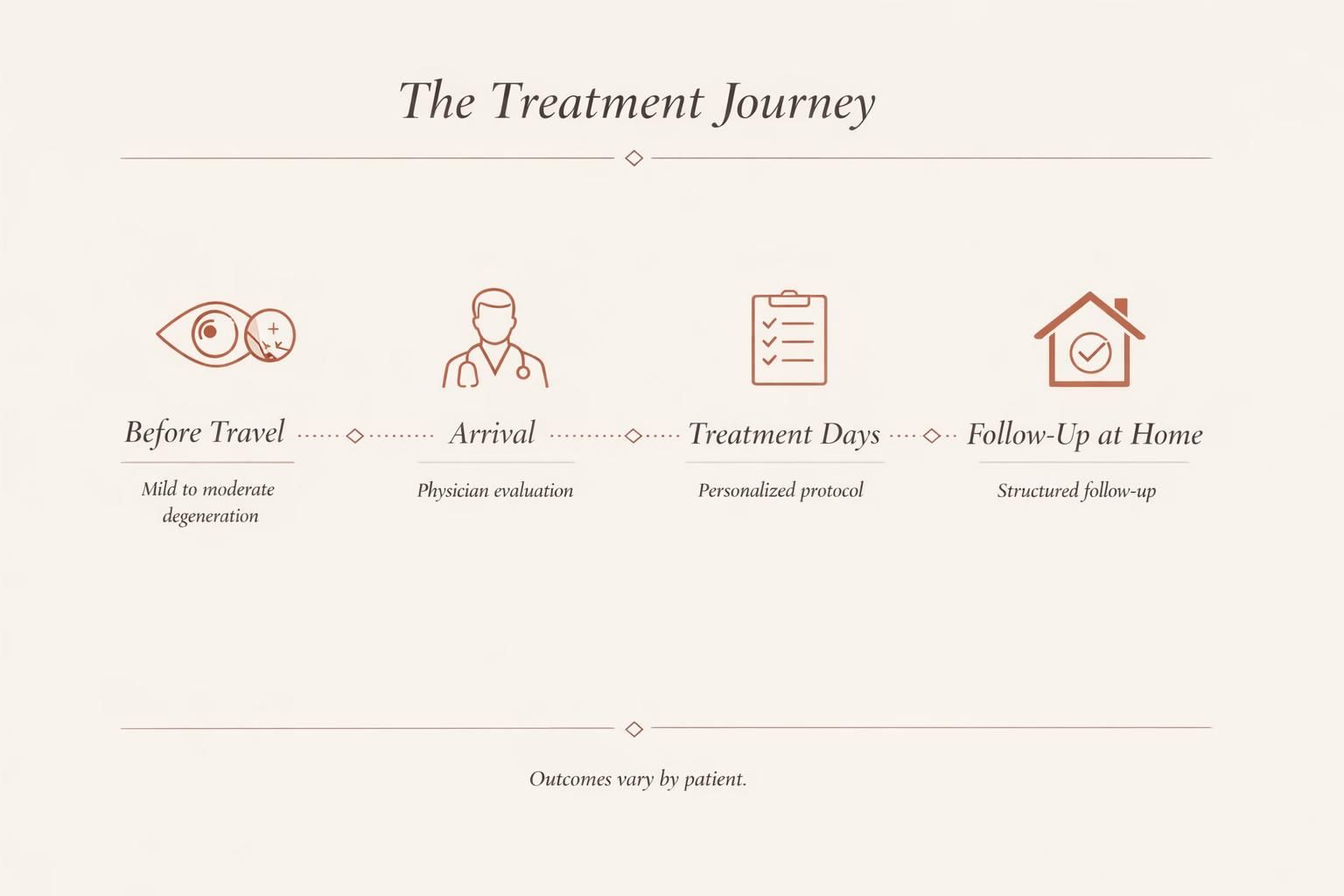
Cellular Institute does not offer a single injection and send patients home. Our approach to regenerative medicine in Cancún begins with a thorough evaluation of the patient’s medical history, imaging findings, inflammation status, and overall health profile.
From there, the medical team designs a personalized protocol. For spinal conditions, this may include a combination of approaches:
- Stem cell therapy with certified stem cells sourced and processed to documented quality standards
- Exosome therapy to support cell signaling and tissue communication
- EBOO therapy to address systemic inflammation that may worsen spinal degeneration
- Recovery technologies such as hyperbaric oxygen therapy, red light therapy, and PEMF to support the body’s healing environment
- Peptide therapy as part of a broader recovery and optimization strategy
Our recovery technologies are integrated into the patient experience because we understand that the treatment itself is only one part of the process. Reducing systemic inflammation, supporting tissue oxygenation, and optimizing the cellular environment around the therapy all matter.
International patients traveling from the United States and Canada receive coordinated support throughout their visit, including bilingual coordination, logistics assistance, and structured follow-up after returning home. If you are exploring medical tourism in Mexico, our team can walk you through what to expect at every stage.
Questions to Ask Before Choosing a Clinic
If you are evaluating clinics for stem cell therapy for degenerative disc disease, these questions can help you make a more informed decision:
- Where do the stem cells come from, and how are they processed?
- Can the clinic provide a certificate of analysis or quality documentation for the product?
- What delivery method will be used, and why is it appropriate for my condition?
- Will a licensed physician evaluate my imaging and medical history before recommending treatment?
- What complementary therapies are included in the protocol?
- What follow-up support will I receive after returning home?
- What regulatory framework does the clinic operate within?
If a clinic cannot answer these questions clearly, that matters. For additional guidance on evaluating providers, read our article on how to choose a stem cell clinic in Mexico.

Frequently Asked Questions
Is stem cell therapy a replacement for spine surgery?
Not in every case. For patients with mild to moderate degeneration who have not responded to conservative care, regenerative approaches may offer a less invasive option worth evaluating. However, patients with severe structural instability or urgent neurological compromise may still require surgical intervention. A physician must assess each case individually.
How long does it take to notice results from stem cell therapy for back pain?
Results vary significantly by patient. Some individuals report gradual improvements in pain and mobility over several weeks to months. Others may notice changes more slowly. There is no fixed timeline, and outcomes depend on the severity of degeneration, overall health, the quality of the biologic product, and the completeness of the protocol. To understand expectations better, explore how long stem cell therapy results may last.
Is it safe to receive stem cell therapy in Mexico?
Safety depends heavily on the clinic you choose. Cellular Institute operates within Mexico’s medical regulatory framework, uses documented quality standards through our affiliated lab ecosystem, and requires physician evaluation before any treatment. Patients should ask every clinic about their regulatory structure, product sourcing, and medical oversight. Learn more about stem cell therapy safety in Mexico.
How much does stem cell therapy for degenerative disc disease cost in Mexico?
Pricing varies based on the protocol, the number of sessions, complementary therapies included, and the quality of the biologic product. Cost alone should not drive your decision. A lower price often reflects a lower-quality product, fewer complementary modalities, or less physician oversight. For a broader cost context, review our guide on stem cell therapy cost in Mexico.
Final Thoughts
Stem cell therapy for degenerative disc disease is not a miracle solution. It is an evidence-informed, physician-guided approach that may support disc health, reduce inflammation, and improve quality of life in appropriately selected patients. The therapy itself matters, but so does the quality of the biologic product, the personalization of the protocol, the recovery environment, and the medical oversight around every step.
If you have been living with chronic back pain and feel like you have run out of conventional options, it may be worth exploring whether regenerative medicine could play a role in your path forward.
The first step is a conversation. Schedule a discovery call with our team to share your history, ask your questions, and learn whether you may be a candidate for a personalized regenerative protocol at Cellular Institute in Cancún.
Medical Disclaimer
This article is for educational purposes only and does not replace medical advice, diagnosis, or treatment. Regenerative therapies are not appropriate for every patient, and outcomes vary. A licensed physician must evaluate your medical history, goals, and candidacy before any treatment can be recommended.