
Written by: Cellular Institute Editorial Team
Medical reviewer: Dr. Matilde Rodríguez – CP 12651081
Laboratory reviewer: Biotecnóloga Diana Navarrete – CP 15029468
Quick Answer
Plasmapheresis and plasma exchange are closely related terms that patients often use interchangeably. In many clinical contexts, they refer to the same core process: separating plasma from the blood, removing it, and returning the remaining blood components to the body. The key difference lies in what happens next. Some procedures return the plasma after filtering it. Others replace the removed plasma with a substitute fluid. A physician must evaluate your medical history, current condition, and therapeutic goals before recommending any blood-processing procedure.
What Patients Should Know
If you have been researching blood-cleansing or immune-modulating therapies, you have probably seen both terms. The confusion is understandable. Medical literature, clinic websites, and even some healthcare providers use these words differently depending on context.
Here is the straightforward distinction:
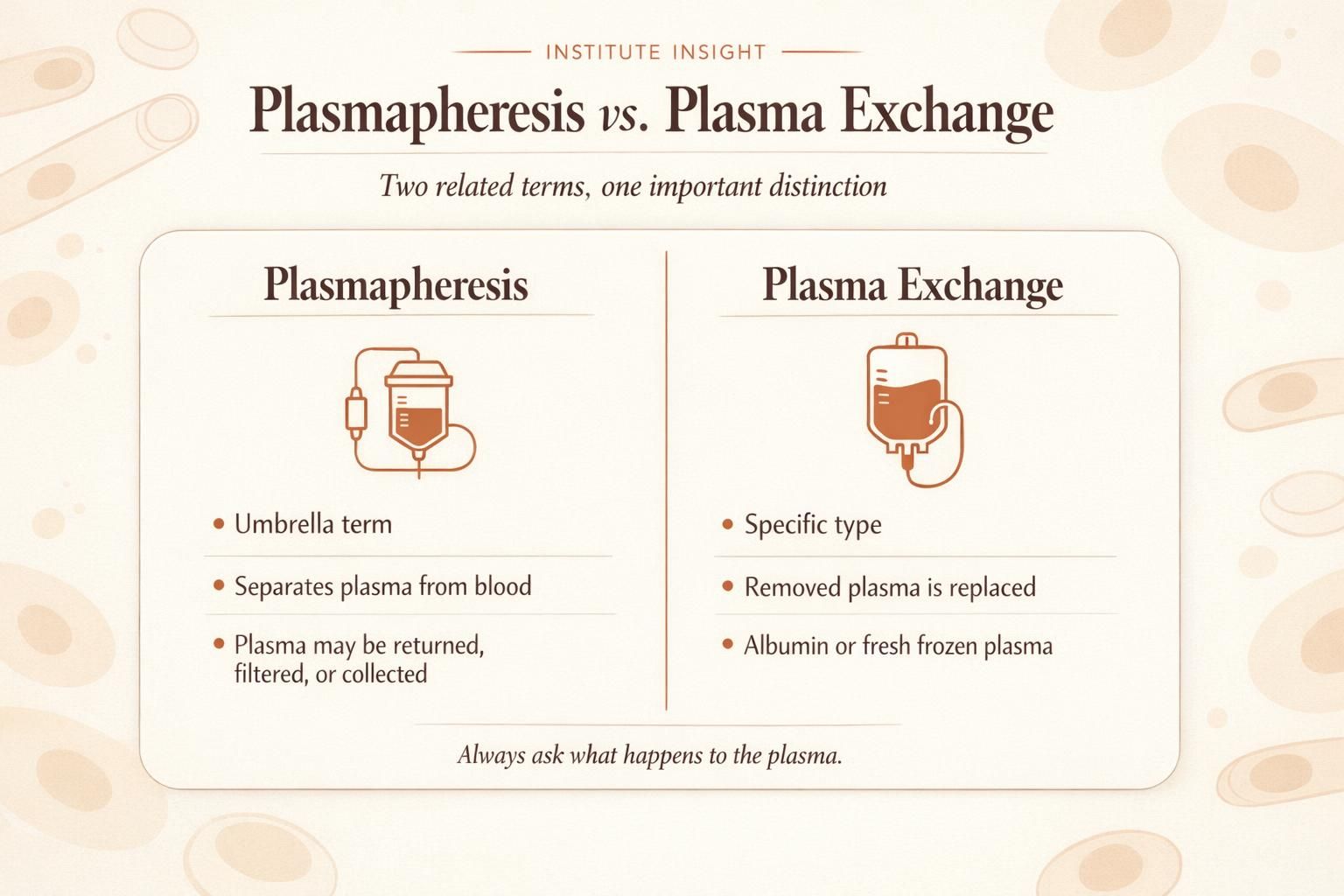
- Plasmapheresis refers broadly to any process that separates plasma from blood. It serves as an umbrella term. The plasma may be filtered and returned, discarded, or collected for donation.
- Plasma exchange is a specific type of plasmapheresis. In this version, the physician removes the patient’s plasma and replaces it with a substitute. That substitute is typically albumin, fresh frozen plasma, or a combination of both.
In everyday clinical conversations, many providers use plasmapheresis to mean plasma exchange. This overlap creates confusion for patients trying to understand what a clinic actually offers. When evaluating any clinic or procedure, always ask specifically what happens to the plasma during the process.
How These Procedures May Work in a Clinical Context
Both procedures involve separating blood components outside the body. A machine draws blood, separates the plasma from red blood cells, platelets, and white blood cells, and then processes or replaces the plasma before returning everything to the patient.
Plasma contains proteins, antibodies, clotting factors, and other molecules. In certain immune-related conditions, the plasma may carry harmful antibodies or inflammatory proteins. Removing or diluting those components is the therapeutic goal in many plasma exchange applications.
Clinically, therapeutic plasma exchange has well-established uses in conditions such as myasthenia gravis, Guillain-Barré syndrome, and certain kidney and blood disorders. These are serious medical indications managed by specialists in neurology, nephrology, or hematology.
Outside of those established medical applications, some patients explore plasma-based therapies as part of broader regenerative medicine or longevity protocols. This is a growing area of interest, and physician evaluation remains essential before any procedure.
What Affects Quality and Safety
Not all blood-processing procedures carry the same level of risk or deliver the same results. Several factors affect both safety and the potential value of the procedure for a given patient.
- Medical supervision: Any procedure involving extracorporeal blood processing requires physician oversight. A trained medical team must monitor the patient throughout the session.
- Equipment standards: The machines and filtration systems involved vary significantly. Patients should ask about the specific equipment a clinic uses and how it is maintained.
- Replacement fluid quality: In plasma exchange, the type and quality of replacement fluid matters. Albumin and fresh frozen plasma each carry different considerations.
- Patient selection: These procedures are not appropriate for every patient. Underlying conditions, medications, clotting history, and cardiovascular status all influence candidacy.
- Protocol design: A single session rarely tells the full story. The number of sessions, timing, and what other therapies accompany the procedure all affect outcomes.
At Cellular Institute, medical evaluation comes before any recommendation. Dr. Roni Moya, Immunologist, works with patients whose concerns involve immune function and inflammatory burden, helping to assess whether a blood-based therapy may be appropriate within a personalized protocol.
How This Relates to Advanced Blood Detox Therapies
Patients researching plasmapheresis and plasma exchange often encounter a related technology called EBOO, or extracorporeal blood oxygenation and ozonation. While EBOO is not the same as plasma exchange, both fall within the broader category of blood-processing therapies.
EBOO passes blood through an external circuit where it receives ozone and additional oxygen before returning to the body. Clinicians and researchers have explored its potential to support circulation, reduce oxidative stress, and modulate inflammatory markers. It does not remove or replace plasma in the same way that therapeutic plasma exchange does.
Patients interested in blood-based therapies should understand the differences between these approaches. EBOO therapy in Cancún at Cellular Institute is part of a broader advanced blood detox platform designed around physician-guided protocols, not standalone procedures.
If you want to understand how EBOO may relate to systemic inflammation, our article on EBOO therapy and systemic inflammation offers a more detailed look at the science behind this approach.
Who May Be a Candidate
Patients who may explore plasma-based therapies under physician guidance include those with:
- Confirmed immune-mediated neurological or kidney conditions where therapeutic plasma exchange has established clinical evidence
- High inflammatory burden that has not responded to standard approaches
- Autoimmune concerns that a physician is actively evaluating
- Interest in blood-based support as part of a broader longevity or regenerative protocol
Candidacy always depends on individual medical history, lab results, current medications, and physician judgment. These procedures are not appropriate for self-directed use or without proper clinical evaluation.
Who May Not Be a Candidate
Not every patient qualifies for plasma-based therapies. A physician may advise against these procedures for patients with:
- Active bleeding disorders or clotting abnormalities
- Severe cardiovascular instability
- Active infections or sepsis
- Certain medication sensitivities, particularly related to replacement fluids
- Conditions that make extracorporeal blood processing unsafe
This is why candidate evaluation matters. A physician who understands both the therapy and the patient’s full medical picture makes the recommendation, not a marketing page.
How Cellular Institute Approaches This
Cellular Institute approaches advanced therapies as part of a complete, physician-guided protocol — not as isolated procedures. Our medical team evaluates each patient individually before recommending any blood-based or regenerative therapy.
Patients who visit us for immune modulation, inflammation support, or longevity optimization often receive a protocol that combines multiple tools. These may include advanced blood therapies, peptide therapy, recovery technologies, and regenerative biologics — all designed around the individual patient’s goals and clinical picture.
Our broader regenerative medicine in Cancún platform supports patients from the United States, Canada, and beyond who want access to advanced, evidence-informed care in a medically supervised environment. We also support the full patient journey, including travel coordination, bilingual care, and structured follow-up after treatment.
If you are considering any blood-based therapy abroad, we encourage you to read our guide on how to choose a stem cell clinic in Mexico to understand what quality standards and transparency should look like at any clinic you evaluate.
Questions to Ask Before Choosing a Clinic
If you are evaluating a clinic for plasmapheresis, plasma exchange, or any related blood therapy, ask these questions before committing:
- Is this procedure performed by a licensed physician with relevant training?
- What specific equipment does the clinic use, and how is it maintained?
- Will my plasma be filtered and returned, or replaced with a substitute fluid?
- What replacement fluid does the clinic use, and why?
- How does the clinic evaluate whether I am a candidate?
- What monitoring happens during the procedure?
- How does this therapy fit into a broader protocol for my goals?
- What follow-up support does the clinic provide after treatment?
These questions separate clinics that think carefully about patient safety from those that prioritize procedure volume over personalized care.
Frequently Asked Questions
Are plasmapheresis and plasma exchange the same thing?
Plasmapheresis is the broader term for separating plasma from blood. Plasma exchange is a specific type of plasmapheresis where the removed plasma is replaced with a substitute fluid. In casual clinical use, many providers use the two terms interchangeably, which creates confusion. Always ask your physician or the clinic exactly what their procedure involves.
Is plasma exchange the same as EBOO?
No. EBOO, or extracorporeal blood oxygenation and ozonation, is a different procedure. EBOO passes blood through an external circuit where it receives ozone and oxygen support before returning to the body. It does not remove or replace plasma the way therapeutic plasma exchange does. Both fall under the category of advanced blood-processing therapies, but they work through different mechanisms and serve different clinical purposes.
Is plasma exchange safe?
Therapeutic plasma exchange has an established safety profile when performed by trained physicians using appropriate equipment. Like any medical procedure, it carries potential risks. These may include changes in blood pressure, reactions to replacement fluids, or complications related to vascular access. Physician evaluation, proper patient selection, and clinical monitoring are all essential to reducing risk. No blood-processing procedure is appropriate for every patient.
Can plasma exchange be part of a longevity or regenerative medicine protocol?
Some patients and researchers have explored plasma-based therapies in the context of longevity medicine and immune optimization. This remains an evolving area of interest. Any application outside established clinical indications requires careful physician evaluation. Cellular Institute evaluates patients individually and designs protocols based on medical history, goals, and clinical reasoning — not generalized trends.
Final Thoughts
Plasmapheresis and plasma exchange describe closely related processes with meaningful distinctions. Understanding the difference helps you ask better questions, evaluate clinics more clearly, and approach any blood-based therapy with realistic, informed expectations.
If you are exploring advanced blood therapies as part of a broader health strategy, the most important first step is a thorough medical evaluation. The therapy itself is only one part of the equation. The protocol around it, the physician guiding it, and the clinical environment supporting it all matter equally.
Cellular Institute welcomes patients who want to understand their options before making a decision. Our team takes time to evaluate each patient’s history, goals, and candidacy before recommending any therapy. We believe education should always come before treatment.
If you are ready to explore whether a blood-based or regenerative therapy may support your health goals, we invite you to schedule a discovery call with our patient coordination team. There is no obligation. Just an honest conversation about what may be appropriate for you.
Medical Disclaimer
This article is for educational purposes only and does not replace medical advice, diagnosis, or treatment. Regenerative therapies are not appropriate for every patient, and outcomes vary. A licensed physician must evaluate your medical history, goals, and candidacy before any treatment can be recommended.