

Written by: Cellular Institute Editorial Team
Medical reviewer: Dr. Matilde Rodríguez – CP 12651081
Laboratory reviewer: Biotechnologist Diana Navarrete – CP 15029468
Quick Answer
Mesenchymal stem cells, or MSCs, may help modulate an overactive immune system by sending regulatory signals that reduce inflammatory activity. In lupus, where the immune system mistakenly attacks the body’s own tissues, this signaling capacity makes MSCs an area of growing clinical interest. MSC therapy does not replace conventional medical care, and it does not work for every patient. A thorough physician evaluation is required to determine whether this approach may be appropriate for your specific case.
What Patients With Lupus Should Know
Lupus, formally known as systemic lupus erythematosus or SLE, is a chronic autoimmune condition. The immune system targets healthy tissue, which can affect the joints, skin, kidneys, heart, and other organs. Flares can be unpredictable, and managing them often involves long-term use of corticosteroids, antimalarials, or immunosuppressant drugs.
Many patients manage reasonably well on these medications. However, some experience significant side effects, incomplete flare control, or organ involvement that makes their quality of life difficult over time. These patients often ask a reasonable question: is there a more targeted option?
Mesenchymal stem cells have attracted serious research interest precisely because of their immunomodulatory properties. They do not simply suppress the immune system broadly. Instead, they appear to interact with specific immune pathways and help encourage a more balanced immune response.
It is important to approach this topic with clear expectations. MSC therapy for lupus is still an evolving area of science. It shows promise, and early clinical data is encouraging, but it does not represent a cure. Responsible candidacy evaluation and physician guidance remain essential.
How Mesenchymal Stem Cells May Work Differently Than Conventional Drugs
Standard lupus medications typically work by suppressing immune activity across the board. This approach can reduce inflammation, but it also lowers the body’s ability to defend against infection and may cause long-term side effects affecting bone density, metabolism, and organ function.
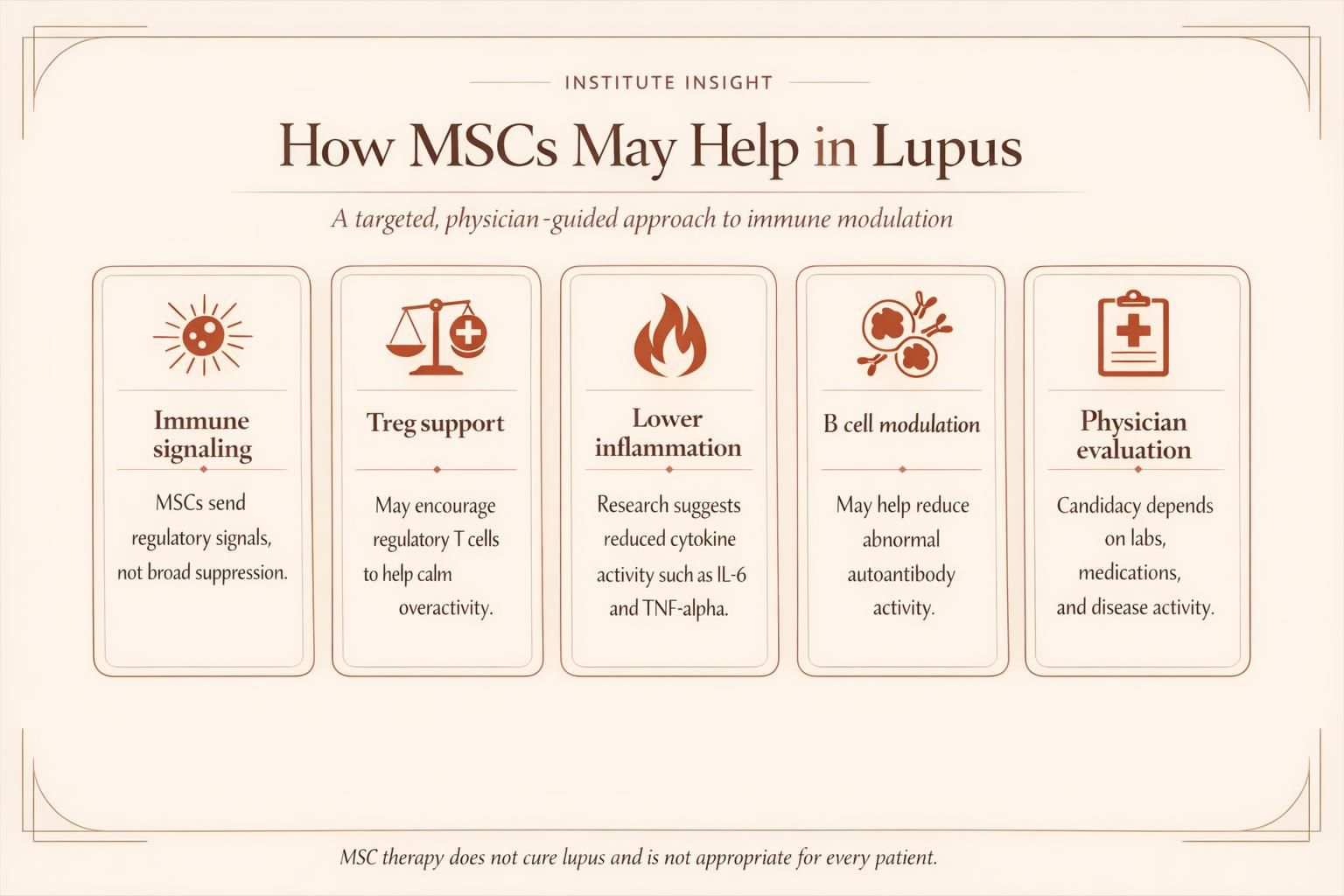
MSCs operate differently. These cells naturally produce signaling molecules that influence immune behavior at a more targeted level. Key mechanisms observed in research include:
- Promotion of regulatory T cells: MSCs may help the body produce more Treg cells, which play a role in preventing the immune system from attacking healthy tissue.
- Reduction of pro-inflammatory cytokines: MSCs appear to reduce levels of inflammatory proteins such as IL-6, TNF-alpha, and interferon-gamma, which drive lupus activity.
- Modulation of B cell activity: In lupus, B cells often produce autoantibodies that damage the body’s own organs. MSCs may help reduce this abnormal B cell activation.
- Support for tissue homeostasis: Beyond immune modulation, MSCs may support repair signaling in tissues already affected by chronic inflammation.
This multi-pathway approach is why researchers and clinicians consider MSC therapy a potentially meaningful complement to conventional lupus management, not a replacement for it.
At Cellular Institute, Dr. Roni Moya, Immunologist, helps guide evaluation for patients exploring immune-related regenerative protocols. Physician oversight at every stage is a non-negotiable part of the process.
What Affects Quality and Safety in MSC Therapy
Not all mesenchymal stem cell preparations carry the same quality standards. The source, processing method, viability, and sterility of the cells influence both the safety profile and the potential clinical value of the therapy.
Patients should ask specific questions before choosing any clinic. Where do the cells come from? How are they processed? What documentation exists for viability and sterility? Has the preparation undergone safety testing?
At Cellular Institute, these questions have clear answers. The clinic works with its affiliated biologics ecosystem through Cellgenic, which supports lab quality and transparency standards, including traceability, viability documentation, xeno-free processing, and sterility testing. This level of visibility into the biologic product is a meaningful differentiator. Many clinics outsource cells without offering patients any documentation of what they actually received.
Cellular Institute also works with certified stem cells that meet documented quality standards within Mexico’s regulatory framework, supporting a safer and more transparent patient experience.
Who May Be a Candidate for MSC Therapy in Lupus
Candidacy depends entirely on individual medical history, current medications, disease activity, and organ involvement. That said, patients who tend to benefit most from further evaluation include those who:
- Experience frequent or severe flares despite standard medical treatment
- Have significant side effects from long-term immunosuppressants or corticosteroids
- Show signs of organ involvement such as lupus nephritis
- Are in a stable enough phase to safely explore adjunct options
- Want a more personalized, integrative approach alongside conventional care
A protocol at Cellular Institute may also incorporate complementary support tools. Depending on the patient’s inflammatory burden and recovery status, the physician team may consider options such as EBOO therapy in Cancún for systemic inflammation support, or recovery technologies to support the body during and after treatment.
Who May Not Be a Candidate
MSC therapy is not appropriate for every lupus patient. A physician must carefully evaluate each case. Patients who may not be suitable candidates include those with:
- Active severe infection or uncontrolled sepsis
- Active malignancy or a recent cancer history requiring individualized review
- Extremely high disease activity requiring immediate emergency intervention
- Pregnancy or breastfeeding
- Medical complexity that requires further evaluation before any adjunct therapy
This is why the process at Cellular Institute begins with evaluation, not a booking form. The medical team reviews each patient’s history, labs, and goals before recommending any protocol.
How Cellular Institute Approaches MSC Therapy for Autoimmune Support
Cellular Institute does not offer a single injection and send patients home. The approach is built around a complete regenerative experience. This means evaluation, preparation, treatment, recovery, and follow-up are all part of the plan.
Patients traveling for treatment also receive coordinated support from the moment they book. International patient coordination, logistics support, and bilingual communication are part of the experience. For patients researching what this journey looks like, the guide to medical tourism in Mexico offers a useful overview of what to expect.
The clinic’s regenerative medicine in Cancún platform is built to support immune-related conditions as part of a personalized, physician-guided protocol. This is not a one-size-fits-all offering.
Questions to Ask Before Choosing a Clinic
If you are comparing clinics that offer MSC therapy for autoimmune conditions, these questions will help you evaluate quality and safety:
- Where do the cells come from, and how are they processed?
- What documentation exists for viability, sterility, and traceability?
- Does a licensed physician perform a medical evaluation before treatment?
- Does the clinic customize the protocol based on your specific condition and history?
- What complementary support tools are available to support recovery and outcomes?
- What follow-up support will you receive after returning home?
For a deeper guide to evaluating clinics, the article on how to choose a stem cell clinic in Mexico walks through key red flags and what responsible regenerative care should include.

Frequently Asked Questions
Are mesenchymal stem cells a cure for lupus?
No. MSC therapy does not cure lupus. Research suggests it may help modulate immune activity and reduce inflammatory burden in appropriately selected patients, but it does not eliminate the underlying condition. It should be considered a potential complement to physician-supervised conventional care, not a replacement for it.
How long might it take to notice changes after MSC therapy?
Response timelines vary significantly between patients. Some report gradual changes over weeks to months. Others see more modest or delayed effects. Factors such as disease severity, medication history, and overall health status all influence the pace and extent of any response. For a broader overview of what timelines may look like, the article on how long stem cell therapy results may last offers helpful context.
Can MSC therapy be combined with existing lupus medications?
This depends on the individual patient and requires careful physician review. In many cases, patients continue their existing medications during and after a regenerative protocol. The medical team evaluates all current medications before recommending any treatment. Patients should never stop or adjust medications without physician guidance.
What makes Cellular Institute different from other clinics offering stem cell therapy for autoimmune conditions?
Cellular Institute combines physician-led evaluation, in-house biologic quality standards through Cellgenic, personalized protocol design, and coordinated international patient support. The clinic does not offer a standardized package. Each protocol reflects the patient’s unique medical context, goals, and clinical needs. The team includes an on-site immunologist, which is a meaningful asset for patients managing autoimmune conditions.
Final Thoughts
For lupus patients living with frequent flares, organ involvement, or significant side effects from long-term immunosuppression, mesenchymal stem cell therapy represents a serious area of emerging clinical interest. The science is not complete, but the evidence base continues to grow. The key is finding a clinic that approaches this option responsibly, with physician oversight, quality-controlled biologics, and a protocol built around your specific case.
If you are exploring whether MSC therapy may be appropriate for your situation, the next step is a medical conversation, not a booking decision. Schedule a discovery call with the Cellular Institute team to discuss your history, ask questions, and learn whether you may be a candidate for a physician-guided regenerative protocol in Cancún.
Medical Disclaimer
This article is for educational purposes only and does not replace medical advice, diagnosis, or treatment. Regenerative therapies are not appropriate for every patient, and outcomes vary. A licensed physician must evaluate your medical history, goals, and candidacy before any treatment can be recommended.