

Written by: Cellular Institute Editorial Team
Medical reviewer: Dr. Matilde Rodríguez – CP 12651081
Laboratory reviewer: Biotecnóloga Diana Navarrete – CP 15029468
Quick Answer
Stem cell therapy success rates vary significantly. Condition type, patient health, cell quality, protocol design, and delivery method all influence how a patient responds. No responsible clinic can promise a fixed percentage of success for every patient. A physician evaluation is always required to assess candidacy and set realistic expectations before any treatment begins.
Why Success Rates Are Complicated to Define
When patients search for stem cell therapy success rates, they often hope to find a single, reassuring number. The reality is more nuanced. Regenerative medicine does not work like a standardized pharmaceutical drug with uniform, predictable outcomes across a population.
Success depends on how you define it. For one patient, success means less joint pain after three months. For another, it means returning to exercise after years of chronic inflammation. For a third, it means measurable improvements in energy and recovery capacity. These are very different outcomes, and they require very different ways of measuring results.
Published research and clinical registry data do show that certain conditions respond more consistently than others. But even within those categories, individual variables matter enormously. Understanding what drives better outcomes puts patients in a much stronger position when evaluating clinics and deciding whether to move forward.
Which Conditions Show the Strongest Evidence
Research into regenerative medicine continues to grow. Certain conditions have more supporting data than others at this stage of the science.
Orthopedic applications, including knee osteoarthritis, joint degeneration, tendon injuries, and cartilage damage, represent one of the most studied areas. Multiple clinical studies and registry reports suggest that a meaningful portion of appropriately selected patients experience reductions in pain and improvements in function. Physicians like Dr. Wajid Burad, Orthopedist at Cellular Institute evaluate these patients carefully to determine whether regenerative orthopedic protocols may be appropriate.
Autoimmune and inflammatory conditions also appear in a growing body of clinical research. Immune modulation is one of the proposed mechanisms through which mesenchymal stem cells may support the body, though this area requires careful patient selection and physician supervision.
Neurological and systemic conditions carry more variable data. Results depend heavily on disease stage, baseline inflammation, and overall health. Patients exploring these categories should approach with especially calibrated expectations and thorough medical evaluation.
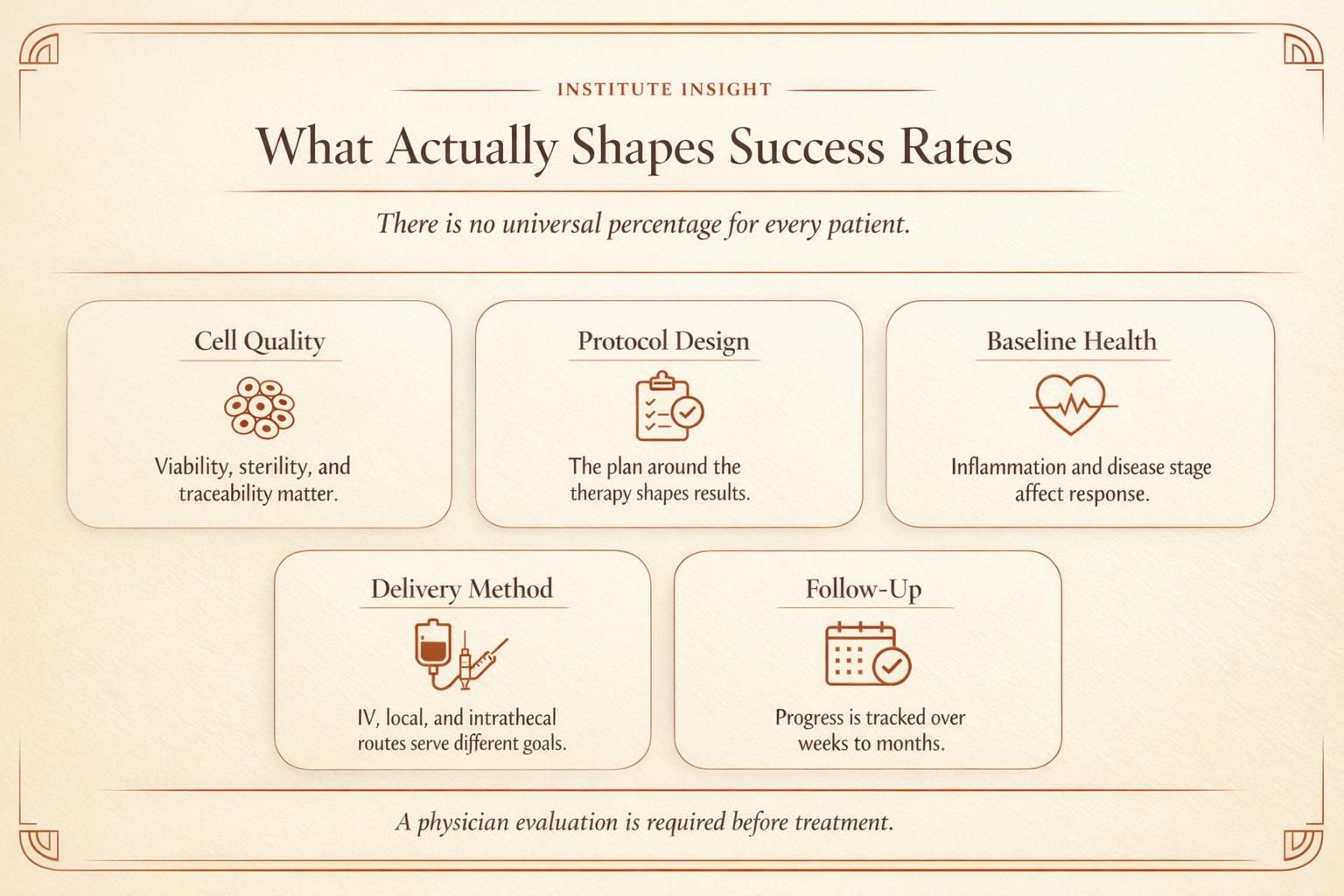
What Actually Affects Whether Stem Cell Therapy Works
The quality of the outcome depends on far more than the therapy itself. Several factors consistently influence how patients respond.
- Cell quality and viability: Cells that arrive at low viability or with poor documentation offer far less therapeutic potential. Clinics should provide traceability and quality documentation for every biologic product used.
- Protocol design: A single injection is rarely a complete strategy. The protocol around the therapy, including complementary modalities, recovery support, and follow-up, significantly shapes results.
- Patient health at baseline: Higher systemic inflammation, advanced disease stage, poor metabolic health, or unmanaged chronic conditions reduce the body’s ability to respond effectively.
- Delivery method: How and where cells are administered matters. Intravenous delivery, targeted local injection, and intrathecal approaches each carry different mechanisms and appropriate use cases.
- Timing and follow-up: Regenerative medicine is not instantaneous. Many patients notice changes gradually over weeks to months. Structured follow-up helps the clinical team assess progress and adjust the plan.
How Cell Quality Connects to Outcome Quality
One factor that many patients overlook is the quality of the biologic product itself. Not all stem cells come from the same source, undergo the same preparation process, or meet the same safety standards. This is one of the most important variables in regenerative medicine, and it rarely receives enough attention in marketing-focused content.
At Cellular Institute, the biologics used in patient protocols are prepared through the affiliated Cellgenic lab ecosystem. This means greater traceability, documented viability and sterility, xeno-free processing standards, and clearer visibility into exactly what the patient receives. Biotechnologist Diana Navarrete leads laboratory review as part of this quality process. You can learn more about this commitment to lab quality and transparency on the Cellular Institute science page.
Many clinics outsource biologics or provide little visibility into product origin. When a clinic cannot clearly explain where its cells come from, how they were processed, or what documentation supports their quality, that gap deserves serious attention. Patients should ask about certified stem cells and what standards a clinic follows before committing to treatment.
Who May Be a Good Candidate
Physician evaluation determines candidacy. That said, patients who tend to respond better often share certain characteristics.
- Earlier to moderate disease stage rather than end-stage degeneration
- Manageable systemic inflammation at the time of treatment
- Good baseline metabolic health and kidney and liver function
- Realistic expectations and willingness to support recovery with lifestyle changes
- No active infection, malignancy, or contraindicated conditions
- Commitment to follow-up evaluation and protocol adjustments
Who May Not Be a Strong Candidate
Regenerative medicine is not appropriate for everyone. Patients with advanced end-stage conditions, active malignancy, severe immunosuppression, or certain cardiovascular contraindications may not qualify. A thorough medical evaluation determines fit. Responsible clinics will tell a patient they are not a candidate when that is the honest answer.
How Cellular Institute Approaches This
Cellular Institute does not approach regenerative medicine as a single-injection procedure. The team builds personalized protocols around each patient’s condition, goals, labs, and health history. Depending on the evaluation, a protocol may include stem cell therapy alongside complementary modalities such as exosome therapy, peptide therapy, recovery technologies like hyperbaric oxygen or red light therapy, and advanced blood therapies.
Medical oversight comes from a physician-led team. Dr. Rafael Moguel, Medical Director, guides clinical evaluation and ensures that every patient receives a protocol aligned with their specific profile. The team also includes specialists in immunology, orthopedics, and aesthetics, allowing for condition-appropriate expertise throughout the patient journey.
Patients traveling internationally benefit from coordinated support, bilingual communication, structured follow-up, and a complete regenerative medicine experience in Cancún designed around their needs, not a standardized package.
Questions to Ask Before Choosing a Clinic
When evaluating clinics, ask specific questions. The answers reveal a great deal about quality and transparency.
- Where do the stem cells or exosomes come from, and how are they processed?
- What quality documentation is available, including viability, sterility, and traceability?
- Does a licensed physician evaluate my candidacy before treatment?
- Is the protocol personalized to my condition, or is it a standard package?
- What complementary therapies support recovery and improve outcomes?
- What does follow-up care look like after I return home?
- What are the realistic expectations for my specific situation?
For a deeper look at how to evaluate clinics and what red flags to watch for, the guide on how to choose a stem cell clinic in Mexico covers the essential questions in detail.

Frequently Asked Questions
What is a realistic stem cell therapy success rate?
There is no universal success rate that applies to all patients and conditions. Clinical studies in orthopedic and inflammatory conditions have reported positive response rates ranging widely depending on how success is defined, patient selection criteria, and protocol design. A physician evaluation helps determine what outcome range may be realistic for your specific situation.
How long does it take to see results from stem cell therapy?
Most patients do not experience immediate changes. Regenerative processes take time. Some patients notice early shifts within four to six weeks. Others observe more meaningful changes at three to six months. Results vary by condition, protocol, and individual biology. You can read more about how long stem cell therapy results may last in our dedicated guide.
Does stem cell quality affect success rates?
Yes, significantly. Cell viability, sterility, sourcing, and processing standards directly affect therapeutic potential. A clinic that cannot provide quality documentation for its biologic products introduces an important variable that patients cannot ignore. This is why lab transparency and certified stem cell sourcing matter so much when choosing where to receive treatment.
Is stem cell therapy in Mexico safe and credible?
Mexico has a regulated medical environment, and serious clinics operating within that framework follow documented safety protocols. However, not all clinics meet the same standards. Patients should research clinic credentials, physician licensing, regulatory structure, and biologic sourcing carefully. Our article on stem cell therapy safety in Mexico offers a detailed breakdown of what to evaluate.
Final Thoughts
Stem cell therapy success rates are real, but they cannot be reduced to a single number. The right question is not what percentage of patients improve. The right question is whether you are a strong candidate, whether the clinic follows serious quality standards, whether the protocol addresses your specific situation, and whether you have the medical support to recover and optimize your results.
Patients who invest time in asking the right questions before treatment tend to make better decisions. If you are evaluating your options and want to speak with a medical team that prioritizes transparency, quality, and personalized care, we invite you to schedule a discovery call with Cellular Institute. Our team will help you understand whether regenerative medicine may be appropriate for your goals.
Medical Disclaimer
This article is for educational purposes only and does not replace medical advice, diagnosis, or treatment. Regenerative therapies are not appropriate for every patient, and outcomes vary. A licensed physician must evaluate your medical history, goals, and candidacy before any treatment can be recommended.