
Written by: Cellular Institute Editorial Team
Medical reviewer: Dr. Matilde Rodríguez – CP 12651081
Laboratory reviewer: Biotechnologist Diana Navarrete – CP 15029468
Quick Answer
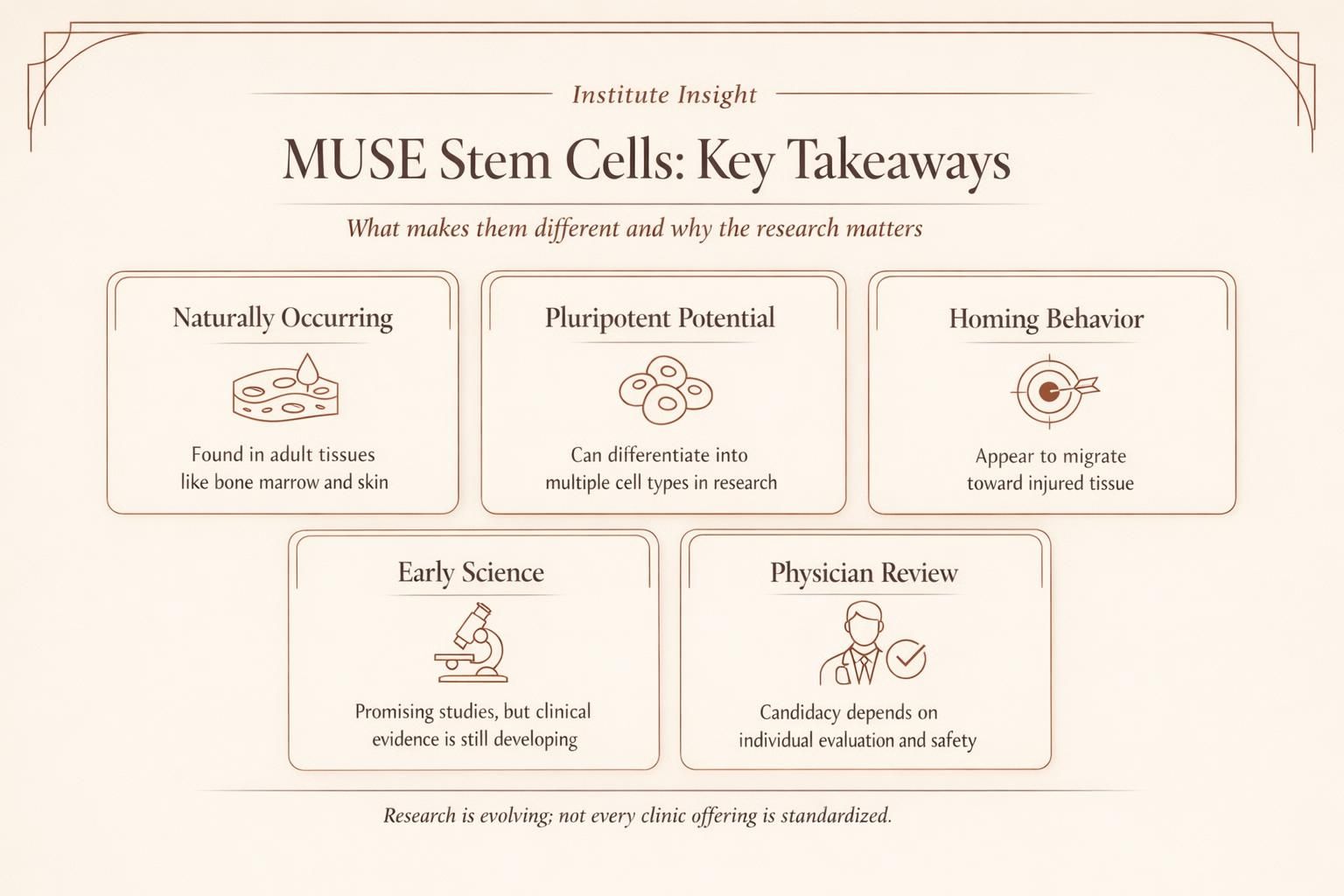
MUSE stem cells, or Multilineage-differentiating Stress Enduring cells, are a naturally occurring type of pluripotent stem cell found in adult human tissues. Researchers have identified them in bone marrow, skin, and connective tissue. Unlike many conventional stem cell types, MUSE cells appear to migrate toward damaged tissue and differentiate into specialized cells without forming tumors, which makes them a subject of growing scientific interest. They are not a standard clinical offering at most regenerative medicine clinics. Physician evaluation is required to determine whether any stem cell therapy may be appropriate for your individual situation.
What Patients Should Know About MUSE Stem Cells
If you recently heard the term MUSE stem cells from a clinic, video, or social post, you are not alone. Interest in this cell type has grown significantly among patients researching advanced regenerative options.
MUSE stands for Multilineage-differentiating Stress Enduring. Researchers in Japan first identified this cell population in 2010. The team, led by Dr. Mari Dezawa at Tohoku University, discovered that these cells exist naturally within adult connective tissue and bone marrow.
What makes MUSE cells distinctive is a combination of properties that most adult stem cells do not share together. They appear to be pluripotent, meaning they can potentially differentiate into multiple cell types across different tissue lineages. At the same time, they do not require genetic reprogramming to reach this state, unlike induced pluripotent stem cells, or iPSCs.
Researchers have also noted that MUSE cells appear to home in on areas of tissue stress or damage. They respond to signals released by injured tissue and migrate toward those sites. This homing behavior is one reason scientists have focused on their potential for applications in conditions involving neurological damage, cardiovascular injury, and musculoskeletal repair.
How MUSE Cells Differ from Other Stem Cell Types
Understanding what makes MUSE cells unique requires a brief comparison with other commonly discussed stem cell types.
- Embryonic stem cells are pluripotent and widely studied, but their use raises ethical concerns and they carry a risk of forming teratomas, a type of tumor.
- Induced pluripotent stem cells (iPSCs) are adult cells reprogrammed to behave like embryonic stem cells. They are powerful but require complex genetic manipulation and carry safety considerations.
- Mesenchymal stem cells (MSCs) are the most commonly used adult stem cells in regenerative medicine today. They support tissue repair primarily through anti-inflammatory signaling. They are considered multipotent, not pluripotent, meaning their differentiation potential is more limited.
- MUSE cells appear to occupy a unique position. They exist naturally in adult tissue, show pluripotent differentiation potential, respond to distress signals in injured tissue, and have not demonstrated tumor-forming behavior in early research.
This combination has made MUSE cells a compelling area of scientific investigation. However, patients should understand that the research is still developing. Clinical trials have begun in Japan and other regions, but MUSE cell therapy is not yet a widely established or standardized clinical protocol.
What the Current Science Says
Clinical research on MUSE cells has advanced meaningfully in Japan. A pharmaceutical-grade MUSE cell product called CL2020 has undergone clinical trials for conditions including amyotrophic lateral sclerosis (ALS), stroke, spinal cord injury, and neonatal hypoxic-ischemic encephalopathy.
Early trial results have shown signals of safety and potential benefit in select patient populations. However, most trials remain in early or mid-stage phases. Large-scale, randomized controlled trials have not yet confirmed efficacy across broad patient populations.
This context matters. Patients searching for MUSE stem cells online may encounter clinics making strong claims about outcomes. Responsible regenerative medicine requires that patients receive honest, evidence-informed information about what the science currently supports and what remains under investigation.
For patients exploring regenerative medicine in Cancún, understanding the difference between established protocols and emerging research is an important part of making an informed decision.
What Affects Quality and Safety in Stem Cell Therapy
Whether a clinic offers MUSE cells, mesenchymal stem cells, or other biologic products, quality and safety depend heavily on how those cells are sourced, processed, tested, and administered.
Patients should ask detailed questions before committing to any regenerative therapy. Key considerations include:
- Where do the cells come from, and how are donors screened?
- How are the cells processed and stored before administration?
- What quality documentation, such as certificates of analysis, viability reports, and sterility testing, does the clinic provide?
- Does the clinic have physician oversight and personalized candidate evaluation?
- Does the clinic operate within a recognized regulatory framework?
At Cellular Institute, our affiliated lab ecosystem through Cellgenic supports traceability, viability testing, sterility standards, and xeno-free processing. Our team reviews product documentation before any biologic reaches a patient. This process reflects our belief that quality in regenerative medicine begins long before the treatment day.
You can learn more about our commitment to certified stem cells and the standards we apply to every biologic product we use.
Who May Be a Candidate for Advanced Stem Cell Protocols
Candidacy for any regenerative medicine protocol depends on a thorough medical evaluation. Factors that physicians typically assess include:
- The patient’s primary health goals and condition history
- Current inflammatory status and immune function
- Prior treatments and response
- Overall health, organ function, and medication history
- Realistic expectations and understanding of what regenerative medicine can and cannot support
Patients exploring options for neurological support, musculoskeletal recovery, chronic inflammation, or longevity optimization may be appropriate candidates for physician-guided regenerative protocols. A physician review of your medical history is always the starting point.
Who May Not Be an Appropriate Candidate
Not every patient qualifies for stem cell therapy, and responsible clinics will tell you this upfront. Patients with active infections, certain autoimmune conditions in acute flare, active malignancies, or other contraindicated medical conditions may not be appropriate candidates for certain regenerative protocols.
A physician must review each case individually. No reputable clinic should offer regenerative therapy without first conducting a meaningful medical evaluation.
How Cellular Institute Approaches Advanced Regenerative Protocols
Cellular Institute does not position itself as a single-injection clinic. Our approach to regenerative medicine treats the therapy as one part of a broader, personalized protocol designed around the patient’s goals, history, and clinical profile.
Our medical team, led by Dr. Rafael Moguel, Medical Director, evaluates each patient before any protocol is recommended. We combine advanced biologic therapies with complementary modalities such as exosome therapy, recovery technologies including hyperbaric oxygen and red light therapy, and peptide therapy when clinically appropriate.
Our immunology team, including Dr. Roni Moya, Immunologist, plays an important role in evaluating inflammatory burden and immune status before treatment. This kind of comprehensive evaluation is what separates a personalized regenerative protocol from a one-size-fits-all approach.
We also support international patients traveling from the United States and Canada through coordinated logistics, bilingual patient support, and structured follow-up after treatment. If you are researching medical tourism in Mexico, we encourage you to read more about what a complete patient journey looks like before making any decisions.
Questions to Ask Before Choosing a Clinic
If a clinic claims to offer MUSE stem cells or any advanced regenerative therapy, these are reasonable questions to ask before moving forward:
- What is the source of the cells, and how are they processed?
- What quality documentation can the clinic provide?
- Is the protocol physician-supervised, and will a physician evaluate my candidacy?
- What complementary therapies or recovery support does the protocol include?
- What are realistic expectations for my situation, and what does the evidence currently support?
- Does the clinic operate within a recognized regulatory structure?
You may also find it helpful to read our guide on how to choose a stem cell clinic in Mexico before beginning your search.

Frequently Asked Questions
Are MUSE stem cells available at clinics today?
MUSE cell therapy is currently in clinical trial stages in Japan and select research settings. A pharmaceutical-grade product called CL2020 has been studied for specific neurological conditions. Most regenerative medicine clinics, including those in Mexico, do not yet offer a standardized MUSE cell protocol. If a clinic claims to offer MUSE cells, patients should ask detailed questions about the source, quality documentation, and scientific basis for that offering.
How do MUSE cells differ from mesenchymal stem cells?
Mesenchymal stem cells, or MSCs, are the most commonly used adult stem cells in clinical regenerative medicine. They support tissue repair primarily through anti-inflammatory and paracrine signaling. MUSE cells appear to offer broader differentiation potential and a unique homing ability toward damaged tissue. However, MSCs have a much longer clinical track record, while MUSE cell research is still developing.
Is stem cell therapy in Mexico safe?
Safety in regenerative medicine depends on the clinic’s quality standards, physician oversight, regulatory structure, and product sourcing. Mexico has a growing number of serious, physician-led clinics operating within recognized regulatory frameworks. Patients should research carefully and ask specific questions about safety protocols. You can learn more about stem cell therapy safety in Mexico in our dedicated guide.
How long do stem cell therapy results typically last?
Results from regenerative medicine protocols vary significantly by patient, condition, protocol design, and overall health status. There is no universal timeline. Some patients report gradual improvement over weeks to months. The durability of any response depends on many individual factors. You can read more about how long stem cell therapy results may last and what factors influence outcomes.
Final Thoughts
MUSE stem cells represent a genuinely exciting area of regenerative science. Their natural pluripotency, tissue-homing behavior, and safety profile in early research make them a subject worth watching carefully. At the same time, patients deserve honest guidance about where the science currently stands and what clinical access to this therapy realistically looks like today.
At Cellular Institute, we believe that responsible regenerative medicine starts with education. We design personalized protocols around each patient’s history, goals, and clinical profile, using quality-controlled biologics, physician supervision, and advanced complementary technologies.
If you are curious about whether a regenerative medicine protocol may be appropriate for your situation, we encourage you to take the first step and schedule a discovery call with our patient coordination team. We are here to answer your questions, review your history, and help you understand your options with clarity and care.
Medical Disclaimer
This article is for educational purposes only and does not replace medical advice, diagnosis, or treatment. Regenerative therapies are not appropriate for every patient, and outcomes vary. A licensed physician must evaluate your medical history, goals, and candidacy before any treatment can be recommended.