
Written by: Cellular Institute Editorial Team
Medical reviewer: Dr. Matilde Rodríguez – CP 12651081
Laboratory reviewer: Biotecnóloga Diana Navarrete – CP 15029468
Quick Answer
Stem cell therapy for Parkinson’s disease is an emerging area of regenerative medicine that some patients and physicians are exploring as a complement to conventional care. Early research suggests that certain cell-based approaches may support neuroprotection and help modulate the inflammatory environment associated with neurodegeneration. However, stem cell therapy does not cure Parkinson’s disease, and outcomes vary significantly by patient. A thorough physician evaluation is required to determine whether a candidate may benefit from a personalized regenerative protocol.
What Patients with Parkinson’s Disease Should Know
Parkinson’s disease affects the nervous system progressively. It primarily involves the loss of dopamine-producing neurons in a region of the brain called the substantia nigra. As dopamine levels decline, patients experience motor symptoms such as tremors, stiffness, slow movement, and balance difficulties. Non-motor symptoms, including fatigue, cognitive changes, and sleep disturbances, also affect quality of life.
Conventional treatments such as levodopa and other dopaminergic medications help manage symptoms. However, they do not stop or reverse neurodegeneration. Over time, many patients notice that medication effectiveness changes, and side effects may become more difficult to manage. This reality leads many patients and families to ask whether regenerative medicine may offer something additional.
Stem cell therapy does not replace conventional neurological care. It may, however, be explored as part of an integrated protocol designed to support the body’s own repair mechanisms, modulate inflammation, and promote a healthier cellular environment. Patients should approach this option with realistic expectations and a commitment to working with a qualified physician team.
How Stem Cell Therapy May Work in a Parkinson’s Protocol
Researchers and regenerative medicine physicians have explored several mechanisms through which stem cells may support patients with Parkinson’s disease. These include neuroprotective signaling, anti-inflammatory modulation, and potential support for the surrounding cellular environment of the brain.
Mesenchymal stem cells, often derived from umbilical cord tissue or Wharton’s jelly, are among the most studied cell types in this context. These cells do not simply replace lost neurons. Instead, they may release signaling molecules that support surviving cells, reduce neuroinflammation, and promote a more balanced immune response.
Some protocols also incorporate exosome therapy, which uses extracellular vesicles derived from stem cells to deliver regenerative signals at the cellular level. Exosomes may complement stem cell administration by enhancing communication between cells and supporting tissue-level repair processes.
It is important to understand that these mechanisms are still under active investigation. No regenerative medicine protocol for Parkinson’s disease carries guarantees, and results vary from patient to patient. Physician-guided evaluation remains essential.
What Affects Quality and Safety in Stem Cell Therapy
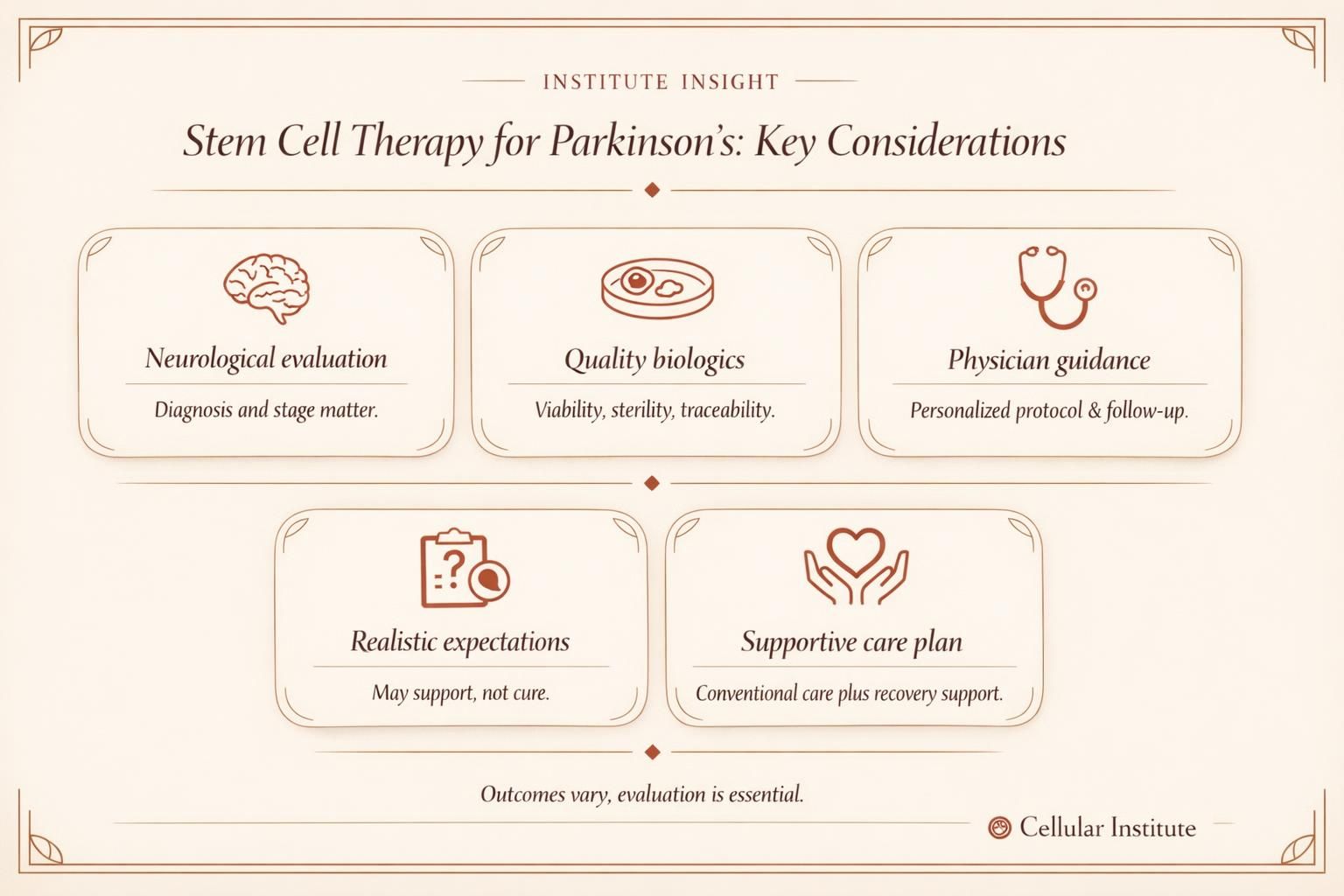
Not all stem cell therapies are equal. The quality of the biologic product, the source and processing of the cells, and the clinical environment all influence patient safety and potential outcomes. Patients researching stem cell therapy for Parkinson’s disease should ask detailed questions before choosing a provider.
Key quality factors include cell viability, sterility, traceability, and documentation. Clinics that rely on outsourced or poorly documented biologics introduce unnecessary uncertainty. At Cellular Institute, biologics are prepared through an affiliated lab ecosystem supported by Cellgenic, which prioritizes quality control, xeno-free processing standards, and full traceability from source to clinical application. Biotechnologist Diana Navarrete plays an active role in laboratory review and quality oversight at the clinic.
Patients can also review our certified stem cells page to better understand how product quality and safety documentation factor into responsible regenerative medicine. For a broader overview of what to look for when comparing providers, our guide on how to choose a stem cell clinic in Mexico covers the most important questions to ask.
Who May Be a Candidate
Candidacy for stem cell therapy in the context of Parkinson’s disease requires a careful medical evaluation. Patients who may be worth evaluating further typically share certain characteristics.
- They have a confirmed Parkinson’s disease diagnosis from a neurologist.
- They experience progressive motor decline or medication-related challenges.
- They are in a relatively stable medical condition overall.
- They hold realistic expectations about what regenerative medicine may support.
- They are committed to a physician-guided protocol, including pre-treatment preparation and post-treatment follow-up.
Patients in earlier stages of the disease, or those whose conventional care is no longer providing adequate symptom relief, may be among those who ask most about complementary regenerative options. A full clinical evaluation helps determine whether a protocol may be appropriate for any individual case.
Who May Not Be a Candidate
Stem cell therapy is not appropriate for everyone. Certain health conditions, medication profiles, or disease severity levels may affect candidacy. Patients with active infections, certain immune conditions, advanced systemic illness, or other contraindications may not qualify for a regenerative protocol. This is why physician evaluation is not optional. It is foundational to responsible care.
How Cellular Institute Approaches This
At Cellular Institute, regenerative medicine protocols for neurological conditions are designed around the patient, not around a single product or procedure. The medical team conducts a thorough evaluation before recommending any protocol. That evaluation considers the patient’s neurological history, current medications, inflammation status, overall health, and goals.
A protocol for a Parkinson’s patient may include stem cell therapy alongside complementary modalities such as EBOO therapy in Cancún to support systemic inflammation reduction, recovery technologies such as hyperbaric oxygen therapy or PEMF, and ongoing optimization through peptide therapy when clinically appropriate. The goal is to create a supportive biological environment, not to promise a specific outcome.
Cellular Institute’s connection to the broader Global Stem Cells Group and ISSCA ecosystem means the medical team draws on more than 15 years of regenerative medicine experience and physician education. This is not an influencer clinic or a trend-driven wellness center. It is a physician-led, science-informed platform designed around patient safety and personalized care. Learn more about Cellular Institute’s approach to regenerative medicine and what sets the clinic apart.
For international patients considering travel, Cellular Institute also offers structured support through our medical tourism coordination team. Our guide to medical tourism in Mexico covers what patients from the U.S. and Canada should know before making the trip.
Questions to Ask Before Choosing a Clinic
Patients researching stem cell therapy for Parkinson’s disease should ask any clinic they consider the following questions before moving forward.
- Where do the stem cells or biologics come from, and how are they processed?
- What quality documentation is available, such as certificates of analysis, viability testing, and sterility results?
- Does the protocol go beyond a single injection to include preparation, recovery support, and follow-up?
- Will a physician evaluate my medical history before treatment?
- What are realistic expectations for someone in my condition?
- How does the clinic handle patients who are also receiving conventional neurological care?
These questions help patients distinguish between clinics that prioritize quality, transparency, and clinical reasoning and those that prioritize volume and pricing alone.

Frequently Asked Questions
Can stem cell therapy cure Parkinson’s disease?
No. Stem cell therapy does not cure Parkinson’s disease. Research is ongoing, and no regenerative approach has demonstrated the ability to reverse or eliminate the disease. However, some patients and physicians explore stem cell protocols as a complement to conventional care, with the goal of supporting neuroprotection, reducing neuroinflammation, and improving quality of life under physician supervision.
How long might results from stem cell therapy last for Parkinson’s patients?
Results vary significantly by patient, disease stage, protocol quality, and overall health. Some patients report gradual improvements in energy, motor comfort, or quality of life over several months following treatment. For a general overview of expectations, our article on how long stem cell therapy results may last provides useful context. A physician should set expectations based on your individual case.
Is it safe to travel to Mexico for stem cell therapy?
Patients who choose a physician-led clinic operating within Mexico’s regulatory framework and who work with a structured medical tourism coordination team can travel safely and receive high-quality care. Cellular Institute supports international patients with logistics, bilingual coordination, transportation, and clinical preparation. You can learn more about stem cell therapy safety in Mexico on our dedicated resource page.
What other therapies might be included in a Parkinson’s protocol?
A personalized protocol may include exosome therapy, EBOO for inflammation support, hyperbaric oxygen therapy, PEMF, peptide therapy, and advanced diagnostics, depending on the patient’s clinical evaluation. Cellular Institute’s approach focuses on building a full regenerative environment around the patient rather than offering a single-modality procedure. Explore the full range of regenerative medicine in Cancún to understand what an integrated protocol may include.
Final Thoughts
Stem cell therapy for Parkinson’s disease is not a replacement for conventional neurological care, and it carries no guarantees. However, for patients who understand what regenerative medicine may realistically support and who want to explore a physician-guided, evidence-informed approach, it may be worth a serious conversation.
The most important step is a thorough medical evaluation with a qualified team that will review your history, set honest expectations, and design a protocol around your specific situation, not around a standard package.
If you or a family member is living with Parkinson’s disease and wants to understand whether a regenerative medicine protocol may be appropriate, we invite you to schedule a discovery call with the Cellular Institute team. We will listen to your situation, answer your questions, and help you determine whether you may be a candidate for a personalized protocol.
Medical Disclaimer
This article is for educational purposes only and does not replace medical advice, diagnosis, or treatment. Regenerative therapies are not appropriate for every patient, and outcomes vary. A licensed physician must evaluate your medical history, goals, and candidacy before any treatment can be recommended.