

Written by: Cellular Institute Editorial Team
Medical reviewer: Dr. Matilde Rodríguez – CP 12651081
Laboratory reviewer: Biotecnóloga Diana Navarrete – CP 15029468
Quick Answer
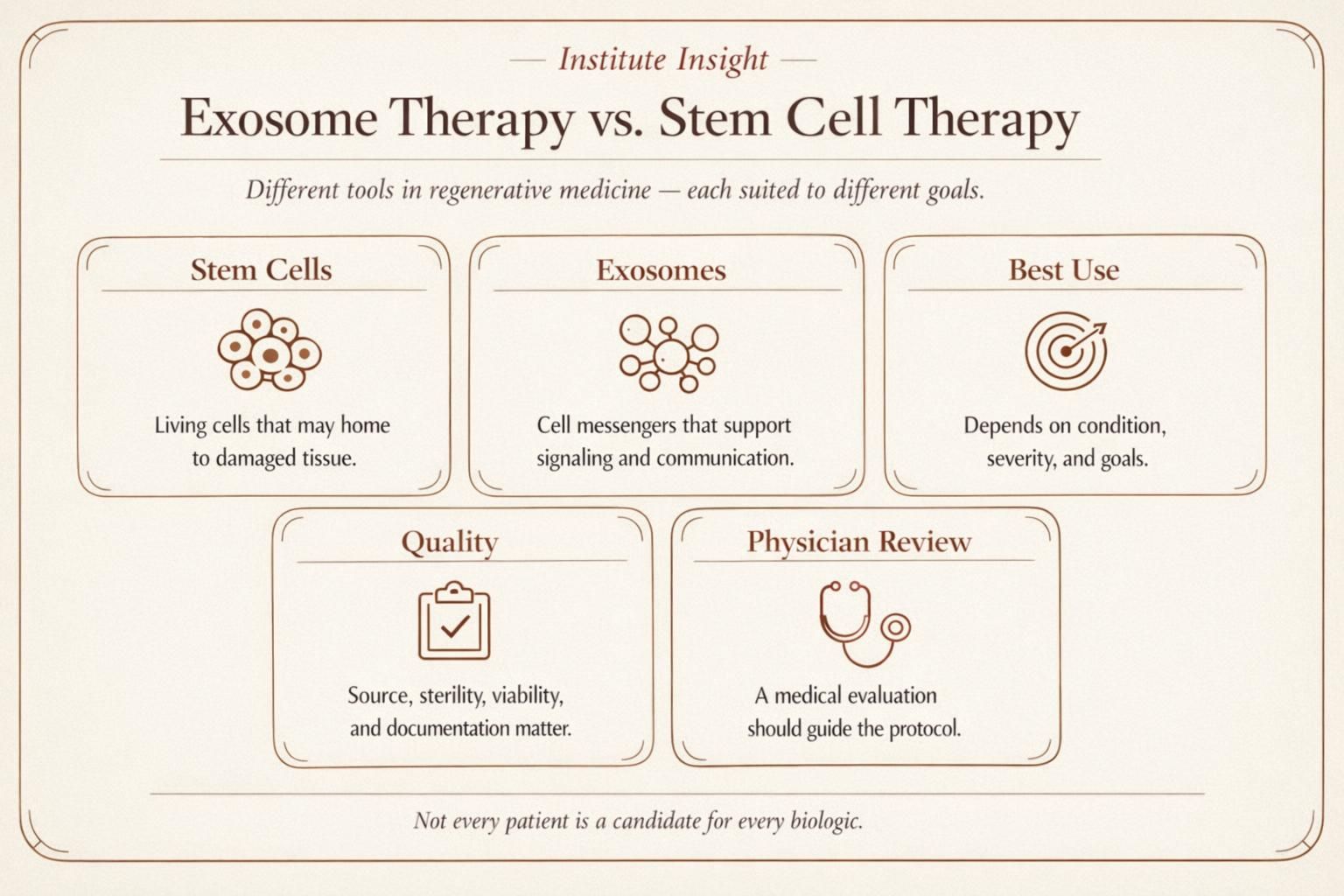
Exosome therapy and stem cell therapy are both advanced regenerative tools, but they work in different ways and may be better suited to different goals and conditions. Stem cells are living cells that can home to areas of injury and support tissue repair. Exosomes are signaling particles derived from cells that communicate with the body’s existing cells to promote repair, reduce inflammation, and support recovery. Neither option is universally right for every patient. A physician must evaluate your medical history, inflammatory status, condition severity, and goals before recommending a protocol.
What Patients Should Know
If you have been researching regenerative medicine, you have likely encountered both terms. The confusion is understandable. Clinics often use them interchangeably, and online information is inconsistent. Understanding the core difference helps you ask better questions before choosing a treatment.
What Are Stem Cells?
Stem cells are living, undifferentiated cells with the potential to become specialized cell types. In regenerative medicine, mesenchymal stem cells (MSCs) sourced from umbilical cord tissue or Wharton’s jelly are among the most commonly used. These cells can travel to areas of injury or inflammation. Once there, they may release growth factors, modulate immune responses, and support tissue repair in ways the body can no longer do efficiently on its own.
Stem cell therapy may be considered for patients dealing with joint degeneration, chronic inflammation, autoimmune-related conditions, neurological concerns, and systemic recovery goals. You can learn more about the types of stem cell treatments in Mexico available today.
What Are Exosomes?
Exosomes are tiny extracellular vesicles naturally produced by cells. They carry proteins, lipids, and genetic material between cells. In therapeutic applications, exosomes derived from MSCs deliver powerful signaling messages to the body’s existing cells. They do not replicate or engraft like stem cells. Instead, they act as messengers that may support cellular communication, reduce inflammatory signaling, and stimulate the body’s own repair processes.
Exosome therapy has gained significant attention for skin rejuvenation, inflammation modulation, neurological support, and as a complement to stem cell protocols. The technology continues to evolve rapidly.
How Each Approach May Work in a Regenerative Protocol
The distinction between these two options matters most when building a personalized protocol. A physician considers your condition, its severity, your immune health, and your overall medical picture before recommending one approach over the other, or a combination of both.
When Stem Cell Therapy May Be a Stronger Fit
- Moderate to severe joint or tissue degeneration requiring structural support
- Chronic systemic inflammation that may benefit from immune modulation
- Autoimmune-related conditions where broader immunoregulatory activity matters
- Patients seeking systemic regenerative support as part of a longevity protocol
- Conditions where cellular engraftment or homing to damaged tissue may be valuable
When Exosome Therapy May Be a Stronger Fit
- Patients who want targeted cellular signaling without introducing living cells
- Aesthetic and skin rejuvenation applications
- Neurological or cognitive support goals where signaling rather than structural repair is the priority
- Patients who have already undergone stem cell therapy and want to extend or reinforce results
- Cases where a physician determines that exosome signaling better matches the patient’s current biology
Many patients at Cellular Institute receive both as part of an integrated protocol. The combination can allow for the structural and immunomodulatory support of stem cells alongside the precise cellular communication that exosomes provide.
What Affects Quality and Safety
Not all stem cells and not all exosomes are equal. The source, processing method, storage conditions, viability, and sterility of the biologic product directly affect what the patient receives. This is one of the most important and least discussed aspects of regenerative medicine.
At Cellular Institute, biologics are prepared through Cellgenic, the clinic’s in-house lab ecosystem. Cellgenic supports traceability, sterility testing, viability documentation, and xeno-free processing standards. Patients receive products backed by quality documentation, not just marketing claims. Lab quality and transparency are central to how the clinic approaches every protocol.
Patients should always ask any clinic where their cells or exosomes come from, how they are processed, what quality testing has been performed, and whether a certificate of analysis is available. Certified stem cells backed by documented quality standards represent a meaningful difference from loosely sourced products with no traceability.
Safety also depends on physician oversight. A qualified physician should review your health history, inflammatory markers, and candidacy before any biologic therapy. Skipping that evaluation is one of the most significant red flags in the industry. Learn more about stem cell therapy safety in Mexico and what responsible providers do differently.
Who May Be a Candidate
Candidates for exosome therapy or stem cell therapy typically include adults with chronic conditions that have not responded fully to conventional care, patients pursuing longevity optimization, individuals recovering from orthopedic or sports injuries, and those dealing with systemic inflammation or immune dysregulation. Candidate evaluation always requires a full medical review.
Who May Not Be a Candidate
Patients with active infections, certain blood disorders, uncontrolled autoimmune conditions, or a history of specific cancers may not be appropriate candidates for regenerative biologics. A thorough physician evaluation protects the patient and shapes the right approach. Results also vary significantly by patient, condition, age, and overall health status.
How Cellular Institute Approaches This
Cellular Institute does not offer a one-size-fits-all injection. The medical team, led by Dr. Rafael Moguel, Medical Director, designs each protocol around the patient’s specific history, goals, and clinical picture. This means a patient seeking joint support may receive a different protocol than a patient focused on longevity optimization or inflammation reduction.
Protocols may incorporate stem cell therapy, exosome therapy, peptide therapy, recovery technologies such as hyperbaric oxygen and red light, and complementary approaches like EBOO therapy for systemic inflammation support. Every decision reflects clinical reasoning, not a preset menu.
For patients traveling from the United States or Canada, Cellular Institute also provides full medical tourism support in Cancún, including patient coordination, bilingual communication, and follow-up planning after treatment. If you want to understand the broader journey, our article on regenerative medicine in Cancún covers what to expect before you arrive.
Questions to Ask Before Choosing a Clinic
Whether you are evaluating exosome therapy, stem cell therapy, or a combined protocol, these questions help you distinguish serious providers from less rigorous ones.
- Where do your stem cells or exosomes come from, and how are they processed?
- What quality documentation is available for the biologic product?
- Does a physician evaluate my candidacy before recommending a protocol?
- Is the protocol personalized to my condition and goals, or is it a standard package?
- What complementary therapies or recovery support are included?
- What follow-up does the clinic provide after treatment?
- What regulatory framework does the clinic operate under?
For deeper guidance on evaluating clinics, read our article on how to choose a stem cell clinic in Mexico.

Frequently Asked Questions
Is exosome therapy safer than stem cell therapy?
Both therapies carry potential risks and benefits. Exosomes do not contain living cells, which some physicians consider an advantage in specific cases. However, safety in either approach depends heavily on product quality, physician oversight, and appropriate patient selection. Neither option should be described as risk-free, and both require a thorough medical evaluation before proceeding.
Can I receive both exosome therapy and stem cell therapy at the same time?
In many cases, yes. Physicians at Cellular Institute often design protocols that combine both. Stem cells may address structural and immunomodulatory goals while exosomes support cellular signaling and recovery amplification. The right combination depends on your individual medical picture and the physician’s clinical judgment.
How do I know which option is right for my condition?
You cannot determine the right approach based on online research alone. A qualified physician must review your history, goals, labs, and current health status. The distinction between stem cells and exosomes matters, but so does the protocol built around them. Start with a medical evaluation rather than a predetermined preference for one therapy over another.
Does Cellular Institute offer both stem cell therapy and exosome therapy?
Yes. Cellular Institute offers both as part of personalized regenerative protocols. The medical team evaluates each patient individually and designs a protocol that may include one or both biologics, alongside complementary recovery and optimization technologies. To learn whether you may be a candidate, schedule a discovery call with the patient coordination team.
Final Thoughts
The question is not really exosome therapy versus stem cell therapy. The better question is: what does your body need right now, and what protocol gives you the best chance of achieving your goals safely and responsibly?
Choosing the right biologic is one part of the answer. The quality of that biologic, the physician guiding your care, the protocol built around your specific condition, and the recovery support surrounding your treatment all matter equally.
If you are ready to move from research to a real conversation, schedule a discovery call with the Cellular Institute team. We will help you understand whether you may be a candidate, what a personalized protocol might look like, and what to expect from your experience in Cancún.
Medical Disclaimer
This article is for educational purposes only and does not replace medical advice, diagnosis, or treatment. Regenerative therapies are not appropriate for every patient, and outcomes vary. A licensed physician must evaluate your medical history, goals, and candidacy before any treatment can be recommended.