
Written by: Cellular Institute Editorial Team
Medical reviewer: Dr. Matilde Rodríguez – CP 12651081
Laboratory reviewer: Biotecnóloga Diana Navarrete – CP 15029468
Quick Answer
Most patients who respond well to stem cell therapy report benefits that last anywhere from several months to a few years. Some experience meaningful improvements well beyond that window. Results vary significantly depending on the condition, the protocol design, the quality of the biologic product, and how the patient supports recovery afterward. No clinic can guarantee how long results will last for any individual. A thorough physician evaluation helps set realistic expectations and identify whether you may be a good candidate.
Why Patients Ask This Question
By the time most patients ask how long stem cell therapy results last, they have already done the research. They understand the basic concept. What they want now is a straight answer: will the benefits fade in a few months, or can they last for years?
It is a fair and important question. Understanding realistic timelines helps patients plan their care, budget appropriately, and set expectations that are grounded in clinical reality rather than marketing claims.
The honest answer is that durability varies. But that variability is not random. Several well-understood factors influence how long results may hold — and many of them are within a patient’s control.
What the Evidence Suggests About Timelines
Regenerative medicine is an evolving field. Research continues to grow, and clinical outcomes vary widely between patients and conditions. That said, clinical observations across regenerative medicine programs offer some general patterns that can help guide expectations.
- Orthopedic conditions such as joint pain, cartilage degradation, and inflammation-related mobility issues often show improvement within weeks to months. Many patients report benefits lasting one to three years or longer, particularly when lifestyle changes support the process.
- Autoimmune and inflammatory conditions may show more gradual responses. Some patients notice sustained improvements in immune regulation and inflammation markers over a longer period. Results here tend to depend heavily on the overall protocol, including complementary therapies.
- Systemic wellness and longevity protocols are more difficult to measure in traditional outcome terms. Patients often report improvements in energy, recovery capacity, cognitive clarity, and general vitality. These benefits may be supported and extended through follow-up optimization.
- Neurological support applications remain an area of active research. Timelines and outcomes are harder to predict and require careful physician evaluation and responsible expectations from the start.
The research behind how long stem cell therapy results may last continues to expand, and patient-reported outcomes are an important part of how clinicians refine protocols over time.
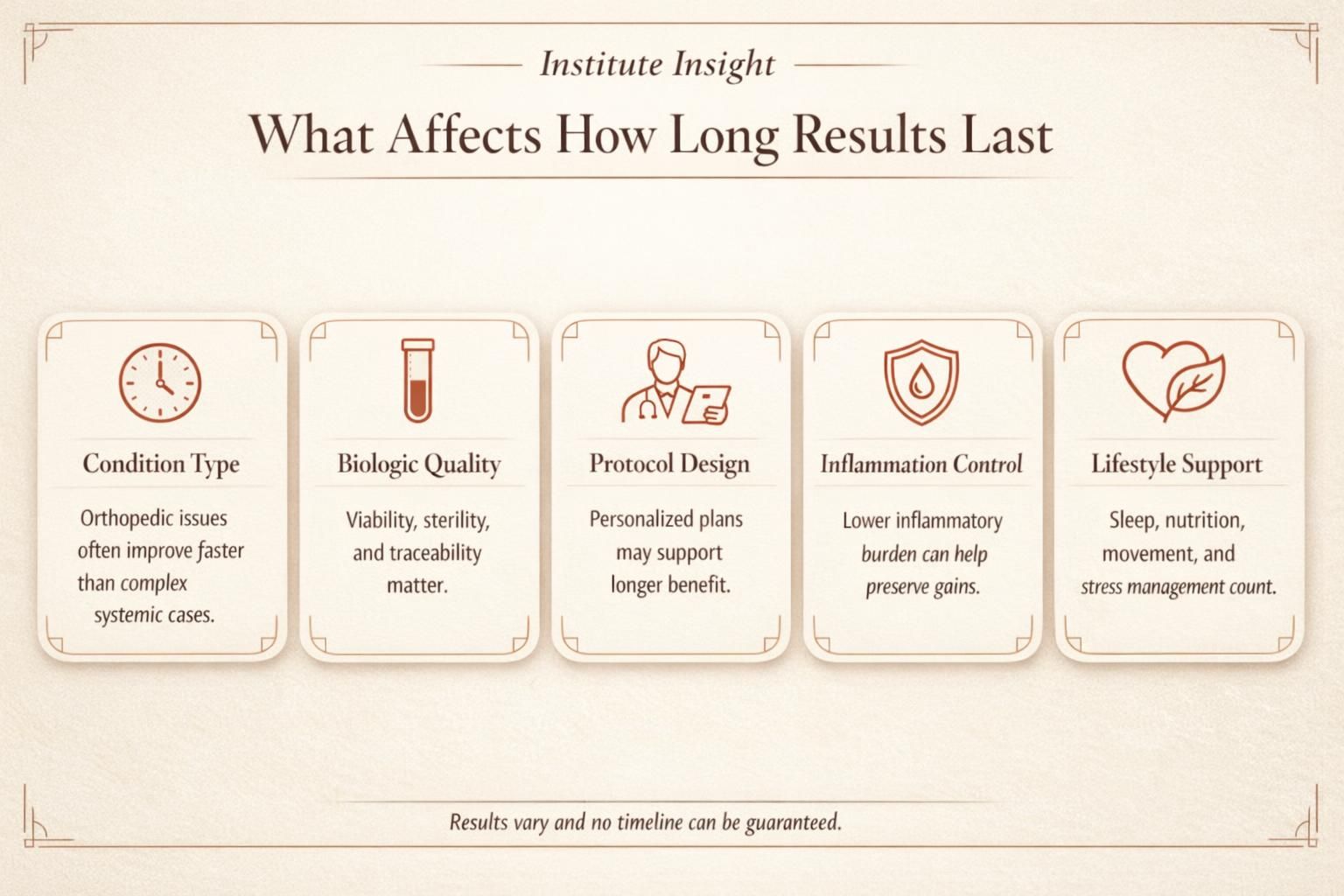
What Affects How Long Results Last
Duration is not just about the therapy. It is about the entire clinical picture surrounding the patient. Several factors meaningfully influence how long benefits may persist.
The Quality of the Biologic Product
Not all stem cell products perform equally. Cell viability, passage number, sterility, and preparation standards all affect how well the cells function after administration. Clinics that use rigorously processed, well-documented biologics tend to support better clinical outcomes.
At Cellular Institute, biologic products go through a quality-controlled process supported by our in-house lab ecosystem through Cellgenic. Patients can ask about viability documentation, sterility standards, and traceability. These details matter — and they often separate responsible providers from those offering unverified products.
You can learn more about our commitment to lab quality and transparency and why the science behind the therapy matters as much as the therapy itself.
The Protocol Design
A single injection rarely tells the whole story. Patients who receive stem cell therapy as part of a broader, physician-guided protocol — one that includes complementary therapies, anti-inflammatory support, recovery optimization, and follow-up care — often maintain results for longer.
Complementary modalities such as exosome therapy may help amplify cellular signaling and support the regenerative process. Recovery technologies including hyperbaric oxygen, red light therapy, and PEMF can help the body integrate treatment and reduce inflammatory burden during recovery.
Inflammation Control
Chronic systemic inflammation is one of the most common reasons regenerative results fade faster than expected. When the body remains in a high-inflammatory state, the environment that stem cells enter may work against the therapeutic process.
Addressing inflammation before and after treatment is a core part of how responsible regenerative protocols are designed. Some patients benefit from therapies such as EBOO — a blood filtration and ozone-based approach that may help reduce oxidative stress and systemic inflammatory burden — as part of their preparation or recovery plan.
Lifestyle Factors
Sleep quality, nutrition, physical activity, stress management, and metabolic health all influence how long regenerative benefits hold. Patients who use treatment as a catalyst for broader lifestyle changes tend to report more sustained results over time. Those who return to the same patterns that contributed to their condition often notice faster regression.
The physician team at Cellular Institute discusses lifestyle optimization as part of every personalized protocol. The goal is to make the most of the regenerative investment the patient is making.
Do Patients Ever Need Repeat Treatments?
Yes — and this is not a sign that the first treatment failed. Repeat treatments are a standard part of many regenerative medicine programs, particularly for conditions that involve ongoing degeneration, chronic inflammation, or systemic aging processes.
Some patients return for a maintenance protocol one to two years after their initial treatment. Others respond so well that they do not feel the need to return for several years. The right approach depends on the individual, their condition, and their goals.
Cellular Institute designs protocols with long-term patient health in mind, not just the immediate treatment window. Our team evaluates each patient’s response and helps them understand what continued optimization may look like for their specific case. Exploring the regenerative medicine services we offer in Cancún gives patients a clearer picture of the full scope of support available.
Who May Be a Good Candidate for Longer-Lasting Results
Patients who tend to respond well and maintain results over time often share certain characteristics. They enter treatment with a physician-evaluated protocol. They address underlying inflammation and lifestyle factors. They combine stem cell therapy with complementary modalities when appropriate. They follow through on post-treatment recommendations and stay in contact with their care team.
Candidates who work with certified stem cells from a traceable, quality-controlled source also tend to start with a stronger foundation than those who choose providers based on price alone.
Who May Not See Long-Lasting Results
Results are less predictable in patients with very advanced disease, severe systemic inflammation that has not been addressed, poor baseline health, or conditions that fall outside the current evidence base for regenerative medicine. Patients who receive low-quality biologics or protocols that are not personalized to their medical history may also see shorter or less meaningful results.
This is why candidate evaluation is not optional. It is the foundation of responsible regenerative care.
How Cellular Institute Approaches This
Cellular Institute does not treat stem cell therapy as a single event. The team — led by Dr. Rafael Moguel, Medical Director — evaluates each patient’s history, inflammatory profile, goals, and medical context before designing a protocol. The protocol may include stem cell therapy, exosome therapy, recovery technologies, peptide support, or other modalities based on what the patient actually needs.
Patients traveling for treatment also receive full coordination support, including pre-arrival guidance, treatment-day care, and structured follow-up. The goal is not just to deliver a therapy. It is to give the patient the best possible foundation for lasting benefit.
For patients exploring the broader medical travel experience, our guide to medical tourism in Mexico covers what to expect before, during, and after your visit.

Frequently Asked Questions
How long do stem cell therapy results typically last?
Most patients who respond well report benefits lasting from several months to several years. The exact duration depends on the condition, the quality of the protocol, the biologic product used, and the patient’s lifestyle and health habits after treatment. Results vary, and no clinic can guarantee a specific timeline for any individual.
Do I need to come back for a second treatment?
Some patients return for a maintenance or booster protocol after one to two years. Others do not feel the need for several years. Whether repeat treatment makes sense depends on how your body responded and what your long-term health goals are. Your physician will help you evaluate this over time.
Does lifestyle affect how long results last?
Yes, significantly. Sleep, nutrition, physical activity, stress management, and metabolic health all influence how well the body maintains the gains achieved through regenerative therapy. Patients who adopt healthier habits alongside treatment tend to report more sustained results.
Is stem cell therapy in Mexico a good option for patients from the U.S. or Canada?
Many international patients choose to receive regenerative medicine in Cancún because of the combination of advanced medical care, experienced physicians, and accessible costs compared to treatment in North America. Choosing the right clinic matters significantly. Learning how to choose a stem cell clinic in Mexico is an important first step before making any decisions.
Final Thoughts
How long stem cell therapy results last is one of the most practical questions a patient can ask — and it deserves a practical, honest answer. Duration depends on many factors: the condition, the biologic quality, the protocol design, inflammation management, and lifestyle support. Results are real for many appropriately selected patients. But they are not automatic, unlimited, or the same for everyone.
The best way to understand what results may look like for your specific situation is to speak with a physician who can evaluate your history and help design a protocol around your actual needs.
If you are ready to explore whether you may be a candidate, schedule a discovery call with the Cellular Institute team. We will help you understand your options, set realistic expectations, and determine whether a regenerative medicine protocol may support your goals.
Medical Disclaimer
This article is for educational purposes only and does not replace medical advice, diagnosis, or treatment. Regenerative therapies are not appropriate for every patient, and outcomes vary. A licensed physician must evaluate your medical history, goals, and candidacy before any treatment can be recommended.