
Written by: Cellular Institute Editorial Team
Medical reviewer: Dr. Matilde Rodríguez – CP 12651081
Laboratory reviewer: Biotecnóloga Diana Navarrete – CP 15029468
Quick Answer
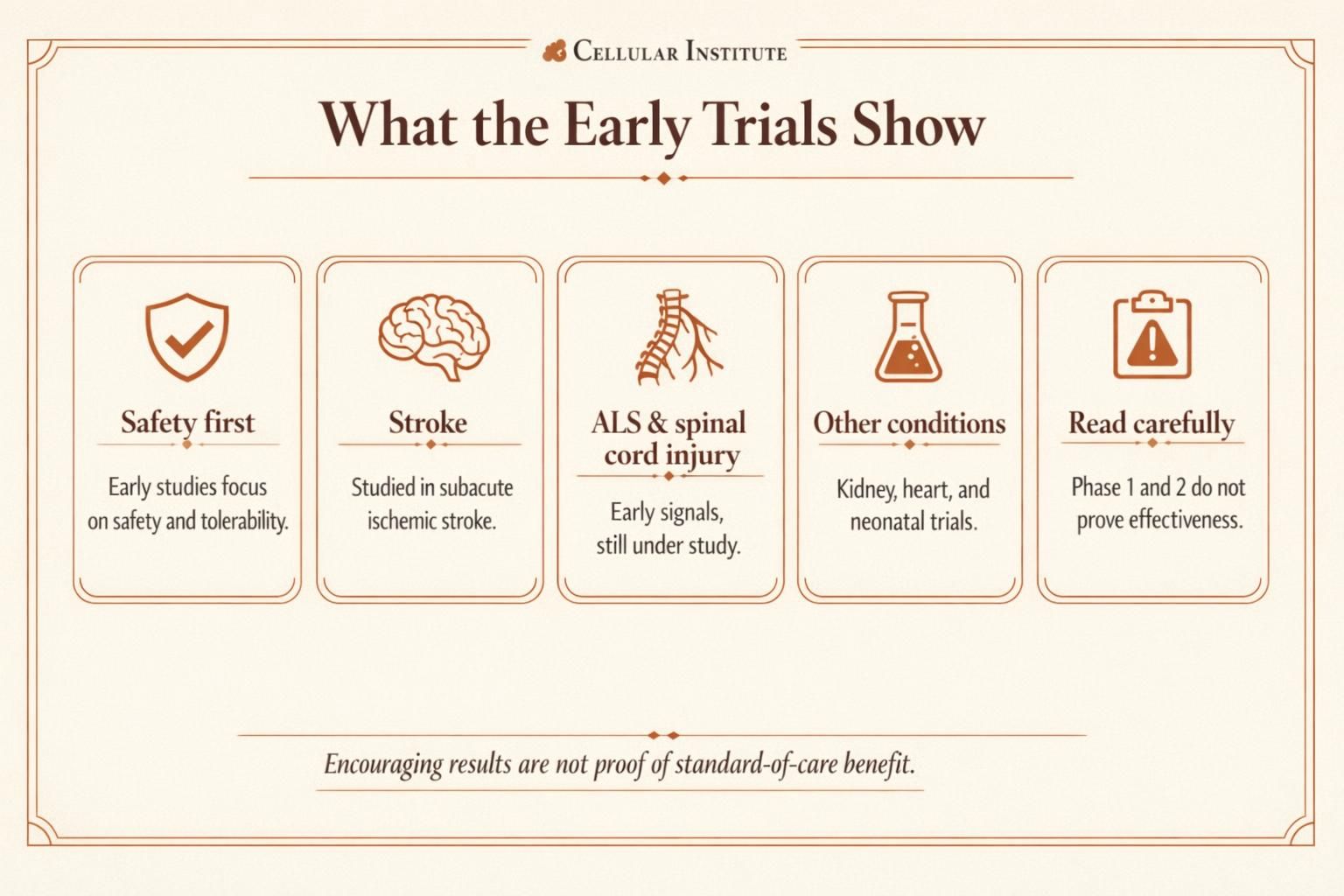
MUSE cell clinical trials have produced early encouraging findings across several conditions, including stroke, amyotrophic lateral sclerosis (ALS), and spinal cord injury. However, these trials remain in early phases. Most evidence comes from Phase 1 and Phase 2 studies. No large-scale, definitive clinical trials have established MUSE cells as a standard-of-care therapy. Physician evaluation is required before any regenerative protocol is considered appropriate for a given patient.
What Are MUSE Cells?
MUSE stands for Multilineage-differentiating Stress Enduring cells. Researchers first identified them as a naturally occurring subpopulation of mesenchymal stem cells (MSCs). Unlike standard MSCs, MUSE cells can differentiate into cells from all three germ layers. This means they may have broader repair potential.
MUSE cells also appear to have a strong stress-tolerance profile. They survive harsh environments more effectively than many other stem cell types. This characteristic has made them an interesting subject for regenerative medicine research, particularly in conditions involving tissue injury or ischemia.
Importantly, MUSE cells do not require gene manipulation or special induction to exhibit pluripotency-like behavior. Researchers collect them from bone marrow, adipose tissue, or skin fibroblasts using a stress-selection process.
What MUSE Cell Clinical Trials Have Studied
The most advanced MUSE cell research originates primarily from Japan, where the company Life Science Institute (a Mitsubishi Chemical Group subsidiary) has developed a MUSE cell product called CL2020. Several trials have explored its potential across distinct conditions.
Stroke
A Phase 2 clinical trial evaluated intravenous MUSE cell administration in patients with ischemic stroke. The trial enrolled patients in the subacute phase, roughly two to four weeks after stroke onset. Researchers observed that MUSE cell treatment appeared safe and well-tolerated. Some participants showed functional improvement at 12 weeks compared to placebo recipients, though the differences did not reach statistical significance in all endpoints. The results were published in peer-reviewed journals and contributed to Japan’s conditional regulatory approval of CL2020 for stroke in 2022.
Amyotrophic Lateral Sclerosis (ALS)
MUSE cells have also entered clinical investigation for ALS. Early-phase trials focused primarily on safety and tolerability. ALS is a progressive neurodegenerative condition with very limited treatment options. Researchers have been exploring whether MUSE cells may support motor neuron health and slow functional decline. Results so far suggest a reasonable safety profile, but clinical benefit requires further investigation in larger, controlled studies.
Spinal Cord Injury
Another area of active research involves spinal cord injury. A pilot clinical study examined MUSE cell administration in patients with subacute spinal cord injuries. Early data suggested potential safety and some signals of functional improvement. Researchers noted that MUSE cells may migrate to injury sites and contribute to local repair processes, though the underlying mechanisms and clinical significance require further study.
Other Conditions Under Investigation
MUSE cell trials have also explored applications in diabetes-related kidney disease, neonatal hypoxic-ischemic encephalopathy, and myocardial infarction. Each of these trials remains in early phases. The cumulative picture is that MUSE cells show a consistent safety profile across conditions and some early signals of biological activity, but definitive efficacy data is still emerging.
What Patients Should Understand About This Evidence
Reading clinical trial data requires context. Early-phase trials primarily test safety and tolerability, not definitive effectiveness. When a trial reports encouraging results, it does not mean a therapy is proven or ready for widespread clinical use. When a trial shows safety without clear efficacy, it means research is progressing responsibly.
Patients researching MUSE cell therapy should look for clinics that use this evidence appropriately. A responsible clinic will explain what trials have shown, acknowledge what remains uncertain, and frame the therapy within an evidence-informed but honest conversation about realistic expectations.
Be cautious of any provider that presents early-phase trial results as proof of guaranteed outcomes. That approach misrepresents the science. Responsible expectations are a core part of any credible regenerative medicine program.
If you are evaluating clinics that offer regenerative cell therapies, reading about how to choose a stem cell clinic in Mexico can help you ask the right questions and avoid common mistakes.
How Lab Quality Connects to Clinical Evidence
One of the most important lessons from clinical trial research is that product quality directly influences outcomes. In trials, researchers control viability, sterility, cell passage number, and product consistency. These standards exist because the quality of the biologic product affects what the body actually receives.
The same logic applies to regenerative medicine outside of trials. Clinics that maintain high standards for cell viability, sterility, traceability, and documentation are operating closer to the scientific rigor that trial research demands.
At Cellular Institute, lab quality and transparency form a core part of how biologics are prepared and reviewed. The clinic works within the Cellgenic ecosystem to maintain traceability, xeno-free processing standards, and quality documentation. This infrastructure matters because the quality of the biologic product is not separate from the clinical outcome. It is part of it.
Patients can also learn more about the standards behind certified stem cells and what quality documentation should look like when evaluating any clinic’s offerings.
Who May Be a Candidate for MUSE Cell or Related Regenerative Protocols
Candidacy for any regenerative protocol depends on multiple clinical factors. These include diagnosis, disease stage, inflammatory burden, current medications, overall health status, and treatment goals. Physicians must evaluate each patient individually.
MUSE cell research has focused primarily on neurological and cardiovascular conditions. Patients exploring regenerative support for these areas may find the emerging research relevant to their conversation with a physician. However, no patient should assume they are a candidate based on reading about a clinical trial.
A complete candidate evaluation should include a review of medical history, laboratory findings, and a detailed discussion of realistic expectations. Results vary by patient, and regenerative medicine is not appropriate for everyone.
Who May Not Be a Candidate
Patients with active malignancy, severe uncontrolled systemic illness, certain autoimmune conditions requiring immunosuppression, or contraindications identified during physician evaluation may not be appropriate candidates for regenerative protocols. This determination requires physician oversight, not self-assessment based on online research.
How Cellular Institute Approaches Regenerative Medicine
Cellular Institute does not position any single biologic product as a solution. Instead, the medical team designs personalized protocols that may incorporate multiple evidence-informed tools based on each patient’s clinical picture.
Under the direction of Dr. Rafael Moguel, Medical Director, the team evaluates each patient before recommending any protocol. The process includes clinical review, diagnostic evaluation, and a structured conversation about goals, timelines, and realistic outcomes.
Complementary approaches may include advanced regenerative tools, recovery support technologies, peptide therapy, or other modalities selected based on the patient’s specific needs. The goal is always a complete, physician-guided regenerative experience, not a single procedure.
International patients considering treatment in Cancún can explore the full scope of regenerative medicine in Cancún and understand what a structured, physician-led protocol actually involves.
Questions to Ask Before Choosing a Clinic
Patients researching MUSE cells or any regenerative therapy should feel empowered to ask direct questions of any clinic they consider.
- Does the clinic reference clinical trial data accurately, or does it overstate what the evidence shows?
- What is the source and quality standard of the biologic products used?
- Does the clinic provide traceability documentation, viability data, or certificates of analysis?
- Is a physician evaluation required before treatment is recommended?
- Does the clinic acknowledge which conditions have and have not been studied in trials?
- How does the clinic handle patient follow-up and outcome tracking?
Clinics that engage these questions with transparency are more likely to operate with the scientific seriousness that responsible regenerative medicine requires. You can also review what to watch for by reading about safe stem cell clinics in Mexico.

Frequently Asked Questions
Are MUSE cells the same as mesenchymal stem cells?
MUSE cells are a naturally occurring subpopulation found within mesenchymal stem cell populations. They share some characteristics with MSCs but differ in their stress tolerance and multilineage differentiation potential. Researchers isolate MUSE cells through a specific stress-selection process, which separates them from the broader MSC population.
Is MUSE cell therapy approved anywhere?
Japan conditionally approved CL2020, a MUSE cell product developed by Life Science Institute, for ischemic stroke in 2022. This conditional approval was based on Phase 2 trial data and requires ongoing post-market safety and efficacy studies. No equivalent regulatory approval exists in the United States, Canada, or Mexico as of the time of this writing. Patients should always ask clinics about the regulatory and evidence basis for any therapy offered.
How should patients interpret early-phase clinical trial results?
Early-phase trials primarily assess safety and tolerability. They are not designed to prove that a therapy works definitively. When researchers report encouraging signals in a Phase 1 or Phase 2 trial, it means the therapy appears safe and warrants further study. It does not mean the therapy is proven effective. Patients and clinics alike should communicate about this distinction honestly.
How do I know if a clinic is using MUSE cell research responsibly?
A credible clinic will describe the clinical trial landscape accurately, including what is known and what remains uncertain. It will not promise outcomes that trials have not established. It will require physician evaluation before recommending any protocol. And it will be transparent about biologic product sourcing, quality standards, and documentation. These are the same standards you should apply when reviewing any regenerative medicine provider.
Final Thoughts
MUSE cell therapy represents one of the more scientifically grounded areas of emerging stem cell research. The clinical trial landscape shows a consistent safety profile and early signals of biological activity across several conditions. The science is moving carefully and responsibly, as good regenerative medicine research should.
For patients and families navigating this landscape, the goal is not to find a clinic that promises the most. The goal is to find a clinic that understands the evidence, respects its limits, and builds a protocol around your specific clinical picture.
If you want to explore whether a physician-guided regenerative medicine protocol may be appropriate for your situation, the best next step is an honest medical conversation. Schedule a discovery call with the Cellular Institute team to start that conversation today.
You can also explore more patient education resources on the Cellular Institute blog to continue building your understanding before making any decisions.
Medical Disclaimer
This article is for educational purposes only and does not replace medical advice, diagnosis, or treatment. Regenerative therapies are not appropriate for every patient, and outcomes vary. A licensed physician must evaluate your medical history, goals, and candidacy before any treatment can be recommended.