

Written by: Cellular Institute Editorial Team
Medical reviewer: Dr. Matilde Rodríguez – CP 12651081
Laboratory reviewer: Biotecnóloga Diana Navarrete – CP 15029468
Quick Answer
Mesenchymal stem cells for lupus represent an emerging, evidence-informed approach that may help modulate an overactive immune system in patients with systemic lupus erythematosus (SLE). Early research and clinical observations suggest that mesenchymal stem cells (MSCs) may support immune balance, reduce inflammatory signaling, and improve certain markers of disease activity. This is not a cure, and results vary significantly between patients. Physician evaluation by a qualified specialist, such as Dr. Roni Moya, Immunologist at Cellular Institute, is required before any regenerative protocol can be considered appropriate for an individual patient.
What Patients With Lupus Are Looking For
Living with lupus can feel like an unpredictable battle. Flares arrive without warning. Immunosuppressant medications carry long-term side effects. And many patients reach a point where conventional therapy no longer provides adequate control.
For this reason, patients and caregivers increasingly research whether regenerative medicine may offer a complementary path forward. The interest in mesenchymal stem cells for lupus has grown as researchers publish findings on their immune-modulatory properties.
The questions patients ask most often include:
- Can stem cells calm my immune system without suppressing it entirely?
- Could this reduce how often I experience flares?
- Is this safe for someone already on immunosuppressant medications?
- Where can I find a physician-guided protocol that takes my full case into account?
How Mesenchymal Stem Cells May Support Immune Modulation
Mesenchymal stem cells are multipotent cells found in bone marrow, adipose tissue, umbilical cord tissue, and other sources. What makes them particularly relevant to lupus is not their ability to replace tissue. It is their known capacity to communicate with and regulate immune cells.
Research suggests that MSCs may:
- Reduce the activity of autoreactive T and B cells that mistakenly attack the body’s own tissues
- Promote regulatory T cell populations that help suppress excessive immune responses
- Decrease pro-inflammatory cytokines such as TNF-alpha and IL-6
- Support a shift away from a chronically inflamed immune environment
In lupus, the immune system loses the ability to distinguish between self and non-self. This leads to chronic inflammation and organ involvement. MSCs do not stop this process outright, but they may help reset certain immune signals over time.
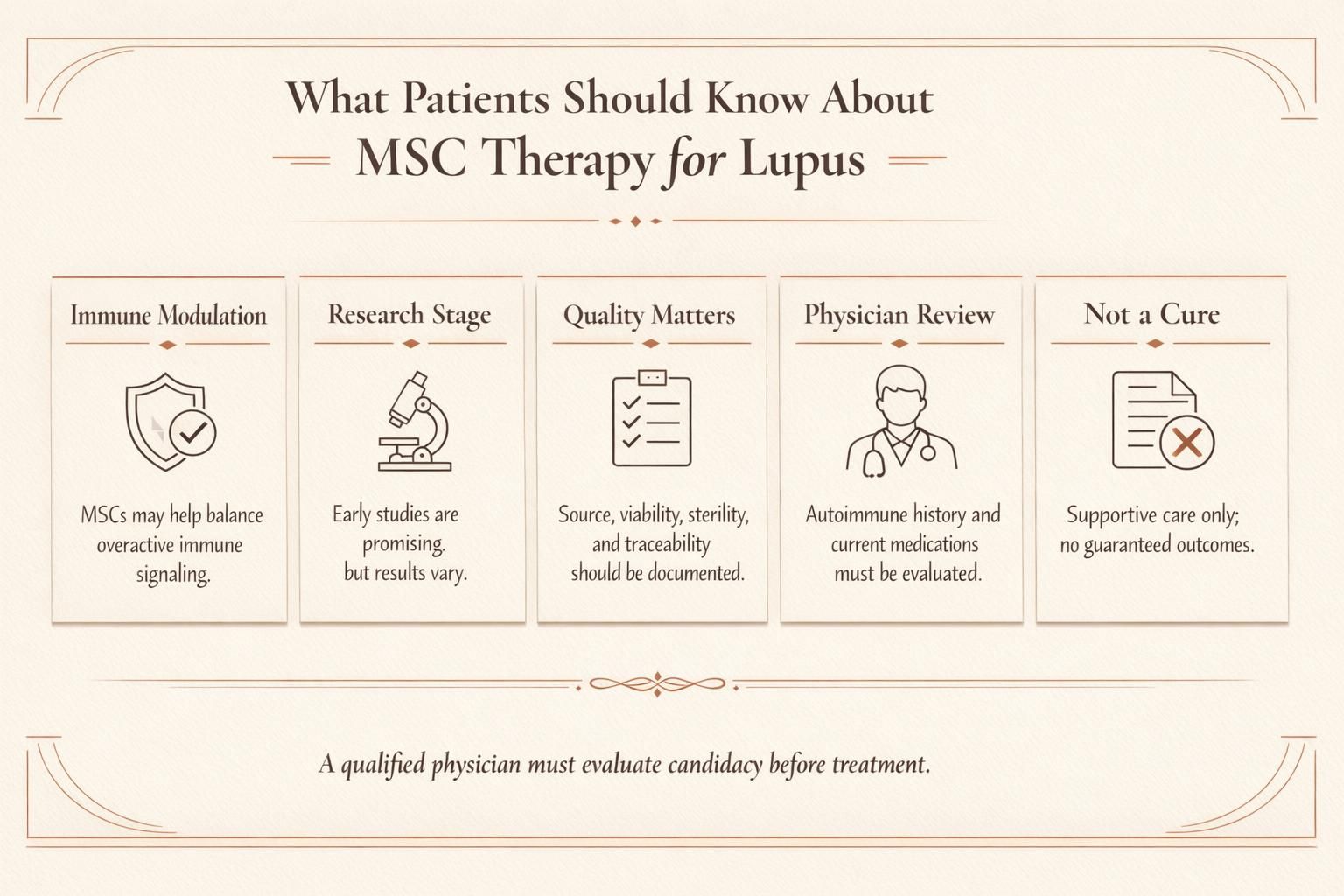
It is important to state clearly: this field is still evolving. Most studies are early-phase or observational. No regenerative therapy for lupus is considered a standard of care at this time. Responsible expectations and physician oversight are essential.
What Affects Quality and Safety in MSC Therapy
Not all mesenchymal stem cell products are equal. The source of the cells, how they are processed, and how they are administered all influence both safety and the potential for clinical benefit.
Key quality factors patients should ask about include:
- Cell source: Umbilical cord-derived MSCs are among the most studied for immune modulation. Sourcing should be documented and ethically validated.
- Viability and sterility: Cells must meet viability thresholds and pass sterility testing before clinical use.
- Processing standards: Xeno-free processing reduces contamination risk and is a marker of higher quality manufacturing.
- Traceability: Patients should be able to ask about where their biologic product came from and what documentation supports it.
- Physician oversight: A qualified physician should evaluate immune status, current medications, organ involvement, and overall candidacy before any protocol begins.
At Cellular Institute, certified stem cells go through a quality-controlled process supported by our affiliated lab ecosystem through Cellgenic. Biotechnologist Diana Navarrete and her team provide lab quality and transparency documentation that gives patients and physicians greater confidence in the biologic product before it is ever administered.
Who May Be a Candidate
Candidacy for mesenchymal stem cell therapy in the context of lupus depends on several clinical factors. A thorough medical evaluation is always the starting point.
Patients who may be appropriate candidates include those who:
- Have a confirmed diagnosis of SLE with documented disease activity
- Have experienced inadequate response to conventional immunosuppressant therapy
- Are in a relatively stable phase rather than an acute, severe flare
- Carry no active infections or uncontrolled comorbidities that would contraindicate the protocol
- Understand that this is an adjunctive, supportive approach and not a replacement for medical care
Who May Not Be a Candidate
Regenerative therapy is not appropriate for everyone. Patients with active severe infections, uncontrolled organ failure, certain malignancy histories, or other contraindications may not qualify. This is precisely why physician evaluation matters so much in this context.
The medical team at Cellular Institute reviews each patient’s case individually before making any recommendation. No protocol moves forward without a clear clinical rationale and an informed patient.
How Cellular Institute Approaches Lupus and Immune Support
Cellular Institute does not offer a one-size-fits-all stem cell injection. The medical team designs a personalized protocol around the patient’s immune profile, disease history, current medications, inflammatory burden, and overall health goals.
For patients exploring regenerative support for immune-related conditions like lupus, a protocol may include:
- MSC therapy: Physician-guided mesenchymal stem cell infusion using certified, quality-documented biologics
- Exosome therapy: Extracellular vesicles that may support cell signaling and reduce inflammatory communication
- EBOO therapy: Advanced blood filtration with ozone that may help reduce oxidative stress and systemic inflammatory load. Learn more about EBOO therapy and systemic inflammation.
- Recovery technologies: Hyperbaric oxygen, red light therapy, and PEMF to support tissue environment and recovery capacity
- Peptide therapy: Select peptides that may support immune function and recovery optimization
The goal is not to replace the patient’s rheumatologist or immunologist. The goal is to build a supportive regenerative layer around conventional care, guided by a physician who understands both the science and the individual patient.
Patients traveling internationally to explore regenerative medicine in Cancún receive structured coordination from arrival through follow-up. The patient journey at Cellular Institute includes bilingual support, concierge coordination, and a recovery-focused environment that takes medical tourism seriously.
Questions to Ask Before Choosing a Clinic
If you are evaluating regenerative medicine clinics for lupus support, the following questions will help you identify programs built on genuine medical standards:
- Does the clinic have a physician with immunology or autoimmune experience reviewing my case?
- What is the source and processing standard for the MSCs they use?
- Can they provide viability, sterility, and traceability documentation for the biologic product?
- Is the protocol personalized to my disease stage and current medications?
- Does the clinic coordinate with my existing medical team?
- What follow-up support do they provide after treatment?
For a broader guide on evaluating options, review our article on how to choose a stem cell clinic in Mexico.

Frequently Asked Questions
Can mesenchymal stem cells cure lupus?
No. Mesenchymal stem cell therapy does not cure lupus. Research suggests it may support immune modulation and reduce certain inflammatory signals, but it is not a replacement for established medical care. Patients should maintain their current treatment plan and work with their rheumatologist alongside any regenerative protocol.
Is MSC therapy safe for lupus patients on immunosuppressant medications?
This depends entirely on the individual patient’s case. A physician must review current medications, immune status, disease activity, and organ involvement before recommending any regenerative protocol. Some patients may be appropriate candidates, while others may not be at a given time. Safety is evaluated on a case-by-case basis.
How many treatments are typically involved in a regenerative protocol for lupus?
Protocol structure varies by patient. Some individuals start with a single treatment cycle and progress from there based on response and clinical assessment. The medical team at Cellular Institute designs each protocol around the patient’s individual profile rather than applying a fixed number of sessions to all cases.
What should I expect in terms of timeline and results?
Results vary significantly between patients. Some individuals report improved energy, reduced flare frequency, and better overall wellbeing within weeks to months. Others notice more gradual shifts. Learn more about how long stem cell therapy results may last and what factors influence outcomes over time.
Final Thoughts
Mesenchymal stem cells for lupus represent a genuinely promising area of regenerative research. For patients who have not responded well to standard therapies, or who are looking for a complementary approach to reduce their inflammatory burden, physician-guided MSC therapy may offer a meaningful path worth exploring.
At Cellular Institute, we approach this with the seriousness it deserves. That means rigorous candidate evaluation, quality-documented biologics through Cellgenic, personalized protocol design, and ongoing physician supervision. We do not promise outcomes. We design the best possible conditions for the body to respond.
If you are ready to understand whether this approach may be appropriate for your case, schedule a discovery call with our team. We will review your history, answer your questions, and help you determine whether a regenerative protocol in Cancún makes sense for where you are today.
Medical Disclaimer
This article is for educational purposes only and does not replace medical advice, diagnosis, or treatment. Regenerative therapies are not appropriate for every patient, and outcomes vary. A licensed physician must evaluate your medical history, goals, and candidacy before any treatment can be recommended.