
Written by: Cellular Institute Editorial Team
Medical reviewer: Dr. Matilde Rodríguez – CP 12651081
Laboratory reviewer: Biotecnóloga Diana Navarrete – CP 15029468
Quick Answer
Stem cell therapy for fibromyalgia is an emerging area of regenerative medicine research. Early evidence and clinical observations suggest that mesenchymal stem cells may help modulate inflammation, support nervous system regulation, and promote cellular repair in some patients. However, this is not a cure, and results vary significantly by individual. Physician evaluation is required to determine whether a patient may be an appropriate candidate for a regenerative protocol.
What Patients with Fibromyalgia Are Actually Asking
Living with fibromyalgia is exhausting in ways that go beyond pain. Widespread musculoskeletal discomfort, persistent fatigue, cognitive fog, and disrupted sleep can limit daily function for years. Many patients have already tried antidepressants, anticonvulsants, physical therapy, and various pain management strategies with limited or disappointing results.
It is no surprise that more patients are asking a simple but hopeful question: Is there something else?
Regenerative medicine, and specifically stem cell therapy, has entered that conversation. Patients want to know whether these therapies are real, whether they are safe, and whether they might offer something conventional medicine has not.
These are legitimate questions, and they deserve honest, medically responsible answers.
What Stem Cell Therapy May Support in Fibromyalgia
Fibromyalgia involves complex dysfunction across the central nervous system, immune regulation, and inflammatory signaling. Researchers believe the condition involves central sensitization, where the nervous system amplifies pain signals beyond normal thresholds. This makes it different from purely structural conditions like a torn ligament or arthritic joint.
Mesenchymal stem cells (MSCs), the type most commonly used in regenerative protocols, release signaling molecules that may influence inflammation, immune activity, and tissue repair. In fibromyalgia, the theoretical interest lies in their potential to help calm inflammatory burden, support nervous system modulation, and promote a more balanced cellular environment.
Some patients and clinicians report improvements in pain perception, sleep quality, energy, and cognitive clarity following regenerative protocols. However, large-scale clinical trials remain limited. The evidence base is growing, but it is not yet conclusive. Any responsible clinic will tell you that.
At Cellular Institute, our approach is grounded in evidence-informed medicine. We do not overstate what regenerative therapies can do. We help patients understand what the science currently supports, what their individual profile suggests, and what a personalized protocol may look like for their situation. Explore our regenerative medicine in Cancún service to learn more about how we structure these protocols.
Why Fibromyalgia Requires a Protocol, Not Just an Injection
Fibromyalgia is multisystem. It involves immune dysregulation, neurological sensitization, metabolic stress, and inflammatory burden. A single stem cell injection cannot address all of those dimensions on its own.
Responsible regenerative medicine treats fibromyalgia as a complex condition that requires a layered approach. At Cellular Institute, protocols may combine multiple complementary therapies depending on the patient’s evaluation, lab results, and health history.
For example, EBOO therapy in Cancún is an ozone-based blood filtration therapy that may help reduce systemic oxidative stress and inflammatory load, creating a better environment for cellular recovery. This type of support may enhance the body’s response to regenerative interventions.
Similarly, peptide therapy may support recovery, immune regulation, and neurological function as part of a broader protocol. Recovery technologies such as hyperbaric oxygen, red light therapy, and PEMF may further support the healing environment after treatment.
The goal is not to sell more procedures. The goal is to design a protocol that actually addresses what is happening in the patient’s body. That requires clinical thinking, not a package menu.
What Affects Quality and Safety in Stem Cell Therapy
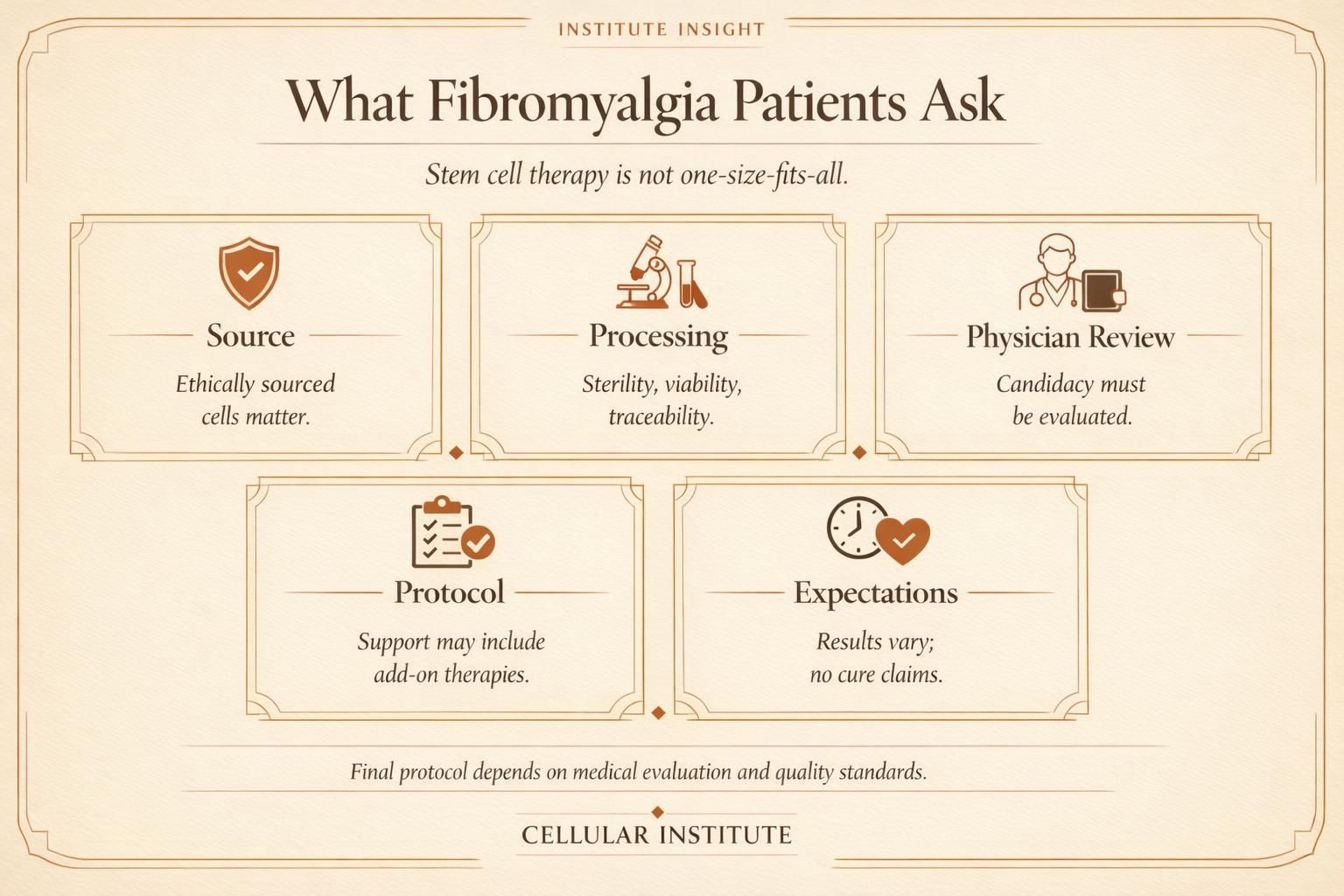
Not all stem cell therapy is the same. The quality of the biologic product matters enormously. Patients exploring this option should ask specific questions before committing to any clinic.
- Where do the cells come from? Ethically sourced mesenchymal stem cells from Wharton’s jelly or placental tissue are commonly used in allogeneic protocols. The source and handling process affect both safety and efficacy.
- How are the cells processed? Xeno-free processing standards, sterility testing, viability documentation, and traceability all matter. Ask for a certificate of analysis.
- Who is supervising the protocol? Physician-led evaluation is not optional. A clinician must assess your history, labs, and current health status before any therapy is recommended.
- What quality standards does the clinic follow? Clinics operating within a regulated structure, with documented protocols and safety oversight, offer a meaningfully different level of care.
At Cellular Institute, our biologic products come through our affiliated lab ecosystem, Cellgenic, which maintains strict quality control, traceability, and xeno-free processing standards. Our laboratory team, including Biotechnologist Diana Navarrete, reviews product documentation to ensure every preparation meets our quality standards before clinical use. You can learn more about our commitment to certified stem cells and what that means for patient safety.
If you are evaluating clinics abroad, we also recommend reading our guide on how to choose a stem cell clinic in Mexico before making any decisions.
Who May Be a Candidate
Regenerative medicine is not appropriate for every fibromyalgia patient. Candidacy depends on several factors that a physician must evaluate individually. Patients who may be considered for a regenerative protocol often share some of the following characteristics:
- They have received a confirmed fibromyalgia diagnosis from a licensed physician.
- They have tried conventional treatments without adequate relief.
- They do not have active cancer, serious uncontrolled infection, or other conditions that would contraindicate biologic therapies.
- They are committed to a full protocol that may include pre-treatment preparation and post-treatment recovery support.
- They hold realistic expectations about what regenerative medicine may support.
Who May Not Be a Candidate
Some patients are not suitable candidates for stem cell therapy at this time. These may include individuals with active malignancies, uncontrolled autoimmune flares, certain blood disorders, pregnancy, or conditions that require careful evaluation before any regenerative intervention. A physician must make this determination based on a full medical review.
At Cellular Institute, we do not approve every inquiry. Our medical team, led by Dr. Roni Moya, Immunologist, evaluates each patient’s immune health, inflammatory profile, and medical history to determine whether a regenerative protocol is appropriate and safe for that individual.
How Cellular Institute Approaches Fibromyalgia Patients
Cellular Institute does not offer a standardized fibromyalgia package. Every patient undergoes a clinical evaluation before any protocol is designed. The team reviews labs, health history, current medications, inflammatory markers, and the patient’s specific symptom pattern.
From there, the medical team builds a protocol that may include stem cell therapy, complementary biologics such as exosome therapy, recovery technologies, peptide support, or ozone-based blood therapies depending on what the evaluation suggests.
International patients traveling to Cancún receive coordinated support from the moment they book. This includes patient coordinator guidance, logistics support, clinic orientation, treatment-day care, and structured follow-up after returning home. To understand what the patient journey looks like, visit our guide on regenerative medicine in Cancún: 10 things to know before you go.

Frequently Asked Questions
Is stem cell therapy a cure for fibromyalgia?
No. Stem cell therapy is not a cure for fibromyalgia. It may support inflammation modulation, nervous system balance, and cellular repair in appropriately selected patients. Results vary significantly, and no regenerative clinic should promise a cure. The goal is to help the body function better, not to eliminate a condition permanently.
How long might it take to notice changes after a regenerative protocol?
Timelines vary by patient. Some individuals report gradual improvements in energy, sleep, and pain perception within weeks. Others may notice changes over several months as the body responds to the therapy. To understand realistic expectations, read our article on how long stem cell therapy results may last.
Is it safe to travel to Mexico for regenerative treatment?
Cancún is an established medical tourism destination with experienced clinics, international patient infrastructure, and regulated medical providers. Safety depends heavily on choosing the right clinic. Read more about stem cell therapy safety in Mexico to make a more informed decision.
How much does stem cell therapy cost in Mexico?
Pricing varies depending on the protocol, number of sessions, complementary therapies included, and the clinic’s quality standards. Cost should never be the only factor in your decision. Learn more about stem cell therapy cost in Mexico and what should be included in a quality protocol.
Final Thoughts
If you are living with fibromyalgia and conventional treatments have not given you the relief you need, regenerative medicine may be worth exploring with the right medical team. The science is still evolving, but the clinical interest is real and the approach is advancing.
What matters most is not simply accessing stem cell therapy. What matters is how the protocol is designed, how the biologic products are sourced and processed, how the medical team evaluates your candidacy, and how the full experience supports your recovery before, during, and after treatment.
If you want to understand whether you may be a candidate, we invite you to schedule a discovery call with our patient coordinator team. There is no pressure, no obligation, and no one-size-fits-all answer. Just an honest conversation about your situation and whether Cellular Institute may be the right fit for you.
Medical Disclaimer
This article is for educational purposes only and does not replace medical advice, diagnosis, or treatment. Regenerative therapies are not appropriate for every patient, and outcomes vary. A licensed physician must evaluate your medical history, goals, and candidacy before any treatment can be recommended.