
Written by: Cellular Institute Editorial Team
Medical reviewer: Dr. Matilde Rodríguez – CP 12651081
Laboratory reviewer: Biotecnóloga Diana Navarrete – CP 15029468
Quick Answer
Stem cell therapy and knee replacement surgery serve different patient profiles. Knee replacement is a well-established surgical option for advanced joint degeneration. Stem cell therapy is a non-surgical, regenerative approach that may support joint health, reduce inflammation, and improve mobility in appropriately selected candidates. Neither option is right for everyone. A physician evaluation is required to determine which path may be most appropriate for your specific condition, age, imaging findings, and health history.
Understanding the Two Options
Knee pain from osteoarthritis, cartilage damage, or chronic inflammation affects millions of people. When conservative treatments stop working, patients often face a crossroads: continue managing symptoms or pursue a more definitive intervention.
Knee replacement surgery replaces the damaged joint with a prosthetic implant. It has decades of clinical history and strong outcomes data for patients with severe, end-stage joint disease. However, it involves significant surgery, general or regional anesthesia, hospitalization, and a lengthy rehabilitation period.
Stem cell therapy takes a different approach. Instead of replacing the joint, regenerative protocols aim to support the body’s own repair mechanisms. Mesenchymal stem cells, often sourced from umbilical cord tissue, may help modulate inflammation and support tissue recovery in the affected area. The procedure is non-surgical and does not require hospitalization. Results vary by patient, and this approach does not apply to every case.
Comparing Key Factors Side by Side
Invasiveness and Procedure Type
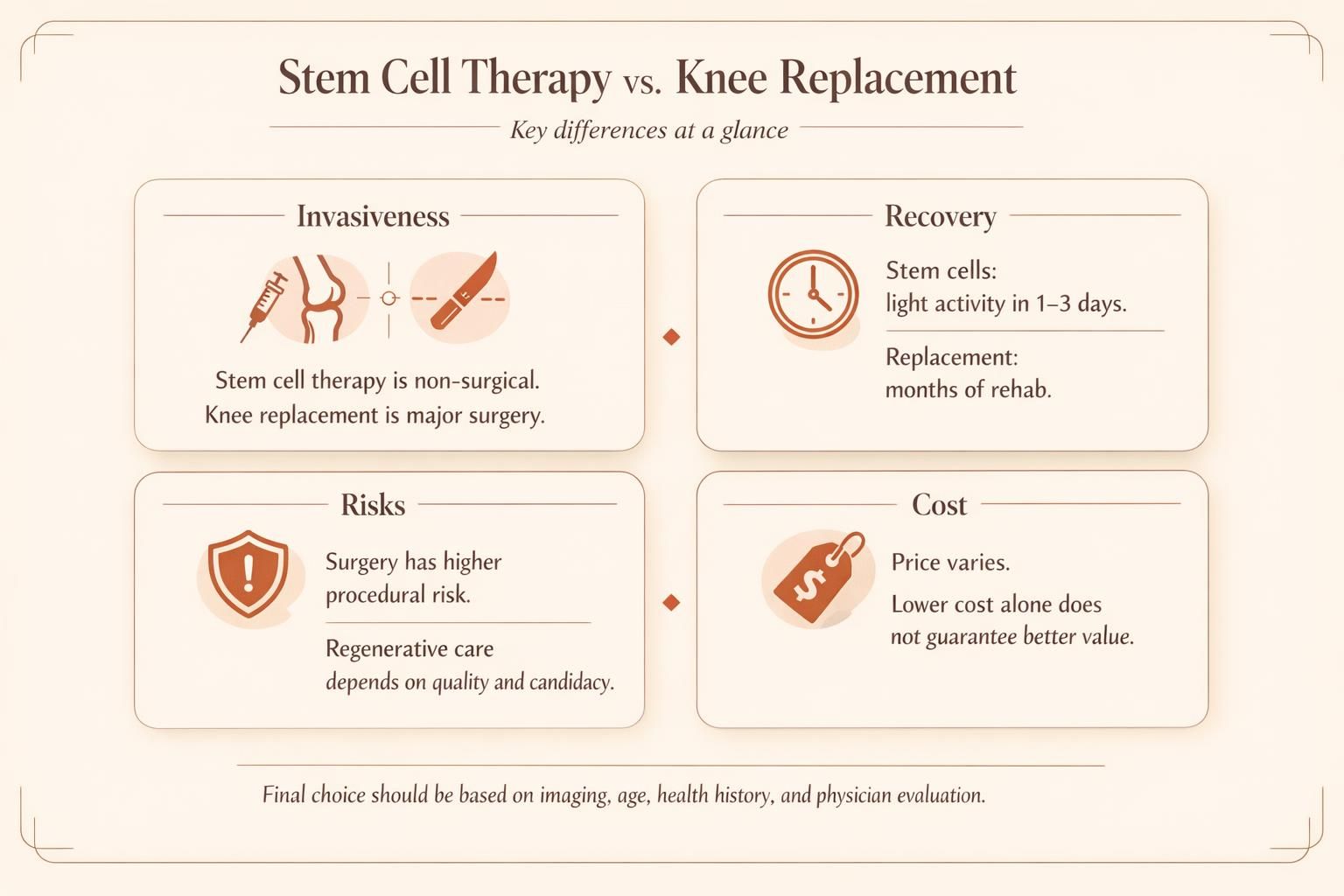
Knee replacement is a major orthopedic surgery. The surgeon removes damaged bone and cartilage and fits a metal and plastic implant. It typically requires a hospital stay of one to three days and carries the risks associated with any major procedure.
Stem cell therapy involves injections delivered directly into the joint or administered intravenously, depending on the protocol. It does not require incisions, general anesthesia, or hospitalization. Most patients tolerate the procedure well and return to daily activities within a short time.
Recovery Time
Recovery from total knee replacement typically takes three to six months for most functional milestones. Full recovery, including strength and range of motion, can take up to a year. Physical therapy begins within days of surgery and continues for several months.
Recovery after stem cell therapy is generally much shorter. Most patients resume light activity within one to three days. The regenerative process, however, continues over weeks and months as the body responds. Patients should maintain realistic expectations about the timeline for noticing changes.
Risks and Considerations
Knee replacement carries surgical risks including infection, blood clots, implant complications, nerve damage, and the possibility of revision surgery over time. Implants also have a functional lifespan, often estimated at fifteen to twenty years, which matters for younger patients.
Stem cell therapy carries fewer procedural risks, but it is not without considerations. The quality of the biologic product, the delivery method, the physician’s experience, and the patient’s overall health all affect both safety and outcomes. Not every patient responds the same way. Physician supervision and candidate evaluation are essential.
Cost Differences
Knee replacement in the United States typically costs between $30,000 and $50,000 or more, depending on the facility and insurance coverage. Even with insurance, out-of-pocket costs can be substantial.
Stem cell therapy at a quality clinic in Mexico generally costs significantly less. However, price alone should not drive the decision. The quality of the biologic product, the physician team, the protocol design, and the safety standards matter far more than finding the lowest number. Patients researching stem cell therapy cost in Mexico should ask what is included in the price and how the clinic documents biologic quality.
What Affects Quality and Safety in Stem Cell Therapy
Not all stem cell therapies are the same. The source of the cells, how they are processed, the viability at the time of administration, and whether a physician designs the protocol all influence what a patient may experience.
At Cellular Institute, biologic quality starts in the lab. Through the affiliated Cellgenic platform, the team supports traceability, sterility testing, cell viability documentation, and xeno-free processing standards. Certified stem cells backed by quality documentation are a meaningful differentiator in a field where transparency varies widely between providers.
Patients should always ask where the cells come from, how they are stored and prepared, and what documentation the clinic can provide. If a clinic cannot answer those questions clearly, that is a concern worth taking seriously.
Who May Be a Candidate for Stem Cell Therapy
Stem cell therapy may be a reasonable option to explore for patients who meet certain criteria. These include individuals with mild to moderate knee osteoarthritis, early cartilage wear, chronic joint inflammation that has not responded to conservative care, or those who wish to delay or avoid surgery due to age, health status, or personal preference.
Younger patients with active lifestyles and those who are not yet at the stage where replacement is clinically necessary may be particularly interested in regenerative options. The medical team evaluates each case individually to determine candidacy.
Dr. Wajid Burad, Orthopedist, brings focused expertise in regenerative orthopedics to Cellular Institute’s clinical team. His evaluation considers imaging findings, symptom history, functional goals, and overall health before any protocol is recommended.
Who May Not Be a Candidate
Stem cell therapy is not appropriate for everyone. Patients with severe, end-stage joint destruction, bone-on-bone degeneration with significant structural loss, or certain underlying health conditions may not respond well to regenerative approaches alone. In those cases, a surgical consultation may be the more appropriate path.
Honest candidate evaluation is a core part of how Cellular Institute operates. The goal is never to push a patient toward a therapy that does not match their clinical picture. If a patient is not a good candidate, the team will say so.
How Cellular Institute Approaches Joint Pain Protocols
Cellular Institute does not offer a single injection and call it a protocol. The medical team designs a personalized plan based on the patient’s condition, inflammation status, health history, and recovery goals.
Depending on the evaluation, a joint health protocol may include stem cell therapy, exosome therapy to support cell signaling and tissue recovery, and complementary modalities such as hyperbaric oxygen, red light therapy, or PEMF through the clinic’s recovery technologies platform. Some patients also benefit from peptide therapy as part of a broader recovery and optimization strategy.
This integrated approach reflects a foundational belief at Cellular Institute: the therapy is only one part of the strategy. The protocol around the therapy is just as important.
Patients traveling from the United States or Canada can explore what medical tourism in Mexico involves, including logistics, coordination, and what to expect before and after treatment.
Questions to Ask Before Choosing a Path
- What does my imaging show, and how severe is my joint damage?
- Has my physician reviewed me as a surgical and regenerative candidate?
- Where do the stem cells come from, and how is quality documented?
- Is the protocol personalized, or is it a standard package?
- What is the clinic’s safety framework and regulatory standing?
- What does recovery look like for each option given my age and health?
- What complementary therapies may support my results?
- What follow-up does the clinic provide after treatment?
For patients evaluating regenerative options, learning how to choose a stem cell clinic in Mexico is a practical starting point before making any commitment.

Frequently Asked Questions
Can stem cell therapy replace knee replacement surgery?
Stem cell therapy is not a replacement for knee replacement surgery in all cases. It may be a meaningful alternative for patients with mild to moderate joint degeneration who are not yet at the stage requiring surgery. In advanced cases with severe structural damage, surgical intervention may still be the most appropriate option. Physician evaluation is required to determine which path fits your specific condition.
How long might stem cell therapy results last for knee pain?
Results vary by patient and depend on the severity of the condition, the quality of the biologic product, the protocol used, and how well the patient supports recovery afterward. Some patients report improvements that persist for one to several years. To understand expectations more fully, explore what is known about how long stem cell therapy results may last.
Is stem cell therapy for the knee safe?
When performed by a qualified physician using properly sourced and processed biologics, stem cell therapy carries a low procedural risk profile compared to surgery. However, safety depends significantly on the clinic’s quality standards, biologic sourcing, and medical oversight. Patients should research stem cell therapy safety in Mexico before selecting a provider.
What is the cost difference between stem cell therapy and knee replacement?
Knee replacement in the United States often costs $30,000 to $50,000 or more, even with insurance. Stem cell therapy at a quality clinic in Mexico may cost significantly less, though pricing varies based on the protocol, biologic product, and included services. Price should never be the only consideration. Lab quality, physician oversight, and protocol design all affect value and outcomes.
Final Thoughts
Choosing between stem cell therapy and knee replacement is not a simple comparison. It depends on the severity of your joint damage, your age, your health status, your recovery goals, and the quality of the care available to you.
For patients who are not yet at the stage of surgical necessity, regenerative medicine may offer a meaningful, less invasive path worth exploring under physician guidance. For those with end-stage joint destruction, surgery may still be the most clinically appropriate choice.
At Cellular Institute, every patient begins with a thorough medical evaluation. The team designs protocols around the individual, not around a product or a price point. If you are weighing your options and want to understand whether a regenerative approach may be appropriate for your case, schedule a discovery call with our patient coordination team today.
Medical Disclaimer
This article is for educational purposes only and does not replace medical advice, diagnosis, or treatment. Regenerative therapies are not appropriate for every patient, and outcomes vary. A licensed physician must evaluate your medical history, goals, and candidacy before any treatment can be recommended.