

Written by: Cellular Institute Editorial Team
Medical reviewer: Dr. Matilde Rodríguez – CP 12651081
Laboratory reviewer: Biotecnóloga Diana Navarrete – CP 15029468
Quick Answer
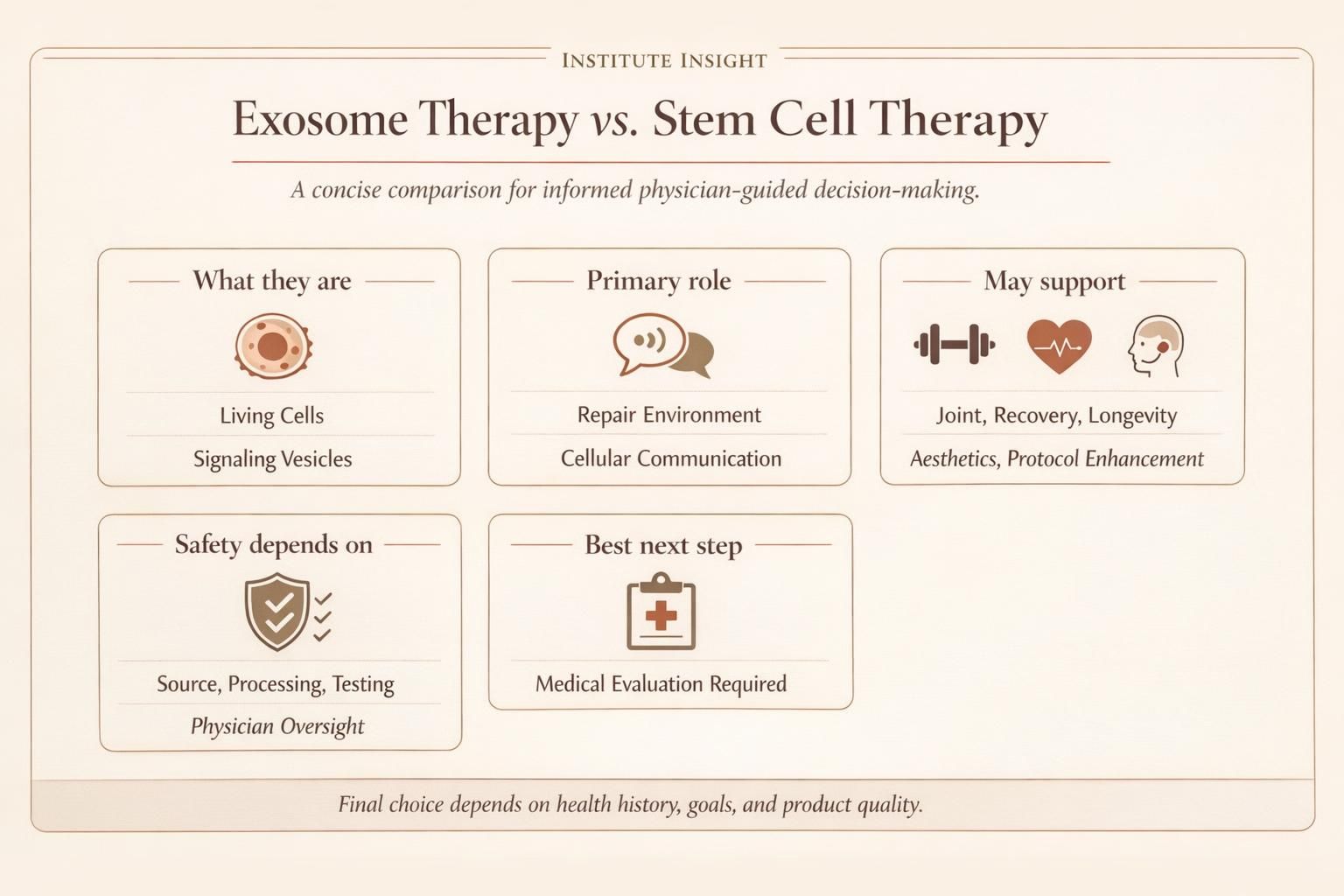
Exosome therapy and stem cell therapy are both advanced regenerative tools, but they work differently and may support different patient goals. Stem cells are living cells that can potentially differentiate and support tissue repair. Exosomes are signaling molecules derived from cells that help coordinate biological communication and may support the body’s own repair processes. Neither approach is appropriate for every patient. A physician must evaluate your health history, goals, and candidacy before recommending either option. In many cases, the most effective approach combines both therapies as part of a personalized protocol.
Understanding the Core Difference
Patients comparing exosome therapy vs stem cell therapy often assume one must be better than the other. The more accurate answer is that they serve different biological roles.
Stem cells are the foundational units of the body’s repair system. Mesenchymal stem cells, in particular, can interact with damaged or inflamed tissue, modulate immune responses, and support the environment needed for recovery. They may also secrete signaling factors that influence nearby cells.
Exosomes are extracellular vesicles, meaning tiny particles released by cells. They carry proteins, lipids, and genetic material such as RNA. Their primary role is cell-to-cell communication. When introduced therapeutically, exosomes may help signal the body to activate its own healing processes, reduce inflammation, and support cellular function.
Think of stem cells as the workers and exosomes as the messages those workers send. Both play important roles. The right choice depends on your specific situation.
What Conditions Each Approach May Support
Stem Cell Therapy May Be Considered For
- Joint and musculoskeletal conditions where tissue support is a priority
- Chronic inflammation with systemic involvement
- Autoimmune-related concerns requiring immune modulation
- Neurological support goals in appropriately evaluated candidates
- Longevity and cellular optimization protocols
Exosome Therapy May Be Considered For
- Recovery support following injury or intensive physical stress
- Skin rejuvenation and regenerative aesthetics
- Hair restoration protocols
- Systemic inflammation support
- Patients who may not be ideal candidates for cellular therapy but could benefit from signaling support
- Enhancing or amplifying an existing stem cell protocol
Exploring the types of stem cell treatments in Mexico can help patients understand the broader range of options available beyond a single modality.
How Safety Profiles Compare
Both therapies carry a favorable general safety profile when administered by qualified physicians using high-quality biologic products. However, not all products are equal, and the source and processing of these biologics matter significantly.
Stem cells sourced from human umbilical cord tissue are commonly used at physician-led clinics. These cells are typically harvested from consented donors, tested for sterility and viability, and processed under controlled conditions. The quality of the cell product directly affects both safety and potential outcomes.
Exosomes derived from mesenchymal stem cells also require rigorous manufacturing standards. Because exosomes are not living cells, some providers consider them to carry a lower risk of immune reaction. However, the quality of the source material, the concentration of the preparation, and the clinical context still determine whether administration is appropriate.
Patients researching stem cell therapy safety in Mexico should always ask clinics about product sourcing, quality documentation, and physician oversight before booking any treatment.
How Quality and Lab Standards Affect Your Results
The biologic product behind the therapy is as important as the therapy itself. A stem cell preparation with low viability, questionable sourcing, or insufficient safety testing carries real risks. The same is true for exosome products.
At Cellular Institute, biologic quality is managed through our affiliated lab ecosystem, Cellgenic. The process includes sourcing transparency, xeno-free manufacturing standards, sterility testing, viability documentation, and certificate of analysis review. Our laboratory team, including Biotechnologist Diana Navarrete, plays a direct role in reviewing product documentation before any biologic reaches clinical use.
Many clinics outsource their biologics with limited visibility into the origin, processing, or testing of those products. Patients should ask specific questions about lab quality and transparency before choosing any provider.
Cost Considerations
Exosome therapy generally costs less than stem cell therapy when compared as standalone options. This reflects differences in manufacturing complexity, cell volume, and clinical protocol design.
However, cost comparisons can be misleading. A lower price does not always indicate a simpler or safer treatment. It may reflect lower product quality, fewer cells, limited physician involvement, or the absence of supportive therapies that improve outcomes.
A complete regenerative medicine protocol may include stem cells, exosomes, recovery technologies such as hyperbaric oxygen therapy or PEMF, and complementary support through peptide therapy or EBOO. When comparing costs, patients should evaluate what is actually included in the program. Our detailed guide on stem cell therapy cost in Mexico covers what to expect and what factors drive pricing differences.
Who May Be a Candidate
Stem cell therapy candidates typically include patients with chronic joint conditions, systemic inflammation, immune-related concerns, or longevity goals who have completed a medical evaluation and do not have contraindications such as active malignancy or certain blood disorders.
Exosome therapy candidates may include patients seeking targeted signaling support, regenerative aesthetics, recovery optimization, or patients whose health profile makes cellular therapy less appropriate. Exosomes also work well as a complement to stem cell therapy in integrated protocols.
Candidacy for either therapy always requires physician evaluation. General health status, inflammatory burden, medication profile, treatment goals, and medical history all influence which approach makes sense.
Who May Not Be a Candidate
Neither therapy is appropriate for patients with active cancer or certain hematologic conditions. Patients with serious infections, uncontrolled autoimmune flares, or significant organ dysfunction may require stabilization before considering regenerative support. Physician evaluation is essential before proceeding.
How Cellular Institute Approaches This Decision
Cellular Institute does not offer a one-size-fits-all protocol. Our physician team evaluates each patient individually before recommending any combination of therapies.
Dr. Rafael Moguel, Medical Director, leads the clinical team with a background in cardiology and regenerative medicine. Evaluations consider the patient’s full medical history, inflammation status, goals, and recovery capacity. The protocol is then built around those findings, not around a fixed menu of services.
Many patients who visit Cellular Institute receive a protocol that combines exosome therapy and certified stem cells together, supported by recovery technologies, peptide therapy, or EBOO when clinically appropriate. This integrated approach reflects our belief that the protocol around the therapy is just as important as the therapy itself.
Patients considering medical tourism in Mexico for regenerative care should look for clinics that offer this kind of individualized, physician-guided structure.
Questions to Ask Before Choosing a Clinic
- Where do the stem cells or exosomes come from, and how are they processed?
- What quality documentation is available for the biologic product?
- Will a physician evaluate my candidacy before treatment?
- Is the protocol personalized based on my health history and goals?
- What complementary therapies are available to support my results?
- What follow-up support does the clinic provide after treatment?
- Does the clinic operate within a regulated medical framework?
Reading our guide on how to choose a stem cell clinic in Mexico gives patients a practical framework for evaluating providers before committing to travel or treatment.

Frequently Asked Questions
Can exosome therapy and stem cell therapy be used together?
Yes. Many physician-guided protocols combine both approaches. Stem cells may provide structural and immune-modulating support, while exosomes enhance cellular communication and may amplify the overall response. The decision to combine therapies depends on the patient’s medical evaluation and goals.
Is exosome therapy safer than stem cell therapy?
Both therapies carry favorable general safety profiles when administered by qualified physicians using high-quality biologic products. Exosomes are not living cells, which some clinicians consider a lower-risk profile for immune reaction. However, product quality, sourcing, concentration, and clinical context all affect safety for either therapy. Physician evaluation is essential for both.
How long does it take to notice results from either therapy?
Results vary significantly by patient, condition, protocol design, and individual biology. Some patients report changes within weeks. Others notice gradual improvements over several months. Regenerative medicine supports the body’s own biological processes, and those processes take time. Our resource on how long stem cell therapy results may last explores this topic in more detail.
Do I need to travel to Cancún for a full protocol, or can I receive a single session?
Cellular Institute designs personalized protocols rather than single-injection visits. For most patients, a complete regenerative experience includes evaluation, treatment, recovery support, and a follow-up plan. Patients traveling internationally benefit from this integrated model because it ensures the experience is medically coordinated from start to finish, not just a single procedure performed in isolation.
Final Thoughts
The question is not simply which therapy is better. The more useful question is which approach, or which combination, may be most appropriate for your specific situation, goals, and medical profile.
Exosome therapy and stem cell therapy both represent advanced regenerative tools when used correctly. The difference often comes down to the quality of the product, the depth of the medical evaluation, the structure of the protocol, and the experience of the team delivering care.
If you are ready to explore whether you may be a candidate, we invite you to schedule a discovery call with our patient coordination team. We will help you understand your options, ask the right questions, and determine whether a visit to Cellular Institute in Cancún may be the right next step.
Medical Disclaimer
This article is for educational purposes only and does not replace medical advice, diagnosis, or treatment. Regenerative therapies are not appropriate for every patient, and outcomes vary. A licensed physician must evaluate your medical history, goals, and candidacy before any treatment can be recommended.