
Written by: Cellular Institute Editorial Team
Medical reviewer: Dr. Matilde Rodríguez – CP 12651081
Laboratory reviewer: Biotecnóloga Diana Navarrete – CP 15029468
Quick Answer
Stem cell therapy results can vary significantly from patient to patient. For musculoskeletal conditions, many patients report meaningful improvement lasting one to three years or longer. For systemic and autoimmune-related conditions, results tend to emerge gradually and may require more than one treatment cycle. No outcome can be guaranteed. A physician must evaluate your medical history, condition severity, inflammation status, and overall health before any protocol can be recommended. The quality of the biologic product, the delivery method, and the support protocol all influence how long results may last.
What Patients Should Know Before Setting Expectations
One of the most common questions patients ask before pursuing regenerative medicine is simple: how long will this last? It is a fair and important question. The honest answer is that durability depends on several interacting variables, and responsible clinics will tell you that upfront.
Stem cell therapy does not work the same way for every person or every condition. It is not a single injection that produces a fixed result. The therapy works by supporting the body’s own repair and signaling processes. How the body responds, how well it sustains that response, and how long any benefit lasts will differ based on who the patient is and what they are treating.
Understanding this from the start helps patients set realistic expectations and make more informed decisions about whether regenerative medicine may be appropriate for their situation.
Realistic Timelines by Condition Type
Orthopedic and Joint Conditions
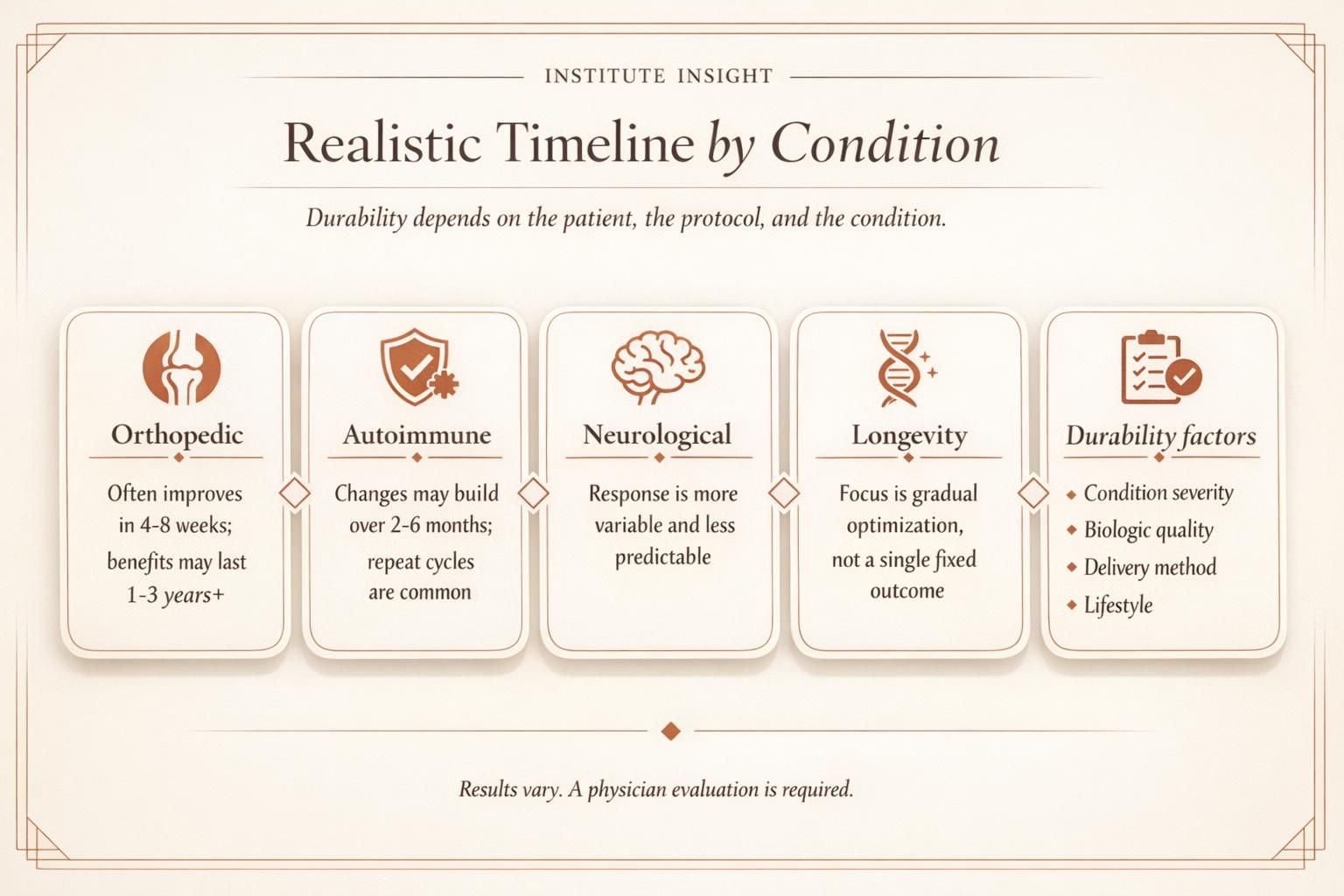
Joint conditions such as osteoarthritis, tendon injuries, and cartilage degeneration are among the most studied applications of regenerative medicine. Many patients in this category notice gradual improvement beginning within four to eight weeks. More significant functional changes often appear between three and six months as the regenerative process continues.
For appropriately selected candidates, improvements in pain, mobility, and joint function may last anywhere from one to three years. Some patients report sustained benefit beyond that window. Repeat treatments may help maintain results over time, particularly as the underlying degenerative process continues.
Patients working with our orthopedic team, including Dr. Wajid Burad, Orthopedist, receive condition-specific evaluations to help determine whether regenerative protocols may be a reasonable option for their joint health goals.
Autoimmune and Inflammatory Conditions
For patients managing autoimmune or chronic inflammatory conditions, the timeline tends to be longer and more gradual. Some patients notice changes in fatigue, inflammation levels, or symptom patterns within the first two to three months. Full benefit, when present, may take six months or more to develop.
Because these conditions involve complex immune dynamics, outcomes vary considerably. Repeat treatment cycles are more commonly part of the protocol. Inflammation burden at the time of treatment also plays a significant role in how well the body may respond.
Neurological and Systemic Conditions
Neurological applications remain an active area of research. Results in this category are more variable and generally less predictable than orthopedic outcomes. Some patients report subtle improvements in function, energy, or cognitive clarity. Others notice minimal change. Physician evaluation, honest expectation-setting, and a comprehensive protocol are especially important here.
Longevity and General Optimization
Patients pursuing regenerative medicine for longevity or general health optimization often focus on energy, recovery capacity, immune resilience, and systemic inflammation. In this context, the goal is not always a single measurable outcome but rather a gradual improvement in how the body functions over time. Many patients in this category incorporate regenerative therapy as part of an ongoing optimization protocol rather than a one-time treatment.
What Affects How Long Results May Last
The durability of stem cell therapy results is not determined by the therapy alone. Several factors influence how long any benefit may persist.
- Condition severity at the time of treatment: Earlier-stage conditions generally respond more favorably. Advanced degeneration or long-standing inflammation may limit the depth of response.
- Patient age and baseline health: Younger patients with good metabolic health and lower systemic inflammation tend to recover and respond more effectively.
- Biologic product quality: Cell viability, passage number, sterility, and sourcing all affect how well the therapy performs. Low-quality products may produce minimal or short-lived results regardless of protocol design.
- Delivery method: How and where the cells are administered matters. Local joint injections, intravenous delivery, and intrathecal routes each have different applications and response profiles.
- Lifestyle factors: Sleep, nutrition, physical activity, stress management, and avoidance of pro-inflammatory habits all influence how the body sustains any regenerative benefit.
- Complementary therapies: Protocols that include recovery support tools such as hyperbaric oxygen therapy, red light therapy, PEMF, and peptide therapy may help extend and reinforce the benefits of stem cell treatment.
At Cellular Institute, biologic quality begins in the lab. Through our affiliated biologics ecosystem, lab quality and transparency are foundational to every protocol. Cell viability, sterility, traceability, and xeno-free processing standards matter because what goes into the patient directly affects what the patient may experience.
Why the Protocol Around the Therapy Matters
Many patients ask about stem cell therapy as if it were a standalone procedure. In a well-designed regenerative medicine program, it rarely is. The therapy is one part of a larger strategy.
Reducing systemic inflammation before treatment, optimizing the recovery environment after treatment, and supporting the body’s long-term repair capacity all contribute to how well and how long results may hold. This is why Cellular Institute builds personalized protocols rather than delivering single-session injections.
Complementary modalities such as peptide therapy and recovery technologies like hyperbaric oxygen, PEMF, and red light therapy may support the regenerative process and help the body sustain its response over time. For patients with high inflammatory burden, preparing the biological environment before treatment can make a meaningful difference.
Does Stem Cell Therapy Require Repeat Treatments?
For some patients, a single treatment cycle produces lasting benefit. For others, periodic retreatment is part of a longer-term maintenance plan. The right approach depends on the condition, the initial response, and the patient’s health goals.
Patients managing progressive or chronic conditions often benefit from structured follow-up and periodic reassessment. A physician-guided approach ensures that any decision about retreatment reflects the patient’s current health status and not just a general schedule.
To understand how long stem cell therapy results may last for your specific situation, a formal medical evaluation is always the starting point.
How Cellular Institute Approaches This
Cellular Institute does not offer one-size-fits-all protocols. Every patient begins with a medical evaluation that considers their condition, history, labs, inflammation status, recovery capacity, and goals. The protocol is built around that picture.
The clinic’s connection to certified stem cells produced under quality-controlled, COFEPRIS-recognized standards means that the biologic product itself meets a higher bar. Viability, sterility, and traceability documentation support a more transparent clinical process.
Patients traveling from the United States and Canada can also explore what medical tourism in Mexico looks like through Cellular Institute’s fully coordinated international patient experience, which includes clinical evaluation, bilingual support, concierge coordination, and structured follow-up after treatment.

Frequently Asked Questions
How soon after stem cell therapy will I notice results?
Most patients do not notice immediate changes. Early signs of improvement often appear between four and eight weeks after treatment. For many conditions, the most meaningful changes develop between three and six months as the regenerative process continues. Results vary significantly by condition, patient health, and protocol design.
Can stem cell therapy results wear off over time?
Yes. Results are not always permanent. The body continues to age and face environmental stressors. For conditions like osteoarthritis, the underlying degenerative process does not stop. This is one reason why maintenance protocols and follow-up care are often part of a responsible long-term plan.
Does the quality of stem cells affect how long results last?
Yes, significantly. Cell viability, passage number, sourcing, and processing standards all influence biological activity. Low-viability or poorly processed cells are less likely to produce durable results. Asking a clinic about their product documentation, sourcing, and quality standards before treatment is a reasonable and important step.
What can I do to help my results last longer?
Lifestyle plays a meaningful role. Anti-inflammatory nutrition, consistent physical activity appropriate to your condition, quality sleep, stress management, and avoiding known inflammatory triggers may all help sustain regenerative benefits. Complementary therapies prescribed as part of your protocol may also support longer-lasting outcomes.
Final Thoughts
Stem cell therapy can offer meaningful support for the right patients. But how long results last depends on far more than the therapy itself. Product quality, protocol design, the patient’s baseline health, the condition being addressed, and ongoing lifestyle choices all shape the outcome.
Patients who approach regenerative medicine with realistic expectations, a physician-guided protocol, and a commitment to supporting their own recovery tend to report the most satisfying long-term experiences.
If you are seriously considering stem cell therapy and want to understand whether you may be a candidate, the right first step is a thorough medical evaluation. The team at Cellular Institute is here to help you understand your options clearly and honestly.
Schedule a discovery call with our patient coordination team to begin the evaluation process and learn what a personalized protocol may look like for your situation.
Medical Disclaimer
This article is for educational purposes only and does not replace medical advice, diagnosis, or treatment. Regenerative therapies are not appropriate for every patient, and outcomes vary. A licensed physician must evaluate your medical history, goals, and candidacy before any treatment can be recommended.