

Written by: Cellular Institute Editorial Team
Medical reviewer: Dr. Matilde Rodríguez – CP 12651081
Laboratory reviewer: Biotecnóloga Diana Navarrete – CP 15029468
Quick Answer
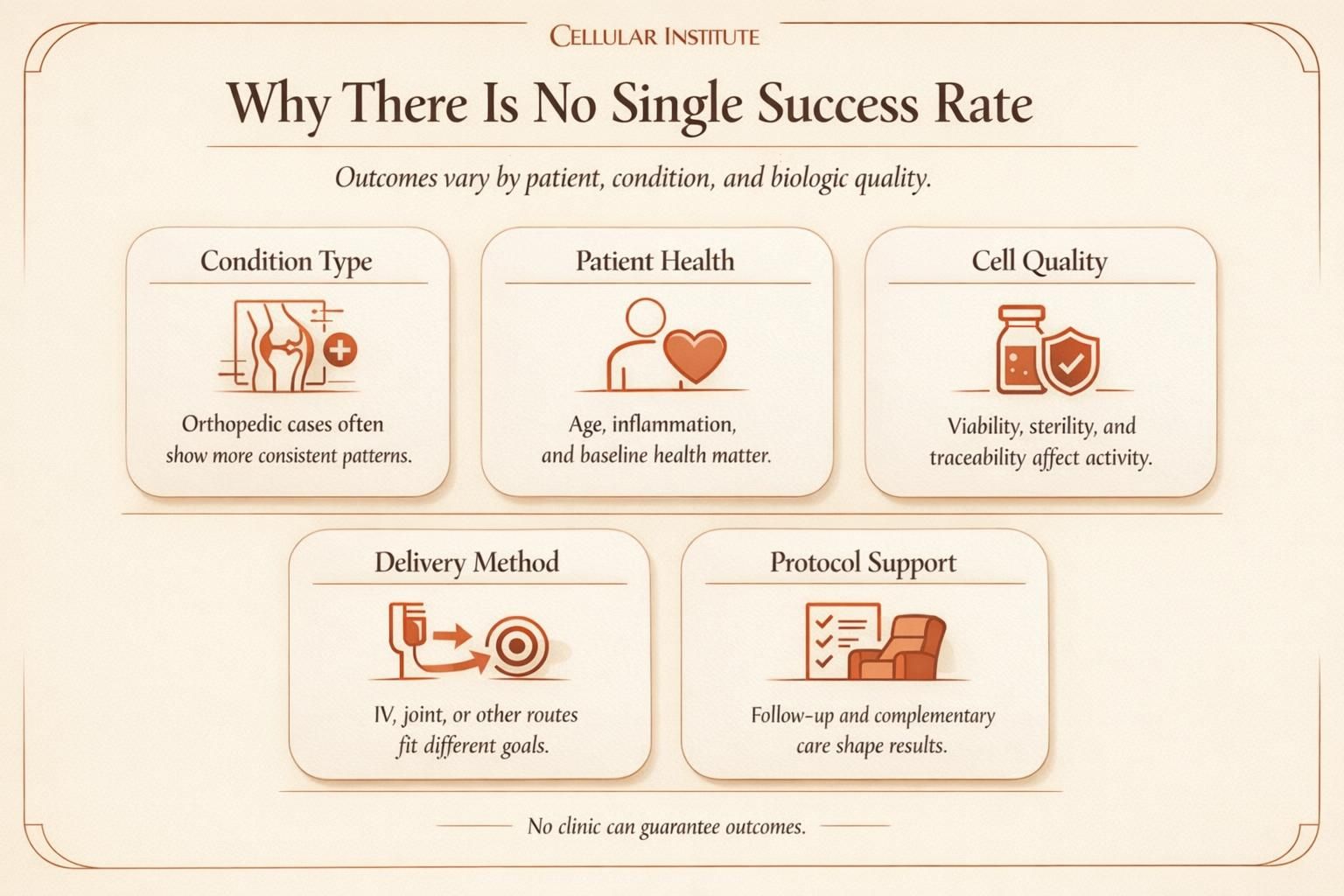
Stem cell therapy does not have a single, universal success rate. Outcomes depend heavily on the condition being addressed, the patient’s health status, the type and quality of cells used, the delivery method, and the clinical protocol surrounding the therapy. In appropriately selected candidates, regenerative medicine protocols may support measurable improvement in function, pain levels, inflammation, and quality of life. However, results vary by patient, and a physician must evaluate candidacy before any treatment recommendation can be made.
Why There Is No Single Success Rate
Many patients search for a clear number. They want to know whether stem cell therapy works 70% of the time or 90% of the time. That is a reasonable question. Unfortunately, the honest answer is more nuanced.
Stem cell therapy is not a single treatment. It describes a broad category of regenerative interventions that vary widely by cell type, source, dose, delivery method, target condition, and patient profile. Comparing success rates across these variables is like comparing the success rate of surgery across every type of surgical procedure.
What the available clinical evidence does suggest is that certain patient populations, treated under appropriate protocols with quality-verified biologics, may experience meaningful improvement. The key word is may. No responsible clinic can guarantee specific outcomes.
What Factors Influence Outcomes
Several variables affect how a patient responds to regenerative therapy. Understanding these factors helps patients set responsible expectations and ask the right questions.
Condition Type and Severity
Some conditions respond more consistently to regenerative protocols than others. Orthopedic and musculoskeletal conditions, such as joint inflammation, cartilage wear, and soft tissue injuries, tend to generate the most studied and documented patient outcomes. Inflammatory and immune-related conditions may also respond, though results vary more widely. Earlier-stage conditions generally offer more favorable outcomes than advanced or end-stage disease.
Patient Age and Baseline Health
Younger patients with stronger baseline health and lower systemic inflammation tend to respond more robustly. Older patients or those with significant comorbidities may still benefit, but outcomes may be more gradual or modest. A physician must assess the patient’s overall health before estimating likely response.
Cell Type and Quality
Not all stem cell products are equal. Cell viability, passage number, sourcing, processing method, and sterility all affect biological activity. A therapy using poorly documented, low-viability, or improperly handled cells is unlikely to perform the same way as a protocol built on certified stem cells with traceable quality documentation.
Delivery Method and Protocol Design
How cells reach the target tissue matters. Systemic IV delivery, direct joint injection, intrathecal delivery, and other methods each carry different mechanisms and appropriate applications. A well-designed protocol matches the delivery approach to the condition and the patient.
Complementary Therapies
Stem cell therapy rarely produces its best outcomes in isolation. Complementary tools such as hyperbaric oxygen therapy, red light therapy, PEMF, and peptide therapy may support the body’s regenerative environment before and after treatment. Protocols that combine multiple evidence-informed modalities often create better conditions for cellular activity.
What Realistic Improvement May Look Like
Patients should not expect overnight transformation. Regenerative medicine works with the body’s natural biology. Cellular activity takes time to produce observable changes.
In orthopedic cases, patients may notice reduced joint discomfort and improved mobility within four to twelve weeks. Full response often continues developing over three to six months. Some patients report sustained benefit well beyond that window. To learn more about timelines, read about how long stem cell therapy results may last.
For systemic or inflammatory conditions, improvement patterns tend to be more gradual and less linear. Patients may notice better energy, reduced inflammatory burden, or improved immune response over several months. Not every patient experiences the same trajectory.
What patients consistently report in well-documented cases is not a cure. They report meaningful functional improvement, better quality of life, and reduced reliance on symptom management. That is the appropriate frame for realistic expectations.
Why Cell Quality Is the Foundation of Any Success Rate
Discussing stem cell therapy success rates without addressing cell quality is incomplete. A therapy is only as effective as the biologic product behind it.
At Cellular Institute, the biologics used in regenerative protocols come from a controlled process supported by Cellgenic, the clinic’s in-house lab ecosystem. The team prioritizes lab quality and transparency, including viability testing, sterility confirmation, traceability documentation, and xeno-free processing standards. Patients receive more visibility into what they are receiving than most clinics provide.
This matters because a clinic offering lower prices may be sourcing biologics with limited documentation, unknown passage numbers, or reduced viability. Those variables directly affect biological activity and, ultimately, patient outcomes.
Who May Be a Candidate
Stem cell therapy may be appropriate for patients who meet certain clinical criteria. Candidates often include individuals with:
- Musculoskeletal or orthopedic conditions, including joint inflammation, cartilage degeneration, or sports injuries
- Chronic inflammatory burden or immune-related challenges
- Neurological support goals in appropriately selected cases
- General longevity and cellular optimization goals
- Recovery support needs following injury or significant health events
Candidate evaluation always requires a full medical review. A physician must assess your history, labs, imaging when applicable, inflammation markers, and overall health before recommending any protocol. Our regenerative medicine in Cancún programs begin with that evaluation.
Who May Not Be a Candidate
Not every patient qualifies for stem cell therapy. Candidacy evaluation exists for good reason. Patients with active malignancies, severe uncontrolled systemic conditions, certain coagulation disorders, or other specific contraindications may not be appropriate candidates. A physician must make that determination. Clinics that skip this step are a red flag.
How Cellular Institute Approaches Stem Cell Therapy
Cellular Institute does not approach regenerative medicine as a single injection. The medical team designs protocols around the full patient picture, not just the therapy name or dose.
Under the oversight of Dr. Rafael Moguel, Medical Director, each patient undergoes a clinical evaluation before any protocol recommendation. The team considers the patient’s condition, goals, inflammatory profile, medical history, and recovery environment. Complementary technologies such as recovery technologies including hyperbaric oxygen and PEMF may support the cellular environment before and after treatment.
The clinic operates within Mexico’s medical regulatory framework with a COFEPRIS-recognized structure, and its biologics come with quality documentation. This is a meaningful distinction from clinics that cannot or do not provide the same level of transparency.
For patients considering traveling internationally, the team also provides full concierge coordination as part of a complete medical tourism in Mexico experience.
Questions to Ask Before Choosing a Clinic
Before booking any stem cell therapy, patients should ask the following questions:
- What type of cells does the clinic use, and where do they come from?
- Can the clinic provide viability and sterility documentation for the biologic product?
- Does a licensed physician evaluate candidacy before recommending treatment?
- Is the protocol personalized, or does the clinic apply the same approach to every patient?
- What complementary therapies support the treatment, and are they included in the protocol?
- What follow-up does the clinic provide after treatment?
- Does the clinic operate within a recognized regulatory framework?
For more guidance, read our article on how to choose a stem cell clinic in Mexico.

Frequently Asked Questions
What percentage of patients see improvement from stem cell therapy?
No universal percentage applies across all conditions, cell types, and patient profiles. Published research on specific conditions, particularly orthopedic applications, reports patient-reported improvement in a meaningful portion of appropriately selected candidates. However, results vary based on condition severity, patient health, protocol design, and biologic quality. A physician evaluation helps estimate individual likelihood of response.
How long does it take to see results from stem cell therapy?
Most patients begin noticing changes within four to twelve weeks. Full response may continue developing over three to six months. Some patients report benefits that extend well beyond that window. Timeline depends on the condition, the protocol used, and how the body responds to regenerative support.
Does cell quality affect success rates?
Yes, significantly. Cell viability, sourcing, processing standards, and documentation all influence biological activity and patient response. Clinics that use certified, well-documented biologics with confirmed viability and sterility provide a stronger foundation for favorable outcomes than those that cannot demonstrate the same standards.
Is stem cell therapy in Mexico safe?
Safety depends heavily on the clinic, its regulatory structure, its medical team, and its quality standards. Clinics operating within Mexico’s regulatory framework with physician-led protocols and transparent biologic sourcing offer a substantially different safety profile than unregulated providers. Read more about stem cell therapy safety in Mexico to understand what questions to ask before choosing a provider.
Final Thoughts
The real success rate of stem cell therapy is not a fixed number. It is a reflection of many variables working together: the condition, the patient, the biologic product, the protocol, the medical team, and the recovery environment.
Patients who approach regenerative medicine with realistic expectations, physician guidance, and a quality-first mindset are better positioned for meaningful outcomes. Those who chase the lowest price or skip the evaluation process often face disappointment.
If you want to understand whether regenerative medicine may be appropriate for your situation, the best starting point is a real conversation with a qualified medical team. Schedule a discovery call with Cellular Institute to discuss your goals, your health history, and what a personalized protocol might look like for you.
Medical Disclaimer
This article is for educational purposes only and does not replace medical advice, diagnosis, or treatment. Regenerative therapies are not appropriate for every patient, and outcomes vary. A licensed physician must evaluate your medical history, goals, and candidacy before any treatment can be recommended.