

Written by: Cellular Institute Editorial Team
Medical reviewer: Dr. Matilde Rodríguez – CP 12651081
Laboratory reviewer: Biotecnóloga Diana Navarrete – CP 15029468
Quick Answer
Stem cell therapy for multiple sclerosis is an active area of clinical research. Some studies suggest that certain stem cell approaches may help modulate immune activity and support the nervous system in select patients. However, stem cell therapy does not cure MS, and results vary significantly between individuals. Physician evaluation is required to determine whether a patient is an appropriate candidate. Any protocol must account for the patient’s MS type, disease stage, current medications, and overall health status.
What Patients With MS Should Know
Multiple sclerosis is a complex autoimmune and neurological condition. The immune system mistakenly attacks the myelin sheath, the protective coating around nerve fibers. This damage disrupts communication between the brain and the rest of the body, leading to symptoms such as fatigue, weakness, vision problems, spasticity, and cognitive changes.
Many patients manage MS with disease-modifying therapies. These medications help reduce relapse frequency and slow progression in some cases. But they also carry long-term side effects and do not work equally well for everyone. This leads many patients to ask a reasonable question: could regenerative medicine offer additional support?
The honest answer is that stem cell therapy is not a replacement for conventional MS care. It may, however, serve as a complementary approach in appropriately selected patients. The goal in a regenerative medicine context is to support immune modulation, reduce systemic inflammation, and promote the body’s natural repair processes. These are not the same as reversing disease or replacing damaged nerve tissue.
Patients researching this topic should look for clinics that set responsible expectations, require a full medical evaluation, and design protocols with clinical reasoning rather than standardized packages.
How Stem Cell Therapy May Work in an MS Protocol
The most studied stem cell approach for MS involves mesenchymal stem cells, often called MSCs. These cells come from sources such as umbilical cord tissue and carry significant immunomodulatory properties. MSCs do not attack or replace the immune system. Instead, they may help recalibrate immune signaling, reduce inflammatory activity, and create conditions that support tissue repair.
Early clinical data and ongoing trials suggest that MSC-based therapy may help some patients experience reductions in relapse frequency, inflammation markers, or fatigue burden. The evidence is still emerging, and no regulatory body has approved stem cell therapy as a standard treatment for MS. Patients should approach this with informed optimism, not unrealistic expectations.
In a well-designed protocol, stem cell therapy rarely stands alone. A physician-guided approach at Cellular Institute may incorporate complementary tools alongside regenerative cell therapy. These could include exosome therapy to support cell signaling and anti-inflammatory pathways, blood detox therapies to reduce systemic inflammatory burden, and recovery technologies to promote nervous system resilience.
Our immunology team, led by Dr. Roni Moya, plays a central role in evaluating immune health, inflammation status, and autoimmune considerations before any regenerative protocol begins.
What Affects Quality and Safety in Stem Cell Therapy for MS
Not all stem cell products are equal. This is one of the most important things MS patients must understand before choosing a provider.
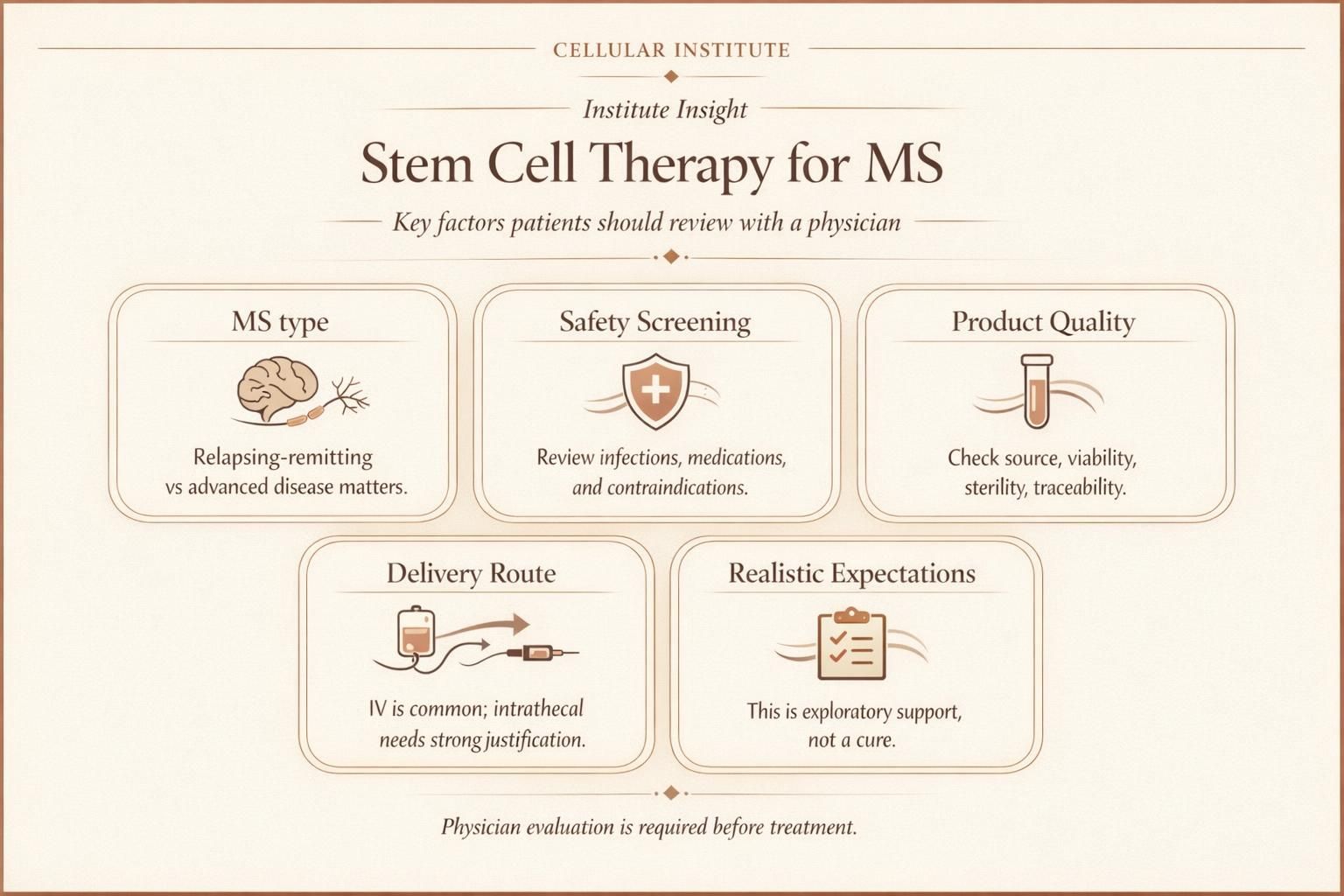
The quality of the biologic product matters enormously. Key factors include the source of the cells, how they are processed, whether xeno-free standards apply, cell viability at the time of administration, sterility testing, and product traceability. A clinic that cannot provide clear documentation on these points gives patients very little basis for trust.
Cellular Institute sources its stem cells through its affiliated lab ecosystem, Cellgenic. This relationship provides greater control over quality, traceability, and product documentation. Patients can learn more about our certified stem cells and the standards behind them. Our laboratory team, including biotechnologist Diana Navarrete, reviews each biologic product before it reaches the patient.
Delivery method also matters. Intravenous administration is the most common route for MS-related protocols because it allows systemic distribution. Intrathecal administration, which delivers cells closer to the spinal cord, is used in some clinical settings but requires additional medical justification and expertise.
Finally, safety requires a full medical evaluation before treatment. Patients with active infections, certain cancers, or contraindicated medications require careful screening. This is not optional. It is a medical requirement.
Who May Be a Candidate for Stem Cell Therapy With MS
Candidacy depends on many factors. Patients who may benefit most tend to share certain characteristics:
- Relapsing-remitting MS with active inflammation and documented progression
- Patients who have not responded adequately to conventional disease-modifying therapies
- Those with manageable overall health and no active systemic infections
- Patients who understand the exploratory nature of regenerative approaches and hold responsible expectations
- Those willing to commit to a full evaluation, preparation, and follow-up process
Who May Not Be a Candidate
Stem cell therapy is not appropriate for every MS patient. The following factors may affect eligibility:
- Primary progressive MS in advanced stages with significant disability
- Active systemic infections or recent major illness
- Certain immunosuppressive medications that may conflict with the protocol
- Conditions that significantly increase procedural risk
- Patients seeking a cure or guaranteed outcome
A thorough medical evaluation determines whether a patient is an appropriate candidate. The physician reviews the full clinical picture before any protocol is recommended.
How Cellular Institute Approaches MS and Regenerative Medicine
Cellular Institute does not offer a one-size-fits-all MS protocol. The medical team designs each program around the individual patient’s history, MS type, lab results, inflammation status, current medications, and personal goals.
Our regenerative cell therapy programs begin with a detailed medical evaluation. From there, the physician may recommend a combination of stem cell therapy, complementary biologics, recovery technologies, and supportive tools. Some patients may also benefit from advanced blood detox therapies designed to support systemic inflammation reduction as part of their overall protocol.
Cellular Institute operates within Mexico’s medical regulatory framework, with COFEPRIS-recognized licensing structures related to regenerative medicine and tissue handling. Patients traveling from the United States or Canada receive comprehensive coordination support, including bilingual patient assistance, medical preparation guidance, and structured follow-up after treatment.
For patients considering medical travel to Cancún, our team helps explain what to expect at every step. You can also explore our complete guide to medical tourism in Mexico for practical information about the process, costs, and logistics.
Questions to Ask Before Choosing a Clinic
Patients evaluating stem cell therapy for MS should ask every clinic they consider these core questions:
- Where do your stem cells come from, and how are they processed?
- Can you provide documentation on cell viability, sterility, and product traceability?
- Does a licensed physician evaluate each patient before recommending a protocol?
- Is the protocol personalized, or does every patient receive the same package?
- What complementary therapies are included to support the overall outcome?
- How do you handle follow-up after treatment?
- What are realistic expectations for someone with my MS type and stage?
Clinics that cannot answer these questions clearly deserve further scrutiny. You can also review our guide on how to choose a stem cell clinic in Mexico for a more complete checklist.

Frequently Asked Questions
Does stem cell therapy cure multiple sclerosis?
No. Stem cell therapy does not cure MS. The goal of a regenerative approach is to support immune modulation, reduce systemic inflammation, and help the body create conditions for better neurological function. Results vary significantly between patients. Responsible expectations and physician guidance are essential.
How long might results from stem cell therapy last in MS patients?
Duration of benefit varies widely. Some patients report sustained improvements in fatigue, mobility, or relapse frequency over many months. Others may require follow-up protocols. There are no guaranteed timelines. A physician-supervised follow-up plan helps support and monitor results over time.
Is stem cell therapy for MS safe?
When administered by a qualified physician using properly documented biologic products, the risk profile for MSC-based therapy is generally considered manageable. However, no medical procedure is without risk. A full medical evaluation, product quality standards, and appropriate clinical supervision all reduce risk. Patients should avoid any clinic that cannot demonstrate transparency in these areas.
Can I continue my MS medications while pursuing stem cell therapy?
This depends on the specific medications involved and the protocol design. Some immunosuppressive drugs may affect the therapy’s potential benefit. The physician reviews all current medications during the evaluation phase and provides individualized guidance. Patients should never stop medications without direct physician instruction.
Final Thoughts
Stem cell therapy for multiple sclerosis is a developing area of regenerative medicine. The current evidence suggests that certain approaches may offer meaningful support for some patients, particularly in modulating immune activity and reducing systemic inflammation. However, it is not a cure, and it is not appropriate for everyone.
What matters most is the quality of the evaluation, the integrity of the biologic product, the experience of the medical team, and the structure of the full protocol. A single injection at a low-quality clinic is not the same as a physician-guided regenerative program designed around your specific condition.
If you are living with MS and want to explore whether regenerative medicine may be appropriate for you, the first step is a clinical conversation. Our team at Cellular Institute is ready to help you understand your options and determine whether you are a candidate.
Book a Discovery Call to speak with our patient coordination team and begin the evaluation process.
Medical Disclaimer
This article is for educational purposes only and does not replace medical advice, diagnosis, or treatment. Regenerative therapies are not appropriate for every patient, and outcomes vary. A licensed physician must evaluate your medical history, goals, and candidacy before any treatment can be recommended.