
Written by: Cellular Institute Editorial Team
Medical reviewer: Dr. Matilde Rodríguez – CP 12651081
Laboratory reviewer: Biotecnóloga Diana Navarrete – CP 15029468
Quick Answer
Stem cell therapy for Parkinson’s disease is not a cure. It does not reverse neurological damage or stop disease progression in every patient. However, some patients in early to moderate stages report improvements in energy, reduced stiffness, or better quality of life following a physician-guided regenerative protocol. Results vary significantly by patient, disease stage, overall health, and the quality of the protocol itself. A thorough medical evaluation is always required before determining whether regenerative medicine may be appropriate for your situation.
What Parkinson’s Patients Should Know First
Parkinson’s disease involves the progressive loss of dopamine-producing neurons in the brain. This loss leads to the well-known symptoms: tremors, muscle rigidity, slowed movement, and balance problems. Current medications like levodopa can help manage symptoms, but they do not slow the underlying process.
It is natural to search for additional options when medications become less effective or side effects increase. Stem cell therapy has attracted significant attention as a potential supportive tool. However, patients deserve honest information about what the current science supports and what it does not.
Regenerative medicine for neurological conditions like Parkinson’s is still an evolving field. Early-phase clinical trials are ongoing globally, and researchers continue studying how stem cells may interact with the nervous system. At this stage, responsible clinics do not position stem cell therapy as a replacement for standard neurological care.
How Stem Cell Therapy May Support Parkinson’s Patients
Researchers believe mesenchymal stem cells may support the body through several mechanisms. They may help modulate neuroinflammation, which plays a role in Parkinson’s progression. They may also promote a cellular environment that supports neuroprotection and tissue communication.
Some patients report subjective improvements in fatigue, cognition, or daily functioning after treatment. These reports are promising, but they are not uniform. Not every patient responds the same way, and no clinic can predict individual outcomes with certainty.
At Cellular Institute, regenerative medicine in Cancún is approached as part of a broader, personalized protocol. Stem cell therapy is rarely used in isolation. The medical team designs each plan around the individual patient, combining multiple evidence-informed tools based on the patient’s history, inflammation status, disease stage, and goals.
What Affects Quality and Safety
Not all stem cell therapies are equal. The source of the cells, how they are processed, the viability at the time of administration, and the delivery method all influence what the patient may experience.
Patients should ask clinics specific questions about their biologics. Where do the cells come from? How are they processed? What quality documentation exists? Does the clinic provide certificates of analysis, viability data, and sterility testing?
Cellular Institute sources its biologics through Cellgenic, its affiliated in-house lab ecosystem. This relationship supports greater traceability, xeno-free processing standards, and clearer documentation from the lab to the patient. Patients can review certified stem cells documentation and understand the quality controls that apply to every protocol.
Biotechnologist Diana Navarrete leads laboratory quality review and supports the chain of documentation, viability verification, and sterility standards that underpin every treatment. This level of lab-to-clinic transparency is not standard at every regenerative medicine provider.
Who May Be a Candidate
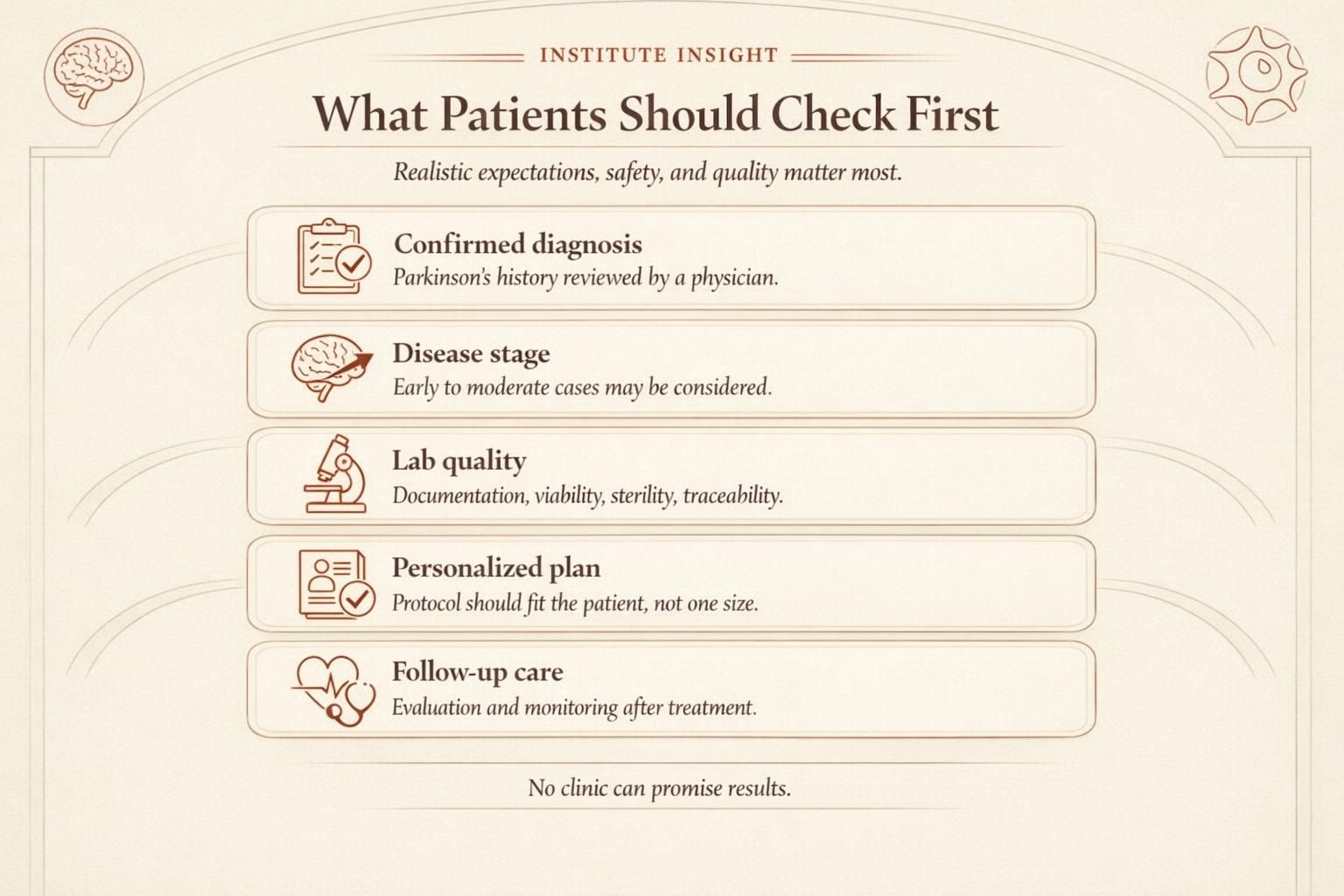
Patients in the early to moderate stages of Parkinson’s disease tend to generate the most discussion as potential candidates for regenerative support. Physicians generally look for patients who:
- Have a confirmed Parkinson’s diagnosis with documented history
- Are experiencing reduced medication effectiveness or quality-of-life decline
- Do not have active infections, uncontrolled systemic disease, or certain cancers
- Are able to travel safely and participate in a multi-day protocol
- Hold realistic expectations and understand the current state of the science
Every candidate undergoes a thorough medical evaluation before any protocol begins. The team reviews labs, history, current medications, and overall health status before making any recommendations.
Who May Not Be a Candidate
Regenerative medicine is not appropriate for every patient. Physicians at Cellular Institute evaluate each case individually and may determine that stem cell therapy is not the right fit. Patients in advanced stages of Parkinson’s, those with significant comorbidities, or those who hold unrealistic expectations about outcomes may not be suitable candidates at this time.
Responsible clinics will tell patients honestly when they do not qualify. If a clinic promises results regardless of your condition or history, that is a significant red flag. Learn more about how to choose a stem cell clinic in Mexico and what standards to evaluate before booking.
How Cellular Institute Approaches This
Cellular Institute does not offer a single injection and send patients home. The team builds a complete protocol around the patient. For neurological support cases, this may include stem cell therapy combined with complementary tools such as exosome therapy, which supports cell signaling and anti-inflammatory communication, or recovery technologies like hyperbaric oxygen therapy and PEMF, which may support tissue oxygenation and cellular repair.
The medical team, led by Dr. Rafael Moguel, Medical Director, oversees clinical evaluation and protocol design. Physician oversight is not optional at Cellular Institute. It is the foundation of every patient experience.
Patients traveling from the United States and Canada also receive comprehensive support. Cellular Institute coordinates patient logistics, bilingual communication, medical documentation, and structured follow-up after treatment. The experience is designed to feel guided and medically responsible from the first consultation through post-treatment care.
If you want to understand how long stem cell therapy results may last and what realistic timelines look like, our educational resources cover these questions in detail.
Questions to Ask Before Choosing a Clinic
Whether you are evaluating Cellular Institute or any other provider, the following questions help you make a more informed decision:
- Where do the stem cells come from, and what documentation supports their quality?
- Does the clinic perform a medical evaluation before accepting patients?
- Is the protocol personalized, or does everyone receive the same treatment?
- What complementary therapies are included, and why?
- Does the clinic provide follow-up care after treatment?
- Is there physician oversight throughout the entire process?
- Does the clinic operate within a recognized regulatory framework?
These are not difficult questions. A responsible clinic should answer them clearly and without pressure.

Frequently Asked Questions
Can stem cell therapy stop Parkinson’s disease from progressing?
Current evidence does not support the claim that stem cell therapy stops Parkinson’s progression. Research is ongoing, and some studies suggest stem cells may support neuroprotection and inflammation modulation. However, no regenerative therapy currently offers a confirmed disease-modifying effect in Parkinson’s patients. Responsible clinics present this honestly and build protocols around realistic goals.
Is stem cell therapy for Parkinson’s safe?
When administered by a qualified physician using high-quality, properly processed biologics, stem cell therapy carries a manageable risk profile for appropriate candidates. Safety depends on the quality of the cells, the delivery method, the clinic’s medical oversight, and the patient’s individual health status. Learn more about stem cell therapy safety in Mexico and what standards matter most.
How many sessions might a Parkinson’s patient need?
Protocol design varies by patient. Some patients receive a single treatment session followed by evaluation and follow-up. Others may benefit from a series of sessions spaced over time. The physician determines the appropriate approach based on disease stage, overall health, and treatment response. There is no universal answer.
What does treatment in Cancún involve for an international patient?
Patients traveling to Cellular Institute in Cancún receive support throughout their journey. This includes pre-arrival coordination, bilingual medical consultations, a structured treatment protocol, recovery support, and post-treatment follow-up. Cancún is a well-connected international destination with direct flights from most major U.S. and Canadian cities. Read our complete guide to medical tourism in Mexico for more detail on what to expect.
Final Thoughts
Parkinson’s patients and their families deserve honest answers, not false hope. Stem cell therapy may offer meaningful supportive benefits for carefully selected candidates as part of a physician-guided, personalized protocol. It is not a cure. It does not work equally for everyone. And the quality of the therapy matters enormously.
At Cellular Institute, the goal is to design a complete regenerative experience around the patient. That means starting with a thorough evaluation, building a protocol that fits the individual, using high-quality certified biologics, and providing guided support before, during, and after treatment.
If you or a loved one is living with Parkinson’s disease and wondering whether regenerative medicine may be appropriate, the first step is a conversation with our team. Schedule a discovery call to speak with a patient coordinator, ask your questions, and find out whether you may be a candidate for a personalized protocol.
Medical Disclaimer
This article is for educational purposes only and does not replace medical advice, diagnosis, or treatment. Regenerative therapies are not appropriate for every patient, and outcomes vary. A licensed physician must evaluate your medical history, goals, and candidacy before any treatment can be recommended.