
Written by: Cellular Institute Editorial Team
Medical reviewer: Dr. Matilde Rodríguez – CP 12651081
Laboratory reviewer: Biotecnóloga Diana Navarrete – CP 15029468
Quick Answer
Both stem cell therapy and PRP fall under the category of regenerative medicine, and both may support joint health, tissue repair, and inflammation modulation in appropriately selected patients. However, they work differently, carry different complexity levels, and may be better suited to different conditions and stages of tissue damage. A physician must evaluate your medical history, imaging, and goals before recommending either approach. Results vary by patient, and neither therapy is appropriate for everyone.
What Patients Should Know
If you are living with joint pain, a sports injury, or an orthopedic condition, you may have heard about both stem cell therapy and platelet-rich plasma therapy. Many patients arrive at a decision point where they are unsure which option makes more sense for their situation. The comparison is not always straightforward.
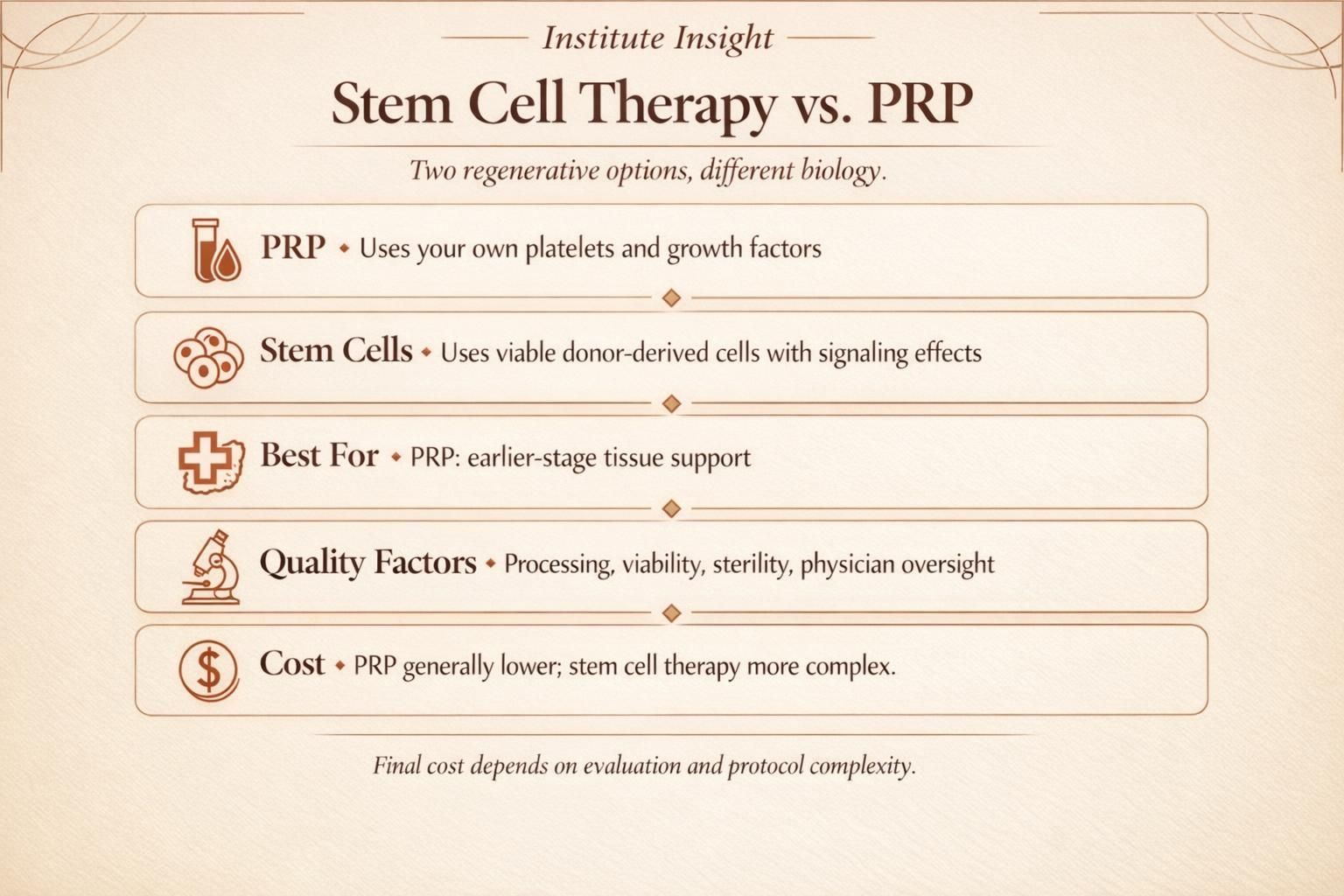
PRP, or platelet-rich plasma, involves drawing a small amount of your own blood, processing it to concentrate the platelets and growth factors, and injecting that concentrate into the affected area. The goal is to deliver a higher concentration of your body’s natural healing signals directly to the tissue that needs support.
Stem cell therapy, by contrast, introduces living cells, typically mesenchymal stem cells derived from umbilical cord tissue or other donor sources, into the body. These cells may support tissue repair through cell signaling, anti-inflammatory activity, and communication with surrounding cells. The mechanism is more complex and the biologic product requires higher quality standards to be clinically meaningful.
Understanding the difference between these two therapies helps patients ask better questions, set appropriate expectations, and choose a provider who takes quality and medical evaluation seriously. You can explore the full range of options through our regenerative medicine services in Cancún.
How Each Therapy May Work in a Regenerative Protocol
PRP: Amplifying Your Body’s Own Signals
PRP therapy uses your own blood, so it carries a low risk of rejection or immune reaction. The platelet concentrate contains growth factors such as PDGF, TGF-beta, and VEGF, which may stimulate tissue repair at the injection site. PRP has been studied most extensively for conditions like tendinopathy, mild-to-moderate osteoarthritis, and soft tissue injuries.
The procedure typically takes about an hour from blood draw to injection. Recovery time is relatively short. Most patients return to light activity within a few days. Multiple sessions may be needed to achieve the best possible response, and results can take several weeks to become noticeable.
PRP is generally considered a lower-complexity intervention. It works within the existing environment of the joint or tissue. Its effectiveness depends largely on the quality of your own platelet concentration, the processing method used by the clinic, and whether the tissue environment can respond to growth factor stimulation.
Stem Cell Therapy: A More Complex Regenerative Approach
Stem cell therapy introduces a biologic product from an external source. Most regenerative medicine clinics today use mesenchymal stem cells derived from Wharton’s jelly, the tissue found in umbilical cords donated after healthy births. These cells are not embryonic, and they do not require a procedure to harvest from the patient.
These cells may support the body’s repair processes through paracrine signaling, meaning they release molecules that communicate with nearby cells and modulate the inflammatory environment. Researchers continue to study how stem cells interact with damaged tissue in conditions like osteoarthritis, cartilage degeneration, and chronic joint inflammation.
The quality of the stem cell product matters enormously. Viability, cell count, sterility, processing standards, and sourcing transparency all influence whether the therapy may deliver meaningful support. At Cellular Institute, our affiliated lab ecosystem through Cellgenic supports rigorous quality control, including traceability, xeno-free processing, and documented viability standards. Learn more about our certified stem cells and what quality documentation should look like.
Which Conditions May Each Therapy Support?
PRP may be more commonly considered for earlier-stage joint conditions, mild cartilage wear, tendon injuries, and cases where the patient’s own biology can still mount a meaningful healing response. It is a logical starting point for patients with moderate joint concerns who have not yet experienced significant structural damage.
Stem cell therapy is often considered when the damage is more extensive, when PRP has not provided sufficient support, or when the patient’s physician determines that a more robust regenerative intervention may be appropriate. Some protocols combine both approaches. Physician judgment and clinical evaluation determine which path makes the most sense.
Our orthopedic team, including Dr. Wajid Burad, Orthopedist, evaluates each patient individually. The goal is never to recommend the most expensive option. The goal is to recommend what may be most appropriate for the patient’s specific anatomy, condition severity, and health baseline.
What Affects Quality and Safety
Quality differences between clinics are significant. For PRP, the quality of the centrifuge, the processing protocol, and the platelet concentration method affect the final product. For stem cell therapy, the sourcing, processing, storage, and delivery of the biologic material are critical variables that patients should ask about directly.
Patients should ask any clinic the following questions before proceeding with either therapy:
- Where does the biologic product come from?
- What is the viability and cell count of the stem cell product?
- Is a certificate of analysis available?
- Does the clinic follow xeno-free processing standards?
- Does a licensed physician evaluate each patient before treatment?
- What is the follow-up process after treatment?
Choosing a clinic based on price alone carries real risk. The quality of the biologic product, the medical evaluation, and the post-treatment support all matter. You can learn more about what to look for in our guide on how to choose a stem cell clinic in Mexico.
Cost Differences: What Patients Should Expect
PRP therapy generally costs less than stem cell therapy. In the United States, PRP for a single joint may range from $500 to $2,500 per session, and multiple sessions are often recommended. Stem cell therapy in the United States can range from $5,000 to $25,000 or more depending on the protocol and provider.
Many patients choose to travel to Mexico for regenerative medicine because the cost structure is significantly different without sacrificing clinical quality at a well-credentialed clinic. For a detailed breakdown of what treatment may cost and what should be included, visit our article on stem cell therapy cost in Mexico.
Cost comparisons should always account for what is included: the medical evaluation, the quality of the biologic product, complementary recovery technologies, follow-up support, and the overall patient experience. A lower number does not always represent better value.
Who May Be a Candidate
Patients with mild-to-moderate joint pain, tendon injuries, or early-stage osteoarthritis may be appropriate candidates for PRP evaluation. Patients with more significant joint degeneration, cartilage loss, chronic inflammation, or those who have not responded adequately to conservative care may be candidates for a physician evaluation regarding stem cell therapy.
Neither therapy is appropriate for everyone. Underlying health conditions, inflammatory status, immune function, age, and prior treatments all influence candidacy. A comprehensive medical evaluation is required before either approach can be responsibly recommended.
Who May Not Be a Candidate
Patients with active infections, certain blood disorders, active malignancies, severe immunosuppression, or end-stage joint destruction may not be appropriate candidates for PRP or stem cell therapy. Physician evaluation identifies contraindications and helps patients understand realistic expectations before they commit to any protocol.
How Cellular Institute Approaches This
Cellular Institute does not offer a one-size-fits-all approach. Our physician team reviews each patient’s history, imaging, labs, and goals before designing a protocol. In some cases, PRP may be part of the plan. In others, stem cell therapy may be more appropriate. Some patients benefit from an integrated protocol that combines regenerative therapies with complementary support such as recovery technologies or peptide therapy.
Our lab standards through Cellgenic provide greater transparency into biologic product quality. Our lab quality and transparency standards include documentation of viability, sterility, and cell sourcing, giving patients and physicians more confidence in what is being administered. We also support patients throughout the medical tourism journey, from pre-travel coordination to post-treatment follow-up. If you are considering treatment in Cancún, our guide to medical tourism in Mexico covers what to expect at every stage.

Frequently Asked Questions
Is PRP or stem cell therapy better for knee osteoarthritis?
Neither therapy is universally superior. For mild-to-moderate osteoarthritis, PRP has a longer published research history and may be a reasonable starting point. For more advanced degeneration or cases where PRP has not provided sufficient support, stem cell therapy may be considered as part of a physician-guided protocol. A physician must evaluate imaging, symptom history, and overall health to determine which approach may be appropriate.
How long does recovery take after each therapy?
PRP typically involves a shorter recovery period, with most patients resuming light activity within a few days. Stem cell therapy recovery varies depending on the delivery method and the patient’s overall health. Both therapies may involve some localized soreness or inflammation at the injection site in the days following treatment. Your physician will provide recovery guidance specific to your protocol.
Can PRP and stem cell therapy be combined?
In some clinical contexts, physicians may design a protocol that incorporates both approaches. The rationale is that PRP may help prepare the local tissue environment while stem cells provide a more complex regenerative signal. This is a clinical decision that depends on the individual patient’s condition, goals, and candidacy. Not all patients require or benefit from combined protocols.
How do I know if a clinic is using high-quality stem cells?
Ask the clinic for documentation of cell viability, sterility testing, sourcing transparency, and processing standards. A reputable clinic should be able to provide or reference a certificate of analysis for the biologic product used. You can also review resources on identifying safe stem cell clinics in Mexico and what questions to ask before booking.
Final Thoughts
Choosing between stem cell therapy vs PRP is not simply a matter of picking the more advanced or the more affordable option. It is a clinical decision that depends on your diagnosis, the severity of tissue damage, your overall health, and what a qualified physician determines may be appropriate for your case.
Both therapies have a role in regenerative medicine. Both require quality standards, physician oversight, and realistic expectations. The most important step is finding a clinic that evaluates you as an individual and designs a protocol around your specific needs, not just your budget or your keyword search.
If you are ready to explore whether regenerative medicine may support your orthopedic or joint health goals, we invite you to schedule a discovery call with our team. We will help you understand your options, ask the right questions, and determine whether you may be a candidate for a physician-guided protocol at Cellular Institute in Cancún.
Medical Disclaimer
This article is for educational purposes only and does not replace medical advice, diagnosis, or treatment. Regenerative therapies are not appropriate for every patient, and outcomes vary. A licensed physician must evaluate your medical history, goals, and candidacy before any treatment can be recommended.