

Written by: Cellular Institute Editorial Team
Medical reviewer: Dr. Matilde Rodríguez – CP 12651081
Laboratory reviewer: Biotecnóloga Diana Navarrete – CP 15029468
Quick Answer
MUSE stem cells — short for Multilineage-differentiating Stress Enduring cells — represent an emerging area of regenerative medicine research. Early clinical data suggests they may support tissue repair in certain ischemic and musculoskeletal conditions. However, the science is still developing. These cells are not appropriate for every patient, and their availability within structured clinical protocols remains limited. A licensed physician must evaluate your medical history and goals before any regenerative therapy can be recommended.
What Patients Should Know About MUSE Stem Cells
MUSE cells are a naturally occurring subset of pluripotent-like stem cells. Researchers first identified them within mesenchymal stem cell populations derived from bone marrow, adipose tissue, and the umbilical cord. What makes them scientifically interesting is their ability to migrate toward damaged tissue and differentiate into cell types appropriate to the injury site.
Unlike induced pluripotent stem cells, MUSE cells do not require genetic reprogramming. They occur naturally in the body. This characteristic has made them attractive to researchers studying tissue repair after stroke, cardiac ischemia, amyotrophic lateral sclerosis, and musculoskeletal injury.
Early-phase clinical trials — particularly in Japan, where MUSE cell research has advanced furthest — have produced encouraging preliminary results in stroke and ischemic conditions. A completed Phase II trial examining intravenous MUSE cell administration for ischemic stroke showed favorable safety profiles and some functional improvement signals. However, larger confirmatory trials are still underway, and the therapy has not yet reached widespread clinical approval globally.
For injury patients researching MUSE stem cells specifically for limb regeneration or musculoskeletal repair, it is important to set responsible expectations. Regenerative medicine may support tissue recovery, reduce inflammatory burden, and optimize the healing environment. But no regenerative therapy — MUSE cells included — guarantees full tissue restoration, and results vary significantly by patient.
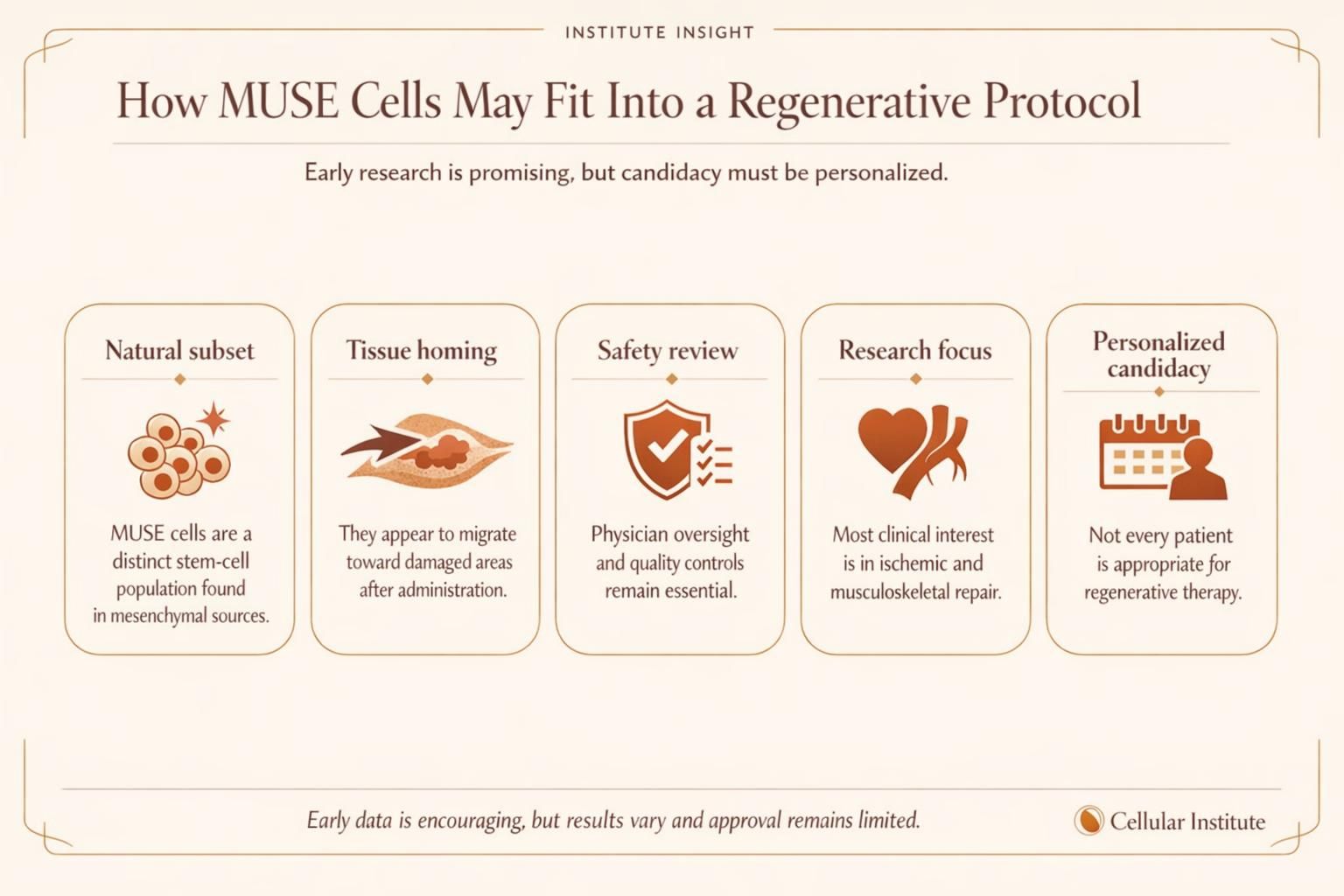
How MUSE Cells May Fit Into a Regenerative Medicine Protocol
One reason MUSE cell research has generated interest is that these cells appear to self-navigate to damaged tissue after systemic administration. This homing behavior may reduce the need for highly localized injection procedures. In early clinical models, intravenously administered MUSE cells migrated to injured tissue sites and began contributing to local repair processes.
In a regenerative medicine context, this matters because the delivery method and the biological environment both shape outcomes. Systemic inflammation, poor circulation, oxidative stress, and inadequate recovery support can all limit how effectively any regenerative therapy performs. This is why experienced clinicians do not approach regenerative medicine as a single injection event.
At Cellular Institute, regenerative medicine in Cancún is designed as a complete, personalized protocol. The medical team evaluates each patient’s condition, inflammatory status, tissue environment, and recovery capacity before designing a treatment strategy. Complementary tools such as recovery technologies like hyperbaric oxygen therapy, red light therapy, and PEMF may support the cellular environment during and after treatment.
Patients dealing with systemic inflammation may also benefit from adjunctive therapies designed to reduce inflammatory burden before or alongside regenerative treatment. Our team may also discuss EBOO therapy in Cancún as part of a broader protocol when clinically appropriate.
What Affects Quality and Safety in Stem Cell Therapy
Not all regenerative therapies use the same biologic products, sourcing standards, or quality controls. This distinction matters enormously for patient safety and outcomes.
At Cellular Institute, biologic products are prepared through our affiliated lab ecosystem, Cellgenic. This structure supports greater traceability, viability documentation, sterility testing, and quality control than many outsourced biologic supply arrangements. Lab quality and transparency are foundational to responsible regenerative medicine — not optional extras.
Patients should always ask about cell sourcing, processing standards, viability at the time of administration, and whether a certificate of analysis is available. These questions help distinguish serious clinical providers from clinics offering unverified biologic products with limited documentation.
Our certified stem cells are prepared with xeno-free processing standards and documented quality controls. Our laboratory team, including Biotechnologist Diana Navarrete, reviews product quality before clinical use.
Who May Be a Candidate for Regenerative Therapy After Injury
Patients with musculoskeletal injuries, ischemic conditions, or chronic tissue damage often ask whether regenerative medicine may support their recovery. While candidacy depends on individual evaluation, some general characteristics may favor a regenerative approach:
- Incomplete recovery after orthopedic injury or surgery
- Chronic joint or soft tissue damage that has not responded well to conventional care
- Ischemic conditions where tissue perfusion and cellular repair are compromised
- Patients seeking to support recovery without or alongside surgical intervention
- Individuals with manageable inflammatory burden who can optimize recovery conditions
Our orthopedic team, including Dr. Wajid Burad, Orthopedist, works with patients presenting musculoskeletal injuries to evaluate whether a regenerative protocol may be appropriate for their specific case.
Who May Not Be a Good Candidate
Regenerative medicine is not appropriate for every patient. Candidacy evaluation is always required. Patients with active infections, certain autoimmune conditions in acute flare, uncontrolled systemic illness, or other contraindications may not qualify for regenerative protocols at a given time. A thorough medical review helps ensure that any recommended approach is clinically sound and appropriately timed.
How Cellular Institute Approaches This
Cellular Institute does not offer a standardized injection package. The medical team designs each protocol around the patient’s condition, goals, inflammatory environment, and recovery capacity. The process includes clinical evaluation, diagnostic review, protocol design, treatment delivery, recovery support, and structured follow-up.
Our connection to the broader ISSCA and Global Stem Cells Group ecosystem adds scientific depth to our clinical approach. This network represents over 15 years of regenerative medicine experience, physician education, and protocol development. Patients benefit from that institutional knowledge when their care plan is designed.
For patients traveling internationally, our team provides concierge-level coordination from arrival through recovery. If you are exploring your options, our guide on how to choose a stem cell clinic in Mexico may help you evaluate providers more clearly before making a decision.
Questions to Ask Before Choosing a Clinic
- Where do your biologic products come from, and how are they processed?
- Is a certificate of analysis available for the cells or biologics used?
- What quality standards govern your lab sourcing and cell preparation?
- Is the protocol designed individually for each patient, or is it a standard package?
- What complementary therapies support the treatment protocol?
- What does physician oversight look like before, during, and after treatment?
- What follow-up support do you provide after the patient returns home?

Frequently Asked Questions
Are MUSE stem cells the same as mesenchymal stem cells?
No, but they share a relationship. MUSE cells are a specific pluripotent-like subset found within mesenchymal stem cell populations. They have unique characteristics, including natural tissue-homing behavior and multi-lineage differentiation potential, that distinguish them from the broader MSC category. Research on MUSE cells as a distinct therapeutic tool is still in active development.
Is MUSE cell therapy widely available for injury patients right now?
MUSE cell therapy remains largely in the clinical trial phase globally. While early results are promising, particularly in stroke and ischemic conditions, the therapy has not yet reached widespread clinical approval outside of limited trial settings. Patients should discuss the current evidence base and available biologic options with a qualified physician during a full medical evaluation.
How long might results from regenerative therapy last for musculoskeletal injuries?
Results vary considerably depending on the patient’s condition, age, inflammatory environment, lifestyle, and the quality of the protocol used. Some patients report sustained benefits over months or longer. Others may benefit from follow-up or maintenance protocols over time. There are no guaranteed timelines. You can read more about what factors influence outcomes in our article on how long stem cell therapy results may last.
Is it safe to travel to Cancún for regenerative medicine treatment?
Many international patients from the United States and Canada travel to Cancún for regenerative medicine each year. Cellular Institute provides full patient coordination, bilingual support, and a structured medical experience from arrival through recovery. Safety depends heavily on choosing a clinic that operates with physician oversight, proper licensing, and documented quality standards. Our article on stem cell therapy safety in Mexico covers what patients should evaluate before traveling.
Final Thoughts
MUSE stem cells represent a genuinely interesting development in regenerative medicine science. The early clinical data on tissue-homing behavior and repair support in ischemic conditions is worth following. At the same time, patients deserve honest, evidence-informed guidance — not overpromised outcomes.
Whether the most appropriate protocol involves advanced stem cell biologics, exosome therapy, recovery technologies, peptide support, or a combination of tools, the starting point is always a thorough medical evaluation. Every decision should be based on your specific condition, goals, and biology.
If you are exploring regenerative medicine options after an injury or for an ischemic condition, we invite you to schedule a discovery call with our patient coordination team. We will help you understand whether you may be a candidate and what a personalized protocol might look like for your situation.
Medical Disclaimer
This article is for educational purposes only and does not replace medical advice, diagnosis, or treatment. Regenerative therapies are not appropriate for every patient, and outcomes vary. A licensed physician must evaluate your medical history, goals, and candidacy before any treatment can be recommended.