

Written by: Cellular Institute Editorial Team
Medical reviewer: Dr. Matilde Rodríguez – CP 12651081
Laboratory reviewer: Biotecnóloga Diana Navarrete – CP 15029468
Quick Answer
MUSE cells and standard mesenchymal stem cells (MSCs) are both regenerative tools, but they differ significantly in origin, mechanism, and the stage of clinical research behind them. MUSE cells represent a more recently identified cell subpopulation with early but promising clinical data. MSCs have a longer track record and broader application in physician-guided protocols. Neither approach is right for every patient. A thorough medical evaluation is always required before any regenerative therapy can be recommended.
What Patients Should Know
If you have been researching regenerative medicine, you have likely come across both MSC-based stem cell therapy and the newer concept of MUSE cells. Understanding the difference between them is an important part of making an informed decision.
The term stem cells covers a wide range of cell types. Not all stem cells are the same, and not all clinics work with the same products, quality standards, or delivery methods. The biology behind these cells matters just as much as the clinical setting around them.
Let us walk through what each cell type is, how it works, and what the current evidence suggests.
What Are Mesenchymal Stem Cells?
Mesenchymal stem cells are multipotent stromal cells. They can differentiate into several tissue types, including bone, cartilage, and fat. More importantly for regenerative medicine, MSCs release signaling molecules that may support tissue repair, modulate inflammation, and communicate with the immune system.
MSCs can come from several sources, including bone marrow, adipose tissue, and umbilical cord tissue (Wharton’s jelly). Umbilical cord-derived MSCs are among the most commonly used in physician-guided regenerative protocols today. They tend to be younger cells with strong signaling capacity and do not require a surgical harvest procedure from the patient.
MSCs have decades of research behind them. Thousands of clinical trials have explored their potential in conditions ranging from orthopedic injuries to inflammatory conditions. The evidence base is still growing, and results vary by patient, condition, cell source, and protocol quality.
You can explore the types of stem cell treatments in Mexico to learn more about how different cell sources and approaches compare in clinical settings.
What Are MUSE Cells?
MUSE stands for Multilineage-differentiating Stress Enduring cells. Researchers at Tohoku University in Japan first identified them in 2010. MUSE cells are a specific subpopulation found within mesenchymal tissues and bone marrow. They express a surface marker called SSEA-3, which distinguishes them from conventional MSCs.
What makes MUSE cells different is their proposed mechanism. Researchers believe MUSE cells may migrate to sites of injury, integrate into damaged tissue, and spontaneously differentiate into cell types that match the local tissue environment. Unlike standard MSCs, MUSE cells appear to do this without forming tumors, which researchers describe as non-tumorigenic behavior.
MUSE cells also appear to have a strong stress tolerance. That tolerance may help them survive in damaged or inflamed environments better than some other cell types.
Japan has advanced the most in MUSE cell research. The cell therapy product known as CL2020, developed by Life Science Institute and Mitsubishi Chemical Holdings, uses MUSE cells and has received conditional approval in Japan for specific indications. Clinical trials for conditions such as ALS and stroke are ongoing globally.
MUSE Cells vs. Regular Stem Cells: Key Differences
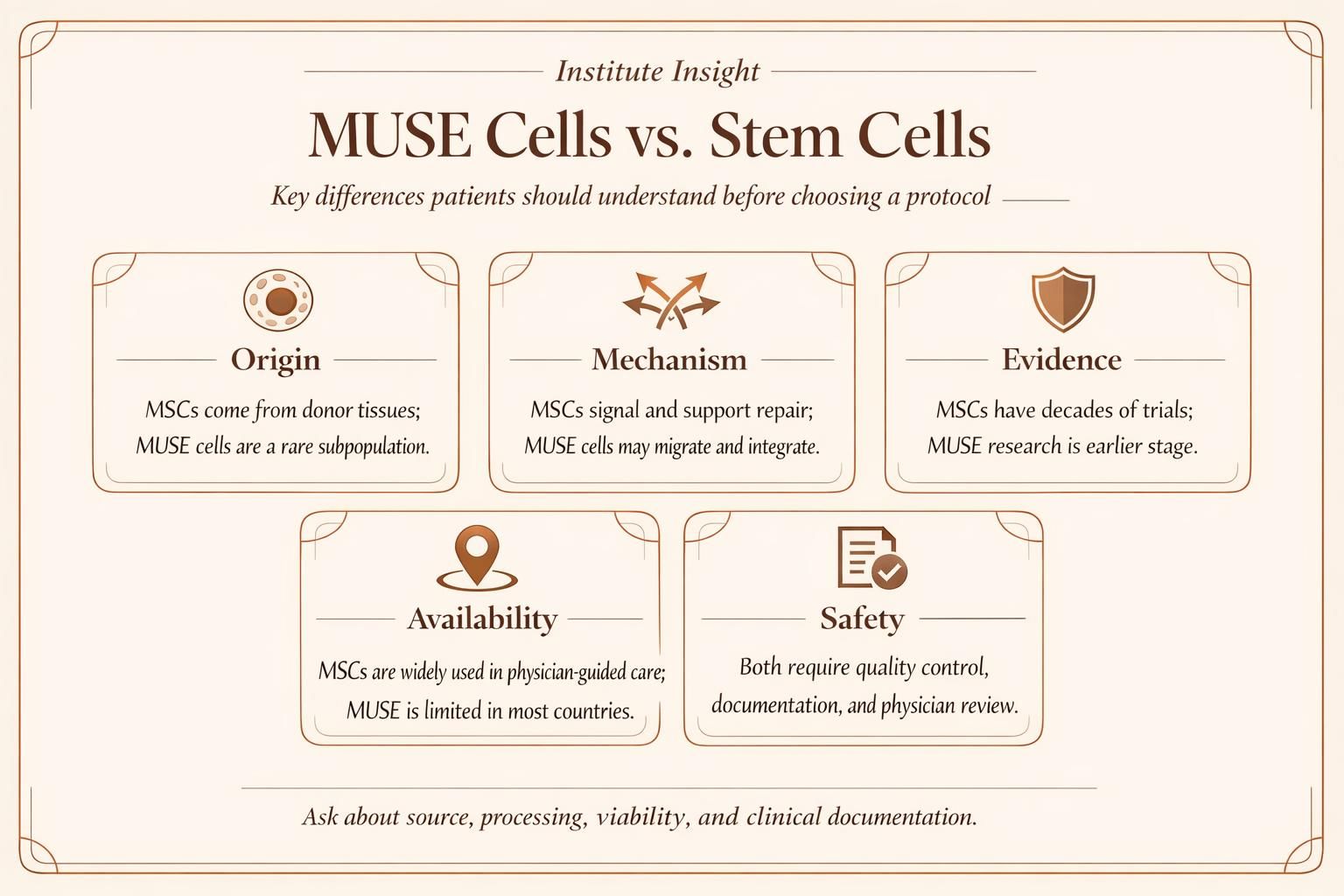
- Origin: MSCs come from various donor tissues. MUSE cells are a subpopulation isolated from within those same mesenchymal tissues using specific surface markers.
- Mechanism: MSCs primarily work through paracrine signaling. MUSE cells may actively migrate to injury sites and differentiate into matching tissue types.
- Tumor risk: Standard MSCs carry a very low but discussed theoretical risk of unintended differentiation. MUSE cells appear non-tumorigenic in early research.
- Research stage: MSCs have decades of peer-reviewed research and thousands of clinical trials. MUSE cell research is earlier stage, with promising but limited clinical data outside Japan.
- Availability: MSC-based therapies are widely available at physician-guided regenerative medicine clinics. MUSE cell products remain in clinical trial phases in most countries.
- Isolation complexity: Isolating MUSE cells requires additional steps and specific markers. This makes standardized commercial production more complex at this stage.
What Affects Quality and Safety in Either Approach
Whether a clinic works with MSCs or newer cell types, the quality of the biologic product matters enormously. Cell source, donor screening, processing method, sterility testing, viability at the time of administration, and cold chain management all influence the outcome.
Many patients focus on the therapy name and overlook the process behind it. A poorly processed or low-viability product will not perform the same way as a high-quality, well-documented one, regardless of what it is called.
At Cellular Institute, Biotechnologist Diana Navarrete oversees laboratory review to support product traceability, sterility, and documentation standards. Our affiliated lab ecosystem through Cellgenic supports xeno-free processing, viability documentation, and quality control at each stage. You can learn more about our commitment to lab quality and transparency.
Patients considering any regenerative therapy should ask the clinic: Where do the cells come from? How are they processed? What documentation is available? What quality standards does the lab follow? These questions matter before any conversation about cell type begins.
For patients researching safety more broadly, our article on stem cell therapy safety in Mexico provides a practical overview of what to evaluate when comparing clinics.
Who May Be a Candidate for Stem Cell Therapy
Patients who may benefit from MSC-based regenerative protocols often include those dealing with inflammatory conditions, joint degeneration, post-injury recovery, immune dysregulation, or longevity optimization goals. Each case requires individual evaluation.
Physician-guided candidate evaluation typically includes a review of medical history, current medications, inflammatory markers, lab work, and specific goals. The protocol is then designed around the individual patient, not a generic package.
MUSE cell-specific therapies remain largely within clinical trial settings for now. Patients interested in this specific approach should speak with a physician about what is currently available and what stage of research applies to their condition.
Who May Not Be a Candidate
Regenerative medicine is not appropriate for every patient. Those with active infections, certain autoimmune flares, uncontrolled systemic conditions, or specific oncologic histories may not qualify. A physician must evaluate each patient individually before any recommendation can be made.
Responsible regenerative medicine always starts with a candidacy evaluation. Any clinic that skips this step or offers the same protocol to every patient regardless of history is a red flag worth noting. Our guide on how to choose a stem cell clinic in Mexico covers this and other important evaluation criteria.
How Cellular Institute Approaches This
Cellular Institute does not position itself as a single-injection provider. Our approach to regenerative medicine in Cancún begins with a thorough medical evaluation led by a qualified physician. From there, the team designs a personalized protocol that may include MSC-based therapy, complementary biologics, recovery technologies, or adjunct therapies depending on the patient’s goals and condition.
Our medical team includes physician leadership with backgrounds in cardiology, orthopedics, and immunology. Under the oversight of Dr. Rafael Moguel, Medical Director, every protocol reflects clinical reasoning, not a standardized menu. Our certified stem cells meet documented quality standards supported by Cellgenic’s in-house lab infrastructure.
We are also connected to the ISSCA and Global Stem Cells Group ecosystem, giving our team access to more than 15 years of regenerative medicine education, protocol development, and physician training. This is not an influencer clinic. It is a medically grounded regenerative medicine destination.
Questions to Ask Before Choosing a Clinic
- Does the clinic use physician-guided evaluation before recommending a protocol?
- What is the source of the cells or biologics being used?
- What quality documentation is available, including viability and sterility?
- Does the clinic use MUSE cells specifically, or MSC-based therapy with MUSE-influenced language?
- Is the protocol personalized to the patient’s history, goals, and lab results?
- What complementary recovery tools are available to support the therapy?
- How does the clinic support international patients with logistics and follow-up?
Patients weighing the cost of treatment should also explore our overview of stem cell therapy cost in Mexico to understand what a complete protocol includes and why price alone does not tell the full story.

Frequently Asked Questions
Are MUSE cells available at regenerative medicine clinics outside Japan?
MUSE cell therapy products remain largely in clinical trial phases outside Japan. The specific commercial product approved conditionally in Japan is not widely available at most international clinics. Patients should ask any clinic offering MUSE cells specifically what product they are using, where it comes from, and what clinical documentation supports it.
Is MSC-based stem cell therapy well-researched?
Yes. Mesenchymal stem cells have been studied in thousands of clinical trials over several decades. The evidence base continues to grow, though outcomes vary by patient, condition, cell source, and the quality of the protocol. MSCs remain the most widely applied cell type in physician-guided regenerative medicine today.
Can a patient receive both MUSE-informed and MSC-based approaches?
Some clinics market MUSE-enhanced or MUSE-enriched MSC products. However, patients should ask specific questions about what that means, how the cells are isolated, and what documentation exists. A physician with experience in regenerative medicine should guide this conversation based on the patient’s individual profile.
How do I know if a stem cell product is high quality?
Quality indicators include cell viability at the time of administration, sterility testing, donor screening documentation, xeno-free processing, and a clear chain of traceability from lab to patient. Ask the clinic for a certificate of analysis and ask about the lab that processes their biologics. Transparency here is a strong signal of a responsible provider.
Final Thoughts
MUSE cells represent a genuinely exciting direction in regenerative medicine research. The early clinical evidence from Japan is worth following. At the same time, MSC-based therapy has a deeper evidence base and broader availability in physician-guided clinical settings right now.
For most patients exploring regenerative options today, a well-designed MSC-based protocol, built around quality biologics, personalized evaluation, and physician supervision, remains the most evidence-informed starting point. As MUSE cell research matures and commercial products become more widely available outside Japan, the landscape may shift.
What stays constant is this: the quality of the biologic, the rigor of the medical evaluation, and the design of the full protocol matter more than any single therapy name.
If you are ready to explore whether a regenerative medicine protocol may be appropriate for your situation, we invite you to schedule a discovery call with our team. We will walk through your goals, history, and questions, and help you understand what options may be available to you at Cellular Institute in Cancún.
Medical Disclaimer
This article is for educational purposes only and does not replace medical advice, diagnosis, or treatment. Regenerative therapies are not appropriate for every patient, and outcomes vary. A licensed physician must evaluate your medical history, goals, and candidacy before any treatment can be recommended.