

Written by: Cellular Institute Editorial Team
Medical reviewer: Dr. Matilde Rodríguez – CP 12651081
Laboratory reviewer: Biotecnóloga Diana Navarrete – CP 15029468
Quick Answer
Mesenchymal stem cells for lupus represent one of the most actively studied areas in regenerative immunology. Early clinical research suggests that mesenchymal stem cells, or MSCs, may support immune modulation and help reduce systemic inflammation in patients with systemic lupus erythematosus, commonly known as SLE. However, this approach does not replace conventional care. It requires careful physician evaluation, and results vary significantly from patient to patient. A licensed physician must review your full medical history before any protocol can be considered.
What Patients With Lupus Are Actually Asking
Most patients who research this topic have already tried standard immunosuppressive medications. They may be managing frequent flares, joint pain, fatigue, kidney involvement, or skin symptoms that continue despite treatment. Their questions are specific and grounded in real frustration.
Common questions include:
- Can stem cells help calm my immune system without suppressing it completely?
- Is there evidence supporting MSC therapy for lupus, or is it experimental?
- What does a protocol actually look like?
- Is this safe to pursue alongside my current medications?
- What kind of results have other lupus patients reported?
These are fair and important questions. The answers require honesty about where the science stands and what a responsible clinical protocol looks like.
What the Evidence Currently Shows
Mesenchymal stem cells are adult, non-embryonic cells found in connective tissues such as bone marrow, umbilical cord, and adipose tissue. They are not immune cells themselves, but they interact powerfully with the immune system.
Researchers have studied MSCs in the context of autoimmune conditions for over a decade. Several published clinical trials, particularly from research centers in China and Europe, have examined MSC infusions in patients with refractory SLE. These studies report that some patients experienced reductions in disease activity scores, lower levels of inflammatory markers, and improved kidney function in lupus nephritis cases.
The proposed mechanisms include the ability of MSCs to shift the immune environment away from overactive inflammatory responses. They may help regulate T-cell activity, support regulatory immune cells, and reduce the production of autoantibodies that drive lupus damage.
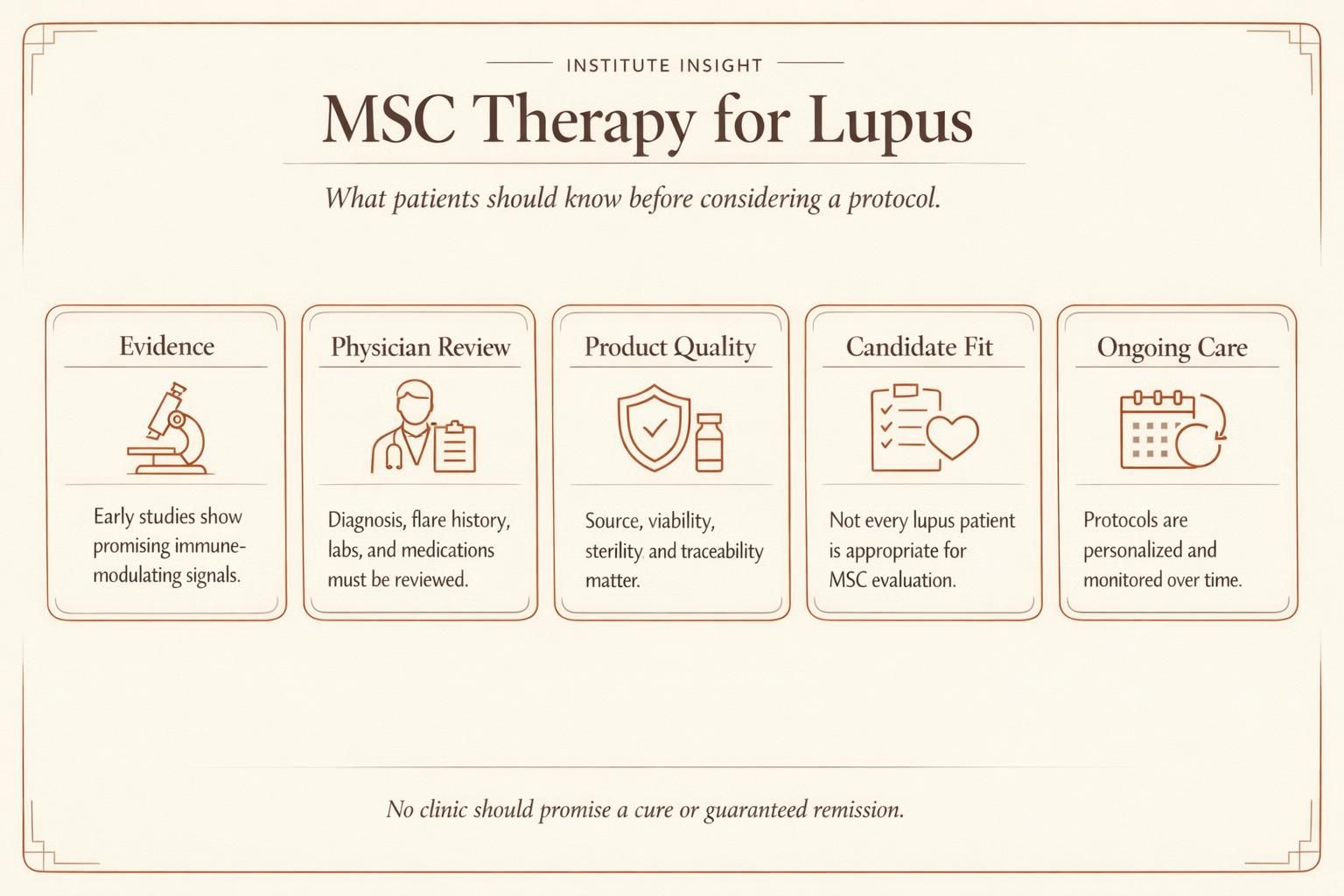
That said, the evidence remains early-stage. Most published studies involve small patient populations. Long-term safety data continues to develop. Researchers have not yet established standardized protocols across clinics worldwide. This is an area of genuine scientific interest, but responsible expectations matter. No clinic should claim that stem cell therapy cures lupus or guarantees remission.
How MSC Therapy May Fit Into a Regenerative Protocol
At Cellular Institute, regenerative protocols for patients with autoimmune conditions are not designed as standalone injections. The medical team evaluates the full picture before recommending any approach.
Dr. Roni Moya, Immunologist, plays a central role in evaluating patients with immune-related conditions. A thorough review of labs, flare history, organ involvement, current medications, and overall health status guides the protocol design.
MSC therapy may be considered as part of an integrated protocol that also includes complementary tools designed to support the immune and inflammatory environment. For example, EBOO therapy and systemic inflammation are closely connected, and some patients with lupus may benefit from ozone-based blood therapies as part of a broader strategy to reduce oxidative stress and inflammatory burden.
Recovery technologies such as hyperbaric oxygen, red light therapy, and PEMF may also support cellular recovery and reduce post-treatment inflammation. The protocol surrounds the therapy. It does not simply deliver cells and send the patient home.
What Affects Quality and Safety in MSC Therapy
Not all mesenchymal stem cell products are equivalent. The source tissue, processing method, passage number, viability at time of administration, and sterility testing all influence what the patient actually receives.
Many clinics outsource their biologic products with limited visibility into sourcing or quality documentation. Cellular Institute works through its affiliated biologics ecosystem, Cellgenic, which maintains higher standards for traceability, xeno-free processing, viability confirmation, and sterility. Lab quality and transparency matter more in autoimmune cases, where the immune system is already dysregulated and the patient’s tolerance for poor-quality products is lower.
Patients should always ask clinics for a certificate of analysis, information about cell source and passage number, and documentation of sterility testing before agreeing to any protocol. Our certified stem cells page explains what quality standards should look like and what questions to ask.
Safety also depends on physician oversight. A clinic that skips medical evaluation, ignores current medications, or applies a one-size-fits-all protocol is not operating responsibly. Lupus patients in particular carry unique risks that require careful clinical reasoning before any regenerative intervention.
Who May Be a Candidate
Patients who may be appropriate candidates for a physician-supervised MSC evaluation typically share some of the following characteristics:
- Confirmed SLE diagnosis with documented disease activity
- Inadequate response or partial response to standard immunosuppressive therapy
- Stable enough health status to safely undergo evaluation and treatment
- No active severe infections or uncontrolled comorbidities
- Willingness to continue working with their rheumatologist alongside any regenerative protocol
Candidacy is always determined through physician evaluation, not through online self-assessment. The patient’s rheumatologist remains a critical part of the care team throughout any regenerative protocol.
Who May Not Be a Candidate
MSC therapy for lupus may not be appropriate for patients in active severe flare, those with uncontrolled infections, patients with significant organ failure, or those who are not medically stable. Patients currently on certain immunosuppressive combinations may also require careful medication review before any protocol begins. These decisions belong to the physician, not to the patient or the clinic coordinator.
How Cellular Institute Approaches This
Cellular Institute approaches autoimmune cases with caution, depth, and individualized thinking. The team does not apply a standard lupus package. Instead, the physician team reviews the patient’s complete profile and builds a protocol around their specific disease history, inflammatory burden, organ involvement, and goals.
International patients traveling from the United States and Canada receive coordinated support throughout the process. This includes pre-treatment communication, lab review, airport coordination, and structured follow-up after returning home. The experience is designed to feel guided and medically grounded, not transactional.
Patients interested in understanding how to choose a stem cell clinic in Mexico will find that the questions worth asking go far beyond price. Physician qualifications, biologic product quality, protocol personalization, and post-treatment follow-up all matter significantly.

Frequently Asked Questions
Is mesenchymal stem cell therapy approved for lupus?
MSC therapy for lupus remains an emerging area of research and is not currently approved as a standard treatment by major regulatory bodies such as the FDA. Clinical studies have shown promising signals, but the evidence base is still developing. Patients should pursue this only under physician supervision and with realistic expectations. Mexico’s regulatory framework under COFEPRIS allows certain regenerative applications within licensed clinical structures, and Cellular Institute operates within that framework.
Will stem cell therapy replace my lupus medications?
No. Stem cell therapy is not a replacement for conventional lupus management. Patients should continue working with their rheumatologist and should never stop prescribed medications without physician guidance. A regenerative protocol may be designed to complement ongoing care, but it does not replace it.
How long might it take to notice any changes?
Timelines vary widely. Some patients report gradual improvements in fatigue, joint comfort, or inflammatory markers over weeks to months. Others notice minimal early changes. Individual response depends on disease severity, immune status, product quality, and the protocol design. For more context on timelines and expectations, visit our resource on how long stem cell therapy results may last.
What is the cost of MSC therapy for lupus in Mexico?
Protocol costs vary depending on the complexity of the case, the number of sessions, the biologic products included, and the complementary technologies that form part of the personalized plan. A single injection model does not reflect how responsible regenerative medicine works. For a general overview of pricing structures, see our guide on stem cell therapy cost in Mexico.
Final Thoughts
Mesenchymal stem cells for lupus represent a genuinely interesting frontier in immune-modulating therapy. The early evidence supports continued investigation, and some patients with refractory SLE have reported meaningful improvements in clinical studies. At the same time, this field requires honest communication about where the science stands, what the risks involve, and why protocol quality matters as much as the therapy itself.
If you have lupus and you want to explore whether a physician-guided regenerative protocol may be appropriate for your situation, the first step is a proper medical evaluation. Our team at Cellular Institute is here to help you understand your options without pressure and without overpromising.
Schedule a discovery call to speak with our patient coordination team and see whether you may be a candidate for evaluation.
You can also explore more patient education resources on the Cellular Institute blog to help you make a more informed decision about regenerative medicine.
Medical Disclaimer
This article is for educational purposes only and does not replace medical advice, diagnosis, or treatment. Regenerative therapies are not appropriate for every patient, and outcomes vary. A licensed physician must evaluate your medical history, goals, and candidacy before any treatment can be recommended.