

Written by: Cellular Institute Editorial Team
Medical reviewer: Dr. Matilde Rodríguez – CP 12651081
Laboratory reviewer: Biotecnóloga Diana Navarrete – CP 15029468
Quick Answer
For patients with COPD, emphysema, or chronic bronchitis who feel that bronchodilators and inhaled steroids are no longer providing adequate relief, stem cell therapy abroad is an option some are actively researching. Early-stage clinical evidence suggests that mesenchymal stem cells may support anti-inflammatory processes and tissue signaling in the lungs. However, this field remains investigational. Results vary significantly by patient, and physician evaluation is required before any protocol can be recommended. Traveling abroad for stem cell therapy may be worth exploring, but only when you choose a clinic that prioritizes quality, transparency, and individualized medical care.
What Patients With COPD Are Experiencing
COPD is a progressive lung condition that makes breathing increasingly difficult over time. Most patients manage their symptoms with bronchodilators, inhaled corticosteroids, pulmonary rehabilitation, and oxygen therapy when needed.
For many, these tools provide meaningful relief in the early stages. But as the disease progresses, patients often reach a point where standard treatments feel insufficient. Breathlessness during simple activities, reduced exercise tolerance, and frequent exacerbations can significantly affect quality of life.
This is the moment many patients begin researching options outside conventional medicine, including regenerative medicine and stem cell therapy abroad.
What the Research Currently Suggests
Stem cell therapy for COPD is not an established standard of care. It remains an area of active investigation. That is important to understand before traveling anywhere for treatment.
Most of the research to date focuses on mesenchymal stem cells, often derived from umbilical cord tissue or bone marrow. Early studies suggest these cells may help modulate inflammation, support tissue repair signaling, and reduce the inflammatory burden associated with chronic lung disease.
Some patients in observational studies have reported improvements in quality of life, reduced breathlessness, and better exercise tolerance. However, these outcomes are not guaranteed, and clinical results vary considerably from patient to patient.
The current scientific consensus is that stem cell therapy for COPD shows promise but requires more large-scale, controlled studies. Any clinic that tells you otherwise is overstating the evidence.
What Affects Quality and Safety When Choosing a Clinic Abroad
Not every clinic offering stem cell therapy abroad operates at the same standard. The therapy itself is only one part of the equation. The quality of the biologic product, the medical evaluation process, and the clinical environment all matter significantly.
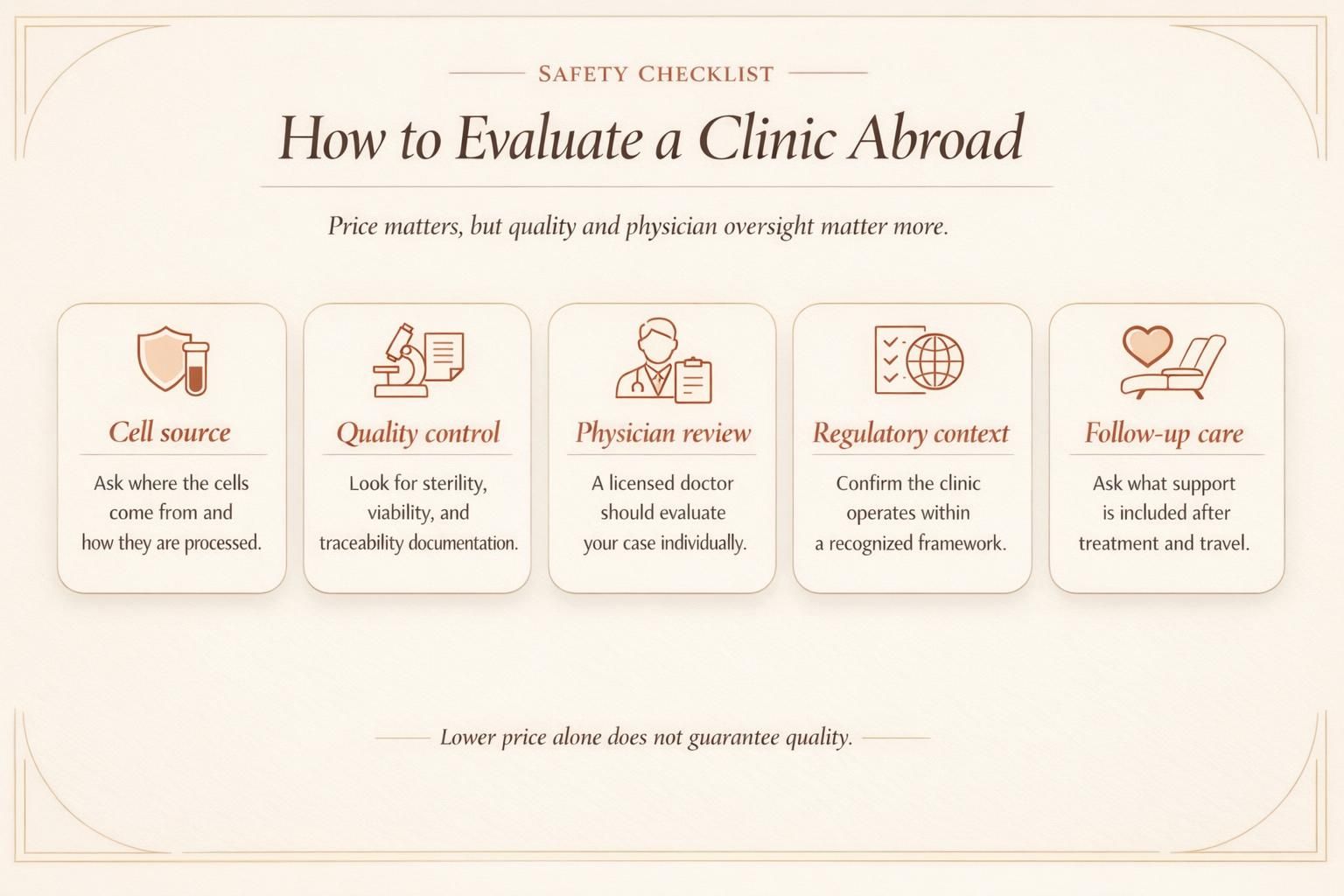
Here is what patients should examine carefully:
- Cell source and processing: Where do the cells come from? How are they processed? Are they tested for viability, sterility, and safety before use?
- Documentation and traceability: Does the clinic provide documentation on the biologic product, including certificates of analysis and quality control records?
- Physician oversight: Does a licensed physician evaluate your specific case before recommending a protocol? Or does the clinic use a one-size-fits-all approach?
- Regulatory context: Does the clinic operate within a recognized medical regulatory framework?
- Complementary support: Does the protocol include recovery tools, anti-inflammatory support, and follow-up care, or is it simply a single injection?
Patients researching stem cell therapy safety in Mexico will find that the clinic infrastructure, biologic sourcing, and medical team credentials matter far more than price or marketing claims.
Who May Be a Candidate for This Approach
Candidacy for stem cell therapy in the context of COPD depends on many individual factors. A physician must review your full medical history, current medications, lung function data, inflammatory markers, and overall health status before any protocol can be considered.
Patients who may be appropriate candidates often share some of the following characteristics:
- Diagnosed with COPD, emphysema, or chronic bronchitis
- Stable on conventional treatment but experiencing declining quality of life
- Not currently in an acute exacerbation or active infection
- Interested in a complementary approach to support their existing care plan
- Willing to undergo a thorough medical evaluation before treatment
Who May Not Be a Good Candidate
Stem cell therapy is not appropriate for every patient. Some individuals should not pursue this approach, including those who:
- Are experiencing an active respiratory infection or acute COPD exacerbation
- Have significant cardiovascular instability or other uncontrolled conditions
- Have a history of certain cancers or active malignancy
- Are medically too fragile to travel or undergo a clinical protocol safely
A responsible clinic will screen for these factors and decline to treat patients who are not appropriate candidates. If a clinic promises treatment to anyone without thorough evaluation, that is a significant red flag. Our guide on how to choose a stem cell clinic in Mexico outlines what a proper screening process should look like.
How Cellular Institute Approaches This
At Cellular Institute in Cancún, we do not view stem cell therapy as a standalone injection. We design personalized protocols around the patient, taking into account their diagnosis, inflammatory burden, health history, and goals.
Our approach to regenerative medicine in Cancún begins with a thorough medical evaluation led by our physician team. Every protocol reflects the individual patient, not a standard package.
The biologic products we use come through Cellgenic, our affiliated lab ecosystem. Cellgenic supports quality control, traceability, viability testing, and sterility documentation. Patients can learn more about our certified stem cells and what quality standards mean in practice.
For patients with chronic inflammatory conditions like COPD, we also consider complementary tools within the protocol. These may include EBOO therapy in Cancún to help address systemic inflammation, as well as recovery technologies such as hyperbaric oxygen therapy, red light therapy, and PEMF, which may support the body’s regenerative response after treatment.
Our medical team, led by Dr. Rafael Moguel, Medical Director, brings a cardiologist’s perspective to systemic health and physician-guided oversight. Patients with chronic respiratory conditions often carry significant cardiovascular burden as well, and that context shapes how we evaluate and design protocols.
Questions to Ask Before Choosing a Clinic Abroad
Before booking any treatment abroad, ask the clinic directly:
- Where do your stem cells or biologics come from?
- Can you share viability, sterility, and quality documentation?
- Will a physician evaluate my specific case before recommending a protocol?
- Is your clinic operating within a recognized regulatory structure?
- What does the full protocol include beyond the stem cell administration?
- What follow-up support do you offer after I return home?
The answers to these questions reveal far more about a clinic’s quality than any marketing claim. You can also explore our guide on safe stem cell clinics in Mexico for a detailed breakdown of what to look for and what to avoid.
Frequently Asked Questions
Is stem cell therapy for COPD approved by the FDA or other major health agencies?
No. Stem cell therapy for COPD is not currently approved by the FDA as a standard treatment. It remains investigational. Clinics operating outside the United States, including in Mexico, may offer these therapies under a different regulatory framework. Patients should ask about the regulatory context of any clinic they consider and ensure that physician oversight and safety standards are clearly in place.
How much does stem cell therapy for COPD cost abroad?
Costs vary widely depending on the clinic, the protocol complexity, the cell type used, and the number of sessions included. In Mexico, stem cell therapy protocols generally cost significantly less than comparable options in the United States. However, price alone should not drive the decision. For a detailed breakdown of what to expect, our article on stem cell therapy cost in Mexico provides helpful context.
How long might results last after stem cell therapy for COPD?
Results vary considerably by patient, disease severity, and the quality of the protocol. Some patients report improvements in breathlessness and quality of life that persist for months. Others may require repeat protocols over time. No clinic can guarantee specific outcomes or durations. For a realistic overview of expectations, our article on how long stem cell therapy results may last covers this topic in more detail.
Is it safe to travel to Cancún for medical treatment?
Cancún is one of Mexico’s most established international destinations and hosts a growing number of serious medical tourism providers. For patients considering treatment, the key factors are choosing a clinic with clear medical credentials, physician oversight, and a structured patient support system. Our guide on medical tourism in Mexico offers a comprehensive overview of what international patients should know before traveling.
Final Thoughts
Traveling abroad for stem cell therapy is a significant decision, and it deserves a serious evaluation process. For COPD patients who feel that conventional treatment has reached its limits, regenerative medicine may offer a complementary path worth exploring, provided it is approached with realistic expectations and a focus on quality.
The research is still developing. Results are not guaranteed. But for carefully selected patients working with a physician-guided clinic that prioritizes safety, biologic quality, and personalized care, the experience may support meaningful improvements in quality of life.
If you are ready to learn whether this approach may be appropriate for your situation, we invite you to schedule a discovery call with our patient coordination team. We will review your case, answer your questions honestly, and help you understand what a responsible next step might look like.
Medical Disclaimer
This article is for educational purposes only and does not replace medical advice, diagnosis, or treatment. Regenerative therapies are not appropriate for every patient, and outcomes vary. A licensed physician must evaluate your medical history, goals, and candidacy before any treatment can be recommended.