
Written by: Cellular Institute Editorial Team
Medical reviewer: Dr. Matilde Rodríguez – CP 12651081
Laboratory reviewer: Biotecnóloga Diana Navarrete – CP 15029468
Editorial Disclosure: Cellular Institute is not affiliated with Dr. Mari Dezawa, MuseCell Innovations, or the Dezawa MuseCells® commercial program. This article requires final medical and Mexican advertising-compliance review before publication.
How Can You Verify a MUSE-Cell Product Before Treatment?
Patients researching how to verify MUSE cells should focus on more than a product name, trademark, or advertised cell count.
Before treatment, ask who manufactured the specific batch, how the laboratory identified or enriched the MUSE population, which quality and safety tests it completed, whether the documentation matches the vial being administered, and what clinical evidence supports the proposed use.
A trademark, large total cell count, or Certificate of Analysis alone does not answer all of those questions.
For that reason, patients should evaluate the product, laboratory, documentation, physician oversight, and clinical protocol together before making a medical or financial decision.
Why MUSE-Cell Product Verification Matters Before You Travel
Patients comparing cellular therapy programs in Mexico may receive treatment proposals that use similar terminology while describing very different products.
For example, one clinic may purchase a branded cellular product from an external supplier. Another clinic may manufacture its product internally.
Likewise, products may differ in whether they are:
- Fresh or cryopreserved
- Enriched or unenriched
- Combined with other cellular populations
- Characterized using different laboratory methods
- Tested using different quality-control panels
- Manufactured on-site or transported from another facility
Verification is not about attacking a specific brand or assuming that every laboratory must use the same commercial system.
Instead, the goal is to obtain enough information to understand what the product is, how the laboratory evaluated it, what evidence applies, and why a physician is recommending it.
Patients who are new to regenerative medicine may also benefit from reviewing our overview of stem cell therapy in Cancún before comparing individual products.
12 Questions to Ask Before Choosing a MUSE-Cell Product
1. Who Manufactured My Specific Batch?
Ask for the legal name and location of the manufacturing laboratory.
The clinic administering the treatment may not be the same organization that produced the cellular product.
Therefore, patients should know exactly who manufactured and released the batch they will receive.
2. Is This a Branded Product or a Clinic-Manufactured Product?
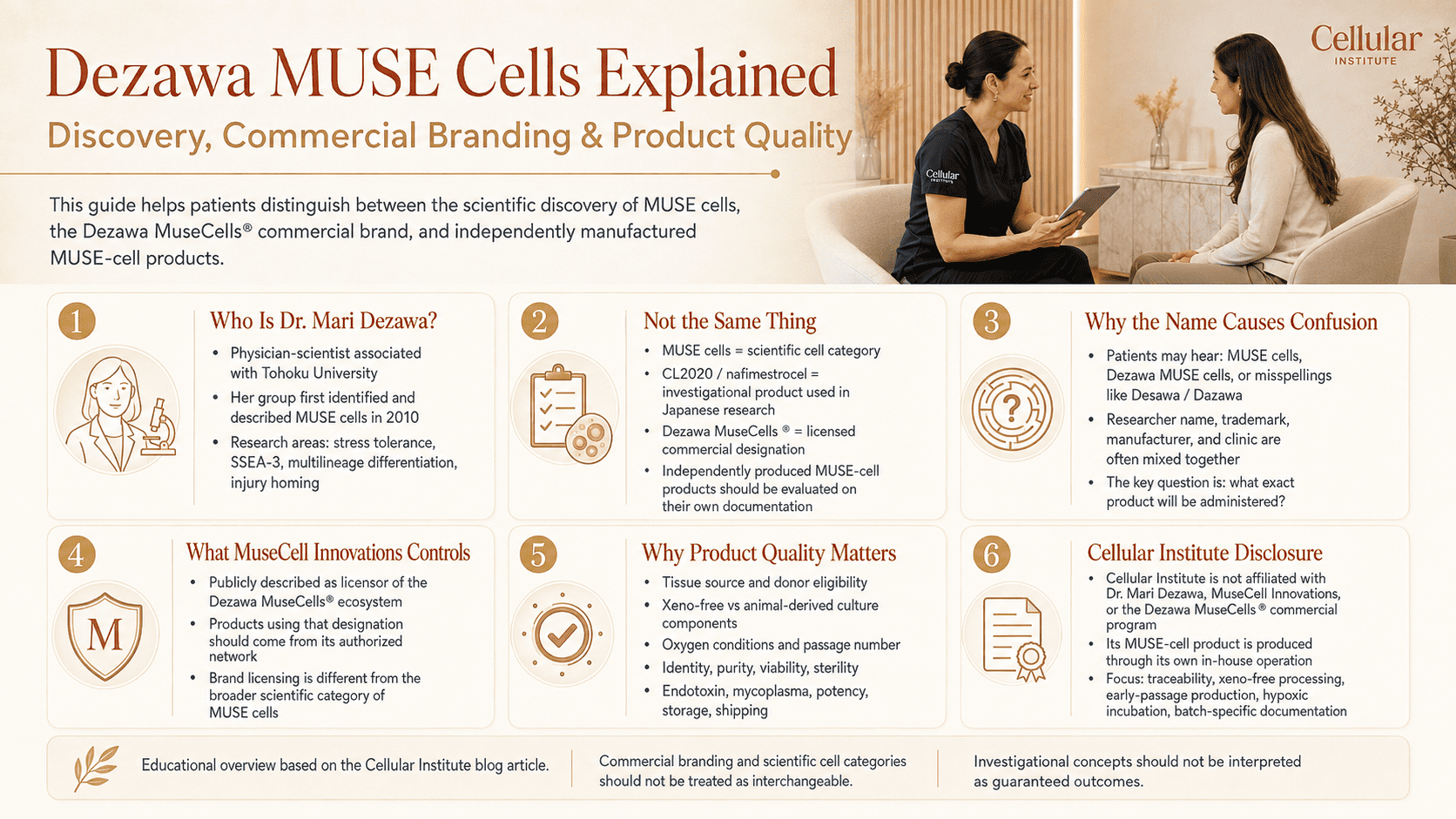
If a clinic uses a licensed brand such as Dezawa MuseCells®, ask for documentation confirming authorization and the product’s branded source.
If the clinic manufactures its own product, ask what nomenclature, characterization criteria, and laboratory methods support the MUSE-cell description.
The scientific term “MUSE cells” and a licensed commercial designation are not automatically interchangeable.
3. What Biological Criteria Are Used to Call the Product MUSE?
SSEA-3 is commonly associated with MUSE-cell characterization.
However, a complete explanation may also include:
- Enrichment methods
- Cellular composition
- Percentage of characterized cells
- Absolute cell count
- Additional identity markers
- Functional assays
- Limitations of the testing method
A single marker should not automatically become proof of purity, potency, or clinical effectiveness.
How to Verify MUSE Cell Count, Viability, and Manufacturing
4. What Percentage and Number of Characterized Cells Are Present?
A proposal advertising 100 million total cells does not necessarily mean the product contains 100 million characterized MUSE cells.
Patients should ask the clinic to clearly distinguish between:
- Total nucleated cells
- Viable cells
- MSCs
- MUSE-characterized cells
- Other cellular populations in the final product
This distinction matters because a large advertised cell number does not automatically describe the identity or composition of the product.
5. What Is the Viability at Administration?
Cell viability may change during:
- Storage
- Transportation
- Cryopreservation
- Thawing
- Preparation
- Delays before administration
Therefore, ask when viability was measured and whether the clinic has a same-day or administration-time result.
Patients can learn more about Cellular Institute’s approach to lab quality and transparency, including viability, sterility, traceability, and cellular quality control.
6. What Passage Number and Expansion History Are Documented?
Passage number represents one manufacturing variable.
However, patients should not treat a low passage number as a stand-alone guarantee of quality.
The laboratory should consider passage number together with:
- Population doublings
- Culture conditions
- Cellular phenotype
- Viability
- Purity
- Potency
- Final product composition
How to Verify the Safety and Quality of MUSE Cells
7. What Safety Tests Were Completed?
Patients should ask about the safety testing applicable to the specific product and jurisdiction.
This may include:
- Sterility
- Endotoxin
- Mycoplasma
- Donor screening
- Relevant infectious-disease testing
- Other release specifications
Simply saying that a product is “tested” does not explain which tests were performed or whether the batch met the laboratory’s acceptance criteria.
Patients who want a broader overview of cellular quality and documentation can also review Cellular Institute’s information about certified stem cells.
8. Is There a Relevant Potency or Functional Assay?
Identity testing asks what markers or characteristics the laboratory detected.
Potency testing, by contrast, aims to evaluate a relevant biological function.
Therefore, patients should ask the laboratory:
- What functional assay it uses
- What biological activity the assay measures
- Whether the assay has defined acceptance criteria
- What the result can and cannot predict clinically
A laboratory result may provide useful product information, but it does not guarantee an individual clinical outcome.
How to Verify a MUSE-Cell Certificate of Analysis
9. Can I Review the Certificate of Analysis Before Administration?
A Certificate of Analysis, or COA, should identify the specific product batch and summarize relevant release testing.
Before treatment, patients should confirm that the COA includes:
- Product name
- Lot or batch number
- Manufacturer
- Relevant testing methods
- Test results
- Release specifications
- Date of release
- Responsible release authority
Most importantly, confirm that the lot number on the document matches the cellular product used for treatment.
A generic sample COA does not verify the patient’s individual batch.
Which Clinical Evidence Applies to the Product?
10. Which Published Evidence Applies to This Exact Product and Condition?
Clinical research involving one MUSE-cell product does not automatically establish the performance of another product.
For example, a study involving CL2020 in subacute ischemic stroke cannot automatically establish the effectiveness of another cellular product for:
- Knee pain
- Parkinson’s disease
- Longevity
- Spinal conditions
- A different administration route
- Another medical indication
Therefore, patients should ask which published research most closely matches:
- The exact product
- Manufacturing process
- Dose
- Route of administration
- Diagnosis
- Patient population
This is especially important when a provider references well-known MUSE-cell research as part of its treatment explanation.
How Should the MUSE-Cell Product Be Administered?
11. Why Is This Delivery Route Being Recommended?
Different routes of administration involve different medical rationales, expertise, settings, and risks.
Possible routes discussed in cellular medicine may include:
- Intravenous infusion
- Intra-articular injection
- Intrathecal administration
- Targeted vascular delivery
The physician should explain why a specific route fits the patient’s diagnosis and proposed treatment plan.
A high-quality cellular product does not replace appropriate medical evaluation or physician judgment.
What Happens After MUSE-Cell Treatment?
12. How Will Outcomes and Complications Be Followed?
Follow-up should form part of the treatment plan before the patient travels.
Ask the clinic:
- Who will contact you after treatment?
- When will follow-up appointments occur?
- Which outcome measures will the medical team use?
- What should you do if symptoms worsen?
- How will potential adverse events be handled?
- Will your local physician receive treatment records?
- Who can you contact after returning home?
Patients preparing to travel for regenerative medicine may also find our guide to regenerative medicine in Cancún helpful when planning the broader treatment journey.
How to Read a MUSE-Cell Certificate of Analysis
A Certificate of Analysis should provide meaningful batch-specific information rather than simply displaying a laboratory logo.
Product and Lot Number
Verify: The number matches the vial and patient record.
Common misunderstanding: A generic or sample COA does not represent the patient’s individual batch.
Manufacturer
Verify: The document identifies the facility responsible for manufacturing and releasing the product.
Common misunderstanding: The treating clinic and manufacturing laboratory are not always the same organization.
Cellular Identity
Verify: The COA identifies the test method and result used to characterize the cellular product.
Common misunderstanding: One marker alone may not define purity, composition, or function.
Cell Count
Verify: The report explains which cellular population was counted and which unit of measurement was used.
Common misunderstanding: Total cell count does not necessarily equal the number of viable MUSE-characterized cells.
Viability
Verify: The report includes the testing method, result, specification, and timing.
Common misunderstanding: Viability at manufacturing release may differ from viability near the time of administration.
Safety Testing
Verify: The report identifies the applicable sterility and contamination tests and their results.
Common misunderstanding: The word “tested” alone does not explain which test was performed or what result the laboratory obtained.
Release Approval
Verify: The documentation identifies the person or responsible function that authorized product release.
Common misunderstanding: A laboratory logo does not replace accountable release documentation.
Branded vs. Independently Manufactured MUSE-Cell Products
A licensed commercial brand can help confirm that a cellular product came through a defined commercial network.
Meanwhile, an in-house manufacturing model may allow a clinic to maintain direct control over production, testing, timing, and coordination with its medical team.
Neither model should be accepted or rejected solely because of the label.
Licensed External Product
Potential advantages may include:
- Defined commercial source
- Licensed terminology
- Standardized commercial documentation
However, patients should still ask:
- Which laboratory manufactured the specific batch?
- How was the product handled and transported?
- What evidence applies to the proposed indication?
- What testing documentation will the patient receive?
Clinic-Manufactured Product
Potential advantages may include:
- Direct traceability
- Local testing
- Coordination between the laboratory and medical team
- Potentially shorter logistics between production and administration
However, patients should still ask:
- How does the clinic characterize the product?
- Which tests validate its identity?
- How does the laboratory release the batch?
- How does the product differ from cellular products used in published clinical studies?
The key question is not simply whether a product is branded or manufactured in-house.
Instead, patients should ask whether the clinic can clearly document what the product is and explain why the proposed protocol is medically appropriate.
Red Flags When Evaluating a MUSE-Cell Product
Patients researching how to verify MUSE cells should pay attention to warning signs before committing to treatment.
Potential red flags include:
- The clinic refuses to identify the manufacturer before payment.
- The advertised cell count is presented as proof of quality or effectiveness.
- The clinic shows a sample COA but will not provide documentation for the patient’s specific batch.
- Research involving one product or disease is used to promise outcomes for unrelated conditions.
- The clinic claims that every MUSE-cell product is identical.
- The clinic makes broad claims about FDA or COFEPRIS approval without identifying the exact product, facility, license, or permitted activity.
- The consultation focuses on selling a cell dose before reviewing the patient’s diagnosis, imaging, medications, contraindications, and goals.
- The clinic promises cartilage regrowth, neurological recovery, reversal of aging, or guaranteed improvement.
- No structured follow-up or adverse-event process is explained.
For a broader provider-selection guide, patients can review how to choose a stem cell clinic in Mexico.
Our guide to the 7 signs of safe stem cell clinics in Mexico also covers key factors related to clinic quality, transparency, medical oversight, and patient safety.
How Cellular Institute Answers the MUSE-Cell Verification Checklist
Cellular Institute’s model centers on in-house cellular manufacturing and coordination between the laboratory and medical team.
The clinic documents elements such as:
- Product origin
- Manufacturing controls
- Cell count
- Viability
- Sterility
- Batch-release information
The medical team also reviews the patient’s history and clinical goals before proposing a treatment protocol.
Cellular Institute is not affiliated with Dr. Mari Dezawa or MuseCell Innovations and does not describe its product as Dezawa MuseCells®.
Likewise, Cellular Institute does not claim that its product is equivalent or superior to MCI products or CL2020.
Instead, the Cellular Institute product should be evaluated according to its own manufacturing and quality documentation. Clinical recommendations should also remain part of a physician-led evaluation.
Frequently Asked Questions About How to Verify MUSE Cells
Does SSEA-3 Prove That a Product Is a MUSE-Cell Therapy?
SSEA-3 is an important marker used in MUSE-cell research and characterization.
However, the result should be interpreted together with:
- Testing method
- Gating strategy
- Percentage of characterized cells
- Absolute cell count
- Other identity information
- Purity
- Potency
- Overall product composition
Therefore, one marker alone does not answer every question about a cellular product.
Is a Certificate of Analysis Enough?
A COA represents important product documentation, but it does not guarantee clinical effectiveness.
The document should be:
- Authentic
- Batch-specific
- Understandable
- Connected to the actual vial
- Connected to the patient’s medical record
Patients should review the document before treatment rather than relying only on a sample certificate.
Should I Choose the Clinic With the Largest Cell Dose?
Not based on dose alone.
Other factors may be equally or more important, including:
- Product identity
- Viable cell count
- Manufacturing quality
- Administration route
- Diagnosis
- Physician expertise
- Safety testing
- Follow-up
A larger advertised number does not automatically mean a better cellular product or treatment protocol.
Can a Clinic Cite Dezawa or CL2020 Research for a Different Product?
A clinic may discuss this research as part of the scientific background.
However, the provider should clearly disclose when a study evaluated a different product.
Research involving CL2020 or another specific MUSE-cell product should not imply identical clinical performance for an independently manufactured product without appropriate supporting evidence.
MUSE-Cell Product Verification Checklist
Before making a treatment decision, confirm that you can answer each of these questions:
Manufacturer identified
Branded or clinic-manufactured status disclosed
MUSE characterization method explained
Characterized-cell percentage and count provided
Viability method and timing provided
Passage and expansion history available
Safety tests documented
Potency or functional testing explained
Batch-specific COA available before treatment
Evidence separated by product and medical condition
Delivery route explained by a physician
Follow-up and adverse-event plan documented
The Bottom Line
Patients do not need to become cell biologists to understand how to verify MUSE cells before treatment.
However, they should receive clear answers about:
- The manufacturer
- Product identity
- Cellular characterization
- Batch testing
- Certificate of Analysis
- Applicable clinical evidence
- Physician responsibility
- Follow-up
A clinic that values transparency should be able to explain these points in understandable language before a patient commits to treatment.
More importantly, product quality represents only one part of the decision. The proposed treatment should also make sense for the patient’s diagnosis, medical history, goals, and overall clinical situation.
Considering MUSE Cell Therapy in Mexico?
Bring this checklist to your consultation.
If you are considering MUSE cell therapy at Cellular Institute, ask our medical and laboratory teams to walk you through the product documentation and explain how the proposed protocol relates to your condition.
You can also schedule a discovery call to discuss your case and questions with our team before making travel plans.
Sources
- Niizuma K, et al. Randomized placebo-controlled trial of CL2020 in subacute ischemic stroke.
https://pubmed.ncbi.nlm.nih.gov/37756573/ - Mahmoud EE, et al. MUSE cells in an osteochondral-defect model.
https://pubmed.ncbi.nlm.nih.gov/29312455/ - MuseCell Innovations. Public product-verification claims and commercial disclosures.
https://musecellinnovations.com/physicians - Cellular Institute MUSE Cell Content Strategy, August 2026.