

Written by: Cellular Institute Editorial Team
Medical reviewer: Dr. Matilde Rodríguez – CP 12651081
Laboratory reviewer: Biotecnóloga Diana Navarrete – CP 15029468
Quick Answer
Stem cell therapy and PRP injections are both regenerative approaches that may support joint health, but they work through different mechanisms and suit different clinical situations. PRP uses concentrated growth factors from your own blood to support tissue healing and reduce inflammation. Stem cell therapy introduces biologically active cells that may support more complex tissue repair and immune modulation. Neither approach is appropriate for every patient. A physician must evaluate your diagnosis, medical history, and goals before recommending either option.
What Patients Should Know First
If you are living with chronic joint pain from osteoarthritis, a sports injury, or cartilage damage, you may have already heard about both platelet-rich plasma and stem cell therapy. Both fall under the broader category of regenerative medicine in Cancún, and both aim to support the body’s natural repair processes rather than simply mask symptoms.
However, these two therapies are not interchangeable. They differ in how they work, what they contain, how complex the process is, and what patient profiles tend to respond best. Understanding those differences helps you ask better questions and make a more informed decision.
How PRP Works
PRP stands for platelet-rich plasma. A medical professional draws a small amount of your blood, processes it in a centrifuge to concentrate the platelets, and then injects that concentrated plasma into the affected joint or tissue.
Platelets contain growth factors that play a natural role in tissue repair. By concentrating them and delivering them directly to an injured area, PRP aims to amplify the body’s own healing signals. The process uses your own biological material, which reduces the risk of rejection or immune reaction.
PRP tends to work best for mild to moderate conditions. These may include early-stage osteoarthritis, tendon irritation, ligament injuries, and soft tissue inflammation. Results vary by patient, and multiple sessions may be needed depending on the condition and response.
How Stem Cell Therapy Works
Stem cell therapy introduces living cells with the potential to support tissue repair, modulate inflammation, and communicate with surrounding cells through signaling processes. Most protocols used in regenerative medicine clinics today rely on mesenchymal stem cells, often sourced from ethically donated umbilical cord tissue or other allogeneic sources.
These cells do not simply replace damaged tissue. Instead, they may support the local environment by releasing signaling molecules, modulating immune activity, and encouraging the body’s own regenerative response. This makes stem cell therapy a more complex and potentially more comprehensive intervention than PRP.
Stem cell therapy may be considered for patients with more advanced joint degeneration, significant cartilage loss, or conditions where PRP alone has not produced meaningful improvement. Physician evaluation determines whether a patient may be a suitable candidate.
To explore the types of approaches available, our team has written a detailed overview of the types of stem cell treatments in Mexico that may be relevant to patients with orthopedic concerns.
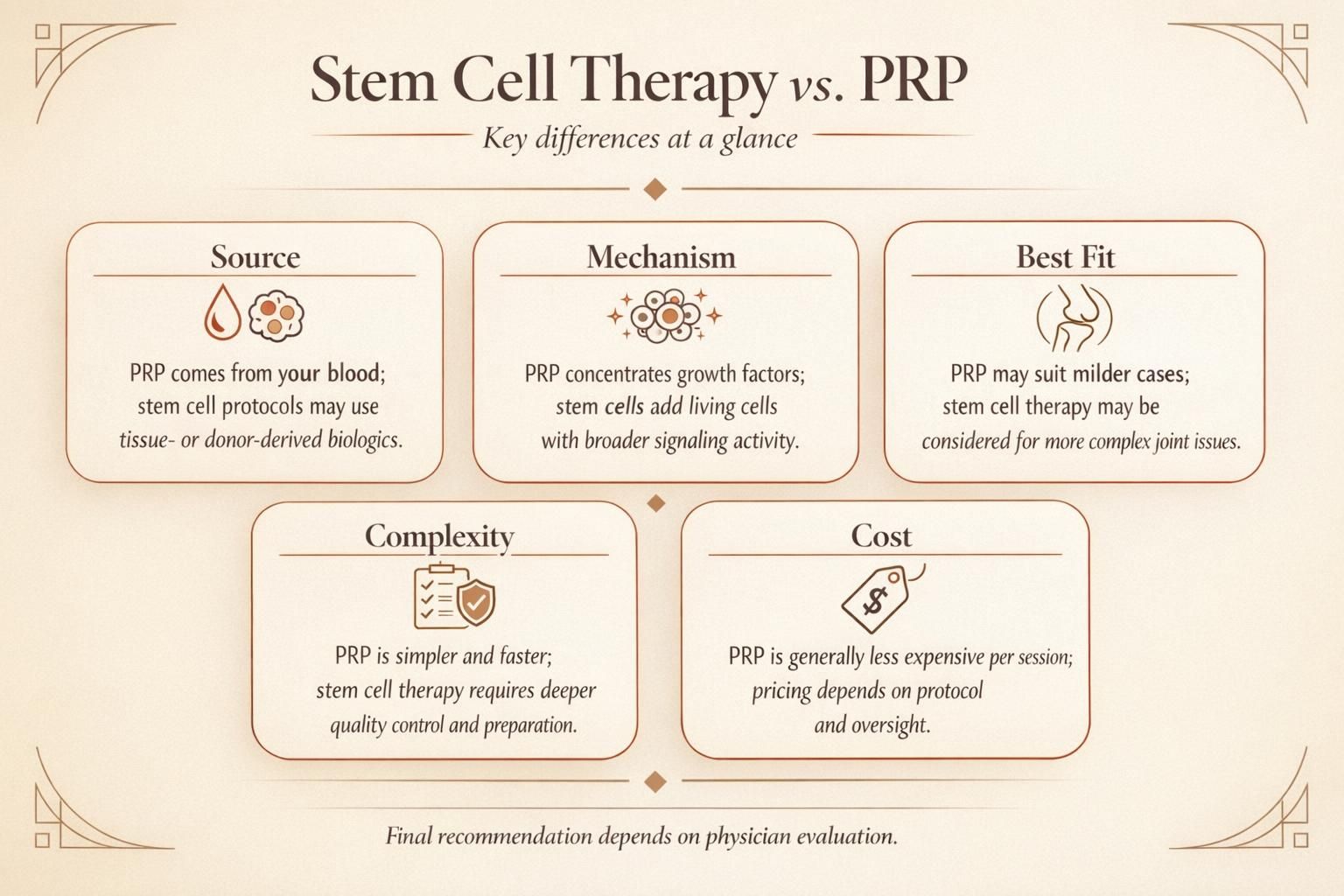
Key Differences at a Glance
- Source: PRP comes from your own blood. Stem cells may come from your own tissue or from a donor source, depending on the protocol.
- Complexity: PRP is a simpler, faster procedure. Stem cell therapy involves a more involved process with greater requirements for quality control and product preparation.
- Mechanism: PRP delivers growth factors. Stem cells deliver living cells with broader biological activity, including immune modulation and paracrine signaling.
- Conditions addressed: PRP may suit milder or earlier-stage conditions. Stem cell therapy may be considered for more complex or advanced cases.
- Cost: PRP is generally less expensive per session. Stem cell therapy involves greater preparation, quality standards, and clinical oversight, which is reflected in the cost.
What Affects Quality and Safety
For PRP, quality depends on the centrifugation protocol, platelet concentration, and proper handling. Not all PRP preparations are equal, and the concentration of growth factors can vary significantly between providers.
For stem cell therapy, quality is far more complex. The source of the cells, the processing method, viability at the time of delivery, sterility, and traceability all matter. A clinic that cannot explain where its cells come from or provide documentation of quality testing should raise serious questions.
At Cellular Institute, our in-house biologics are supported through our affiliated lab ecosystem, Cellgenic. This structure allows for greater traceability, xeno-free processing standards, and documented quality control that patients can ask about directly. Our certified stem cells meet defined standards for viability, sterility, and safety documentation before any patient receives them.
Our Dr. Wajid Burad, Orthopedist, and Dr. Richard Silva lead orthopedic evaluations at the clinic, ensuring that patients with joint pain receive a thorough clinical assessment before any regenerative protocol begins.
Who May Be a Candidate for PRP
PRP may be worth considering if you have mild to moderate joint pain, early-stage osteoarthritis, or a soft tissue injury that has not responded well to rest and conservative care. It may also work as a starting point for patients who want to explore regenerative options before committing to a more involved protocol.
Who May Be a Candidate for Stem Cell Therapy
Stem cell therapy may be considered for patients with more advanced osteoarthritis, significant cartilage degradation, chronic inflammation that has not responded to other interventions, or complex joint conditions where more robust biological support may be appropriate. A physician evaluates each patient individually. Not everyone qualifies, and candidacy depends on several clinical factors.
If you want to understand how long outcomes from stem cell therapy may persist, our team has addressed patient expectations in detail in an article on how long stem cell therapy results may last.
How Cellular Institute Approaches Joint Pain
At Cellular Institute, we do not offer a single injection and send patients home. Our medical team evaluates each patient’s condition, inflammation status, medical history, and goals before designing a personalized protocol. Depending on the case, that protocol may include stem cell therapy, complementary recovery technologies such as hyperbaric oxygen therapy, red light therapy, or PEMF, and adjunct support through peptide therapy when clinically appropriate.
The goal is not just to deliver a biologic product. It is to create the best possible environment for that product to work. Recovery technologies, anti-inflammatory support, and physician-guided follow-up all contribute to a more complete regenerative experience.
For patients traveling internationally, our team also provides full medical tourism support, including coordination, concierge patient care, and structured follow-up. You can learn more about what to expect as an international patient through our guide on medical tourism in Mexico.
Questions to Ask Before Choosing a Clinic
- Does the clinic perform a medical evaluation before recommending a therapy?
- Where do the stem cells or PRP preparations come from, and how are they processed?
- Can the clinic provide quality documentation, such as viability and sterility records?
- Does the protocol include recovery support and follow-up, or is it a single visit?
- Is the care physician-guided, or is it primarily coordinated by sales staff?
- What are the realistic expectations, and how does the clinic communicate them?
For a broader guide on evaluating providers, our article on how to choose a stem cell clinic in Mexico covers the key criteria patients should consider.

Frequently Asked Questions
Is stem cell therapy always better than PRP for joint pain?
Not necessarily. The right approach depends on your diagnosis, the severity of the condition, your medical history, and your goals. PRP may be entirely appropriate for mild conditions. Stem cell therapy may offer broader support for more advanced cases. A physician must evaluate your individual situation before making a recommendation.
Can PRP and stem cell therapy be combined?
In some protocols, physicians may incorporate both approaches as part of a broader regenerative strategy. Whether this makes sense depends on the patient’s condition and clinical context. This kind of decision requires physician oversight, not a menu-based selection.
How much does stem cell therapy cost compared to PRP in Mexico?
PRP is generally less expensive per session because the process is simpler and uses your own blood. Stem cell therapy involves more preparation, stricter quality standards, and greater clinical complexity. For a more detailed breakdown of pricing, our article on stem cell therapy cost in Mexico provides helpful context for patients comparing options.
Is stem cell therapy for joints safe?
When performed under physician supervision at a clinic with proper quality standards and biologic documentation, stem cell therapy carries a considered safety profile. However, no medical procedure is without risk, and not every clinic operates to the same standard. Patients should research clinic credentials, lab transparency, and regulatory context before traveling for treatment. Our article on stem cell therapy safety in Mexico addresses this topic in more depth.
Final Thoughts
Stem cell therapy and PRP represent two meaningful but distinct tools in regenerative orthopedics. Neither is a one-size-fits-all solution, and neither replaces the need for a thorough medical evaluation. The right choice depends on your specific condition, your clinical history, and what a qualified physician determines may support your recovery and quality of life.
At Cellular Institute, we approach joint pain with a full clinical lens. We evaluate before we recommend, and we design protocols around the patient, not around a product. If you are exploring your options and want to speak with a member of our team, we invite you to schedule a discovery call and start with a conversation about your case.
Medical Disclaimer
This article is for educational purposes only and does not replace medical advice, diagnosis, or treatment. Regenerative therapies are not appropriate for every patient, and outcomes vary. A licensed physician must evaluate your medical history, goals, and candidacy before any treatment can be recommended.