
Written by: Cellular Institute Editorial Team
Medical reviewer: Dr. Matilde Rodríguez – CP 12651081
Laboratory reviewer: Biotecnóloga Diana Navarrete – CP 15029468
Quick Answer
Both Cancún and Puerto Vallarta host stem cell clinics that attract US and Canadian patients. However, the two destinations differ significantly in medical infrastructure, laboratory capabilities, physician specialization, available complementary therapies, and travel logistics. Cancún offers direct flights from more North American cities, a more established medical tourism ecosystem, and access to clinics operating within a more comprehensive regenerative medicine framework. Puerto Vallarta has fewer specialized regenerative medicine providers and more limited clinical depth. Choosing the right destination requires careful evaluation of the clinic itself, not just the city. Physician evaluation is always required before any regenerative therapy can be recommended.
Why Patients Compare These Two Destinations
Mexico has become one of the most researched destinations for regenerative medicine among North American patients. Many patients have already decided on Mexico as their treatment country. Now they face a second decision: which city and which clinic?
Puerto Vallarta attracts medical tourists partly because of its beach resort reputation and partly because a small number of regenerative medicine providers have established themselves there. Cancún draws a larger share of international medical travelers due to its stronger flight connections, more developed private hospital infrastructure, and a growing number of specialized regenerative medicine clinics.
Understanding the differences between these destinations helps you make a smarter decision — one based on clinical quality rather than geography or marketing.
Flight Access and Travel Logistics
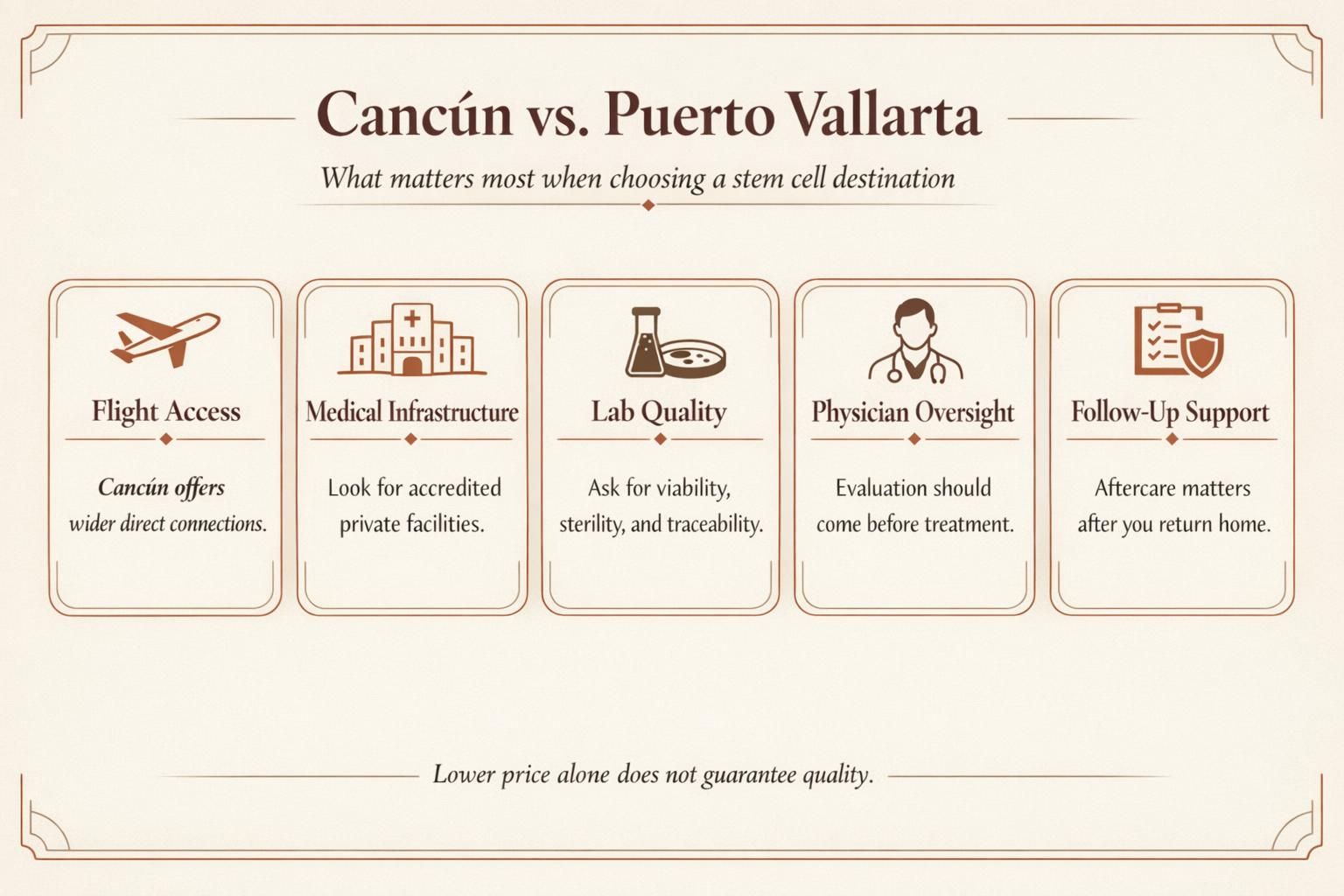
Cancún International Airport serves direct flights from dozens of US and Canadian cities, including New York, Toronto, Chicago, Miami, Houston, Los Angeles, and many more. This makes Cancún one of the most accessible Mexican destinations for North American patients.
Puerto Vallarta also has an international airport with direct connections from select cities, primarily on the US West Coast. Patients traveling from the East Coast or Canada often face a connection or a longer total travel time.
For patients managing chronic conditions, fatigue, or mobility limitations, shorter travel days matter. Easier arrivals mean patients arrive less depleted and more ready to begin their medical experience. Cancún’s flight access gives it a practical edge for the majority of North American travelers.
If you want a broader overview of planning a treatment trip to Mexico, the guide to medical tourism in Mexico covers logistics, costs, and what to expect from start to finish.
Medical Infrastructure: What the Difference Looks Like in Practice
Cancún has a more developed private healthcare infrastructure than Puerto Vallarta. The city hosts internationally accredited private hospitals, specialized diagnostic centers, and a growing number of advanced medicine clinics serving international patients year-round.
Puerto Vallarta has solid general healthcare options, but its regenerative medicine ecosystem is smaller. Patients may find fewer specialized providers, less access to advanced complementary therapies, and more limited follow-up support infrastructure.
For patients seeking a complete regenerative medicine experience — one that includes physician evaluation, advanced biologics, complementary recovery technologies, and coordinated patient support — Cancún currently offers more depth.
What Patients Should Ask About Any Clinic in Either City
The city matters less than the clinic itself. A poorly structured clinic in Cancún is no better than a poorly structured one in Puerto Vallarta. Patients should focus their evaluation on the provider, not just the location.
Here are the most important questions to ask before booking:
- Where do the stem cells or biologics come from? Ask about sourcing, donor screening, and processing standards.
- What quality documentation does the clinic provide? Look for viability testing, sterility confirmation, and traceability records.
- Is the protocol physician-guided? A medical evaluation should come before any treatment recommendation.
- Does the clinic offer complementary therapies? Recovery support through hyperbaric oxygen, red light therapy, PEMF, or ozone-based blood therapies can be part of a more complete protocol.
- What follow-up support does the clinic provide? Treatment does not end at discharge.
- Is the clinic operating within Mexico’s COFEPRIS regulatory framework? Ask about licensing, product certification, and clinical documentation.
Learning how to choose a stem cell clinic in Mexico gives you a more complete framework for evaluating any provider, regardless of city.
Why Laboratory Quality Is a Critical Differentiator
One of the most overlooked factors in choosing a regenerative medicine clinic is the quality of the biologic product itself. Not all stem cell preparations are equal. Viability, sterility, cell passage number, processing environment, and documentation standards all affect what actually reaches the patient.
Many clinics outsource their biologics from third-party suppliers with limited transparency. Patients often receive no documentation about cell viability, sterility testing, or product origin. This creates real uncertainty about what they are receiving.
Clinics with in-house or closely affiliated laboratory ecosystems offer greater control, traceability, and accountability. When evaluating any clinic in Cancún or Puerto Vallarta, ask directly about certified stem cells, what quality standards govern the biologics used, and whether a certificate of analysis is available.
How Cellular Institute Approaches Regenerative Medicine in Cancún
Cellular Institute operates in Cancún as a physician-led regenerative medicine and longevity clinic. The clinic does not position itself as a single-injection provider. Instead, the medical team designs each protocol around the individual patient’s evaluation, health history, goals, and clinical profile.
The clinic’s biologics ecosystem connects to Cellgenic, an in-house affiliated laboratory partner that supports quality control, xeno-free processing standards, cell viability testing, sterility confirmation, and product traceability. This means patients have greater visibility into the quality of what they receive — not just a marketing claim, but a process with documentation behind it.
Dr. Rafael Moguel, Medical Director and cardiologist, leads the clinical team alongside specialists in immunology, orthopedics, and aesthetic medicine. Every patient undergoes a medical evaluation before any protocol begins. This physician-guided approach sets a different standard than clinics that simply process booking requests and administer injections.
Beyond the core regenerative therapy, Cellular Institute integrates complementary protocols that may support recovery and optimization. These include exosome therapy, peptide therapy, EBOO blood detox therapies, hyperbaric oxygen, red light therapy, and PEMF — all coordinated as part of a broader patient strategy when clinically appropriate.
International patient coordination is built into the experience. Patients receive bilingual support, airport transfer assistance, concierge-style medical coordination, and structured follow-up after they return home. For a full picture of what the patient journey looks like, the article on regenerative medicine in Cancún: 10 things to know before you go covers the process in detail.
Realistic Expectations for Either Destination
No clinic in Mexico — or anywhere in the world — can guarantee specific outcomes from regenerative medicine. Results vary significantly depending on patient health status, condition severity, protocol design, biologic quality, and individual response. Any clinic that promises guaranteed results warrants serious skepticism.
Responsible clinics set realistic expectations, require proper medical evaluation, and design protocols based on clinical reasoning rather than price or convenience. Understanding how long stem cell therapy results may last and what affects outcomes helps patients approach the decision with clarity.

Frequently Asked Questions
Is Cancún or Puerto Vallarta better for stem cell therapy?
Neither city is automatically better. The quality of the clinic, its medical team, its laboratory standards, and its patient support infrastructure matter far more than geography. That said, Cancún offers stronger flight connections from most North American cities, a more developed private healthcare ecosystem, and access to more specialized regenerative medicine providers. Patients should evaluate specific clinics carefully rather than choosing based on destination alone.
How do I know if a Mexican stem cell clinic is reputable?
Look for physician-guided protocols, transparent biologic sourcing, quality documentation including viability and sterility testing, COFEPRIS-recognized licensing structure, clear candidate evaluation processes, and structured follow-up support. Clinics that avoid these questions or cannot answer them clearly deserve more scrutiny. Reviewing the signs of safe stem cell clinics in Mexico gives you a practical checklist.
What is the typical cost difference between Cancún and Puerto Vallarta for stem cell therapy?
Pricing varies by clinic, protocol complexity, and biologic type rather than by city. A lower price does not indicate better value if the biologic quality, physician oversight, or follow-up support is weaker. For a broader cost framework, the guide to stem cell therapy cost in Mexico explains what factors drive price differences and what should be included in a complete protocol.
Can I combine stem cell therapy with other regenerative treatments during my trip to Cancún?
Yes, when clinically appropriate and following proper physician evaluation. Cancún clinics with an integrated platform may offer complementary therapies such as exosome therapy, EBOO blood detox, peptide therapy, hyperbaric oxygen, and red light therapy as part of a coordinated protocol. These adjunct therapies may help support recovery, reduce inflammation, and optimize overall outcomes when selected based on individual clinical need.
Final Thoughts
Choosing between a stem cell clinic in Cancún and one in Puerto Vallarta ultimately comes down to evaluating the clinic itself. Cancún offers practical advantages in travel access, medical infrastructure, and specialized regenerative medicine depth. But the most important variables are always the physician team, the biologic quality, the protocol design, and the patient support system.
If you are at the point of comparing destinations and clinics, the next step is a direct conversation with a qualified medical team. Cellular Institute’s approach to regenerative medicine in Cancún is built around evaluation first — designing a protocol around your specific situation, not a package around a price point.
To explore whether you may be a candidate and what a personalized protocol might look like for your goals, schedule a discovery call with our team. There is no pressure and no obligation — just a focused conversation to help you make a better-informed decision.
Medical Disclaimer
This article is for educational purposes only and does not replace medical advice, diagnosis, or treatment. Regenerative therapies are not appropriate for every patient, and outcomes vary. A licensed physician must evaluate your medical history, goals, and candidacy before any treatment can be recommended.