
Written by: Cellular Institute Editorial Team
Medical reviewer: Dr. Matilde Rodríguez – CP 12651081
Laboratory reviewer: Biotecnóloga Diana Navarrete – CP 15029468
Quick Answer
Stem cell therapy for fibromyalgia is an emerging area of interest in regenerative medicine. Early research and clinical observations suggest that mesenchymal stem cells may help modulate immune activity and reduce systemic inflammation — two factors closely linked to fibromyalgia symptoms. However, stem cell therapy is not a cure, outcomes vary significantly by patient, and physician evaluation is required before any protocol can be considered appropriate.
What Patients With Fibromyalgia Should Know
Fibromyalgia affects millions of people worldwide. Widespread musculoskeletal pain, persistent fatigue, disrupted sleep, and cognitive fog — often called fibro fog — make daily life genuinely difficult. Many patients try multiple medications, physical therapy, and lifestyle changes with limited lasting relief.
This frustration leads many patients to explore regenerative options. Stem cell therapy has gained attention as a potential supportive tool, not as a replacement for medical care, but as part of a broader, personalized protocol designed to address the underlying biology of chronic inflammation and immune dysregulation.
Understanding what this therapy may or may not do — and what separates a responsible clinic from an irresponsible one — matters enormously before any patient books a flight or submits a deposit.
How Stem Cell Therapy May Fit Into a Fibromyalgia Protocol
Fibromyalgia involves amplified pain signaling, central sensitization, and a pattern of low-grade systemic inflammation. Researchers continue to investigate the immune and neurological components of this condition.
Mesenchymal stem cells, commonly derived from umbilical cord tissue, carry immunomodulatory and anti-inflammatory properties. In a regenerative medicine context, the goal is not to eliminate a diagnosis. Instead, the therapy aims to help the body recalibrate its inflammatory response and support tissue-level recovery processes.
Patients considering this option often report that conventional treatments have stopped producing meaningful results. A physician-guided regenerative protocol may address multiple contributing factors at once — inflammation, immune dysregulation, oxidative stress, and cellular fatigue — rather than managing symptoms in isolation.
At Cellular Institute, protocols for patients with chronic inflammatory and immune-related conditions are never one-size-fits-all. The medical team evaluates each patient individually, considering their history, labs, current symptom burden, and overall health before designing any plan. You can learn more about this approach through our regenerative medicine in Cancún service page.
Complementary Tools That May Support the Protocol
Stem cell therapy is rarely the only tool in a well-designed protocol. For patients with fibromyalgia, systemic inflammation and oxidative stress are common threads. A physician may recommend additional supportive therapies alongside cellular treatment.
- EBOO therapy supports blood filtration, reduces oxidative stress, and may help lower the inflammatory burden before or alongside cellular therapy. Learn how EBOO therapy and systemic inflammation are connected.
- Exosome therapy delivers cell-signaling molecules that may support recovery, tissue communication, and inflammation modulation at a molecular level. Explore exosome therapy as part of an advanced regenerative approach.
- Peptide therapy may support recovery, sleep quality, and energy regulation — factors that matter deeply for fibromyalgia patients. See how peptide therapy fits into a longevity and recovery protocol.
- Recovery technologies such as hyperbaric oxygen therapy, red light therapy, and PEMF may help the body absorb and respond to regenerative treatment more effectively. Our recovery technologies are available as part of integrated treatment plans.
The combination of these tools, when clinically appropriate, creates a more complete environment for recovery and optimization than any single injection could provide.
What Affects Quality and Safety
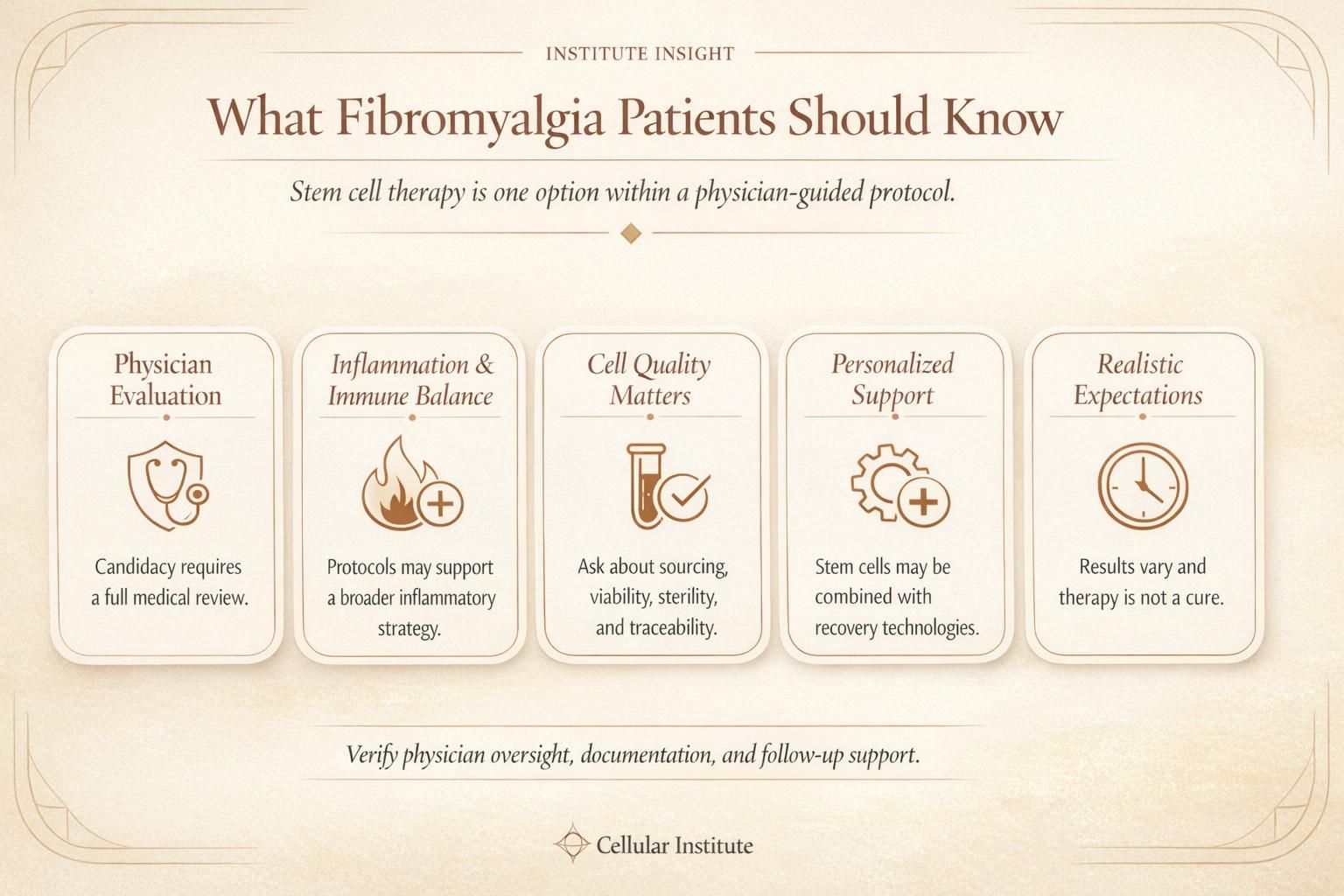
Not all stem cell therapies are equal. The biologic product itself — the cells — matters as much as the therapy concept. Patients should ask hard questions about where the cells come from, how they are processed, and what documentation the clinic provides.
At Cellular Institute, biologic quality begins long before treatment day. Through our affiliated lab ecosystem, Cellgenic, the team applies rigorous standards to cell sourcing, processing, viability testing, sterility confirmation, and traceability. This means patients receive certified stem cells with documented quality control — not an opaque product with no verifiable origin.
Our biotechnology team, including Biotechnologist Diana Navarrete, plays an active role in reviewing product documentation and maintaining the standards that connect lab science to clinical care. This level of lab transparency is one of the clearest ways Cellular Institute differentiates itself from clinics that outsource biologics without visibility into product quality.
Patients who want to make a fully informed decision should read our guide on how to choose a stem cell clinic in Mexico before committing to any provider.
Who May Be a Candidate
Fibromyalgia patients who may be considered for a regenerative protocol often share certain characteristics. These are general observations, not guarantees of candidacy.
- Adults with a confirmed fibromyalgia diagnosis who have tried conventional treatments with limited results
- Patients with elevated inflammatory markers or immune dysregulation patterns on lab work
- Individuals who are not currently managing an active infection, uncontrolled autoimmune flare, or contraindicated health condition
- Patients committed to supporting the protocol with lifestyle, nutrition, and recovery practices
- Those who understand that regenerative medicine may support improvement over time, not overnight transformation
Candidacy always requires a full medical evaluation. A physician reviews your history, current health status, medications, and goals before any recommendation is made.
Who May Not Be a Candidate
Regenerative medicine is not appropriate for everyone. Some patients may not qualify due to active malignancy, certain immune conditions, severe organ dysfunction, or other contraindications. A physician must evaluate each case individually. No patient should self-refer into a regenerative protocol without a proper clinical review.
How Cellular Institute Approaches Fibromyalgia Patients
Cellular Institute does not offer a standardized fibromyalgia package. The medical team — led by Dr. Roni Moya, Immunologist and supported by our full clinical staff — evaluates each patient’s immune profile, inflammatory burden, symptom history, and recovery capacity before designing a protocol.
This approach reflects the core belief at Cellular Institute: the therapy is only one part of the strategy. The process around the therapy — evaluation, preparation, delivery, recovery, and follow-up — determines the quality of the patient experience and shapes what is possible.
International patients traveling from the United States and Canada receive full coordination support, including patient concierge services, bilingual medical guidance, and structured follow-up after returning home. For patients curious about the logistics of traveling for treatment, our guide to medical tourism in Mexico covers what to expect in detail.
Questions to Ask Before Choosing a Clinic
Patients researching stem cell therapy for fibromyalgia should ask every clinic they consider the following questions:
- Where do the stem cells come from, and how are they processed?
- What quality documentation is available — viability, sterility, traceability?
- Does a licensed physician evaluate my candidacy before treatment?
- Is the protocol personalized to my case, or is it a standard package?
- What complementary therapies does the clinic offer to support the protocol?
- What follow-up support does the clinic provide after I return home?
- Is the clinic operating within a recognized regulatory framework?
These questions protect patients from making decisions based on price alone. The quality of the biologic product, the medical evaluation, the recovery environment, and the follow-up plan all matter.

Frequently Asked Questions
Is stem cell therapy approved for fibromyalgia?
Stem cell therapy for fibromyalgia is not FDA-approved in the United States. In Mexico, regenerative medicine operates within a separate regulatory framework under COFEPRIS. Cellular Institute operates within this recognized structure. Patients should understand that regenerative therapies for fibromyalgia remain investigational, and responsible clinics will communicate this clearly rather than overpromising outcomes.
How long does it take to notice results from stem cell therapy?
Results vary significantly by patient. Some individuals report gradual improvements in energy, sleep quality, and pain levels over weeks to months following treatment. Others may notice more modest changes. There are no guarantees, and patients should approach the process with realistic expectations and a commitment to the recovery plan their physician designs. For more context on timelines, explore our article on how long stem cell therapy results may last.
What does stem cell therapy cost for fibromyalgia in Mexico?
Pricing depends on the complexity of the protocol, the number of sessions, and the complementary therapies included. Patients researching cost should understand that the lowest price is rarely the most complete option. Our guide to stem cell therapy cost in Mexico explains what factors influence pricing and what a complete protocol typically includes.
Is it safe to travel to Cancún for stem cell therapy?
Many international patients travel to Cancún each year for regenerative medicine at well-established clinics. Safety depends on choosing a medically credible provider with proper regulatory standing, physician oversight, and transparent quality standards. Cellular Institute supports international patients throughout the entire process, from pre-travel preparation to post-treatment follow-up. Patients can also explore our guidance on stem cell therapy safety in Mexico for additional reassurance.
Final Thoughts
Living with fibromyalgia is exhausting. When conventional approaches stop producing results, it is natural to look further. Stem cell therapy may offer a meaningful addition to a well-designed regenerative protocol — but only when pursued through a clinic that takes evaluation, quality, and personalization seriously.
Cellular Institute does not promise a cure. What the team promises is a thorough, physician-guided evaluation, a transparent biologic product backed by lab quality standards, and a complete regenerative experience designed around your individual case.
If you are ready to explore whether you may be a candidate, schedule a discovery call with our patient coordination team. The first step is a conversation — not a commitment.
Medical Disclaimer
This article is for educational purposes only and does not replace medical advice, diagnosis, or treatment. Regenerative therapies are not appropriate for every patient, and outcomes vary. A licensed physician must evaluate your medical history, goals, and candidacy before any treatment can be recommended.