
Written by: Cellular Institute Editorial Team
Medical reviewer: Dr. Matilde Rodríguez – CP 12651081
Laboratory reviewer: Biotecnóloga Diana Navarrete – CP 15029468
Quick Answer
Stem cell therapy for Parkinson’s disease does not offer a cure. However, evidence-informed research and clinical experience suggest that certain regenerative medicine protocols may support neurological function, inflammation modulation, and quality of life in appropriately selected patients. Physician evaluation is required before any protocol can be considered. Results vary significantly by patient, disease stage, and overall health status.
What Patients with Parkinson’s Are Asking in 2026
Parkinson’s disease affects millions of people worldwide. As the disease progresses, many patients find that conventional medications manage symptoms less effectively over time. This leads patients and caregivers to search for additional options.
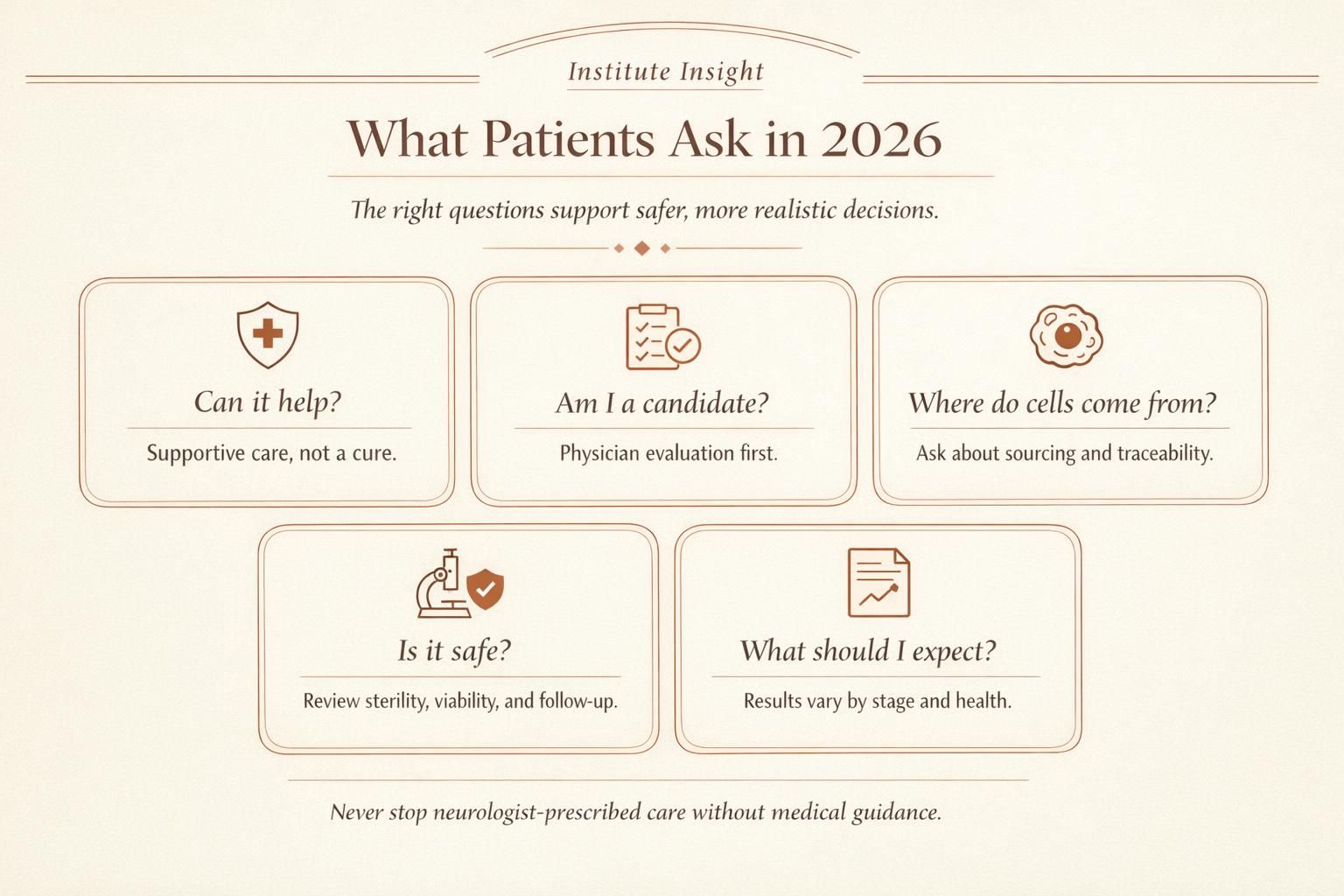
In 2026, stem cell therapy is one of the most searched topics in regenerative medicine for neurological conditions. Patients are not necessarily looking for a miracle. They are asking thoughtful, practical questions.
The most common questions we hear include:
- Can stem cell therapy help reduce tremors or stiffness?
- Is regenerative medicine safe for someone with Parkinson’s?
- What type of stem cells are used, and where do they come from?
- How do I know if I am a candidate?
- What should I realistically expect?
- How does stem cell therapy work alongside my current medications?
These are exactly the right questions to ask. And they deserve honest, medically conservative answers.
What the Research Suggests
Parkinson’s disease involves the progressive loss of dopamine-producing neurons in the brain. Conventional treatments help manage symptoms, but they do not slow the underlying neurodegeneration.
Regenerative medicine researchers have studied whether certain cell types may support neuroprotection, reduce neuroinflammation, and promote a more stable cellular environment. Early-stage clinical research and ongoing trials suggest some areas of interest, particularly around:
- Mesenchymal stem cells (MSCs) and their potential anti-inflammatory and neuroprotective signaling
- Exosome therapy and cell-to-cell communication support
- Reducing systemic inflammation, which may contribute to neurological burden
It is important to be clear: stem cell therapy for Parkinson’s disease is not a standard of care. It does not reverse disease progression. Clinical evidence is still evolving. However, for some patients, a physician-guided regenerative protocol may support overall neurological health and quality of life as part of a broader care strategy.
Patients should never replace their neurologist’s care or stop medications based on regenerative therapy alone. The goal is to complement, not replace, conventional medical management.
What Affects Quality and Safety in Stem Cell Therapy
Not all stem cell therapy is the same. The quality of the biologic product matters enormously. So does the clinical evaluation, the delivery method, the physician’s experience, and the follow-up process.
Patients exploring stem cell therapy for Parkinson’s should ask:
- Where do the stem cells come from, and how are they processed?
- What documentation exists for viability, sterility, and traceability?
- Does the clinic use xeno-free processing standards?
- Is there a physician evaluation before treatment?
- What complementary therapies are included in the protocol?
At Cellular Institute, biologics are prepared through our affiliated lab ecosystem, Cellgenic, which prioritizes certified stem cells with documented quality standards, traceability, and sterility testing. We believe that quality begins in the lab, long before a patient receives any therapy.
Patients can learn more about our commitment to lab quality and transparency to understand what separates a responsible regenerative medicine provider from a low-quality alternative.
Who May Be a Candidate for a Regenerative Protocol
Candidacy for stem cell therapy in the context of Parkinson’s disease depends on several factors. A physician must evaluate the patient before any recommendation can be made.
Patients who may be considered for evaluation include those who:
- Have an established Parkinson’s diagnosis managed by a neurologist
- Want to explore supportive care alongside conventional treatment
- Are in a medically stable condition
- Have realistic expectations about the role of regenerative medicine
- Are willing to follow a structured, physician-guided protocol
Who May Not Be a Candidate
Regenerative medicine is not appropriate for every patient. Physician evaluation will determine whether the potential benefits outweigh any risks for a specific individual.
Patients with active infections, certain autoimmune conditions, advanced systemic disease, or other contraindications may not qualify. Patients who expect a cure or guaranteed symptom elimination are also not well suited for this type of program.
How Cellular Institute Approaches Neurological Support
Cellular Institute does not offer a single-injection approach. We design personalized protocols around each patient’s full medical picture. For patients with neurological conditions like Parkinson’s disease, a protocol may include several complementary therapies working together.
A protocol may combine elements such as:
- Mesenchymal stem cell therapy for neuroprotective and anti-inflammatory support
- Exosome therapy to support cell signaling and cellular communication
- EBOO therapy to address systemic inflammation and oxidative stress
- Hyperbaric oxygen therapy and other recovery technologies to support neurological tissue oxygenation
- Peptide therapy for systemic optimization and recovery support
Each protocol begins with a thorough medical evaluation. Our team reviews the patient’s history, current medications, lab values, and goals before designing any plan. Learn more about our full approach to regenerative medicine in Cancún.
Our clinic operates within Mexico’s medical regulatory framework, with a COFEPRIS-recognized structure that supports responsible tissue handling and clinical application. We are also connected to the broader ISSCA and Global Stem Cells Group ecosystem, which brings over 15 years of regenerative medicine education and physician training to our clinical approach.
Questions to Ask Before Choosing a Clinic
If you are exploring stem cell therapy for Parkinson’s disease, the clinic you choose matters as much as the therapy itself. Use these questions to evaluate any provider:
- Is there a physician evaluation before treatment?
- What type of stem cells do you use, and where are they sourced?
- Can you provide documentation of viability, sterility, and traceability?
- Is the protocol personalized, or is it the same for every patient?
- What complementary therapies are included?
- What does follow-up care look like after I return home?
- Is the clinic operating within a recognized regulatory framework?
For more guidance, read our detailed article on how to choose a stem cell clinic in Mexico. It walks patients through the key factors, red flags, and decisions to make before booking any treatment.

Frequently Asked Questions
Can stem cell therapy cure Parkinson’s disease?
No. Stem cell therapy does not cure Parkinson’s disease. Research suggests that certain regenerative protocols may support neuroprotection, reduce neuroinflammation, and improve quality of life in some patients. However, outcomes vary significantly, and no clinic should promise a cure or disease reversal. A physician evaluation is always required before any treatment recommendation.
Is it safe to travel to Cancún for stem cell therapy with Parkinson’s disease?
Many international patients travel to Cancún for regenerative medicine, including those managing neurological conditions. Safety depends on the patient’s overall health, disease stage, and travel readiness. Cellular Institute supports international patients with coordinated logistics, bilingual patient coordinators, and physician oversight throughout the process. Patients should discuss travel with their neurologist before planning a trip.
How long might the effects of stem cell therapy last for Parkinson’s patients?
Duration of any observable effects varies widely by patient, protocol design, disease stage, and overall health. Some patients report sustained benefits over several months, while others may require follow-up protocols. Understanding how long stem cell therapy results may last is an important part of setting responsible expectations before treatment.
What is the cost of stem cell therapy for Parkinson’s disease in Mexico?
Pricing depends on the protocol, the number of therapies included, the quality of the biologic product, and the level of physician oversight. Patients should be cautious of unusually low prices, as they often reflect lower-quality biologics, minimal physician involvement, or lack of complementary support. For a detailed breakdown, visit our guide on stem cell therapy cost in Mexico.
Final Thoughts
Parkinson’s disease is a complex, progressive condition. Patients and families deserve honest, medically responsible information when they explore regenerative medicine options. Stem cell therapy may offer supportive benefits for some patients, but it is not a replacement for neurological care, and it is never a guaranteed solution.
At Cellular Institute, we approach neurological support with the same evidence-informed, physician-guided philosophy we apply to every condition. We design protocols around the whole patient, not a single injection. We start with a thorough evaluation, build a personalized plan, and support the patient throughout the journey.
If you or a loved one is exploring stem cell therapy for Parkinson’s disease, we encourage you to start with a conversation. Schedule a discovery call with our patient coordination team to ask questions, share your medical history, and learn whether you may be a candidate for a personalized regenerative protocol.
Medical Disclaimer
This article is for educational purposes only and does not replace medical advice, diagnosis, or treatment. Regenerative therapies are not appropriate for every patient, and outcomes vary. A licensed physician must evaluate your medical history, goals, and candidacy before any treatment can be recommended.