

Written by: Cellular Institute Editorial Team
Medical reviewer: Dr. Matilde Rodríguez – CP 12651081
Laboratory reviewer: Biotecnóloga Diana Navarrete – CP 15029468
Quick Answer
Longevity medicine should begin with measurement because no physician can design a responsible, personalized protocol without first understanding a patient’s baseline health. Advanced longevity diagnostics help identify inflammation levels, metabolic function, hormonal status, cellular health indicators, and other key biomarkers before any intervention begins. A thorough evaluation is required before any treatment recommendation can be made. Results vary significantly by patient, and a physician must guide every step of the process.
The Problem With Starting With Treatment
Many executives and health-conscious adults arrive at regenerative medicine or longevity clinics already knowing what they want. They have researched stem cell therapy, peptide therapy, exosomes, hyperbaric oxygen, and advanced biologics. They are ready to act.
That motivation is understandable. But starting with a chosen treatment before completing a thorough diagnostic evaluation carries real risk. Without measurement, a clinician cannot know whether the protocol fits the patient, what the body actually needs, or which interventions may support the patient’s goals most effectively.
Longevity medicine is not a wellness menu. It is a clinical process. And every responsible clinical process begins with data.
What Longevity Diagnostics Actually Measure
The term “longevity diagnostics” covers a broad category of advanced evaluations that go well beyond a standard annual physical. These assessments help a physician build a complete picture of how a patient is aging at the biological level, not just the chronological one.
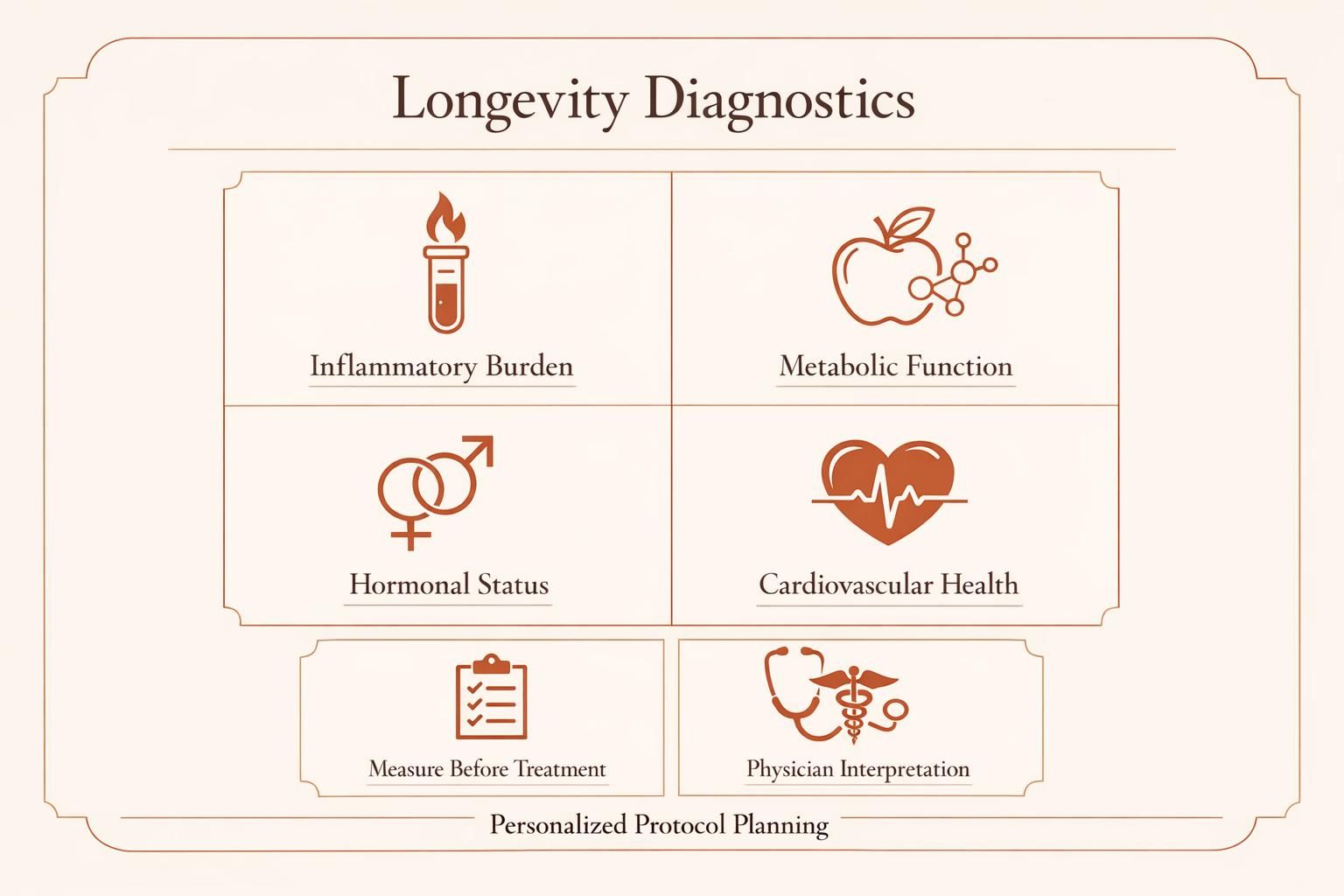
Key areas that longevity diagnostics typically evaluate include:
- Inflammatory burden: Chronic low-grade inflammation accelerates biological aging. Measuring markers like high-sensitivity CRP, interleukins, and fibrinogen helps quantify this burden.
- Metabolic function: Insulin sensitivity, fasting glucose, lipid panels, and liver function all reveal how efficiently the body processes and uses energy.
- Hormonal status: Testosterone, estrogen, DHEA, thyroid hormones, cortisol, and growth factors all decline with age and influence recovery, cognition, and vitality.
- Cardiovascular health: Advanced lipid markers, arterial stiffness indicators, and cardiac function data inform cardiovascular risk and longevity planning.
- Oxidative stress and antioxidant capacity: These markers reveal how much cellular damage is occurring and how well the body manages it.
- Nutritional and micronutrient status: Deficiencies in key nutrients can silently impair cellular function, immune health, and recovery.
- Immune system function: Immune balance matters significantly in both longevity and regenerative medicine protocols.
Together, these data points create a clinical foundation. Without them, even the most advanced regenerative tools lack direction.
Why Measurement Makes Treatment More Meaningful
Consider two patients who both present with fatigue, reduced performance, and early signs of accelerated aging. On the surface, they look similar. But diagnostics may reveal very different pictures.
One patient may show high systemic inflammation, poor metabolic control, and suboptimal testosterone. Another may show low inflammatory burden but significant oxidative stress and hormonal dysregulation. The same protocol would not serve both patients equally well.
When a physician reviews complete diagnostic data, they can prioritize interventions more intelligently. For example, a patient with elevated inflammatory markers may benefit from therapies that support inflammation modulation, such as EBOO therapy in Cancún, before receiving cellular or biologic therapies. Another patient may respond better to a protocol that combines recovery technologies with targeted nutritional and hormonal support.
Measurement does not replace clinical judgment. It informs it.
What Patients Should Know Before Choosing Any Longevity Intervention
If a clinic offers you a treatment before completing a medical evaluation, that is a meaningful red flag. Responsible longevity medicine always starts with a comprehensive assessment. Here is what patients should expect from a serious provider:
- A detailed review of medical history, symptoms, and health goals
- Advanced laboratory panels that go beyond standard bloodwork
- Physician-led interpretation of diagnostic results
- A personalized protocol recommendation based on your specific data
- Clear communication about what each intervention may support and why
- Responsible expectations and follow-up evaluation after treatment
Patients who want to learn more about how to evaluate providers can read our guide on how to choose a stem cell clinic in Mexico, which outlines the key questions every patient should ask before committing to a clinic or protocol.
Who May Benefit From a Longevity Diagnostic Evaluation
A longevity diagnostic evaluation may be appropriate for adults who:
- Feel that their energy, recovery, or cognitive performance has declined
- Want to proactively assess their biological age and health trajectory
- Are considering advanced regenerative interventions and want a clinical foundation first
- Have seen standard lab results described as “normal” but still feel that something is off
- Are executives or high-performing individuals who want to optimize function and longevity
- Have a family history of cardiovascular disease, metabolic conditions, or early aging
Candidacy depends on individual medical history and goals. A physician must evaluate each patient before any protocol can be designed or recommended.
Who May Not Be an Immediate Candidate
Some individuals may need to address acute medical conditions before beginning a longevity optimization program. Patients with active infections, unmanaged chronic disease, or recent surgery may require stabilization before advanced diagnostics translate meaningfully into a longevity protocol. A physician will identify these factors during the initial evaluation.
How Cellular Institute Approaches Longevity Diagnostics
At Cellular Institute in Cancún, the approach to longevity medicine begins with clinical reasoning, not a treatment menu. Under the medical leadership of Dr. Rafael Moguel, Medical Director, the team evaluates each patient’s diagnostic data before designing any protocol.
This evaluation-first model means that every recommendation connects back to the patient’s actual biology. The medical team reviews inflammatory burden, metabolic function, cardiovascular data, hormonal status, and other longevity-relevant markers before recommending any intervention.
Depending on what the evaluation reveals, a personalized protocol may incorporate regenerative medicine in Cancún, advanced biologics, recovery technologies, peptides, ozone-based blood therapies, or a combination of these tools. No two protocols look exactly alike because no two patients are exactly alike.
Cellular Institute’s broader ecosystem, which includes in-house biologics through Cellgenic and physician education through ISSCA, reinforces this commitment to evidence-informed, individualized care. This is not a single-injection model. It is a complete medical optimization system built around the patient’s data and goals.

Frequently Asked Questions
What is the difference between standard bloodwork and longevity diagnostics?
Standard bloodwork typically screens for disease or deficiency at a basic level. Longevity diagnostics go further by measuring biomarkers associated with biological aging, inflammation, oxidative stress, hormonal balance, metabolic efficiency, and cellular health. These advanced panels give a physician more precise data to design a meaningful longevity protocol.
Do I need to complete diagnostics before receiving regenerative therapy?
Yes. A physician must evaluate your medical history, current health status, and relevant biomarkers before any regenerative protocol can be recommended. Skipping this step increases the risk of receiving a protocol that does not match your actual clinical needs. Physician evaluation is always required before treatment.
Can I do my diagnostics before traveling to Cancún?
In some cases, patients can complete preliminary lab work at home before their visit. Cellular Institute’s patient coordinators can guide you through what may be helpful to bring, what will be evaluated on arrival, and how to prepare for your assessment. A discovery call is a good starting point to clarify this process for your specific situation.
How often should longevity diagnostics be repeated?
Most longevity-focused physicians recommend repeating key diagnostic panels every six to twelve months, or after a significant protocol change. Regular measurement allows the medical team to track progress, refine the protocol, and identify new areas for optimization over time. The appropriate interval depends on your individual health status and goals.
Final Thoughts
Longevity medicine attracts some of the most health-conscious and high-performing individuals in the world. These patients deserve more than a list of available treatments. They deserve a clinical process that begins with honest measurement and builds from there.
The most advanced interventions in regenerative medicine, from cellular biologics to ozone-based therapies to recovery technologies, all become more purposeful when a physician designs the protocol around real diagnostic data. Measurement is not a delay in treatment. It is the foundation that makes treatment meaningful.
If you are ready to understand your longevity baseline before choosing any intervention, we invite you to schedule a discovery call with the Cellular Institute team. Our patient coordinators will help you understand what a physician-guided evaluation may look like for your goals and how to take the first step toward a personalized longevity protocol.
Medical Disclaimer
This article is for educational purposes only and does not replace medical advice, diagnosis, or treatment. Regenerative therapies are not appropriate for every patient, and outcomes vary. A licensed physician must evaluate your medical history, goals, and candidacy before any treatment can be recommended.