

Written by: Cellular Institute Editorial Team
Medical reviewer: Dr. Matilde Rodríguez – CP 12651081
Laboratory reviewer: Biotecnóloga Diana Navarrete – CP 15029468
Quick Answer
Cancún has become one of the most visited destinations for international patients seeking regenerative medicine in Cancún. Patients travel here for access to advanced biologics, physician-guided protocols, and a coordinated medical tourism experience that often exceeds what is available close to home. However, not every clinic meets the same standard. Before traveling, patients should carefully evaluate cell quality, physician oversight, regulatory structure, and the level of personalized care. A thorough candidate evaluation is always required before any protocol can be recommended.
Why International Patients Are Choosing Cancún for Regenerative Care
The decision to travel abroad for medical care is rarely simple. Patients from the United States and Canada who explore regenerative medicine often face long wait times, limited access, or significant cost barriers at home. Cancún has emerged as a practical and premium alternative.
The city offers direct flights from major North American hubs, a well-developed medical infrastructure, and a growing number of clinics focused on stem cell therapy, exosome therapy, EBOO, and longevity medicine. The combination of accessibility, clinical quality, and cost-effectiveness makes it an appealing destination for serious medical travelers.
That said, accessibility alone does not make a destination the right choice. What matters most is the clinic behind the experience.
What Patients Should Evaluate Before Choosing a Clinic
Many patients begin their search focused on price. This is understandable, but price tells only part of the story. The quality of a regenerative medicine experience depends on factors that are often invisible in a marketing brochure.
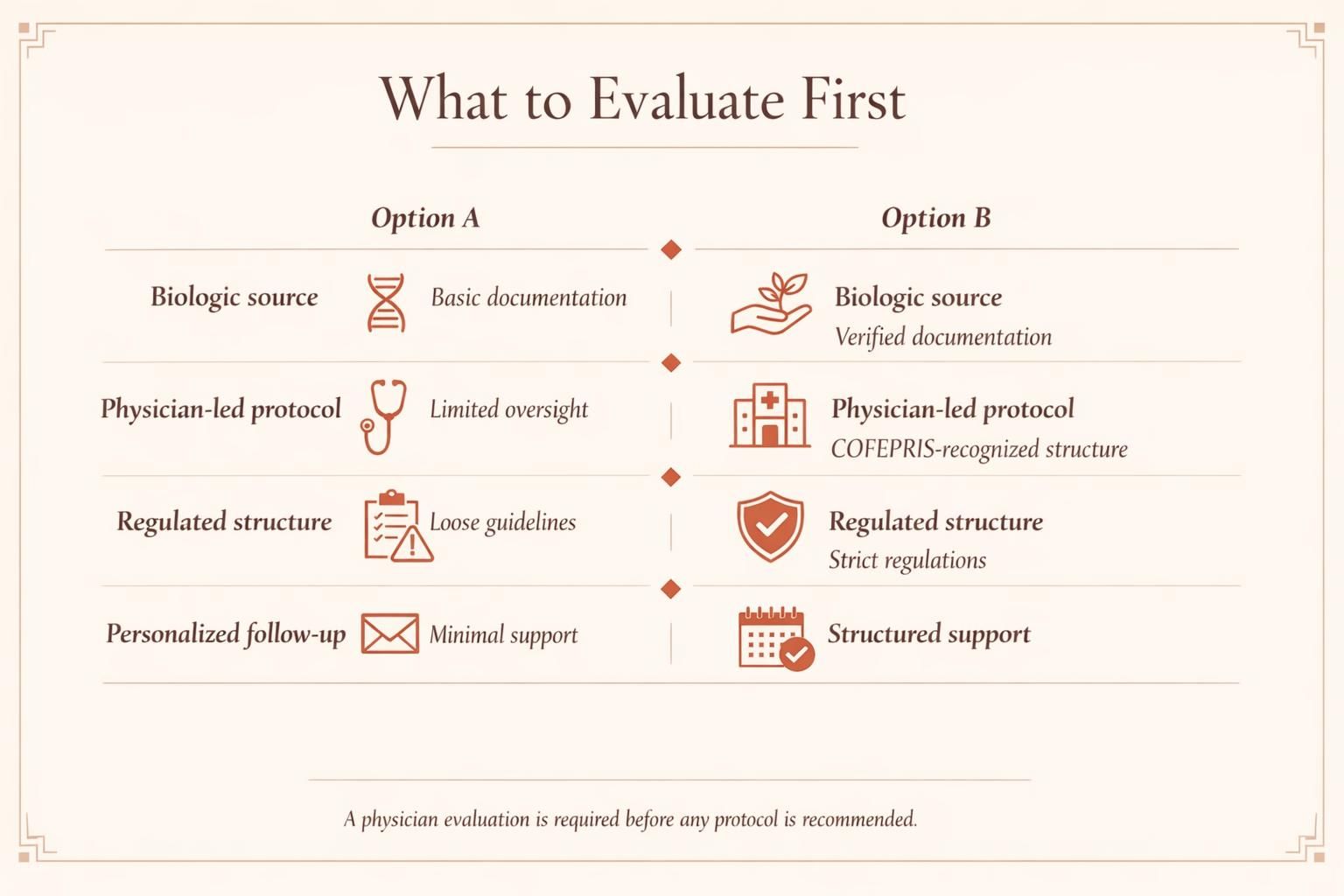
1. Where Do the Cells or Biologics Come From?
Biologic quality is the foundation of any regenerative protocol. Patients should ask where the cells, exosomes, or other biologics originate, how they are processed, and what documentation supports their safety. Key questions include whether the provider follows xeno-free manufacturing standards, whether viability and sterility testing occurs, and whether a certificate of analysis is available.
Clinics that source biologics from external suppliers with limited traceability present a higher risk. Clinics with vertically integrated lab support and clear quality documentation offer greater transparency. Lab quality and transparency should be a non-negotiable standard when comparing providers.
2. Is the Protocol Physician-Led?
Regenerative medicine is not a spa service. A qualified physician should evaluate each patient individually, review medical history and diagnostics, and build a protocol based on that patient’s specific goals and health status. A clinic that offers the same protocol to every patient regardless of condition should raise a concern.
Physician-guided care also means someone is medically accountable throughout the experience. This matters especially for international patients traveling without their primary care physician.
3. Is the Clinic Operating Within a Regulated Structure?
Mexico’s COFEPRIS framework governs medical facilities and biologic handling. Patients should ask whether the clinic operates within a COFEPRIS-recognized structure and holds appropriate licensing for tissue handling, clinical application, and regenerative therapies. Understanding stem cell therapy safety in Mexico begins with knowing how the clinic is structured from a regulatory standpoint.
4. Is the Treatment a Protocol or Just a Procedure?
The most meaningful regenerative medicine experiences go beyond a single injection. A complete protocol may include stem cell or exosome therapy, complementary recovery technologies, advanced blood therapies, peptide support, and structured follow-up. Each layer of the protocol serves a different purpose in supporting the body’s response to treatment.
Clinics that offer only a single-treatment model with no surrounding medical context are likely not designing care around the individual patient.
What a Complete Regenerative Medicine Experience May Include
At Cellular Institute, the patient journey does not begin with a treatment. It begins with a medical evaluation. The clinical team reviews each patient’s history, goals, diagnostics, and overall health status before recommending any protocol.
Depending on the patient’s candidacy and goals, a personalized protocol may include regenerative cell therapies, EBOO therapy in Cancún for inflammation and oxidative support, peptide therapy for recovery and optimization, and advanced recovery technologies such as hyperbaric oxygen, red light therapy, and PEMF.
The medical team also uses certified stem cells backed by quality documentation, with biological products prepared through Cellgenic, the clinic’s affiliated in-house biologics partner. This integrated approach provides greater traceability and a stronger connection between lab science and clinical care.
Who May Be a Candidate
Patients who may benefit from a regenerative medicine evaluation in Cancún include those exploring support for chronic inflammation, musculoskeletal conditions, post-injury recovery, immune-related challenges, metabolic health, or longevity optimization. Many patients come having already tried conventional approaches without achieving the outcome they hoped for.
Candidacy always depends on an individual physician evaluation. A patient’s current health status, medications, inflammatory markers, and overall goals all influence whether a protocol may be appropriate and what that protocol should include.
Who May Not Be a Candidate
Regenerative medicine is not appropriate for everyone. Active infections, certain autoimmune conditions in acute phases, active malignancies, or other contraindications may make a patient unsuitable for specific therapies. A thorough pre-treatment evaluation is essential for patient safety. Any clinic that skips this step presents a serious concern.
How Cellular Institute Approaches This
Cellular Institute is positioned as a complete regenerative medicine and longevity platform, not a single-procedure provider. The clinic is led by Dr. Rafael Moguel, Medical Director, a cardiologist with extensive experience in regenerative medicine and physician-guided protocols. The broader clinical team includes specialists in immunology, orthopedics, aesthetics, and nursing care.
The clinic’s approach is built around the idea that the process around the therapy matters as much as the therapy itself. This includes pre-treatment diagnostics, personalized protocol design, in-house biologic quality through Cellgenic, a premium recovery environment, bilingual patient coordination, and structured follow-up after the patient returns home.
Cellular Institute is also connected to the ISSCA and Global Stem Cells Group ecosystem, representing more than 15 years of experience in regenerative medicine education, physician training, and protocol development across an international network. This background supports the clinical and scientific credibility behind every patient protocol.
Patients who want to understand what makes one clinic different from another can explore our guide on how to choose a stem cell clinic in Mexico before making a decision.

Frequently Asked Questions
Is it safe to travel to Cancún for regenerative medicine?
Many international patients travel to Cancún safely for medical care each year. The key factors are the quality of the clinic, the regulatory structure it operates within, and the level of coordination provided to international patients. Choosing a physician-led clinic with documented biologic quality, COFEPRIS-recognized licensing, and structured patient support significantly reduces risk. You can also read more about medical tourism in Mexico to understand what to expect.
How does regenerative medicine in Cancún compare to other countries?
Mexico offers a combination of regulatory structure, clinical access, physician experience, and cost-effectiveness that few other destinations match. Cancún in particular benefits from direct international travel connections and a well-established medical tourism infrastructure. The quality of any destination ultimately depends on the individual clinic, not the country alone.
What should I ask a clinic before booking?
Ask where the biologic products come from and what quality documentation supports them. Ask whether a physician will evaluate your candidacy before treatment. Ask how the clinic handles patient coordination, follow-up, and safety. Ask whether the protocol is personalized or standardized. These questions will help you separate high-quality providers from those focused only on sales. Our article on safe stem cell clinics in Mexico outlines what to look for in more detail.
How long might results from regenerative medicine last?
Results vary significantly by patient, condition, protocol, and overall health. Some patients report sustained improvements over many months. Others may benefit from follow-up protocols over time. Your physician will discuss realistic expectations based on your individual evaluation. You can learn more about how long stem cell therapy results may last in our educational resources.
Final Thoughts
Traveling for regenerative medicine is a meaningful decision. The right clinic does more than provide a treatment. It builds a personalized, medically guided experience around you. It asks the right questions before recommending anything. It supports you before, during, and after your visit. And it backs every protocol with the science, transparency, and physician oversight that serious medical care requires.
Cancún offers real access to advanced regenerative medicine. But access is only valuable when the quality behind it can be trusted.
If you are ready to explore whether a regenerative medicine protocol may be appropriate for your goals, we invite you to schedule a discovery call with our team. We will help you understand your options, evaluate your candidacy, and design a path forward that makes sense for you.
Medical Disclaimer
This article is for educational purposes only and does not replace medical advice, diagnosis, or treatment. Regenerative therapies are not appropriate for every patient, and outcomes vary. A licensed physician must evaluate your medical history, goals, and candidacy before any treatment can be recommended.