
Written by: Cellular Institute Editorial Team
Medical reviewer: Dr. Matilde Rodríguez – CP 12651081
Laboratory reviewer: Biotecnóloga Diana Navarrete – CP 15029468
Quick Answer
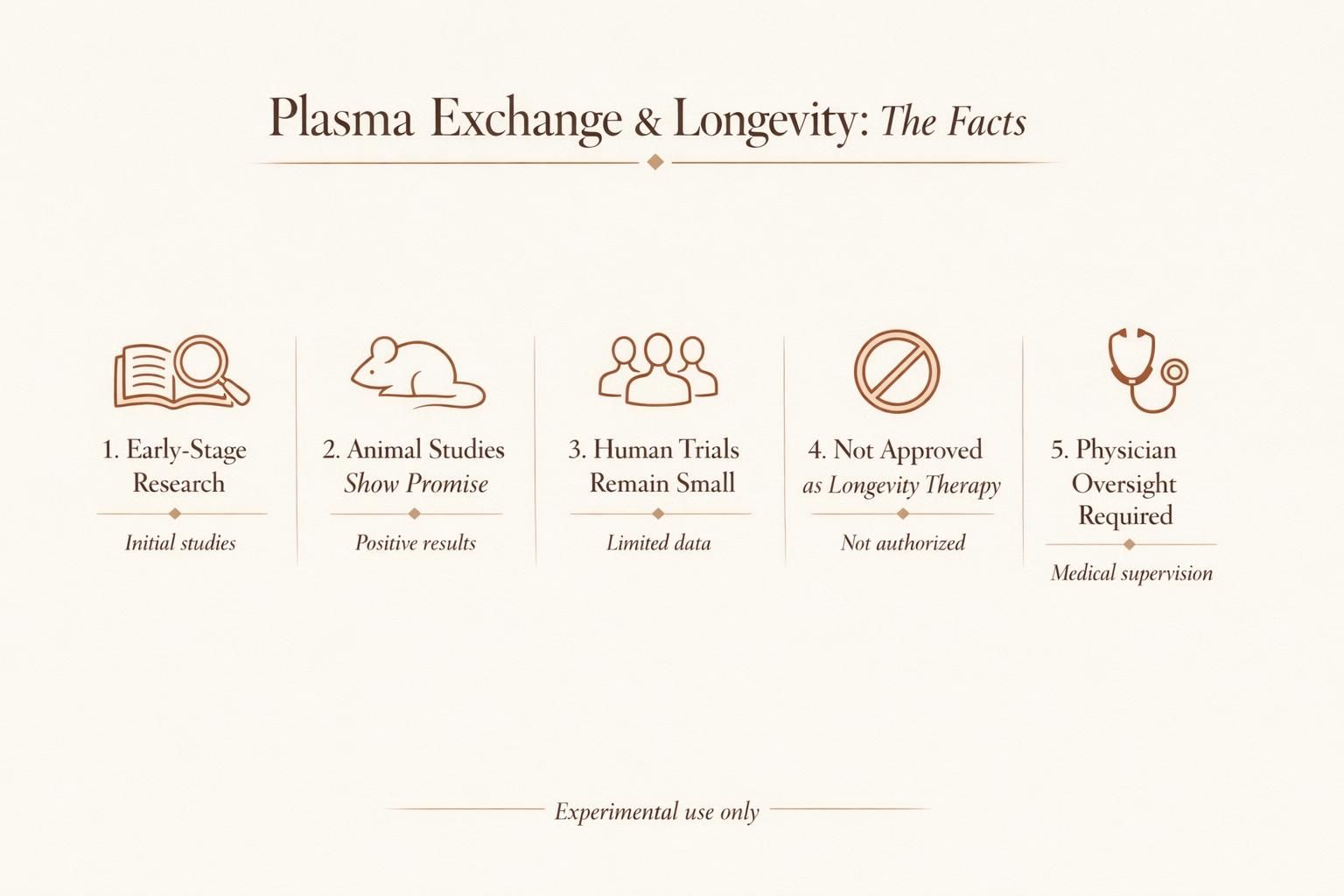
Plasma exchange for longevity is a genuinely interesting area of early-stage research. Some preclinical findings suggest that removing aged plasma and replacing it with younger or neutral plasma may support certain biological markers associated with aging. However, the human evidence remains limited, and most studies are small or still in progress. No regulatory body has approved plasma exchange as a longevity therapy. Physician evaluation is required before any patient considers this type of intervention, and it should be part of a broader, personalized protocol rather than pursued as a standalone solution.
Why People Are Talking About Plasma Exchange for Longevity
The conversation around plasma exchange longevity research gained momentum largely from work coming out of Stanford University. Researchers like Dr. Tony Wyss-Coray published studies suggesting that factors in old blood may actively accelerate aging, while younger blood may carry signals that support biological renewal.
This research captured the attention of longevity communities, podcasts, and biohacking circles. The idea is compelling: if aged plasma contains pro-inflammatory proteins that drive cellular decline, could removing that plasma slow the process?
It is a reasonable scientific question. But it is a long way from a proven longevity therapy.
What the Research Actually Shows
Here is an honest breakdown of where the science currently stands.
Animal Studies Show Promise
Several well-cited studies in mice demonstrated that parabiosis, the surgical joining of young and old mice to share circulation, produced biological changes in older animals. Researchers observed improved cognitive function, muscle regeneration, and other markers of cellular health in the older mice.
These findings were significant enough to inspire human research. But animal models do not always translate directly to human outcomes, and parabiosis is not the same as therapeutic plasma exchange.
Human Trials Remain Early-Stage
Small human trials have explored plasma exchange in the context of aging and cognitive health. Some studies observed changes in inflammatory markers and certain proteins associated with biological aging after therapeutic plasma exchange procedures.
A 2020 study published in Aging examined young plasma infusions in older adults with mild cognitive impairment. Researchers noted some tolerability and early signals worth investigating further. However, the sample sizes were small, follow-up periods were short, and the researchers themselves called for larger controlled trials before drawing clinical conclusions.
The honest summary: early human data is cautiously interesting. It is not yet sufficient to establish plasma exchange as a validated longevity therapy.
What About Therapeutic Plasmapheresis?
Plasmapheresis, a form of plasma exchange, already has established medical uses. Physicians use it to manage certain autoimmune conditions, remove harmful antibodies, and reduce inflammatory burden in specific clinical contexts.
These existing applications provide a safety reference point. Plasma exchange performed under proper medical supervision carries a known risk profile and is not an experimental procedure in those settings. What remains experimental is the specific application of plasma exchange as a longevity optimization tool in otherwise healthy adults.
What Patients Should Understand Before Pursuing This
If you have heard about plasma exchange longevity protocols and you are considering pursuing one, here are the most important things to understand before moving forward.
The Evidence Is Preliminary
The research is real, but it is early. Reputable longevity physicians will be honest with you about this distinction. Be cautious of any provider who presents plasma exchange as a proven or guaranteed anti-aging treatment.
Context and Protocol Matter
In a responsible clinical setting, plasma exchange for longevity would never be the only intervention a physician recommends. Longevity medicine is a systems-level approach. Blood filtration or plasma exchange may support certain biological goals, but it works best as part of an integrated protocol that also addresses inflammation, metabolic health, recovery capacity, and cellular optimization.
At Cellular Institute, we approach longevity as a complete experience. Our medical team evaluates each patient’s history, labs, and goals before designing a protocol. We do not apply a single therapy to every patient and call it longevity medicine.
Advanced Blood Therapies Already Have Broader Clinical Support
While plasma exchange for longevity remains experimental, related blood-based therapies have stronger clinical track records. EBOO therapy in Cancún is one example. EBOO, or extracorporeal blood oxygenation and ozonation, filters blood outside the body, applies ozone, and returns it to the patient. It is designed to support oxidative stress reduction, inflammation modulation, and circulatory health. The evidence base for EBOO is more developed than for plasma exchange in longevity contexts.
Physician Oversight Is Not Optional
Any blood-based intervention requires medical evaluation. A physician needs to review your cardiovascular status, inflammatory markers, immune health, and overall candidacy. At Cellular Institute, our Medical Director Dr. Rafael Moguel, a cardiologist with deep experience in regenerative medicine, leads clinical evaluations for all patients considering advanced therapies.
How Plasma Exchange Fits Into a Broader Longevity Protocol
Longevity-focused patients who ask about plasma exchange are often motivated by the same underlying goals: reduce systemic inflammation, support cellular repair, optimize biological function, and extend healthspan.
Those goals are shared by many of the therapies we offer as part of personalized protocols at Cellular Institute. These may include:
- Advanced blood therapies such as EBOO, which targets oxidative stress and inflammation
- Peptide therapy to support recovery, metabolism, and cellular signaling
- Exosome therapy, which uses extracellular vesicles to support cell communication and tissue repair
- Recovery technologies such as hyperbaric oxygen therapy, red light therapy, and PEMF to support cellular energy and recovery
- Regenerative cellular therapies guided by physician evaluation
The physician designs the protocol around the patient’s specific biology, goals, and clinical picture. That is the foundation of responsible longevity medicine.
Who May Be a Candidate for Advanced Blood-Based Therapies
Patients who may benefit from advanced blood therapies within a longevity protocol often share certain characteristics. They tend to carry a measurable inflammatory burden, have lab findings that suggest oxidative stress or metabolic dysregulation, or have reached a plateau with conventional wellness approaches.
Physician evaluation helps determine whether blood-based interventions make clinical sense for a given patient. No therapy is appropriate for everyone.
Who May Not Be a Good Candidate
Patients with certain cardiovascular conditions, clotting disorders, active infections, or immune system vulnerabilities may not be appropriate candidates for plasma exchange or related blood therapies. This is precisely why a thorough medical evaluation matters before any protocol begins.
Questions to Ask Before Pursuing Plasma Exchange for Longevity
If you are researching this therapy, these questions will help you evaluate any provider responsibly:
- Is this physician-supervised, and what credentials does the supervising physician hold?
- Is this presented as a standalone treatment or part of a broader personalized protocol?
- What specific outcomes are being proposed, and what evidence supports those claims?
- What is the clinic’s approach to safety evaluation, adverse event monitoring, and follow-up?
- Are there alternative therapies with stronger evidence that could support similar goals?
If you are exploring how to choose a stem cell clinic in Mexico or any regenerative medicine provider, these same principles apply. Quality, transparency, and physician oversight are not optional.

Frequently Asked Questions
Is plasma exchange for longevity FDA-approved?
No. Plasma exchange has established medical uses for certain autoimmune and inflammatory conditions, but it is not FDA-approved as a longevity or anti-aging therapy. Patients considering it for longevity purposes should understand they are entering experimental territory and should work only with qualified physicians who are transparent about this distinction.
What is the difference between plasmapheresis and therapeutic plasma exchange?
Plasmapheresis and therapeutic plasma exchange are closely related procedures. Both involve removing blood, separating plasma, and returning blood components to the patient. The difference often lies in what gets replaced. In therapeutic plasma exchange, the removed plasma is replaced with donor plasma or albumin. In plasmapheresis, it may be replaced with saline or a similar solution. The specific protocol varies by clinical goal and physician judgment.
How does EBOO therapy compare to plasma exchange for longevity purposes?
EBOO therapy and plasma exchange are different procedures with different mechanisms. EBOO filters blood extracorporeally, applies medical-grade ozone, and returns oxygenated blood to the patient. It targets oxidative stress and inflammation. Plasma exchange focuses on removing aged or harmful plasma proteins. EBOO currently has a broader evidence base for inflammation support and is offered as part of personalized protocols at Cellular Institute. You can learn more about EBOO therapy and systemic inflammation on our blog.
Can I combine multiple longevity therapies in one visit to Cancún?
Many patients who travel to Cellular Institute for medical tourism in Mexico pursue integrated protocols that combine several therapies over the course of their stay. A physician-guided evaluation helps determine which combination makes sense for your goals, health history, and current biology. Our team coordinates the full patient journey, from arrival to follow-up.
Final Thoughts
Plasma exchange longevity research is at an early but genuinely interesting stage. The preclinical science raised real questions worth investigating. The human evidence is still developing, and no responsible physician should present this therapy as proven or guaranteed.
What the science does support is the broader principle behind the research: that systemic inflammation, pro-aging biological signals, and cellular dysfunction are meaningful targets for longevity medicine. Many of the therapies Cellular Institute offers as part of personalized protocols address exactly these targets, with stronger clinical evidence and physician-guided oversight.
If you are curious about longevity-focused therapies and want to understand what may be appropriate for your specific biology and goals, the right first step is a conversation with a qualified physician. Our team at Cellular Institute takes a complete, evidence-informed, and transparent approach to regenerative medicine in Cancún.
We would welcome the opportunity to speak with you. Schedule a discovery call to start the conversation and see whether you may be a candidate for a personalized longevity protocol.
Medical Disclaimer
This article is for educational purposes only and does not replace medical advice, diagnosis, or treatment. Regenerative therapies are not appropriate for every patient, and outcomes vary. A licensed physician must evaluate your medical history, goals, and candidacy before any treatment can be recommended.