

Written by: Cellular Institute Editorial Team
Medical reviewer: Dr. Matilde Rodríguez – CP 12651081
Laboratory reviewer: Biotecnóloga Diana Navarrete – CP 15029468
Quick Answer
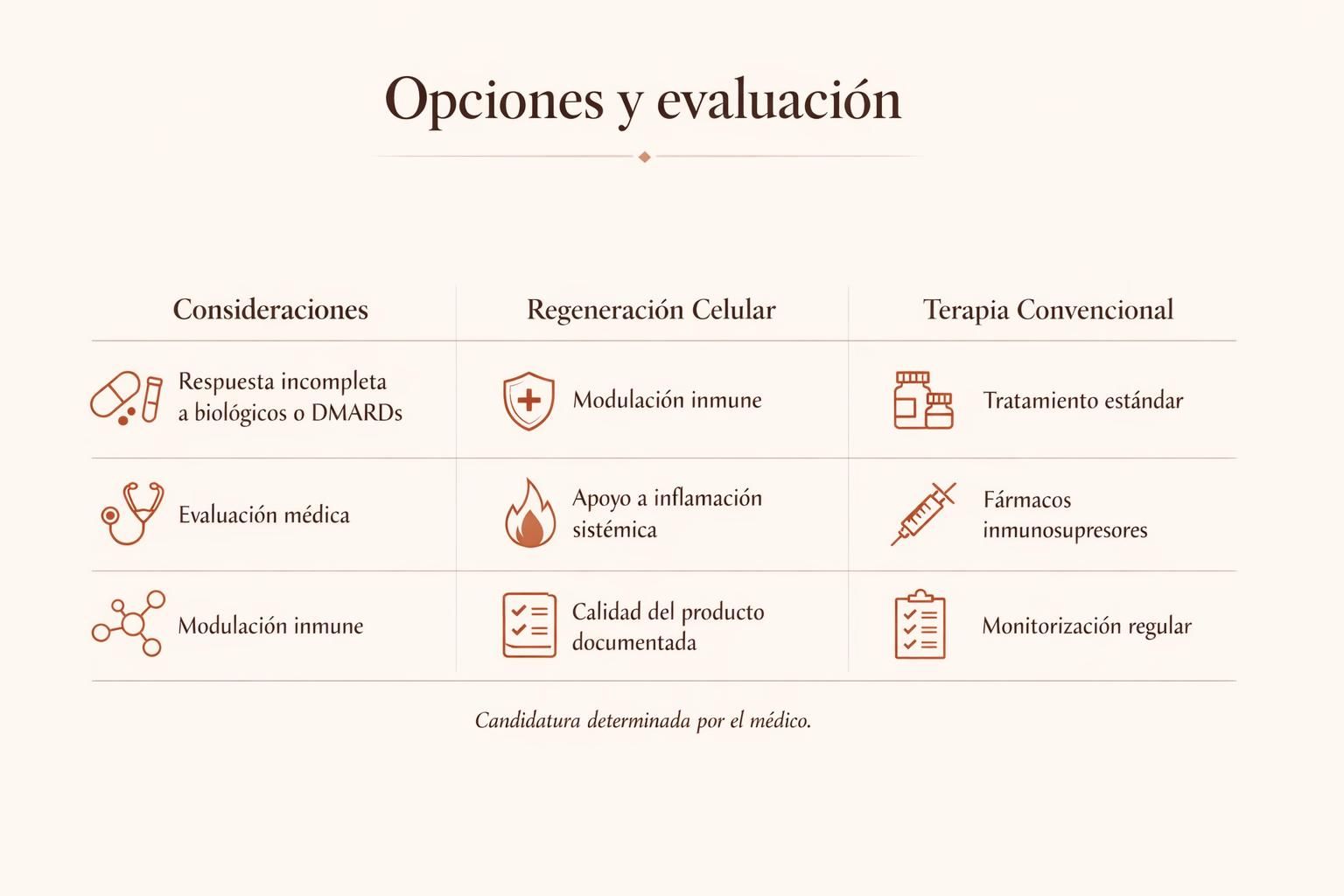
Stem cell therapy for rheumatoid arthritis does not replace conventional care or offer a guaranteed outcome. However, for patients who have had a partial or inadequate response to biologics, DMARDs, or corticosteroids, evidence-informed regenerative protocols may support immune modulation, reduce systemic inflammation, and help slow progression of joint damage. Physician evaluation is required to determine whether you are an appropriate candidate.
When Conventional Treatments Are Not Enough
Rheumatoid arthritis is a chronic autoimmune condition. The immune system attacks the synovial lining of the joints, causing inflammation, pain, swelling, and over time, structural damage. Many patients manage well with methotrexate, hydroxychloroquine, or biologic agents like TNF inhibitors. But a meaningful portion of patients experience only partial relief, medication intolerance, or progressive disease despite treatment.
If you are in that group, you are likely asking a reasonable question: is there something else?
Regenerative medicine does not promise a different answer to the same question. Instead, it approaches the problem from a different direction. Rather than suppressing a specific immune pathway, mesenchymal stem cells may work to modulate immune function more broadly, reduce inflammatory signaling, and support tissue repair in affected joints.
This is not a replacement for your rheumatologist. It is a complementary direction that some patients explore when conventional options have reached their limits.
How Stem Cell Therapy May Support Rheumatoid Arthritis
Mesenchymal stem cells, most commonly sourced from umbilical cord tissue or Wharton’s jelly, carry properties that researchers find particularly relevant to autoimmune conditions like rheumatoid arthritis.
These cells may help the body by:
- Modulating overactive immune responses without broad immune suppression
- Reducing pro-inflammatory cytokines that drive joint inflammation
- Supporting regulatory T-cell activity, which helps balance immune signaling
- Promoting a less inflammatory tissue environment in affected joints
- Potentially slowing the cycle of immune-driven joint damage
Early clinical research and case reports show promising signals, though large-scale randomized trials are still ongoing. Patients should approach this with responsible expectations. Results vary by patient, disease stage, prior treatment history, and individual immune profile.
Our team includes Dr. Roni Moya, Immunologist, who works with patients managing chronic inflammatory and autoimmune-related conditions. Physician-guided evaluation is central to every protocol we design.
Why Protocol Matters More Than a Single Injection
One of the most important things patients should understand is this: stem cell therapy is not a standalone event. The way a clinic designs the protocol around the therapy matters enormously.
At Cellular Institute, we approach rheumatoid arthritis patients with a complete regenerative strategy. Depending on your evaluation, a protocol may include:
- Mesenchymal stem cell therapy delivered intravenously to support systemic immune modulation
- Exosome therapy to enhance cell signaling and amplify the regenerative environment
- EBOO therapy to reduce systemic inflammatory load and support blood quality before or alongside treatment
- Peptide therapy to support recovery, immune balance, and cellular optimization
- Recovery technologies such as hyperbaric oxygen, red light therapy, or PEMF to support tissue recovery
Systemic inflammation plays a major role in rheumatoid arthritis progression. Some patients benefit from addressing that inflammatory burden directly before stem cell therapy begins. Learn more about how EBOO therapy and systemic inflammation relate to autoimmune-driven inflammatory conditions.
What Affects Quality and Safety in Stem Cell Therapy
Not all stem cell products are equal. Patients researching this option should ask hard questions before booking anything.
Quality in regenerative medicine starts before the patient receives any therapy. It begins with sourcing, processing, viability testing, sterility documentation, and product traceability. At Cellular Institute, our biologic products come through our affiliated lab ecosystem, Cellgenic, which maintains xeno-free processing standards and provides documentation including viability and sterility data.
Patients can learn more about our commitment to lab quality and transparency and why these standards matter when choosing a regenerative medicine provider.
We also work with certified stem cells that meet documented quality standards, giving patients and physicians greater confidence in what is being used.
When comparing clinics, patients should also review guidance on stem cell therapy safety in Mexico to understand what questions to ask and what documentation to request.
Who May Be a Candidate
Stem cell therapy for rheumatoid arthritis may be worth exploring if you meet one or more of these criteria:
- You have had an inadequate or partial response to one or more biologics or DMARDs
- You experience significant side effects from your current medications
- You have active inflammation despite ongoing pharmaceutical management
- You are seeking to reduce your dependence on corticosteroids over time
- You are in a relatively stable phase and want to explore supportive options
Candidacy is determined through a comprehensive medical evaluation. Your rheumatology history, labs, imaging, current medications, and overall health status all factor into the assessment.
Who May Not Be a Candidate
Regenerative protocols are not appropriate for every patient. You may not be a candidate if you have active infection, certain malignancies, severe organ dysfunction, or specific immune conditions that contraindicate mesenchymal stem cell therapy. A physician must evaluate your case before any recommendation can be made.
Cellular Institute does not offer regenerative medicine as a universal solution. We evaluate first, and we recommend only when the clinical picture supports it.
How Cellular Institute Approaches Rheumatoid Arthritis Patients
Cellular Institute is a physician-guided regenerative medicine clinic in Cancún, Mexico. We design personalized protocols around each patient’s medical history, inflammatory burden, prior treatment response, and recovery capacity.
Our medical team reviews your case before treatment begins. We do not offer one-size-fits-all injection packages. We build a clinical strategy around you.
For patients traveling from the United States or Canada, our team provides full concierge coordination including airport logistics, bilingual support, treatment scheduling, and structured follow-up. Cancún offers a premium and accessible medical destination for international patients seeking advanced regenerative medicine.
To understand the broader patient journey, visit our guide on regenerative medicine in Cancún: 10 things to know before you go.
Questions to Ask Before Choosing a Clinic
If you are comparing clinics, ask these questions before making any decision:
- Where do the stem cells or exosomes come from, and what documentation is available?
- Does the clinic provide viability, sterility, and traceability data for its biologic products?
- Is a physician involved in designing your protocol, or is this a standardized package?
- Does the clinic evaluate your specific autoimmune history and medication background?
- What complementary therapies are included to support the stem cell treatment?
- What does follow-up look like after you return home?
For a detailed breakdown of what to evaluate, read our guide on how to choose a stem cell clinic in Mexico.

Frequently Asked Questions
Can stem cell therapy replace my biologic medication for rheumatoid arthritis?
Stem cell therapy is not a replacement for your current medications. Patients should never discontinue prescribed treatments without guidance from their rheumatologist. Regenerative protocols may be used alongside conventional care, and some patients work with their physicians over time to reassess their medication needs after treatment. This is a medical decision that requires close physician involvement.
How long might it take to notice changes after stem cell therapy?
Results vary significantly by patient. Some individuals report gradual changes in inflammation levels and joint comfort over several weeks to months following treatment. Others notice more subtle shifts. There is no universal timeline, and responsible expectations are essential. Learn more about how long stem cell therapy results may last and what factors influence outcomes.
Is stem cell therapy for rheumatoid arthritis safe?
When performed by trained physicians using high-quality, well-documented biologic products, mesenchymal stem cell therapy carries a generally favorable safety profile in published research. However, risks exist and vary by patient. Product quality, delivery method, physician oversight, and pre-treatment evaluation all affect safety. Patients should ask about regulatory structure, lab documentation, and physician credentials before proceeding with any clinic.
How much does stem cell therapy cost for rheumatoid arthritis in Mexico?
Pricing depends on the complexity of your protocol, the number of sessions, and the complementary therapies included. A single injection package and a personalized multi-session protocol with exosomes, EBOO, and recovery support are priced very differently. For a full breakdown of what to expect, review our article on stem cell therapy cost in Mexico.
Final Thoughts
Rheumatoid arthritis is a complex, lifelong condition. Biologics and DMARDs help many patients, but they do not work equally well for everyone. If you have reached a ceiling with conventional treatment, stem cell therapy may offer a new direction worth exploring with the right medical team.
Cellular Institute does not promise outcomes. We design evidence-informed, physician-guided protocols around patients who have been carefully evaluated and are appropriate candidates for regenerative medicine.
If you want to understand whether this path may be right for you, we invite you to schedule a discovery call with our patient coordination team. We will review your history, answer your questions, and help you determine whether a personalized regenerative protocol makes sense for your situation.
Medical Disclaimer
This article is for educational purposes only and does not replace medical advice, diagnosis, or treatment. Regenerative therapies are not appropriate for every patient, and outcomes vary. A licensed physician must evaluate your medical history, goals, and candidacy before any treatment can be recommended.