

Written by: Cellular Institute Editorial Team
Medical reviewer: Dr. Matilde Rodríguez – CP 12651081
Laboratory reviewer: Biotecnóloga Diana Navarrete – CP 15029468
Quick Answer
Stem cell therapy and surgery address musculoskeletal conditions through very different mechanisms. Surgery corrects structural problems through direct physical intervention. Stem cell therapy works differently, aiming to support the body’s own repair processes at a cellular level. Neither approach works for every patient. A physician must evaluate your imaging, history, severity, and goals before either path makes sense. For some patients, regenerative medicine may offer a meaningful alternative to surgery. For others, surgery remains the most appropriate option. Understanding the differences helps you start that conversation with your doctor from a more informed position.
Why Patients Ask This Question
Being told you need surgery can feel overwhelming. Whether the diagnosis involves knee osteoarthritis, a herniated disc, a torn rotator cuff, or hip degeneration, the prospect of going under general anesthesia, spending weeks recovering, and potentially facing long-term complications naturally makes patients look for alternatives.
Stem cell therapy has emerged as one of the most discussed options in regenerative orthopedics. But the information online is inconsistent. Some sources overpromise. Others dismiss the therapy entirely. Most patients simply want a clear, honest comparison so they can make a more informed choice alongside their medical team.
This guide offers exactly that.
The Core Difference Between These Two Approaches
Surgery is structural. It removes, repairs, or replaces damaged tissue through direct physical intervention. The goal is to fix a mechanical problem, whether that means trimming a meniscus, fusing vertebrae, or replacing a joint with a prosthetic.
Stem cell therapy is biological. Mesenchymal stem cells, typically sourced from umbilical cord tissue, may support tissue repair by reducing inflammation, modulating immune response, and signaling the surrounding cells to behave differently. The goal is to support the body’s ability to recover from within, without removing or replacing tissue.
These are not competing versions of the same thing. They work differently and serve different situations. Understanding that difference is the starting point for a productive conversation with your physician.
Side-by-Side Comparison
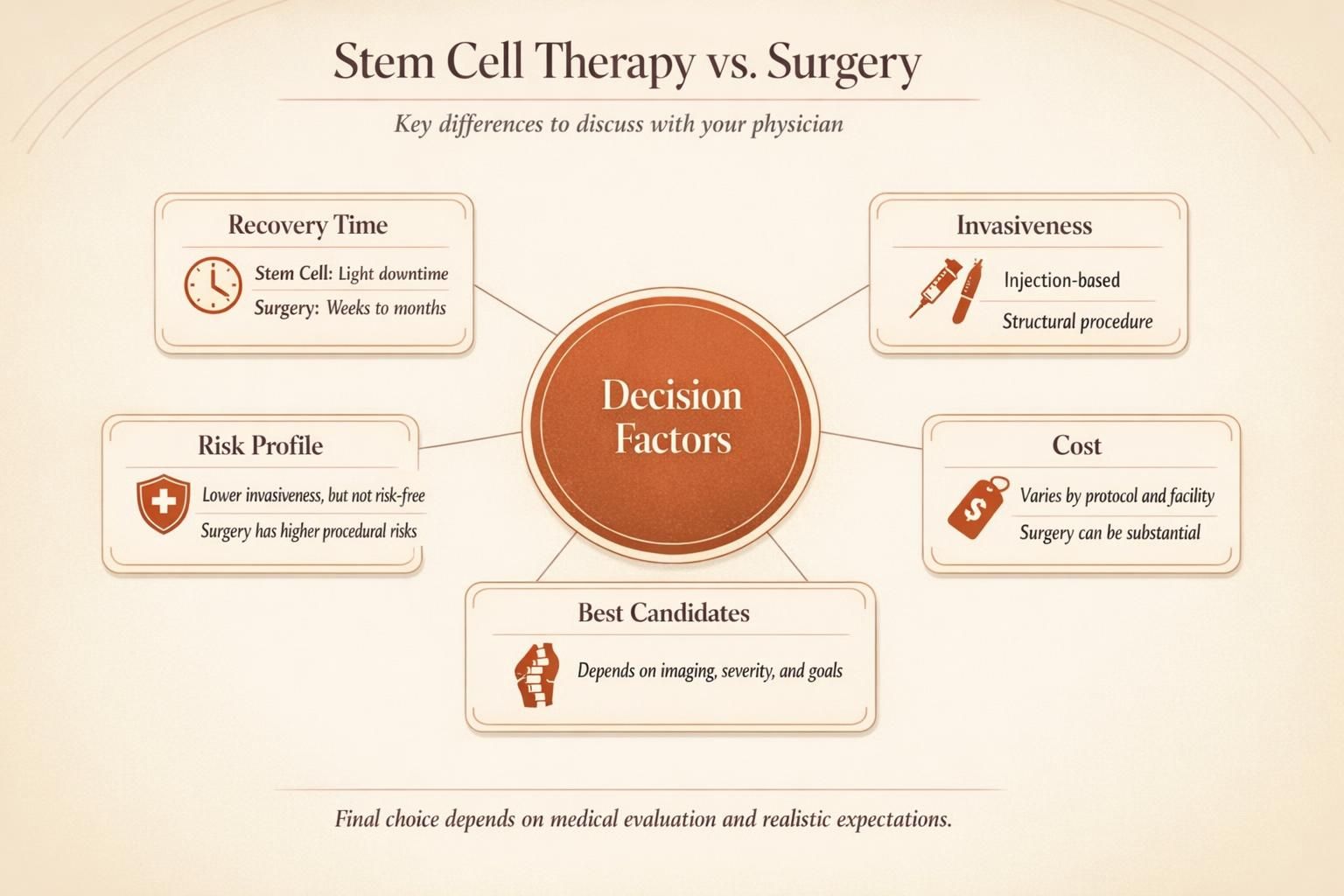
Recovery Time
Most orthopedic surgeries require weeks to months of recovery. Joint replacement may involve three to six months of rehabilitation. Minimally invasive spine procedures may still require four to eight weeks before full activity resumes.
Stem cell therapy typically involves significantly less downtime. Most patients resume light activity within a few days. However, the biological response takes time. Improvements, when they occur, often develop gradually over weeks to months, not overnight.
Invasiveness and Risk Profile
Every surgery carries inherent risks. These include anesthesia complications, infection, blood clots, nerve damage, scar tissue formation, and the possibility that the procedure does not achieve the intended result. These risks vary by procedure and patient health status.
Stem cell therapy is far less invasive. It typically involves an injection or intravenous administration. Risks are generally lower, but they are not absent. Infection at the injection site, temporary flare-ups, and individual biological variability all require consideration. Responsible clinics communicate these possibilities clearly before treatment begins.
Cost Considerations
Surgical costs in the United States can range from tens of thousands to well over one hundred thousand dollars depending on the procedure, facility, and insurance coverage. Out-of-pocket costs after insurance remain significant for many patients.
Regenerative medicine protocols vary in cost depending on the type of therapy, the number of sessions, complementary technologies, and the clinic’s quality standards. Patients researching options in Mexico will find that stem cell therapy cost in Mexico can be meaningfully lower than comparable U.S. options, while still meeting high clinical and laboratory standards when the right clinic is chosen.
Long-Term Outcomes
Surgery offers structural correction that may produce lasting results for the right candidate. Joint replacements, for example, have well-established long-term data. However, not all surgical outcomes are predictable. Some patients experience incomplete relief, adjacent segment problems after spinal fusion, or implant-related complications over time.
Stem cell therapy is a younger field with a growing but still emerging evidence base. Results vary by patient, condition severity, biologic quality, and protocol design. Some patients report meaningful improvements in pain and function. Others experience more modest changes. How long stem cell therapy results may last depends on multiple factors that a physician must assess individually.
What Affects Quality and Safety in Stem Cell Therapy
Not all stem cell therapies are equal. The quality of the biologic product matters enormously. Patients should ask where the cells come from, how they are processed, what viability and sterility testing has been completed, and whether the clinic provides documentation of quality standards.
At Cellular Institute, biologic products are prepared through Cellgenic, our affiliated lab ecosystem. The process prioritizes traceability, xeno-free processing standards, viability testing, and sterility documentation. Patients can review certified stem cells and understand what goes into the product before treatment begins. This level of transparency sets a meaningful standard in a field where not all providers operate with the same rigor.
Physician oversight matters equally. At Cellular Institute, Dr. Wajid Burad, Orthopedist, and Dr. Richard Silva guide orthopedic evaluations and regenerative protocols. Every patient receives a clinical assessment before any treatment recommendation is made.
Who May Be a Candidate for Stem Cell Therapy
Stem cell therapy may be worth exploring if you have early to moderate joint degeneration, a soft tissue injury that has not responded to conservative treatment, or a condition where surgery carries significant risk given your overall health profile. Patients who want to exhaust non-surgical options before committing to an operation are also reasonable candidates for evaluation.
Conditions that patients commonly explore include knee osteoarthritis, hip degeneration, rotator cuff injuries, disc-related back pain, and tendon or ligament damage. Candidacy depends on imaging findings, inflammation levels, overall health, and realistic expectations.
Who May Not Be a Suitable Candidate
Stem cell therapy is not appropriate for everyone. Patients with severe structural damage, complete ligament ruptures, end-stage joint disease, or certain medical conditions may require surgical intervention for meaningful improvement. Active infection, certain autoimmune conditions requiring immunosuppression, and advanced bone-on-bone degeneration may limit candidacy. A physician must make this determination based on a complete clinical picture.
How Cellular Institute Approaches This Decision
At Cellular Institute, the evaluation comes first. The medical team reviews imaging, medical history, current medications, inflammatory markers, and patient goals before designing any protocol. The approach to regenerative medicine in Cancún is physician-guided and individualized from the start.
Protocols often combine stem cell therapy with complementary tools designed to support the overall environment for recovery. These may include recovery technologies such as hyperbaric oxygen, red light therapy, and PEMF, as well as peptide therapy or EBOO-based blood therapies when clinically appropriate. The goal is not to sell an injection. It is to design a complete, personalized protocol around the patient’s actual condition and recovery capacity.
International patients traveling for treatment also receive concierge coordination, bilingual support, airport logistics, and structured follow-up care. Choosing medical tourism in Mexico does not mean sacrificing medical quality. It means choosing a clinical destination that prioritizes both outcomes and patient experience.
Questions to Ask Before Choosing a Path
Whether you are considering surgery or regenerative medicine, ask your care team the following questions:
- What does my imaging actually show, and how severe is the structural damage?
- Have I exhausted conservative options such as physical therapy and anti-inflammatory treatment?
- Am I a realistic candidate for regenerative therapy given my specific condition and severity?
- What is the quality of the biologic product being used, and how is it sourced and tested?
- What does the full recovery protocol look like, beyond the procedure itself?
- What outcomes are realistic for someone in my situation?
- What happens if the regenerative approach does not produce sufficient improvement?
Patients who want to learn more about evaluating clinics responsibly may also find it helpful to read about how to choose a stem cell clinic in Mexico before making any decision.
Frequently Asked Questions
Can stem cell therapy replace surgery for all orthopedic conditions?
No. Stem cell therapy may support recovery and reduce the need for surgery in some patients with early to moderate conditions. However, it cannot replace structural intervention in cases involving severe mechanical damage, complete tears, or end-stage joint disease. A physician must evaluate each case individually.
How long does it take to see results from stem cell therapy?
Biological responses develop over time. Many patients begin to notice changes within six to twelve weeks. More meaningful improvements may continue to develop over several months. Results vary based on the condition, the quality of the biologic product, the protocol design, and the individual patient’s physiology.
Is stem cell therapy for orthopedic conditions safe?
When performed by a qualified physician using properly tested biologics, stem cell therapy carries a relatively low risk profile compared to surgery. However, no procedure is entirely without risk. Injection site reactions, temporary flare-ups, and individual variability are possible. Choosing a clinic with clear quality standards and physician oversight reduces risk meaningfully. You can read more about stem cell therapy safety in Mexico on our educational blog.
What should I look for in a regenerative medicine clinic?
Look for physician-led evaluation, transparent biologic sourcing, quality documentation such as certificates of analysis, a personalized rather than standardized protocol, and a clear follow-up process. Avoid clinics that offer a single price for everyone without a prior medical assessment. Patients can also review guidance on identifying safe stem cell clinics in Mexico before booking any consultation.
Final Thoughts
The decision between stem cell therapy and surgery is not one-size-fits-all. It requires honest medical evaluation, realistic expectations, and the right clinical partner. Stem cell therapy may offer a meaningful path forward for patients who are not ready for surgery, who want to exhaust biological options first, or whose conditions respond well to regenerative approaches. Surgery remains the appropriate choice for others.
At Cellular Institute, the goal is never to push one answer. It is to give you the evaluation, the information, and the medical guidance to make a confident, informed decision. If you want to understand whether regenerative medicine may be appropriate for your specific situation, we invite you to schedule a discovery call with our patient coordination team. We will help you understand your options before you commit to any path.
Medical Disclaimer
This article is for educational purposes only and does not replace medical advice, diagnosis, or treatment. Regenerative therapies are not appropriate for every patient, and outcomes vary. A licensed physician must evaluate your medical history, goals, and candidacy before any treatment can be recommended.