

Written by: Cellular Institute Editorial Team
Medical reviewer: Dr. Matilde Rodríguez – CP 12651081
Laboratory reviewer: Biotecnóloga Diana Navarrete – CP 15029468
Quick Answer
There is no single universal stem cell therapy success rate. Outcomes depend on the condition being addressed, the patient’s health status, the quality of the biologic product, the delivery method, and whether the therapy is part of a physician-guided protocol. Clinical studies report meaningful improvement in selected patient populations, but results vary significantly. Physician evaluation is required to determine whether you may be a candidate and what realistic expectations look like for your specific case.
Why Patients Ask This Question
Patients researching regenerative medicine often encounter bold claims online. Some websites promise dramatic results. Others dismiss the field entirely. Finding accurate, balanced information is genuinely difficult.
The question behind the search is reasonable: Is this worth it for me? That is an important question, and it deserves a transparent answer based on what the evidence actually shows.
The truth is that stem cell therapy success rate data varies widely depending on what is being measured, who the patient is, and how the therapy is delivered. Understanding these factors helps patients make better decisions.
What Clinical Evidence Shows in 2026
Published research on regenerative cell therapies has grown substantially over the past decade. Here is what the evidence-informed picture looks like across commonly studied areas.
Orthopedic and Joint Conditions
Musculoskeletal applications have the most accumulated data. Studies evaluating mesenchymal stem cells for knee osteoarthritis and cartilage support have reported meaningful improvement in pain scores and functional mobility in a significant portion of appropriately selected patients. Some published trials report improvement rates ranging from 60% to 80% in carefully screened populations. However, outcomes depend heavily on disease stage, patient age, inflammation levels, and cell quality.
Inflammatory and Immune-Related Conditions
Research in autoimmune and inflammatory conditions shows promising early data, but this area requires more long-term evidence. Stem cell therapies may support immune modulation in selected patients. Physician evaluation is especially important here because not every inflammatory condition responds the same way.
Neurological Support
Neurological applications represent one of the most active research areas. Early-phase studies have shown some patients report improvements in quality of life and functional metrics. However, the evidence base is still developing, and this field requires careful candidate selection and conservative expectations.
Longevity and Systemic Wellness
Many patients seek regenerative medicine for general optimization, recovery support, and healthy aging goals. In this context, success looks different from a clinical trial endpoint. Patients commonly report improvements in energy, recovery speed, sleep quality, and overall vitality. These outcomes are more subjective and harder to measure in controlled studies, but they represent a meaningful category of patient experience.
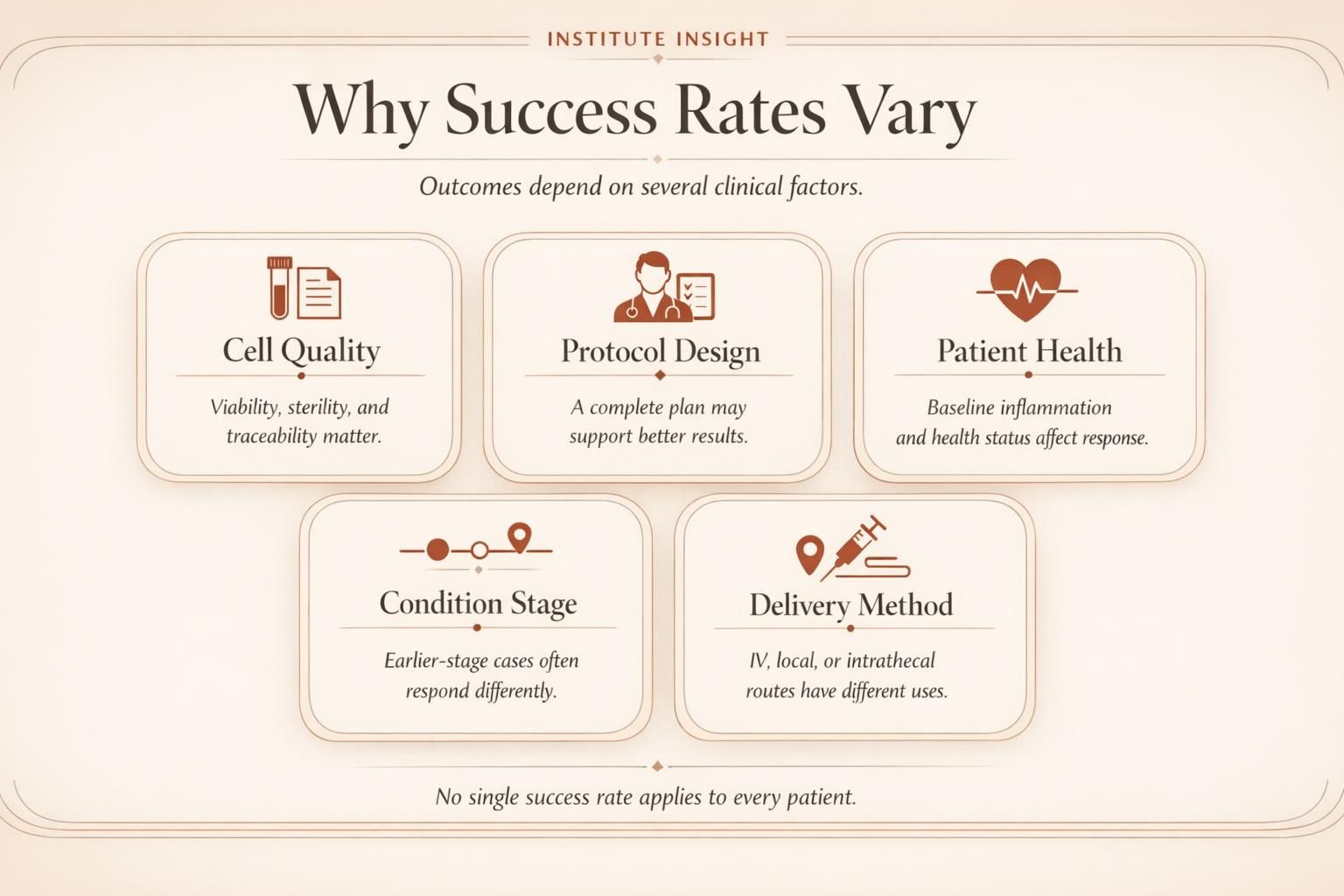
Why Success Rates Vary So Much
A stem cell therapy success rate is not one number. It is a range shaped by multiple intersecting variables. Here are the most important ones.
Cell Quality and Source
The quality of the biologic product matters enormously. Cell viability, sterility, passage number, and sourcing standards all influence how the therapy may perform. A clinic that uses certified, well-documented cells with clear traceability starts from a stronger scientific foundation than one that cannot verify its product origin.
At Cellular Institute, biologic quality is supported through the Cellgenic lab ecosystem. This means greater traceability, xeno-free processing standards, and quality documentation that patients can ask to review. You can learn more about certified stem cells and quality standards on our dedicated page.
Protocol Design
A single injection rarely tells the full story. The protocol around the therapy matters. Complementary modalities such as hyperbaric oxygen therapy, peptide therapy, EBOO, red light therapy, and IV support can meaningfully influence outcomes. A physician who designs a complete protocol around the patient tends to see better results than one who offers a standardized procedure without clinical context.
Patient Health Status
Age, inflammation burden, metabolic health, medication use, and overall systemic condition all affect how the body responds to regenerative therapy. A patient with well-controlled inflammation and good baseline health may respond differently than one with multiple chronic conditions and high oxidative stress.
Condition Stage and Duration
Earlier-stage conditions often show stronger responses. Patients with long-standing, advanced degeneration may see more modest improvement. This does not mean therapy is inappropriate, but it does mean expectations must be calibrated honestly during medical evaluation.
Delivery Method
How cells are delivered affects where they go and how they interact with target tissues. Intravenous administration, direct injection, intrathecal delivery, and other methods each have different evidence profiles depending on the condition. A physician with experience in regenerative medicine selects the appropriate delivery method based on clinical reasoning.
Who May Be a Candidate
Candidates who tend to see the most meaningful outcomes generally share several characteristics. They have realistic expectations. They have a clearly identified condition or wellness goal that aligns with current regenerative evidence. They maintain a reasonably healthy baseline and are willing to follow a complete protocol. They engage with physician guidance before, during, and after treatment.
Patients pursuing regenerative cell therapies at Cellular Institute go through a structured evaluation process before any protocol is recommended.
Who May Not Be a Candidate
Not every patient is appropriate for stem cell therapy. Certain active infections, malignancies, clotting disorders, or immune conditions may make this therapy unsuitable. Patients who expect a cure, who are unwilling to engage with a full protocol, or who have advanced systemic disease may not achieve the outcomes they hope for. A physician must assess individual candidacy with full medical context.
How Cellular Institute Approaches This
Cellular Institute does not sell a single injection. The medical team designs a personalized regenerative protocol around each patient’s history, goals, labs, and condition profile. This means therapy decisions involve clinical reasoning, not a fixed menu.
The clinic’s approach draws on the broader ecosystem of ISSCA and Global Stem Cells Group, representing more than 15 years of regenerative medicine experience, physician education, and protocol development at an international level. Medical oversight at Cellular Institute includes specialists across cardiology, immunology, orthopedics, and regenerative aesthetics.
For international patients considering treatment, understanding how long stem cell therapy results may last is an important part of setting responsible expectations before traveling.
Patients who want to understand what makes one clinic different from another can also explore how to choose a stem cell clinic in Mexico for a practical evaluation framework.
Questions to Ask Before Choosing a Clinic
- Where do the stem cells come from, and how are they processed?
- Can the clinic provide quality documentation including viability and sterility data?
- Is the protocol physician-guided and personalized to my condition?
- What complementary therapies are included in the protocol?
- What does follow-up care look like after treatment?
- Does the clinic operate under a recognized regulatory framework?
- What are realistic expectations for my specific case?
Patients researching their options can also review stem cell therapy safety in Mexico for more context on how to evaluate clinics responsibly.

Frequently Asked Questions
Is there a single published success rate for stem cell therapy?
No. Success rates vary widely depending on the condition, the patient population studied, the cell type used, the delivery method, and how outcomes are measured. Published studies report different ranges across different therapeutic areas. Patients should review condition-specific data with a physician rather than relying on a single general statistic.
How long does it take to notice results from stem cell therapy?
Most patients do not experience immediate results. Some notice early changes within the first few weeks, while others experience gradual improvement over three to six months. Outcomes continue to evolve over time as the biological response unfolds. A physician can help set a realistic timeline based on the patient’s specific protocol and goals.
Does the quality of stem cells affect outcomes?
Yes. Cell viability, sterility, passage number, sourcing, and processing standards all influence how a therapy may perform. Patients should ask clinics directly about their biologic product quality, documentation, and traceability before committing to treatment.
Can stem cell therapy be combined with other regenerative treatments?
Yes, and in many cases a combined protocol may support better outcomes than a single therapy alone. At Cellular Institute, protocols may include complementary tools such as peptide therapy, hyperbaric oxygen, EBOO therapy, red light therapy, and PEMF, depending on the patient’s clinical evaluation and goals.
Final Thoughts
The real stem cell therapy success rate is not a single number. It is the result of many interconnected decisions: the quality of the cells, the design of the protocol, the experience of the medical team, the health of the patient, and the honesty of the expectations set before treatment begins.
Patients who approach regenerative medicine with realistic goals, a complete protocol, and physician guidance tend to report the most meaningful experiences. Those who chase a number or a price without asking deeper questions are more likely to feel disappointed.
If you want to understand whether stem cell therapy may be appropriate for your specific situation, the first step is a medical evaluation with a qualified physician who can review your history, goals, and candidacy honestly.
Ready to take that step? Schedule a discovery call with the Cellular Institute team to see if you may be a candidate for a personalized regenerative protocol.
Medical Disclaimer
This article is for educational purposes only and does not replace medical advice, diagnosis, or treatment. Regenerative therapies are not appropriate for every patient, and outcomes vary. A licensed physician must evaluate your medical history, goals, and candidacy before any treatment can be recommended.