
Written by: Cellular Institute Editorial Team
Medical reviewer: Dr. Matilde Rodríguez – CP 12651081
Laboratory reviewer: Biotecnóloga Diana Navarrete – CP 15029468
Quick Answer
Stem cell therapy for type 2 diabetes is not a cure. However, early clinical research and patient experience suggest that regenerative protocols may support metabolic function, help reduce systemic inflammation, and potentially improve the body’s response to insulin over time. Results vary significantly by patient. A physician must evaluate your history, labs, and current metabolic status before any protocol can be considered.
What Type 2 Diabetes Patients Are Really Asking
Many patients reach a frustrating point in managing type 2 diabetes. Oral medications stop working as well. Insulin doses keep climbing. Fatigue becomes harder to ignore. Early complications like peripheral neuropathy or poor circulation begin to appear.
At this stage, patients often start looking beyond conventional management. They ask: Is there something that can support my body at a deeper level, not just manage my numbers?
That question is driving more people to research stem cell therapy. And it deserves a clear, honest answer.
What Stem Cells May Support in Type 2 Diabetes
Type 2 diabetes involves more than elevated blood sugar. It involves chronic low-grade inflammation, impaired insulin sensitivity, progressive dysfunction in pancreatic beta cells, and widespread cellular stress. These are systemic problems, not just a numbers issue.
Mesenchymal stem cells, which researchers study most often for metabolic conditions, may support the body in several ways:
- Modulating inflammation: Chronic inflammation drives insulin resistance. Stem cells may help calm systemic inflammatory signals that interfere with normal metabolic function.
- Supporting beta cell environment: Some research suggests stem cells may create a more favorable environment for pancreatic tissue, though regenerating beta cells directly remains an active area of study.
- Improving insulin sensitivity: By addressing underlying cellular dysfunction and inflammation, regenerative protocols may support the body’s ability to use insulin more efficiently.
- Supporting circulation and tissue health: Poor vascular function contributes to diabetic complications. Stem cell therapy may support tissue repair and microcirculation in appropriately selected patients.
These are potential mechanisms, not guarantees. Evidence is still developing, and patient outcomes vary. This is precisely why physician evaluation is so important before starting any protocol.
How Regenerative Medicine Approaches Metabolic Health
At Cellular Institute, stem cell therapy for metabolic conditions is not approached as a single injection. The medical team builds a personalized protocol around the patient’s full clinical picture.
A complete regenerative approach for a type 2 diabetes patient may include:
- Stem cell therapy to support inflammation modulation and cellular repair
- Exosome therapy to enhance cell signaling and tissue communication
- EBOO therapy to reduce oxidative stress and support vascular health, which matters significantly in metabolic disease
- Peptide therapy to support metabolic optimization and recovery
- Recovery technologies such as hyperbaric oxygen, red light therapy, and PEMF to support tissue oxygenation and cellular recovery
The goal is not to replace your current medical care. The goal is to support the body’s own repair systems more comprehensively, alongside physician supervision and appropriate monitoring.
Why Biologic Quality Matters for Metabolic Protocols
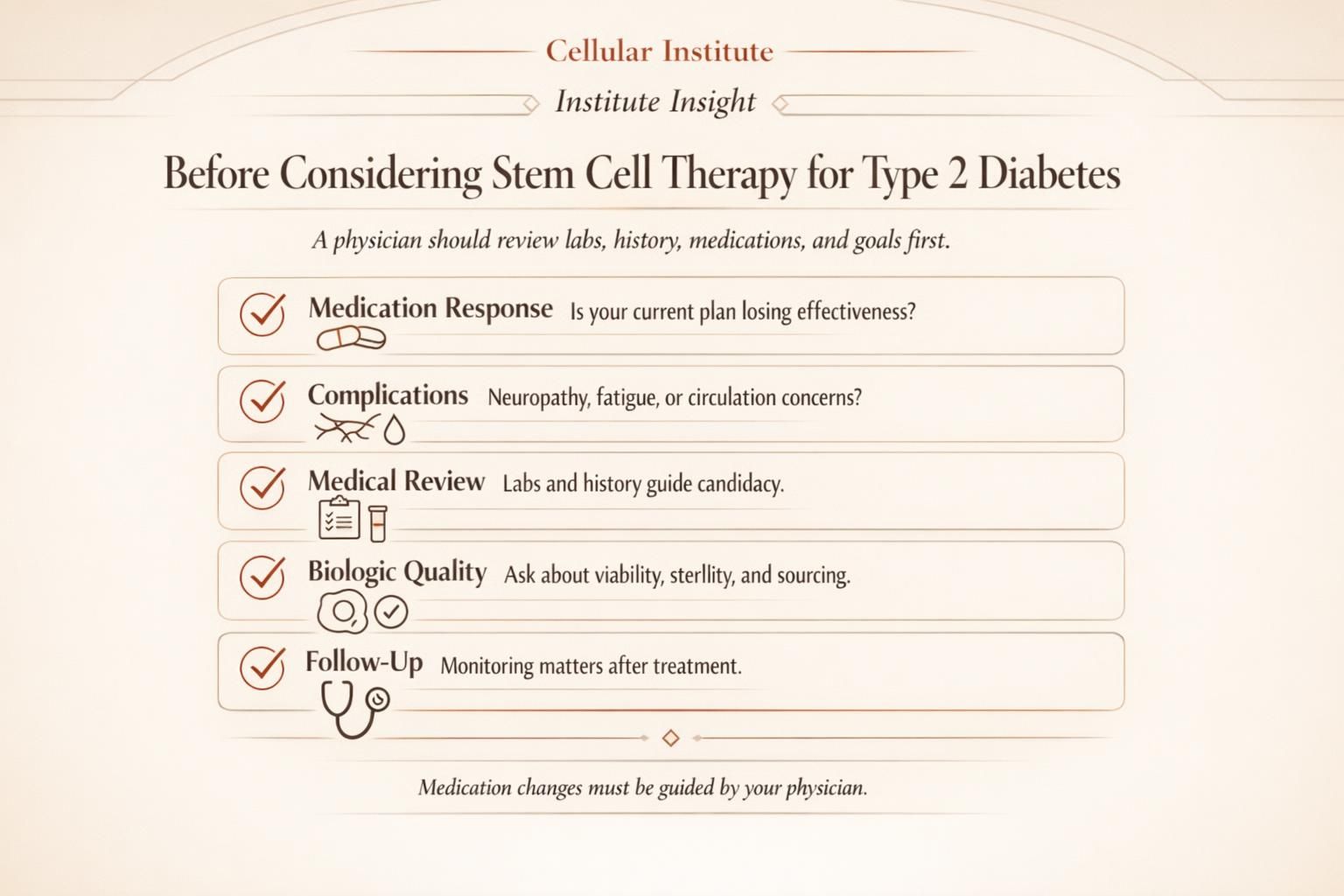
Not all stem cell products are equal. For patients with complex metabolic conditions like type 2 diabetes, the quality, viability, and sourcing of the biologic product directly affect whether therapy may have any meaningful effect.
Cellular Institute works with Cellgenic, our affiliated lab partner, to maintain high standards of traceability, sterility, viability, and xeno-free processing. Each biologic product comes with documentation patients can ask about.
Many clinics outsource their biologics or offer limited transparency into product origin and quality. Patients deserve to know what they are receiving and where it comes from. Our certified stem cells follow a documented quality process designed to support clinical outcomes and patient safety.
Before choosing any clinic, ask about biologic sourcing, cell viability, sterility testing, and quality documentation. These questions are not optional. They are essential.
Who May Be a Candidate
Candidacy for stem cell therapy in the context of type 2 diabetes depends on many clinical factors. Patients who tend to be evaluated as potential candidates often include those who:
- Have been managing type 2 diabetes for several years with declining medication effectiveness
- Experience early complications such as neuropathy, fatigue, or circulation concerns
- Maintain a general willingness to engage with lifestyle, nutrition, and follow-up monitoring
- Do not have active infections, uncontrolled cancer, or other serious contraindications
- Seek to complement, not replace, their existing care plan
Every patient requires individual evaluation. The physician reviews labs, medical history, current medications, inflammation markers, and overall health status before making any recommendation.
Who May Not Be a Candidate
Regenerative therapy is not appropriate for everyone. The medical team may determine that a patient is not currently a candidate if they have:
- Poorly controlled blood sugar with no stable baseline
- Active or recent infections
- Serious cardiovascular instability
- Advanced end-organ complications that require immediate conventional intervention
- A history of certain conditions that contraindicate cellular therapies
Responsible expectations matter. The physician’s role is to evaluate each patient honestly and recommend only what may be clinically appropriate.
How Cellular Institute Approaches This
Cellular Institute offers physician-guided regenerative medicine in Cancún for patients navigating complex metabolic and chronic conditions. Our approach begins with a thorough medical evaluation, not a sales conversation.
Dr. Rafael Moguel, Medical Director and cardiologist, leads our clinical team. His background in cardiovascular medicine brings particular insight to metabolic conditions, where vascular health and inflammation are deeply connected.
Our protocols also include the expertise of Dr. Roni Moya, Immunologist, who supports evaluation of inflammatory burden and immune-related factors in personalized protocol design.
We also support international patients through the full treatment journey. From pre-arrival coordination to recovery planning, our team helps patients from the United States, Canada, and beyond navigate medical tourism in a safe and organized way.
Questions to Ask Before Choosing a Clinic
If you are researching stem cell therapy for type 2 diabetes, ask every clinic you consider these questions:
- Where do the stem cells come from, and what quality documentation is available?
- What is the cell viability and passage number at time of administration?
- Does a licensed physician evaluate each patient individually?
- Is the protocol personalized, or does every patient receive the same product?
- What complementary therapies are included in the protocol?
- What follow-up support does the clinic provide after treatment?
- Does the clinic operate within a recognized regulatory framework?
For more guidance on evaluating clinics, read our article on how to choose a stem cell clinic in Mexico.

Frequently Asked Questions
Can stem cell therapy replace insulin or diabetes medications?
No. Stem cell therapy should not replace medications or insulin without physician guidance. Some patients may experience improved metabolic function over time, which their physician may use to adjust medications. However, any medication changes must be managed by the patient’s own medical team.
How long does it take to notice any changes after treatment?
Regenerative therapies work gradually. Some patients report changes in energy, inflammation, or metabolic markers over weeks to months. Results vary significantly by patient. To understand timelines better, review our educational content on how long stem cell therapy results may last.
Is it safe to travel to Cancún for this type of treatment?
Many international patients travel to Cancún for regenerative medicine safely each year. Cellular Institute coordinates the full patient journey, including logistics and medical support. You can also explore our guide to medical tourism in Mexico for more context on what to expect.
What is the cost of stem cell therapy for type 2 diabetes in Mexico?
Pricing depends on the protocol, the number of sessions, and the complementary therapies included. A complete protocol costs more than a single injection, but the comprehensive approach may support better outcomes. Learn more about stem cell therapy cost in Mexico to set realistic expectations.
Final Thoughts
Type 2 diabetes is a complex, systemic condition. Stem cell therapy is not a shortcut or a substitute for medical management. But for patients whose condition has become harder to control, and who are experiencing early signs of complications, a physician-guided regenerative protocol may offer meaningful support alongside conventional care.
The key is working with a clinic that takes your medical history seriously, uses high-quality biologics, designs a personalized protocol, and provides follow-up support. That is the standard Cellular Institute holds for every patient we evaluate.
If you are curious whether you may be a candidate, the best next step is a conversation with our team. Schedule a discovery call to share your history and learn what may be appropriate for your situation.
Medical Disclaimer
This article is for educational purposes only and does not replace medical advice, diagnosis, or treatment. Regenerative therapies are not appropriate for every patient, and outcomes vary. A licensed physician must evaluate your medical history, goals, and candidacy before any treatment can be recommended.