
Written by: Cellular Institute Editorial Team
Medical reviewer: Dr. Matilde Rodríguez – CP 12651081
Laboratory reviewer: Biotecnóloga Diana Navarrete – CP 15029468
Quick Answer
MUSE cells are a naturally occurring population of pluripotent-like stem cells found in connective tissue, bone marrow, and other areas of the body. Research suggests they may migrate toward damaged or inflamed tissue by responding to specific chemical signals the body releases after injury. This homing behavior is one reason regenerative medicine researchers find MUSE cells particularly interesting. However, this field is still evolving. Physician evaluation is required to determine whether MUSE cell therapy may be appropriate for your specific case.
What Are MUSE Cells?
MUSE stands for Multilineage-differentiating Stress Enduring cells. Scientists first identified them in 2010. Unlike many other stem cell types, MUSE cells appear to tolerate cellular stress well. They also show the ability to differentiate into multiple tissue types, including neural, cardiac, and hepatic cells.
What makes MUSE cells especially relevant in regenerative medicine is their apparent ability to find areas of tissue damage on their own. This behavior is called homing. Understanding this mechanism helps explain why researchers and clinicians view MUSE cells as a potentially more targeted option compared to some other cell-based approaches.
If you want to explore types of stem cell treatments in Mexico, understanding how different cell types behave in the body is a good place to start.
The Homing Mechanism: How MUSE Cells May Find Damaged Tissue
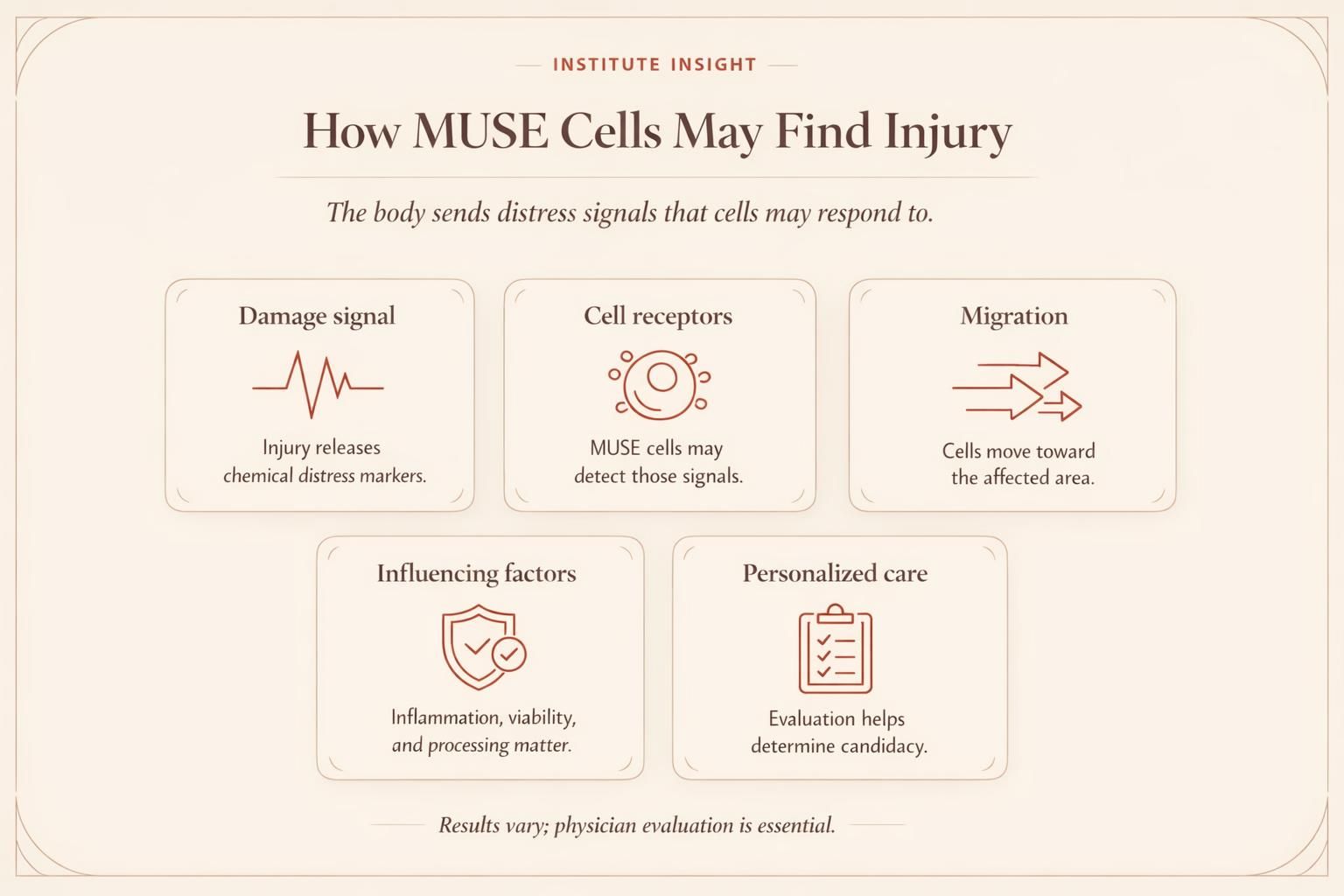
When tissue sustains damage, the body releases a range of signaling molecules. These include sphingosine-1-phosphate (S1P), high-mobility group box 1 (HMGB1), and stromal cell-derived factor-1 (SDF-1). These molecules act like biological distress signals. They communicate that a specific area needs repair.
Research suggests MUSE cells express receptors that respond to these signals. In other words, MUSE cells may detect the chemical environment created by injury and migrate toward the source. This process does not require external guidance or precise targeting by the physician at the time of injection. The cells appear to follow the body’s own chemical map.
Why Is This Different From Other Approaches?
Many cell-based therapies depend on local injection directly into the affected area. This can be effective in some cases. However, MUSE cells administered intravenously may still travel toward areas of tissue distress because of their homing response. This does not mean MUSE cells work for everyone. It does mean that their mechanism of action has attracted significant scientific interest.
The body’s internal signaling environment plays a large role in how this process unfolds. Factors like systemic inflammation, immune function, and overall cellular health can all influence results. This is why the broader protocol surrounding any regenerative therapy matters just as much as the cell type itself.
What Affects the Quality and Effectiveness of MUSE Cell Therapy
Not all MUSE cell preparations are equal. Several factors influence whether administered cells may be capable of homing effectively and supporting tissue repair.
- Cell viability: Cells must be alive and metabolically active at the time of administration. Low-viability preparations may not respond to the body’s signals the way research models suggest.
- Processing standards: How cells are cultured, stored, and prepared affects their functional capacity. Xeno-free processing and rigorous sterility protocols matter.
- Cell passage number: Early-passage cells generally retain stronger biological activity. Cells that have been expanded too many times may lose key functional properties.
- Inflammatory environment: A patient with very high systemic inflammation may present a more complex biological environment. Preparing the body before treatment can support a better cellular response.
- Delivery method and timing: These factors influence how cells distribute in the body and how they interact with the injury signaling environment.
This is why lab quality and transparency are not secondary concerns. They are foundational to whether a regenerative therapy may perform as intended.
MUSE Cells in the Context of a Personalized Protocol
At Cellular Institute, regenerative therapy is never a single-step process. The clinical team evaluates each patient’s medical history, inflammatory status, current health profile, and goals before designing any protocol.
MUSE cell therapy, when clinically appropriate, forms part of a broader physician-guided strategy. That strategy may also include complementary approaches designed to support the cellular environment before, during, and after treatment.
For example, reducing systemic inflammation before cell administration may help optimize the conditions in which MUSE cells operate. Some patients may benefit from supportive therapies such as EBOO therapy in Cancún to address oxidative stress and inflammatory burden as part of their preparation. Others may incorporate peptide therapy or recovery technologies to support the post-treatment phase.
The goal is to create a biological environment where the administered cells have the best possible conditions to respond to the body’s signals and contribute to the repair process.
Who May Be a Candidate for MUSE Cell Therapy
MUSE cell therapy may be appropriate for patients dealing with conditions that involve tissue injury, chronic inflammation, or impaired regenerative capacity. These may include neurological conditions, orthopedic injuries, cardiovascular concerns, and autoimmune-related tissue damage, among others.
Candidacy depends entirely on individual clinical evaluation. Factors the medical team considers include:
- Current diagnosis and disease stage
- Overall health and immune status
- Prior treatments and response history
- Systemic inflammation markers
- Realistic expectations and treatment goals
Who May Not Be a Candidate
Some patients may not be suitable for MUSE cell therapy at a given time. This includes patients with active infections, certain malignancies, severe immunosuppression, or other conditions that the medical team identifies as contraindications during evaluation. A thorough clinical assessment is essential before any treatment recommendation.
How Cellular Institute Approaches MUSE Cell Therapy
Cellular Institute operates as part of a vertically integrated regenerative medicine ecosystem. The clinic works with its affiliated biologics partner, Cellgenic, to support quality control, traceability, and product documentation throughout the cell preparation process.
This means patients receive certified stem cells backed by quality standards that include viability testing, sterility documentation, and xeno-free manufacturing protocols. Biotechnologist Diana Navarrete leads the laboratory review process, adding an additional layer of scientific oversight to every product used in clinical protocols.
The medical team, led by Dr. Rafael Moguel, Medical Director, approaches each case with individualized clinical reasoning. No two protocols look identical because no two patients present the same biological picture.
Patients interested in learning more about regenerative medicine in Cancún can start by understanding what a complete protocol looks like, not just the therapy itself.
Questions to Ask Before Choosing a Clinic
If you are evaluating MUSE cell therapy at any clinic, consider asking these questions before booking:
- Where do the cells come from, and how are they processed?
- What quality documentation accompanies the cell product?
- Is viability and sterility testing completed before administration?
- Does the clinic offer a physician evaluation before recommending a protocol?
- How does the clinic prepare patients before treatment?
- What complementary support does the clinic offer during recovery?
- Is the protocol personalized to your specific condition and goals?
Understanding how to choose a stem cell clinic in Mexico helps patients make more informed decisions and avoid providers that prioritize volume over clinical quality.

Frequently Asked Questions
Do MUSE cells guarantee that the therapy will reach the right location in the body?
No therapy guarantees specific biological outcomes. The homing behavior of MUSE cells is supported by research, but how cells behave in any individual patient depends on many variables, including the patient’s inflammatory environment, immune status, and the quality of the cell preparation. Results vary by patient.
How is MUSE cell therapy different from standard mesenchymal stem cell therapy?
Both are used in regenerative medicine, but MUSE cells represent a distinct subpopulation with specific surface markers and stress tolerance. The homing mechanism associated with MUSE cells has been more precisely characterized in research. Standard mesenchymal stem cells also show some homing behavior, but the mechanisms differ. A physician can help clarify which approach may be more appropriate for your case.
How long might it take to notice any effects from MUSE cell therapy?
Timelines vary significantly depending on the condition being addressed, the patient’s overall health, and the protocol used. Some patients report gradual changes over several weeks. Others may experience a longer timeline. For a broader view of what to expect, you can review information on how long stem cell therapy results may last.
Is MUSE cell therapy available at Cellular Institute?
Cellular Institute offers advanced regenerative protocols that may include MUSE cell preparations, depending on the patient’s clinical profile and candidacy evaluation. The best way to find out whether this approach may be appropriate for you is to schedule a discovery call with the patient coordination team.
Final Thoughts
The homing mechanism of MUSE cells represents one of the most scientifically compelling aspects of this therapy. The idea that a cell can respond to the body’s own injury signals and migrate toward areas that need support is a meaningful advancement in how researchers think about targeted cellular repair.
But science alone does not make a therapy effective. The quality of the cells, the preparation of the patient, the clinical expertise behind the protocol, and the support surrounding recovery all contribute to the outcome. This is why Cellular Institute approaches every regenerative journey as a complete medical experience, not a single procedure.
If you are curious about whether MUSE cell therapy or another regenerative approach may be appropriate for your situation, the first step is a proper evaluation. Schedule a discovery call with our patient coordination team to start the conversation and see whether you may be a candidate.
Medical Disclaimer
This article is for educational purposes only and does not replace medical advice, diagnosis, or treatment. Regenerative therapies are not appropriate for every patient, and outcomes vary. A licensed physician must evaluate your medical history, goals, and candidacy before any treatment can be recommended.