

Written by: Cellular Institute Editorial Team
Medical reviewer: Dr. Matilde Rodríguez – CP 12651081
Laboratory reviewer: Biotecnóloga Diana Navarrete – CP 15029468
Quick Answer
Stem cell therapy for chronic conditions is an evolving area of regenerative medicine. Current evidence suggests it may support inflammation modulation, tissue repair, immune function, and overall quality of life in appropriately selected patients. It does not replace conventional medical care. A thorough physician evaluation is required to determine candidacy, and results vary significantly from patient to patient.
What Patients Living With Chronic Conditions Should Know
Living with a chronic condition often means managing symptoms over months or years. Many patients reach a point where conventional options feel limited. They begin looking for approaches that address the underlying biology of their condition, not just the symptoms.
Stem cell therapy has attracted serious attention in regenerative medicine for this reason. Mesenchymal stem cells, in particular, carry properties that researchers believe may support tissue repair, reduce inflammatory signaling, and help regulate certain immune responses.
However, the science is still developing. Some conditions have more clinical data behind them than others. Patients should approach this field with both openness and realistic expectations.
Conditions Where Stem Cell Therapy Is Being Studied
Researchers are actively studying stem cell applications across a wide range of chronic health challenges. The following areas represent some of the most discussed in current regenerative medicine literature.
Inflammatory and Autoimmune Conditions
Conditions like rheumatoid arthritis, lupus, multiple sclerosis, and inflammatory bowel disease involve persistent immune system activity that can damage tissue over time. Mesenchymal stem cells carry immunomodulatory properties. Early research suggests they may help shift the immune environment toward a more balanced state. This does not mean stem cell therapy replaces disease management, but it may play a supportive role in appropriate candidates.
At Cellular Institute, patients with autoimmune-related concerns work with our in-house immunologist, Dr. Roni Moya, who guides the clinical evaluation and helps determine whether a regenerative protocol is appropriate for the individual patient.
Neurological and Neurodegenerative Conditions
Conditions such as Parkinson’s disease, ALS, and post-stroke recovery represent some of the most complex areas of stem cell research. The central nervous system presents significant biological challenges for regenerative approaches. Some early-phase studies suggest stem cell therapy may support neuroprotection and reduce neuroinflammation in certain contexts. This remains an active and cautious area of research. Physician evaluation is essential, and not all patients with neurological conditions are candidates.
Degenerative Joint and Musculoskeletal Conditions
Osteoarthritis, degenerative disc disease, and chronic joint pain represent some of the most studied areas in regenerative orthopedics. Evidence suggests that stem cell therapy may support cartilage repair, reduce inflammatory signaling in joint tissue, and help improve mobility and comfort in selected patients. This is one of the most evidence-informed areas of current application.
Metabolic and Systemic Conditions
Patients with type 2 diabetes, chronic fatigue, and metabolic dysfunction are also exploring regenerative medicine options. Research in this area continues to evolve. Stem cell protocols in this context are generally approached as supportive tools within a broader optimization strategy, not standalone treatments.
What Affects the Quality and Safety of Stem Cell Therapy
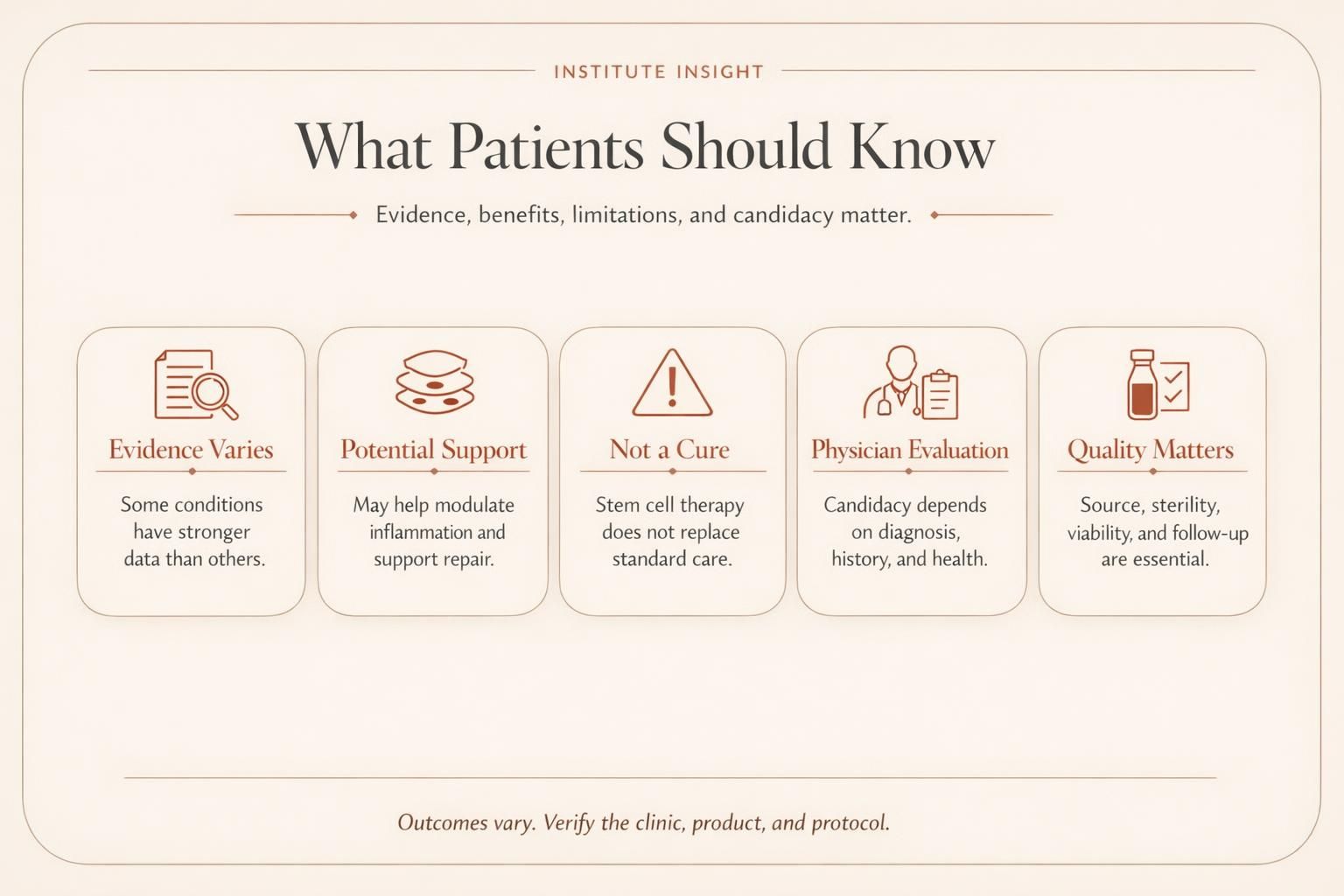
Not all stem cell therapy is the same. The quality of the biologic product matters enormously. Patients should understand that the cells themselves, their source, processing standards, viability, and sterility documentation all play a role in both safety and potential effectiveness.
Many clinics outsource their biologics with limited visibility into the supply chain. Cellular Institute works through its affiliated biologics partner, Cellgenic, which supports in-house quality control, traceability, xeno-free processing standards, and documented viability and sterility testing. Patients can learn more about this process on our lab quality and transparency page.
Beyond the product itself, the delivery method, dosage, patient preparation, and complementary protocols all influence how a patient responds. A single injection without clinical reasoning is not the same as a physician-designed regenerative protocol.
Patients researching certified stem cells should ask clinics directly about their sourcing, processing standards, and quality documentation before proceeding.
Who May Be a Candidate
Patients who may be appropriate candidates for stem cell therapy often share certain characteristics. They typically have a confirmed diagnosis with documented disease activity or functional decline. They have explored or are continuing conventional care but want to add a regenerative layer to their strategy. They have realistic expectations about outcomes and understand that results vary.
Candidacy also depends on overall health status, inflammation load, medication history, and current organ function. A comprehensive medical evaluation is not optional. It is the foundation of responsible care.
Who May Not Be a Candidate
Stem cell therapy is not appropriate for every patient. Those with active infections, certain blood disorders, uncontrolled autoimmune flares without medical supervision, or other contraindications may not qualify. The physician team at Cellular Institute evaluates each patient individually before any protocol is designed.
How Cellular Institute Approaches Chronic Condition Protocols
At Cellular Institute, we do not approach chronic conditions with a single-therapy mindset. Our medical team designs protocols that account for the full clinical picture. Stem cell therapy may serve as a central element, but the protocol often includes complementary tools designed to optimize the environment in which regeneration can occur.
Depending on the patient’s profile, a protocol may incorporate EBOO therapy to address systemic inflammation and oxidative stress, or peptide therapy to support recovery, immune regulation, and cellular optimization. Recovery technologies such as hyperbaric oxygen, red light therapy, and PEMF may also be integrated as part of the patient’s full regenerative medicine protocol.
Our team includes physician specialists across cardiology, immunology, and orthopedics. Every patient receives an individualized evaluation before a care plan is recommended. This is not a one-size-fits-all environment.
Questions to Ask Before Choosing a Clinic
Patients researching stem cell therapy for chronic conditions should ask specific questions when evaluating any clinic. These questions help separate serious medical providers from lower-quality options.
- Where do the stem cells come from, and how are they processed?
- What viability, sterility, and quality documentation does the clinic provide?
- Does a physician evaluate my specific condition before recommending a protocol?
- What complementary therapies are included, and why?
- How does the clinic handle follow-up after treatment?
- Is the clinic operating within a recognized regulatory framework?
Frequently Asked Questions
Can stem cell therapy cure my chronic condition?
No. Stem cell therapy is not a cure for any chronic condition. It is a regenerative medicine tool that may support inflammation modulation, tissue repair, and immune function in appropriately selected patients. Outcomes vary, and the therapy works best as part of a physician-guided protocol alongside conventional care.
How long does it take to notice results from stem cell therapy?
Results vary significantly by patient, condition, and protocol design. Some patients report noticing changes within weeks. Others observe gradual improvements over three to six months. Understanding realistic timelines is an important part of the evaluation process. You can learn more about how long stem cell therapy results may last on our blog.
Is stem cell therapy safe for patients with autoimmune conditions?
Safety depends heavily on the individual patient’s health status, current medications, and disease activity. Some autoimmune patients may be appropriate candidates under careful physician supervision. Others may not qualify at a given time. A thorough medical evaluation by a qualified immunologist or regenerative medicine physician is required before any protocol is considered. Our article on stem cell therapy safety in Mexico provides additional context.
What makes Cellular Institute different from other stem cell clinics?
Cellular Institute operates as a complete regenerative medicine platform, not a single-injection clinic. The clinic combines physician-led evaluation, in-house biologics through Cellgenic, personalized multi-modal protocols, advanced recovery technologies, and structured follow-up. Every patient receives individualized care based on their clinical profile, not a standardized package.
Final Thoughts
Stem cell therapy for chronic conditions represents one of the most actively researched areas in modern medicine. The evidence is promising in several domains, and physician-guided protocols continue to evolve. At the same time, this is not a field where oversimplification or marketing promises serve patients well.
The most important step is finding a clinic that evaluates you as an individual, designs a protocol around your specific condition and goals, and maintains rigorous standards for the biologic products it uses.
If you are living with a chronic condition and want to understand whether regenerative medicine may support your health goals, we invite you to schedule a discovery call with our patient coordination team. We will help you understand what may be appropriate for your case and what the evaluation process involves.
Medical Disclaimer
This article is for educational purposes only and does not replace medical advice, diagnosis, or treatment. Regenerative therapies are not appropriate for every patient, and outcomes vary. A licensed physician must evaluate your medical history, goals, and candidacy before any treatment can be recommended.