

Written by: Cellular Institute Editorial Team
Medical reviewer: Dr. Matilde Rodríguez – CP 12651081
Laboratory reviewer: Biotecnóloga Diana Navarrete – CP 15029468
Quick Answer
A Certificate of Analysis (COA) and quality control documentation are laboratory records that verify the identity, viability, sterility, and safety of a biologic product before it is administered to a patient. In the context of stem cell therapy or exosome therapy, these documents help confirm that what a patient receives has been properly sourced, tested, and processed to defined standards. Not every clinic provides this level of transparency. Patients evaluating regenerative medicine providers should ask directly about quality documentation as part of their research. A medical evaluation is always required to determine whether any regenerative therapy may be appropriate for an individual patient.
What Is a Certificate of Analysis in Regenerative Medicine?
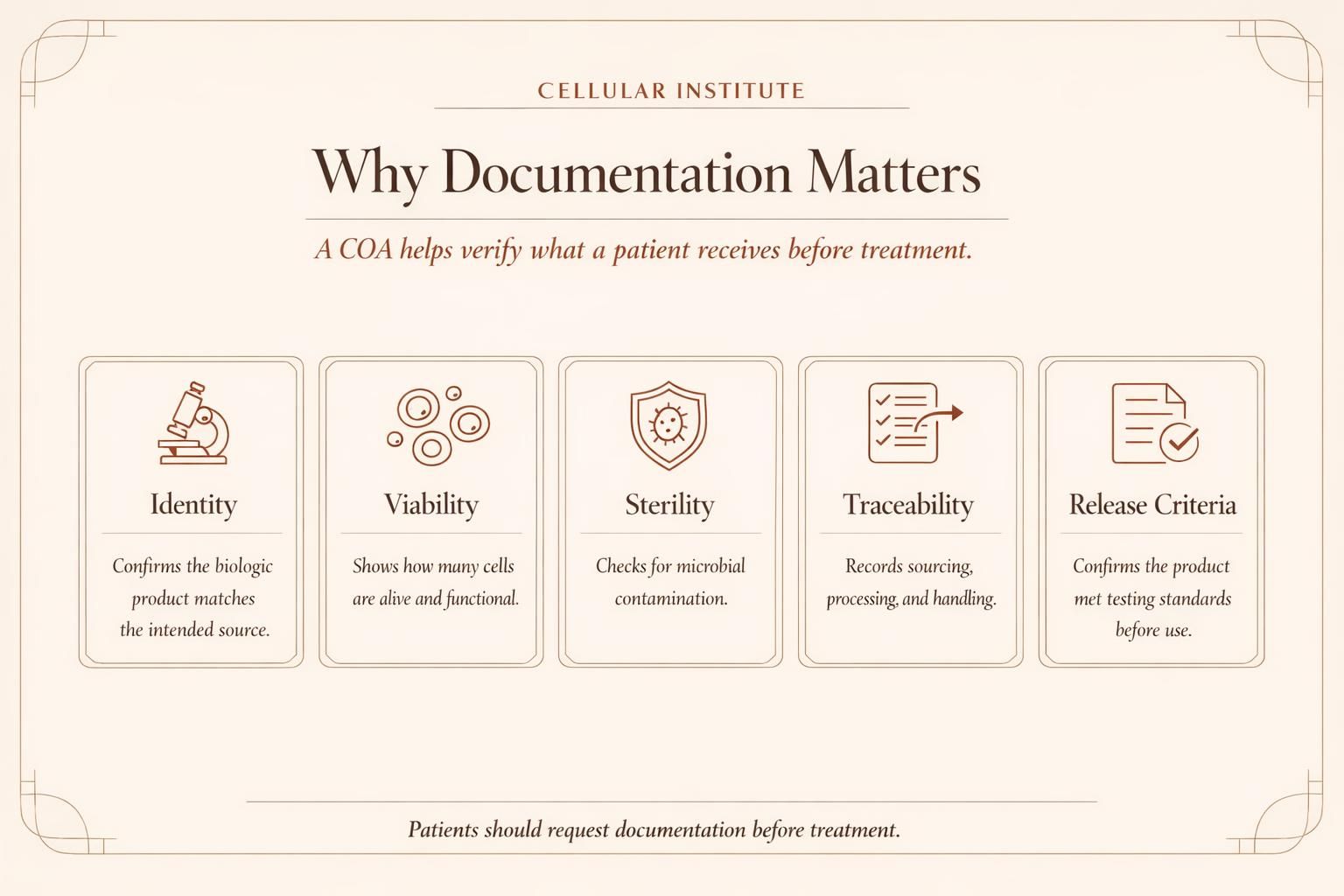
A Certificate of Analysis is a formal document issued by a laboratory that outlines the specific characteristics of a biologic product. In regenerative medicine, this typically includes information about cell viability, cell concentration, sterility testing results, the absence of contaminants, and confirmation that the product meets defined release criteria before clinical use.
Think of it as the quality passport for a biologic product. Without it, neither the physician nor the patient has a clear, documented basis for understanding what is actually being administered.
Quality control, more broadly, refers to the entire set of processes, standards, and checkpoints that a laboratory or biologics provider uses to ensure consistency, safety, and traceability from the point of sourcing all the way through processing, storage, and delivery.
Together, a COA and a quality control framework represent the difference between a biologic product that has been verified and one that has simply been prepared and shipped without independent confirmation of its characteristics.
Why This Matters More Than Most Patients Realize
When patients research stem cell therapy, they often focus on questions like how many cells they will receive, what conditions the therapy may support, or what the cost will be. These are reasonable questions. But the quality of the biologic product itself is a foundational factor that is often overlooked.
Not all stem cell preparations are created equal. Viability, meaning the percentage of cells that are alive and functional at the time of administration, can vary significantly depending on how cells are sourced, processed, stored, and handled. A preparation with low viability may not support the regenerative goals of the protocol in the same way as a high-viability product.
Sterility is equally important. A biologic product that has not been tested for microbial contamination introduces a category of risk that no physician should accept and no patient should ignore.
Traceability is the third pillar. Knowing where the cells or biologics came from, how they were handled, and what testing was completed along the way gives both the physician and the patient a much clearer picture of what they are working with. This is what serious quality control systems are designed to document.
Patients evaluating clinics should understand that safe stem cell clinics in Mexico typically prioritize product documentation as a non-negotiable part of their clinical process, not an afterthought.
What Affects Quality and Safety in Biologic Products
Several variables influence the quality of a stem cell or exosome preparation. Understanding these helps patients ask better questions when evaluating clinics.
- Cell source and donor screening: Where do the cells originate? Has the donor tissue been screened for infectious disease and other safety markers?
- Processing environment: Are cells processed in a controlled, validated laboratory environment? What standards govern the facility?
- Xeno-free standards: Are animal-derived components used during processing? Xeno-free manufacturing reduces the risk of introducing non-human proteins into the preparation.
- Passage number: Early-passage cells are generally considered to retain stronger biological characteristics. Higher passage numbers may indicate that cells have been expanded many times, which can affect their properties.
- Storage and cold chain management: How are products stored and transported? Temperature deviations can compromise viability.
- Release testing: What tests must a product pass before it is approved for clinical use? Is a COA issued at the point of release?
These are not abstract technical concerns. They directly influence what a patient receives and how the biologic product may behave in the body. Patients researching their options should review how to choose a stem cell clinic in Mexico to understand the full set of quality and safety factors worth evaluating.
Who May Benefit From Understanding Quality Documentation
Any patient considering stem cell therapy, exosome therapy, or other advanced biologic treatments should understand the role of quality documentation. This is particularly relevant for patients who are:
- Comparing multiple clinics and trying to evaluate differences beyond price
- Traveling internationally for regenerative medicine and want to verify the standards of a clinic before arrival
- Asking whether the biologic product they will receive has been properly tested and documented
- Seeking a physician-guided experience rather than a transactional injection
Quality documentation is not only a laboratory concern. It is a patient rights concern. Patients deserve to know what they are receiving and to have confidence that the biologic product meets defined safety and quality standards.
Who Should Not Proceed Without This Information
Patients should be cautious about proceeding with any clinic that cannot or will not provide information about the quality of their biologic products. Red flags include:
- No documentation available about the source or processing of cells
- No viability or sterility testing mentioned
- Vague or unverifiable claims about the number or type of cells in a preparation
- No physician evaluation required before treatment
- Pricing that seems unusually low without any explanation of what quality standards are included
These are signals that the clinic may be prioritizing volume or cost over the safety and integrity of the biologic product. No regenerative protocol should be designed around a product of unknown quality.
How Cellular Institute Approaches Quality Control
At Cellular Institute, the quality of the biologic product is treated as the foundation of every regenerative protocol, not a marketing claim.
Through the affiliated Cellgenic biologics ecosystem, the clinic has access to a more controlled and transparent preparation process that includes defined quality control checkpoints, viability documentation, sterility testing, and product traceability. This means the physician overseeing a patient’s care has greater confidence in what is being administered, and the patient has greater transparency into the process behind their treatment.
Cellular Institute works with certified stem cells that meet documented quality standards, and the clinic operates within a COFEPRIS-recognized regulatory structure in Mexico. This matters because it means the clinic is not operating outside of a medical framework. It is working within one.
The broader ecosystem, which includes connections to ISSCA and Global Stem Cells Group, reflects more than 15 years of experience in regenerative medicine, physician education, and protocol development. This is not an influencer clinic or a trend-based wellness center. It is a medically serious environment built around science, process, and patient safety.
Patients who want to understand the science and lab quality behind the biologics used at Cellular Institute can explore the Cellgenic lab quality and transparency page for a deeper look at what goes into the preparation process.
Questions to Ask Before Choosing a Clinic
Before committing to any regenerative medicine provider, patients should consider asking the following:
- Can you provide a Certificate of Analysis for the biologic product I will receive?
- What is the viability of the cells at the time of administration?
- Has the product been tested for sterility and contaminants?
- Where are the cells or exosomes sourced from, and how are donors screened?
- Is your processing facility operating under defined quality standards?
- Is your clinic operating within a recognized regulatory framework?
- Will a physician evaluate my medical history and candidacy before treatment is recommended?
A clinic that cannot answer these questions clearly is a clinic worth researching further before making any decision. Patients who want a broader framework for evaluating providers can also review guidance on what separates the best stem cell clinics in Mexico from the rest.

Frequently Asked Questions
What does a Certificate of Analysis actually confirm?
A Certificate of Analysis is a laboratory document that confirms specific characteristics of a biologic product at the time of testing. In regenerative medicine, this typically includes cell viability percentage, cell concentration, sterility test results, and confirmation that the product meets defined release criteria. It is issued by the laboratory responsible for processing the product and is meant to provide traceability and quality assurance before clinical use.
Is quality documentation required by all stem cell clinics?
Not all clinics require or provide this level of documentation. Some providers operate with limited transparency about the origin, processing, and testing of their biologic products. Patients who are evaluating clinics should specifically ask whether a COA and quality control records are available, and consider this as one of several indicators of a clinic’s commitment to patient safety and product integrity.
How does quality control affect my treatment experience?
Quality control affects the biologic product you receive, the confidence your physician has in that product, and ultimately the integrity of the protocol being designed for you. A high-viability, sterility-confirmed, well-documented product provides a more reliable foundation for a regenerative protocol than a product of unknown characteristics. Results still vary by patient, and quality documentation does not guarantee a specific outcome, but it is a meaningful part of responsible clinical practice.
Can I ask Cellular Institute for quality documentation before my treatment?
Yes. Transparency is a core part of how Cellular Institute operates. Patients are encouraged to ask about the biologic products used in their protocols, including sourcing, processing standards, and quality documentation. This kind of informed engagement is welcomed and reflects the clinic’s commitment to education before treatment. To start the conversation, patients can schedule a discovery call with the patient coordination team.
Final Thoughts
Choosing a regenerative medicine clinic involves more than comparing prices or reading testimonials. The quality of the biologic product you receive, and the documentation that supports it, is a fundamental part of what you are actually being offered.
A Certificate of Analysis and a transparent quality control framework are signs that a clinic takes its responsibility to patients seriously. They reflect a commitment to traceability, safety, and scientific integrity that should be a baseline expectation, not a luxury feature.
If you are exploring regenerative cell therapies and want to understand what quality, safety, and physician-guided care look like in practice, Cellular Institute is here to walk you through the process with clarity and honesty.
To see whether you may be a candidate and to ask questions about our quality standards directly, we invite you to schedule a discovery call with our patient coordination team. There is no pressure. Just an honest conversation about your health goals and whether our approach may be right for you.
Medical Disclaimer
This article is for educational purposes only and does not replace medical advice, diagnosis, or treatment. Regenerative therapies are not appropriate for every patient, and outcomes vary. A licensed physician must evaluate your medical history, goals, and candidacy before any treatment can be recommended.