

Written by: Cellular Institute Editorial Team
Medical reviewer: Dr. Matilde Rodríguez – CP 12651081
Laboratory reviewer: Biotecnóloga Diana Navarrete – CP 15029468
Quick Answer
Choosing a stem cell clinic in Mexico requires more than comparing prices. Patients should evaluate biologic quality, physician oversight, lab transparency, regulatory structure, and the full scope of the patient journey. No clinic should promise cures or guaranteed results. A qualified physician must evaluate your medical history and goals before recommending any treatment. The right clinic builds a personalized, medically guided protocol around you, not a one-size-fits-all injection package.
Why Clinic Selection Matters More Than Most Patients Realize
The regenerative medicine market in Mexico has grown significantly over the past decade. Patients from the United States and Canada now travel to Cancun, Tijuana, and other cities seeking stem cell therapy, exosome therapy, and related biologics at a fraction of the cost they would face at home.
That growth has created real opportunity. It has also created real risk. Not every clinic operates with the same standards. Some prioritize marketing over medicine. Others outsource biologics without clear documentation. A few offer standardized packages with little to no physician evaluation.
The checklist below helps you ask the right questions before you book anything. If you want to explore the best stem cell clinics in Mexico more broadly, that resource can help you compare providers side by side.
The Patient Due-Diligence Checklist
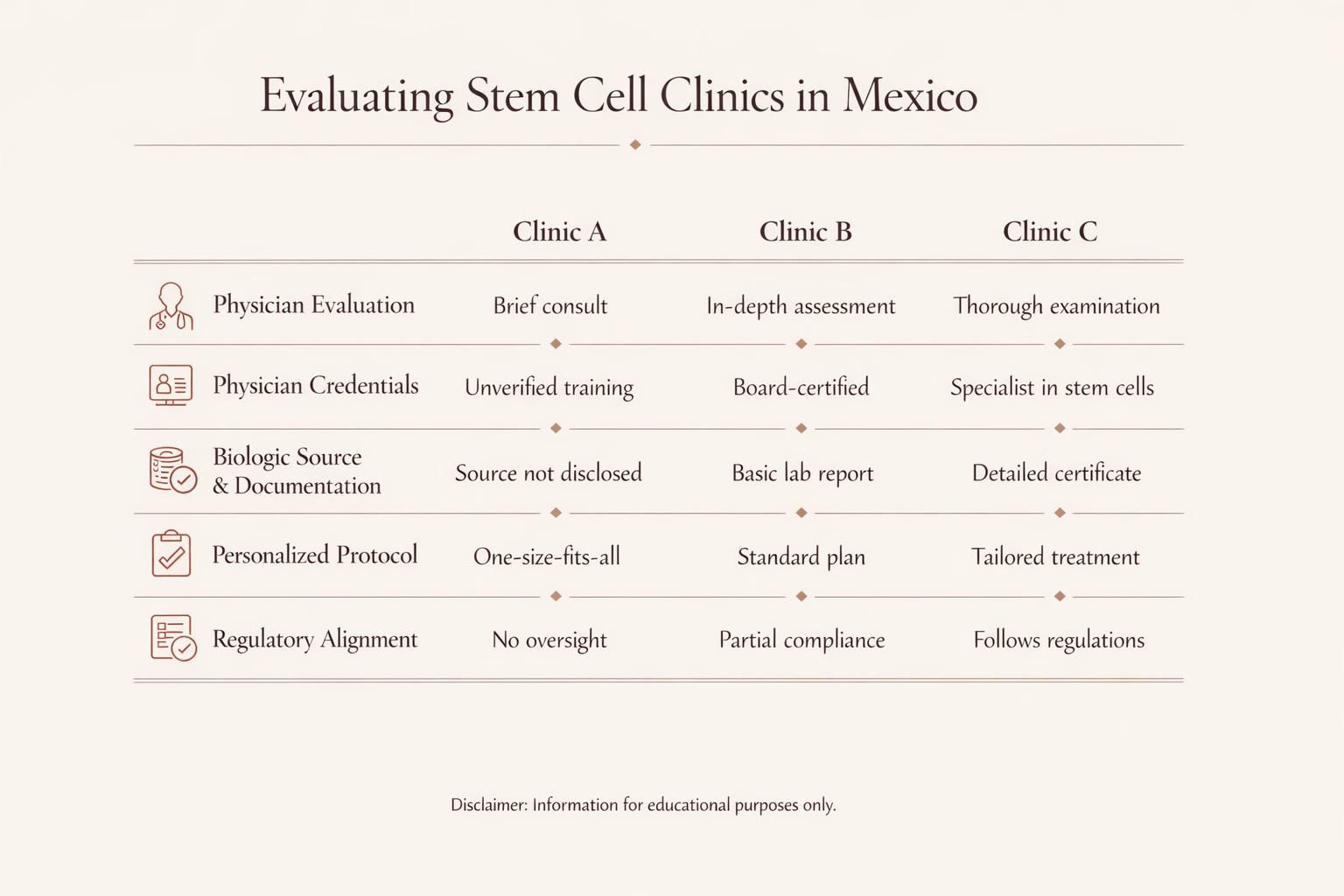
1. Does the clinic require a medical evaluation before treatment?
Any serious clinic requires physician evaluation before recommending a protocol. This means reviewing your medical history, current medications, lab results, inflammation markers, and health goals.
A clinic that skips this step and sells you a package without evaluation is not operating responsibly. Regenerative medicine is not appropriate for every patient. Candidacy matters.
2. Who are the physicians, and what are their credentials?
Ask for the names and credentials of the medical team. Look for licensed physicians with training in regenerative medicine, immunology, orthopedics, or relevant specialties. A clinic backed by a broader medical education ecosystem adds another layer of credibility.
At Cellular Institute, Dr. Rafael Moguel, Medical Director and Cardiologist, leads a physician team that includes specialists in immunology, orthopedics, and aesthetic medicine. The team operates within a structure connected to ISSCA and Global Stem Cells Group, bringing more than 15 years of regenerative medicine experience to patient care.
3. Where do the cells or biologics come from?
This is one of the most important questions you can ask. Many clinics do not disclose the source of their biologic products. Others outsource to third-party suppliers without full visibility into processing conditions.
Ask about cell origin, donor screening, processing standards, and whether xeno-free manufacturing is used. Ask whether the clinic can provide a certificate of analysis confirming viability and sterility.
Cellular Institute works with Cellgenic, an affiliated biologics lab ecosystem that supports quality control, traceability, and product documentation. You can learn more about lab quality and transparency and what that means for patient safety.
4. Does the clinic offer certified stem cells with documented quality standards?
Viability, sterility, and traceability are not marketing terms. They are quality standards that protect you. A clinic should be able to explain how its biologic products are tested and documented before clinical application.
Cellular Institute offers certified stem cells with documented quality processes, including COFEPRIS-recognized regulatory alignment. Ask any clinic you are comparing whether it can provide similar documentation.
5. Is the protocol personalized, or is it a standard package?
A serious clinic designs your protocol around your specific history, goals, inflammation status, and candidacy. It does not sell the same package to every patient.
Regenerative protocols may include stem cell therapy, exosome therapy, peptide therapy, EBOO therapy, hyperbaric oxygen, red light therapy, PEMF, and IV support. The combination depends on your clinical picture, not a price list.
Ask the clinic: How do you decide what goes into my protocol? If the answer is a preset package with no clinical reasoning, that is a red flag.
6. What does the full patient journey look like?
Traveling for treatment is not just about the procedure. You need clarity on what happens before, during, and after your visit. Ask about pre-treatment preparation, what to expect on treatment days, recovery support during your stay, and follow-up after you return home.
Read our guide on regenerative medicine in Cancún: 10 things to know before you go to understand what a well-coordinated patient journey should include.
7. Does the clinic operate within Mexico’s regulatory framework?
Ask about COFEPRIS recognition, clinic licensing, and whether the facility holds relevant permits for tissue handling, biologic application, and clinical operations. A legitimate clinic will answer these questions directly.
Be cautious of clinics that avoid regulatory questions or cannot provide documentation when asked. For more on this topic, review our article on stem cell therapy safety in Mexico.
8. What are the red flags to watch for?
Walk away from any clinic that promises cures, guaranteed outcomes, or results that sound too good to be true. Additional red flags include no physician evaluation, no documentation of biologic quality, no follow-up plan, and pressure to book immediately.
Our article on safe stem cell clinics in Mexico covers seven specific signs to look for when comparing providers.
What Makes a Strong Regenerative Medicine Experience
The best regenerative medicine experience goes beyond the therapy itself. The quality of the biologic product, the medical team, the diagnostic process, the recovery environment, and the follow-up plan all shape your outcome.
Cellular Institute approaches every patient as a complete clinical case. The team evaluates your history, designs a protocol around your goals, supports your recovery with advanced technologies, and coordinates your entire experience from arrival to follow-up. This includes recovery support through hyperbaric oxygen therapy, red light therapy, and PEMF as part of an integrated protocol.
To understand more about what medical tourism in Mexico looks like when done well, our complete guide covers costs, logistics, and what patients should expect at a premium clinic in Cancún.

Frequently Asked Questions
How do I know if a stem cell clinic in Mexico is legitimate?
Look for licensed physicians, documented biologic quality standards, COFEPRIS-recognized regulatory alignment, and a clear process for physician evaluation before treatment. A legitimate clinic answers your questions directly and does not promise cures or guaranteed results.
Is price a reliable indicator of quality?
No. Price alone does not reflect the quality of the biologic product, the experience of the medical team, or the depth of the protocol. Some clinics charge high prices for outsourced, poorly documented products. Others offer transparent, well-documented biologics at reasonable costs. Always ask what is included and why.
What questions should I ask before booking a stem cell clinic?
Ask about physician credentials, cell source and quality documentation, whether a medical evaluation is required, what the protocol includes, how follow-up is structured, and whether the clinic operates within Mexico’s regulatory framework. If a clinic cannot answer these questions clearly, that is a warning sign.
How long do stem cell therapy results typically last?
Results vary significantly by patient, condition, protocol quality, and lifestyle factors. There is no universal answer. A physician-guided protocol with proper preparation and follow-up tends to support better outcomes than a single injection with no surrounding care. For more context, read our article on how long stem cell therapy results may last.
Final Thoughts
Choosing a stem cell clinic in Mexico is one of the most important decisions in your regenerative medicine journey. The therapy itself is only one part of the equation. The lab behind the product, the physician guiding your care, the protocol built around your goals, and the support structure surrounding your visit all shape what is possible.
Cellular Institute invites you to start with education, not a sales pitch. If you are ready to explore whether regenerative medicine may be appropriate for your situation, the next step is a conversation with our team.
Schedule a discovery call and speak with a patient coordinator about your goals, your history, and whether you may be a candidate for a personalized protocol at Cellular Institute in Cancún.
Medical Disclaimer
This article is for educational purposes only and does not replace medical advice, diagnosis, or treatment. Regenerative therapies are not appropriate for every patient, and outcomes vary. A licensed physician must evaluate your medical history, goals, and candidacy before any treatment can be recommended.