

Written by: Cellular Institute Editorial Team
Medical reviewer: Dr. Matilde Rodríguez – CP 12651081
Laboratory reviewer: Biotechnologist Diana Navarrete – CP 15029468
Quick Answer
Mexico has become one of the most active destinations for stem cell therapy, attracting thousands of international patients each year. Patients from the United States and Canada often choose Mexico because of greater access to regenerative therapies, lower overall costs compared to North America, and the availability of experienced physician-led clinics. However, not every clinic operates at the same standard. Quality, safety, physician oversight, and biologic transparency vary significantly from one provider to another. A thorough medical evaluation is always required before any protocol can be recommended.
Why Patients Are Choosing Mexico for Stem Cell Therapy in 2026
Stem cell therapy remains largely unavailable through conventional healthcare systems in the United States and Canada. Insurance does not cover it. Waiting lists for access to clinical trials can stretch for years. As a result, many patients look abroad for options.
Mexico offers a regulated medical environment where regenerative medicine has developed significantly over the past decade. Clinics in cities like Cancún now provide access to mesenchymal stem cells, exosome therapy, and integrated regenerative protocols that most patients cannot access at home.
Cancún, in particular, has emerged as a leading destination for medical tourism in Mexico. The city combines international airport access, modern clinical infrastructure, and a strong patient coordination ecosystem that supports international visitors throughout their treatment journey.
What Patients Should Know Before Comparing Clinics
The biggest mistake patients make is evaluating clinics based on price alone. Cost matters, but it tells only part of the story. The quality of the biologic product, the medical evaluation process, the delivery method, and the follow-up support all shape the overall experience and outcome potential.
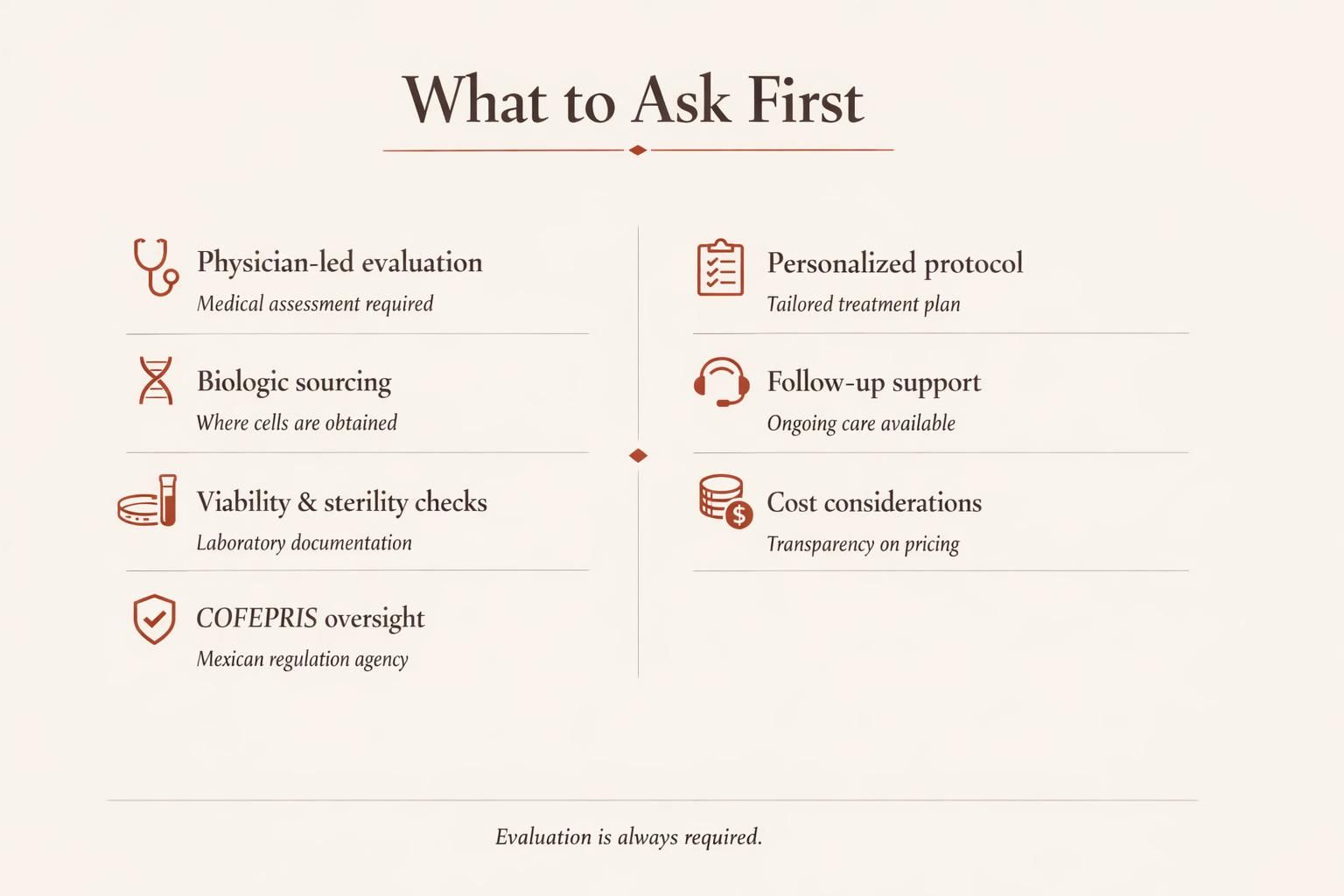
Before contacting any clinic, patients should ask the following questions:
- Where do the stem cells come from, and how are they processed?
- Does the clinic provide documentation of viability, sterility, and quality testing?
- Is the protocol personalized, or does the clinic offer one standard package?
- Does a licensed physician evaluate each patient before treatment?
- What happens after treatment? Is there a follow-up plan?
- Does the clinic operate within Mexico’s regulatory framework under COFEPRIS?
Learning how to choose a stem cell clinic in Mexico is one of the most important steps a patient can take before booking anything.
Understanding Stem Cell Therapy Options in Mexico
Not all stem cell therapies are the same. Patients may encounter mesenchymal stem cells derived from umbilical cord tissue, adipose tissue, or bone marrow. Each source carries different characteristics, and the right option depends on the patient’s health profile, goals, and medical history.
Delivery methods also vary. Some protocols use intravenous administration. Others involve direct injection into a joint, tissue, or targeted area. Many advanced clinics combine stem cell therapy with complementary tools such as exosome therapy, hyperbaric oxygen therapy, peptide therapy, or ozone-based blood therapies to support the body’s recovery and regenerative response.
Patients interested in a broader overview can explore the types of stem cell treatments in Mexico before beginning their clinic search.
What Affects Safety and Quality
Safety in regenerative medicine begins in the laboratory, not in the treatment room. The quality of the biologic product matters as much as the clinical protocol itself.
Patients should look for clinics that provide documented quality control, including cell viability testing, sterility verification, and traceability records. These are not optional details. They are basic standards that serious regenerative medicine providers maintain.
At Cellular Institute, biologic quality is supported through Cellgenic, an in-house lab ecosystem that follows xeno-free processing standards and provides documentation for each biologic product used in patient care. Biotechnologist Diana Navarrete leads the laboratory review process, ensuring that every product meets quality and safety standards before clinical use.
Patients can learn more about our commitment to certified stem cells and what that means for safety, traceability, and quality control.
Who May Be a Candidate
Stem cell therapy may be appropriate for a wide range of patients, depending on their specific health context. Common reasons patients pursue regenerative medicine protocols include:
- Orthopedic conditions such as joint pain, osteoarthritis, or sports injuries
- Autoimmune and inflammatory conditions under physician evaluation
- Neurological support and recovery goals
- General longevity optimization and healthy aging support
- Post-injury recovery or surgical recovery support
- Performance and functional optimization
Candidacy always requires a full medical evaluation. A physician must review the patient’s history, current health status, medications, and goals before any protocol can be designed or recommended.
Who May Not Be a Candidate
Stem cell therapy is not appropriate for everyone. Patients with active malignancies, certain blood disorders, or specific contraindicated conditions may not qualify. This is why physician evaluation is essential before any commitment to treatment. Responsible clinics require this step. Any clinic that skips it is a red flag.
How Cellular Institute Approaches Stem Cell Therapy in Mexico
Cellular Institute does not sell a single injection. The medical team designs a complete regenerative protocol around each patient’s goals, health history, and clinical evaluation.
Under the medical direction of Dr. Rafael Moguel, Medical Director, every patient undergoes a structured evaluation before any treatment begins. The protocol may include stem cell therapy, exosome therapy, peptide therapy, EBOO blood ozone therapy, hyperbaric oxygen, red light therapy, or PEMF, depending on what the physician determines is clinically appropriate.
This integrated approach reflects what regenerative medicine in Cancún can look like when it prioritizes personalization, quality, and physician oversight over volume and price.
International patients also receive full coordination support, including bilingual patient coordinators, airport logistics guidance, and structured follow-up after they return home.
Understanding Cost Without Oversimplifying It
Cost is a legitimate consideration. Stem cell therapy in Mexico is generally more accessible than equivalent care in the United States, but prices still vary based on the type of therapy, the number of sessions, the biologic source, and the complementary technologies included in the protocol.
Patients researching stem cell therapy cost in Mexico should approach pricing with context. A lower price does not always reflect equal quality. What matters is what is included in the protocol and what standards the clinic follows.
Frequently Asked Questions
Is stem cell therapy in Mexico regulated?
Mexico has a regulatory framework for regenerative medicine through COFEPRIS, the federal body that oversees health products and clinical services. Serious clinics operate within this framework and can provide documentation of their licensing structure. Patients should always ask about regulatory standing before choosing a provider. You can read more about stem cell therapy safety in Mexico to understand what responsible oversight looks like.
How long do results from stem cell therapy last?
Results vary significantly from patient to patient. Many factors influence outcomes, including the patient’s age, underlying condition, overall health, the quality of the biologic product, and how well the protocol is designed. There are no guaranteed timelines. Patients can explore a detailed discussion of how long stem cell therapy results may last for a more complete picture.
What should I look for in a safe stem cell clinic in Mexico?
Look for physician-led evaluation, transparent biologic sourcing, documented quality control, COFEPRIS-recognized licensing, personalized protocol design, and structured follow-up. Clinics that skip the evaluation step or offer one-size-fits-all packages without reviewing your medical history should raise concern. Our guide to safe stem cell clinics in Mexico outlines exactly what to look for.
Can I combine stem cell therapy with other treatments during my visit?
Yes, in many cases. Physician-guided clinics often design integrated protocols that combine stem cell therapy with complementary tools such as exosome therapy, EBOO therapy, peptide therapy, or recovery technologies like hyperbaric oxygen and red light therapy. The combination depends entirely on the patient’s goals and candidacy as determined by the physician during evaluation.
Final Thoughts
Stem cell therapy in Mexico offers real access to advanced regenerative medicine for patients who cannot find comparable options at home. But access alone is not enough. The quality of the clinic, the medical team, the biologic product, and the protocol design all determine whether the experience is truly worthwhile.
Cellular Institute exists to provide a complete, physician-guided regenerative medicine experience in Cancún. From the first evaluation to the final follow-up, every step of the patient journey reflects a commitment to quality, safety, transparency, and personalized care.
If you are researching stem cell therapy in Mexico and want to understand whether you may be a candidate, we invite you to schedule a discovery call with our team. We are here to answer your questions, explain your options, and help you make an informed decision.
Medical Disclaimer
This article is for educational purposes only and does not replace medical advice, diagnosis, or treatment. Regenerative therapies are not appropriate for every patient, and outcomes vary. A licensed physician must evaluate your medical history, goals, and candidacy before any treatment can be recommended.