
Written by: Cellular Institute Editorial Team
Medical reviewer: Dr. Matilde Rodríguez – CP 12651081
Laboratory reviewer: Biotecnóloga Diana Navarrete – CP 15029468
Quick Answer
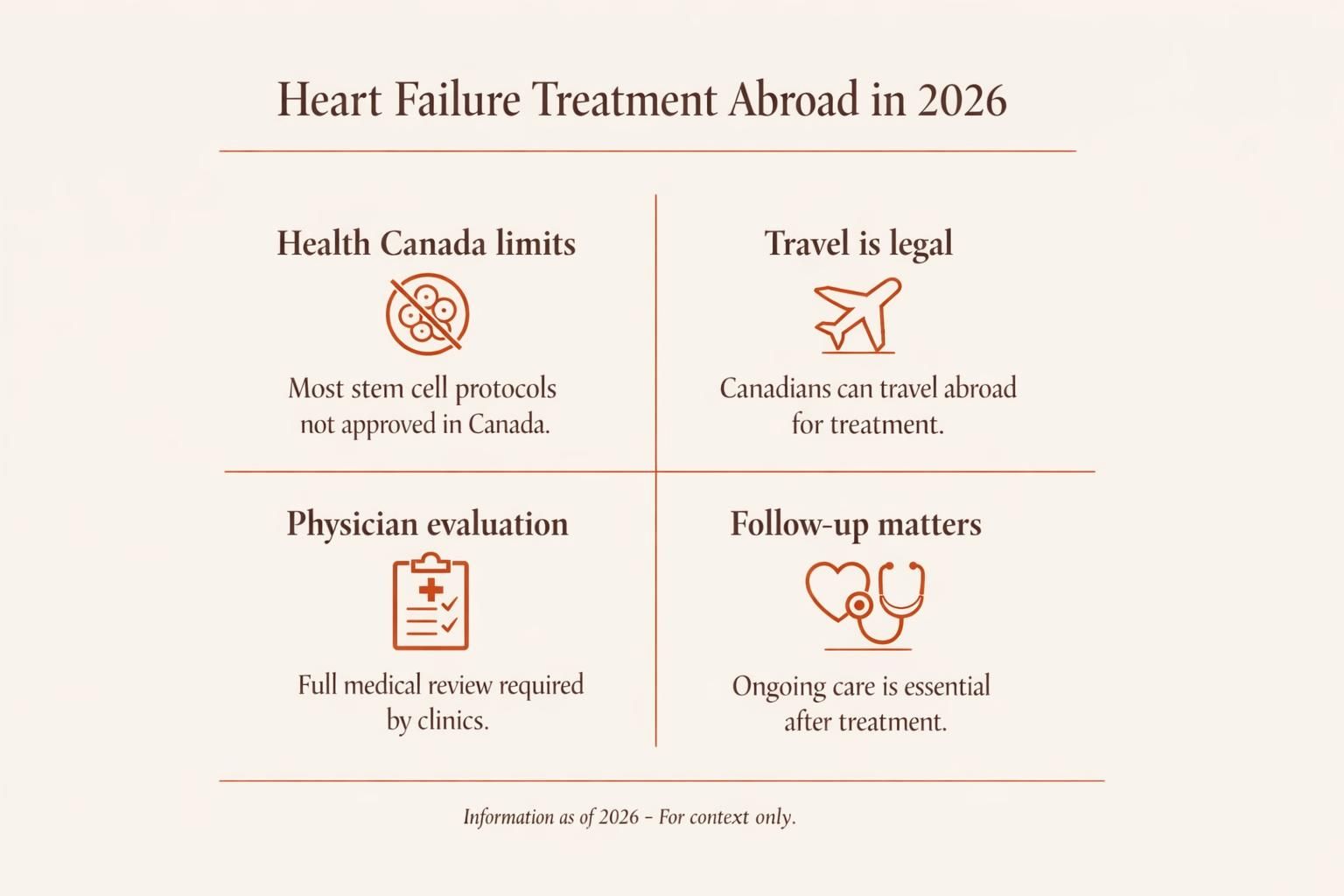
Most regenerative therapies for heart failure — including mesenchymal stem cell protocols — remain unapproved by Health Canada for routine clinical use as of 2026. Canadian patients who want to explore these options legally and safely often travel abroad to countries like Mexico, where physician-guided regenerative medicine operates within a different regulatory framework. A full medical evaluation by a qualified physician is always required before any regenerative protocol can be considered appropriate for a given patient.
Why Most Stem Cell Therapies Are Not Yet Approved in Canada
Health Canada classifies most stem cell therapies as biological drugs. This means they must go through the same rigorous approval process as pharmaceutical treatments before they can be offered in a clinical setting.
As of 2026, only a small number of stem cell therapies hold full Health Canada approval. These are primarily bone marrow transplants for blood-related cancers and a handful of other highly specific applications. Mesenchymal stem cell therapies — the type most often discussed for cardiovascular support, inflammation modulation, and tissue repair — remain investigational in Canada.
This does not mean the science lacks promise. Researchers around the world continue studying regenerative approaches for cardiovascular conditions. The gap exists because the Canadian approval pathway is lengthy, evidence thresholds are high, and most regenerative medicine protocols are still completing the clinical trial phases required for domestic approval.
For Canadian patients living with heart failure who feel they have exhausted conventional options, this regulatory reality can feel frustrating. Many begin asking whether traveling abroad is a viable path.
Is Traveling Abroad for Regenerative Medicine Legal for Canadians?
Yes. Canadian citizens may legally travel to other countries to access medical treatments that are not available domestically. This is a personal medical decision, and it is not prohibited by Canadian law.
What matters is where you go, which clinic you choose, and whether the treatment occurs under qualified physician supervision in a properly licensed medical setting. Mexico has become one of the most established destinations for regenerative medicine in North America. The country operates its own health regulatory body — COFEPRIS — which governs the licensing, practice, and administration of advanced medical therapies including regenerative protocols.
Clinics that operate within Mexico’s regulated medical framework can legally offer physician-guided regenerative medicine to international patients. This is not a legal gray area for the patient. It is simply medical tourism — a well-established practice that millions of people use each year.
If you are considering this path, learning more about medical tourism in Mexico is a practical first step.
What Regenerative Medicine May Offer for Heart Failure Patients
Regenerative medicine does not claim to cure heart failure. That distinction matters. What physician-guided protocols may support is a different question.
Emerging research suggests that certain regenerative approaches — particularly mesenchymal stem cell protocols — may help support inflammation modulation, cellular repair signaling, and cardiovascular function in appropriately selected candidates. These are areas of active clinical investigation globally.
At Cellular Institute in Cancún, Dr. Rafael Moguel, Medical Director and board-certified cardiologist, leads the clinical evaluation process for cardiovascular patients. His background in both cardiology and regenerative medicine means that patient candidacy is assessed with a genuine understanding of cardiovascular physiology — not just a general intake form.
Beyond stem cell therapy, a personalized protocol for a heart failure patient may also incorporate complementary tools such as exosome therapy for cell signaling support, EBOO therapy in Cancún for systemic inflammation and oxidative stress reduction, and recovery technologies designed to support the body during and after treatment.
The medical team designs each protocol around the individual patient. No two cardiovascular cases are identical, and responsible regenerative medicine reflects that reality.
What Canadian Patients Should Evaluate Before Choosing a Clinic Abroad
The biggest risk in medical tourism is not traveling. The biggest risk is choosing the wrong clinic. Not all regenerative medicine providers operate with the same standards, oversight, or transparency.
Here is what Canadian heart failure patients should ask before committing to any clinic abroad:
- Is there a licensed cardiologist or internist who will review my medical history before treatment? Heart failure patients require careful cardiovascular evaluation. A general intake process is not sufficient.
- Where do the stem cells or exosomes come from, and how are they processed? Product sourcing, sterility, viability, and quality documentation matter enormously.
- Does the clinic have regulatory recognition in the country where it operates? In Mexico, look for COFEPRIS-recognized licensing structures related to biologics and clinical application.
- What does the full protocol include? A responsible regenerative medicine provider does not offer a single injection without clinical reasoning, preparation, complementary support, and follow-up planning.
- What is the follow-up process after treatment? Regenerative medicine is not a one-visit solution. Long-term optimization and monitoring matter for cardiovascular patients especially.
For a deeper look at evaluating providers, our guide on how to choose a stem cell clinic in Mexico covers the key questions patients should ask before booking.
How Cellular Institute Approaches Cardiovascular Regenerative Protocols
Cellular Institute is not a wellness spa or a single-treatment injection center. The clinic operates as an advanced regenerative medicine and longevity platform in Cancún, backed by a broader ecosystem that includes in-house biologics through Cellgenic, physician education through ISSCA, and more than 15 years of experience in the Global Stem Cells Group network.
For cardiovascular patients, the process begins with a thorough medical evaluation. Dr. Rafael Moguel reviews each patient’s cardiac history, current medications, diagnostic imaging, and overall health status before any protocol is designed.
The clinic’s biologics partner, Cellgenic, supports lab quality and transparency through documented quality control processes that include viability testing, sterility verification, and traceability. Patients can ask what documentation is available for the cells or exosomes used in their protocol. That level of transparency separates responsible providers from those who rely on marketing language alone.
Complementary tools such as hyperbaric oxygen therapy, red light therapy, PEMF, and peptide therapy may also be incorporated where clinically appropriate. These recovery technologies support the body’s response to regenerative treatment and can play a meaningful role in cardiovascular recovery and optimization.
International patient coordination handles logistics including travel support, bilingual communication, clinic scheduling, and structured follow-up after patients return home to Canada.
Who May Be a Candidate for Regenerative Medicine Abroad
Candidacy for regenerative medicine is never assumed. It is evaluated. A physician must review your complete medical profile before any protocol can be considered appropriate.
Generally speaking, candidates who may benefit from physician-guided regenerative protocols include patients who have stable heart failure not responding adequately to conventional therapy, patients seeking complementary support for inflammation and cellular repair, and patients who are medically cleared to travel and tolerate treatment safely.
Patients with acute cardiac events, recent hospitalizations, active infections, certain cancers, or other contraindications may not be appropriate candidates at a given time. The physician evaluation process exists precisely to make this determination responsibly.
Who May Not Be a Candidate
Regenerative medicine is not appropriate for every patient. A physician may determine that a patient is not currently a candidate based on cardiac instability, recent surgery, active inflammatory disease, or other clinical factors. Responsible clinics will communicate this clearly rather than accepting every patient regardless of medical history. Results vary by patient, and honest expectations are part of a trustworthy regenerative medicine experience.

Frequently Asked Questions
Is it legal for Canadian patients to travel to Mexico for stem cell therapy?
Yes. Canadians may legally travel abroad to access medical treatments not available domestically. Medical tourism is not prohibited by Canadian law. What matters most is choosing a clinic that operates within a regulated medical framework, requires a physician evaluation, and maintains documented quality and safety standards.
Does Health Canada approve any stem cell therapies?
Health Canada approves a small number of stem cell therapies — primarily for blood-related conditions treated with bone marrow transplants. Most mesenchymal stem cell protocols for cardiovascular or inflammatory conditions remain investigational in Canada as of 2026. Patients seeking access to these protocols domestically face significant limitations under current regulations.
What should heart failure patients ask before choosing a regenerative medicine clinic abroad?
Ask whether a licensed cardiologist or internist will evaluate your case before treatment. Ask about the sourcing, processing, and quality documentation for the biologics used. Ask what the full protocol includes beyond the injection itself. Ask about follow-up care after you return home. A clinic that cannot answer these questions clearly may not meet the standard of care you deserve.
How much does regenerative medicine in Mexico cost for cardiovascular patients?
Protocol costs vary depending on the complexity of the case, the biologics selected, the duration of the visit, and the complementary technologies included. A personalized cardiovascular protocol is not a standard package with a fixed price. Speaking directly with a patient coordinator is the best way to understand what a protocol designed for your specific situation would include and cost.
Final Thoughts
Canadian heart failure patients face a real gap between what regenerative medicine may offer and what Health Canada currently approves for routine clinical use. That gap is not permanent — the science continues to evolve — but for patients who need options now, traveling abroad to a physician-guided, regulated regenerative medicine clinic is a legal and increasingly common decision.
The most important factor is not simply accessing treatment. It is accessing the right treatment, from the right team, in the right environment, with the right follow-up in place. That is the standard Cellular Institute is built around.
If you are a Canadian patient exploring regenerative medicine in Cancún for heart failure support, the first step is a medical evaluation — not a booking. Schedule a discovery call with our team to discuss your history, your goals, and whether you may be a candidate for a personalized regenerative protocol.
Medical Disclaimer
This article is for educational purposes only and does not replace medical advice, diagnosis, or treatment. Regenerative therapies are not appropriate for every patient, and outcomes vary. A licensed physician must evaluate your medical history, goals, and candidacy before any treatment can be recommended.