
Written by: Cellular Institute Editorial Team
Medical reviewer: Dr. Matilde Rodríguez – CP 12651081
Laboratory reviewer: Biotecnóloga Diana Navarrete – CP 15029468
Quick Answer
Stem cell therapy for fibromyalgia is an emerging area of interest in regenerative medicine. Early research suggests that mesenchymal stem cells may support immune modulation, inflammation balance, and nervous system regulation. However, this is not a proven treatment for fibromyalgia, and outcomes vary significantly by patient. A thorough physician evaluation is required before anyone considers this approach.
What Patients with Fibromyalgia Are Actually Asking
Most people who reach out to regenerative medicine clinics about fibromyalgia share a similar story. They have tried medications, physical therapy, and lifestyle changes. Some have seen partial improvement. Others feel stuck. They are not looking for a miracle. They are asking whether something deeper can help when standard options have not been enough.
The questions we hear most often include:
- Could stem cell therapy reduce my chronic pain or sensitivity?
- Is there anything regenerative medicine can do for brain fog and fatigue?
- Could inflammation be part of what is driving my symptoms?
- Am I even a candidate for this kind of therapy?
These are fair, thoughtful questions. They deserve honest, medically grounded answers.
What We Know About Fibromyalgia and Inflammation
Fibromyalgia involves widespread pain, heightened sensitivity, fatigue, sleep disruption, and cognitive difficulties. Researchers continue to study its root causes. Evidence points to central sensitization, meaning the nervous system amplifies pain signals in a way that does not always correlate with visible tissue damage.
More recent research also highlights chronic low-grade inflammation, immune dysregulation, and mitochondrial dysfunction as contributing factors. This is relevant because regenerative therapies are designed to work at the level of cellular signaling, immune balance, and tissue environment rather than simply masking symptoms.
Fibromyalgia does not have a single measurable cause. That complexity makes it challenging to treat and equally challenging to study in regenerative medicine trials. Responsible expectations matter here.
How Stem Cell Therapy May Fit Into a Regenerative Protocol
Mesenchymal stem cells, often derived from umbilical cord tissue or Wharton’s jelly, release signaling molecules that may help modulate immune activity and reduce inflammatory burden. Some researchers believe this signaling effect could support the nervous system environment in conditions involving central sensitization.
It is important to be clear: stem cell therapy does not repair fibromyalgia the way it might support a torn tendon or damaged cartilage. The mechanisms are different. The goal in a fibromyalgia context would be to support the systemic environment, reduce inflammatory signaling, and encourage the body’s own regulatory processes.
At Cellular Institute, stem cell therapy is never offered as a standalone injection. The medical team builds a personalized protocol around the patient’s history, inflammation markers, immune status, and functional goals. Depending on the evaluation, a protocol for a fibromyalgia patient might include stem cell therapy alongside EBOO therapy in Cancún to support systemic inflammation reduction, or peptide therapy to support recovery and cellular optimization.
Supporting the body from multiple angles tends to produce more meaningful results than a single intervention.
Why Lab Quality and Cell Standards Matter
Not all stem cell products carry the same quality. Patients exploring this option should ask clinics direct questions about where the cells come from, how they are processed, what viability and sterility testing looks like, and what documentation is available.
Cellular Institute works with certified stem cells through an in-house biologics infrastructure that prioritizes traceability, xeno-free manufacturing standards, and documented quality control. Biotechnologist Diana Navarrete oversees laboratory review as part of the team’s commitment to transparency.
Many clinics outsource their biologic products without clear visibility into the process. At Cellular Institute, the connection between the lab and the clinical team is intentional. Patients deserve to know what they are receiving and how it was prepared. You can learn more about this approach through the clinic’s lab quality and transparency documentation.
Who May Be a Candidate for This Approach
Candidacy depends on several individual factors. A physician evaluation is always the first step. Patients who may be appropriate candidates often share some of these characteristics:
- A confirmed fibromyalgia diagnosis with documented history
- Persistent symptoms that have not fully responded to conventional care
- Elevated inflammatory markers or immune dysregulation visible on labs
- A commitment to a broader wellness and recovery protocol
- Realistic expectations about regenerative medicine as a supportive tool, not a cure
Who May Not Be a Candidate
Regenerative therapy is not appropriate for everyone. The medical team at Cellular Institute evaluates each patient individually. Patients with active malignancies, certain autoimmune conditions in acute flare, active infections, or other contraindications may not qualify. Dr. Roni Moya, Immunologist, plays an important role in evaluating immune health and inflammatory burden as part of the clinical review process.
A responsible clinic will tell you honestly when you are not a good candidate. That honesty is a sign of quality, not a rejection.
How Cellular Institute Approaches Fibromyalgia Cases
Cellular Institute does not offer a single fibromyalgia injection package. The team designs individualized regenerative protocols based on each patient’s medical history, lab results, symptoms, and goals.
A protocol might combine stem cell therapy with recovery technologies such as hyperbaric oxygen therapy, red light therapy, or PEMF to support nervous system recovery and cellular function. Exosome therapy may also be considered as part of a cell signaling approach. Every decision reflects clinical reasoning, not a menu of options.
Patients traveling from the United States or Canada will find a structured, bilingual, concierge-style experience in Cancún. The team supports logistics from arrival through follow-up. If you are curious about what the patient journey looks like, the medical tourism in Mexico guide covers what to expect when traveling for regenerative care.
Questions to Ask Before Choosing a Clinic
If you are comparing clinics that offer stem cell therapy for fibromyalgia, ask these questions directly:
- Where do the stem cells come from, and how are they processed?
- What quality documentation, such as a certificate of analysis, is available?
- Does a licensed physician review my case before recommending a protocol?
- Is the protocol personalized, or does every patient receive the same treatment?
- What complementary therapies are part of the program?
- What follow-up support does the clinic provide after treatment?
A clinic that answers these questions openly and without pressure is one worth considering seriously. You can also review guidance on how to choose a stem cell clinic in Mexico for a more detailed framework.

Frequently Asked Questions
Is stem cell therapy a cure for fibromyalgia?
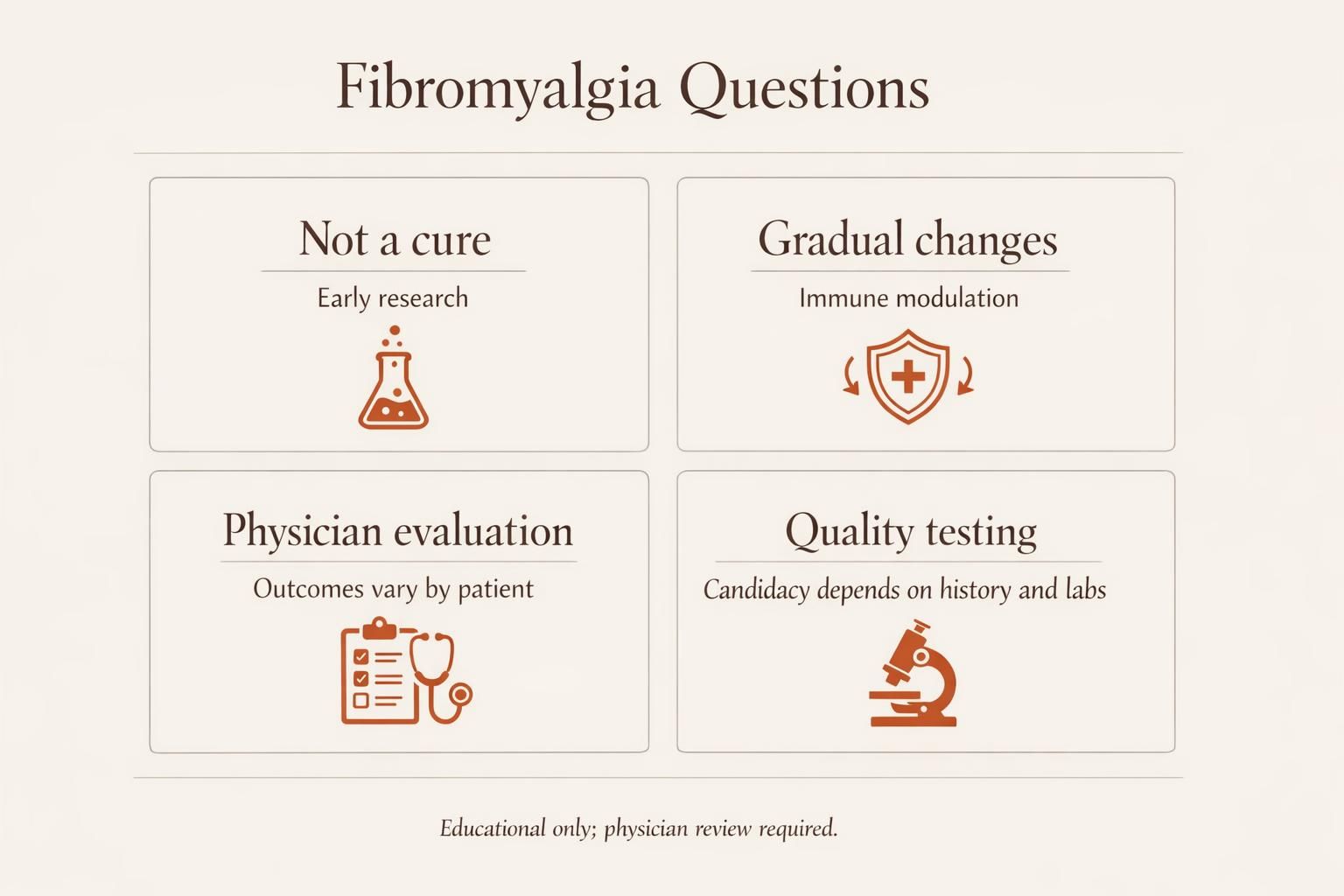
No. Stem cell therapy is not a cure for fibromyalgia. Research in this area is still early. The goal of a regenerative protocol is to support immune balance, reduce inflammatory burden, and encourage the body’s own regulatory processes. Results vary by patient, and a physician evaluation is required to assess candidacy.
How long might it take to notice any changes?
Patients who do respond to regenerative protocols often report gradual changes over weeks to months rather than immediate relief. Fibromyalgia is a complex, multifactorial condition, and the body’s response to regenerative support takes time. Managing expectations responsibly is a core part of how Cellular Institute works with patients.
What does a typical protocol cost for fibromyalgia patients in Mexico?
Protocol costs vary based on what is included, the type of biologics used, and the combination of therapies recommended after evaluation. You can find a detailed cost overview in the guide to stem cell therapy cost in Mexico to understand what affects pricing and what should be included.
Is it safe to travel to Cancún for this kind of treatment?
Many international patients from the United States and Canada travel to Cancún for regenerative medicine care each year. Cellular Institute provides coordinated patient support from pre-arrival through follow-up, including bilingual coordination and clinical oversight. For a thorough review of safety considerations, see the information on stem cell therapy safety in Mexico.
Final Thoughts
Fibromyalgia is one of the most difficult conditions to live with precisely because it is so poorly understood and so inconsistently treated. If you have reached the point of exploring regenerative medicine, you are asking the right questions. The evidence for stem cell therapy in fibromyalgia is still developing, but the biological rationale around inflammation modulation and immune support is real and worth exploring with a qualified physician.
Cellular Institute does not promise outcomes. What the team does promise is a thorough evaluation, an honest conversation about candidacy, and a personalized protocol built around your specific situation if you qualify. That is what responsible regenerative medicine looks like.
If you are ready to find out whether this approach may be appropriate for your case, schedule a discovery call with the Cellular Institute team. The first step is always education and evaluation, not a sales pitch.
Medical Disclaimer
This article is for educational purposes only and does not replace medical advice, diagnosis, or treatment. Regenerative therapies are not appropriate for every patient, and outcomes vary. A licensed physician must evaluate your medical history, goals, and candidacy before any treatment can be recommended.