
Written by: Cellular Institute Editorial Team
Medical reviewer: Dr. Matilde Rodríguez – CP 12651081
Laboratory reviewer: Biotecnóloga Diana Navarrete – CP 15029468
Quick Answer
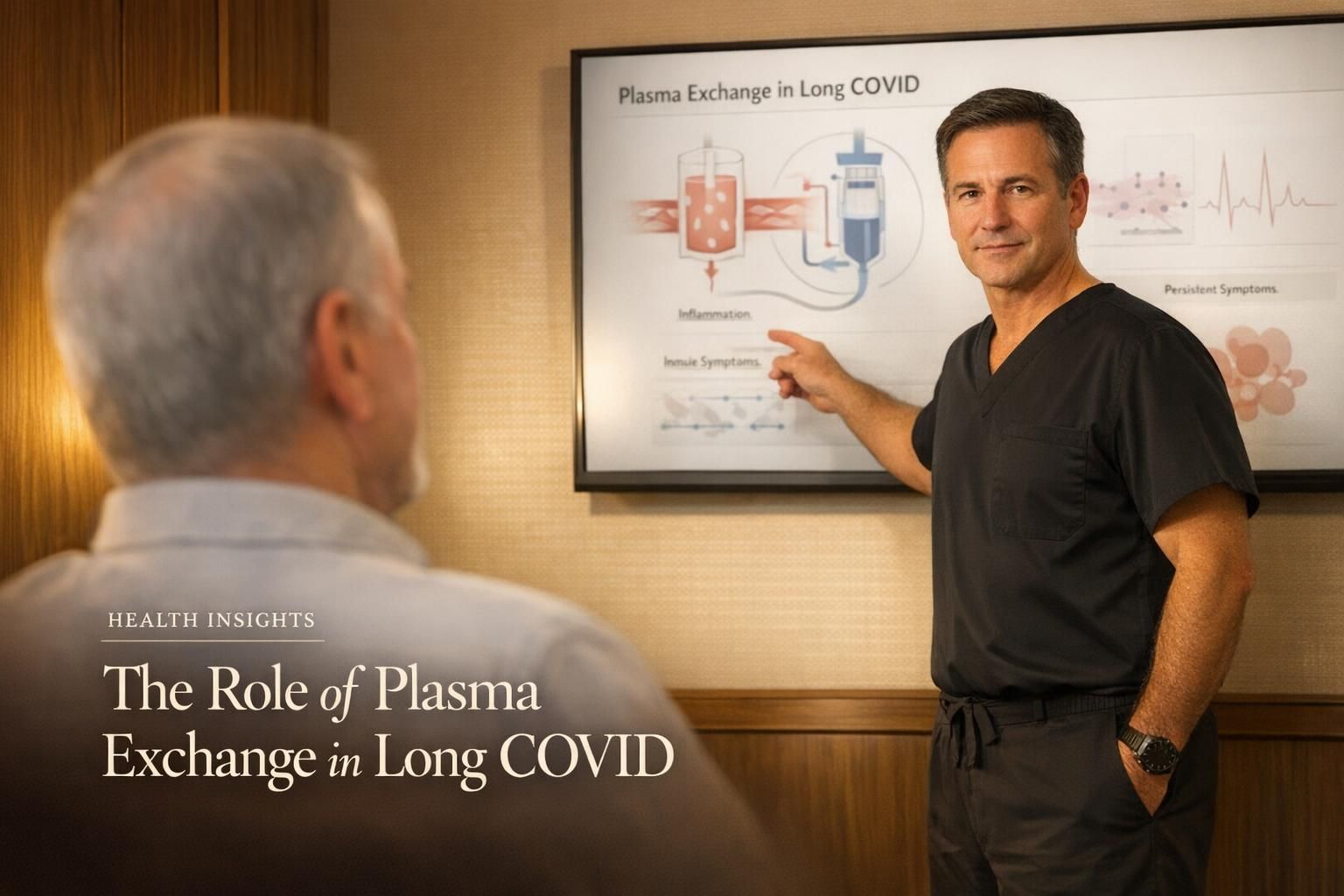
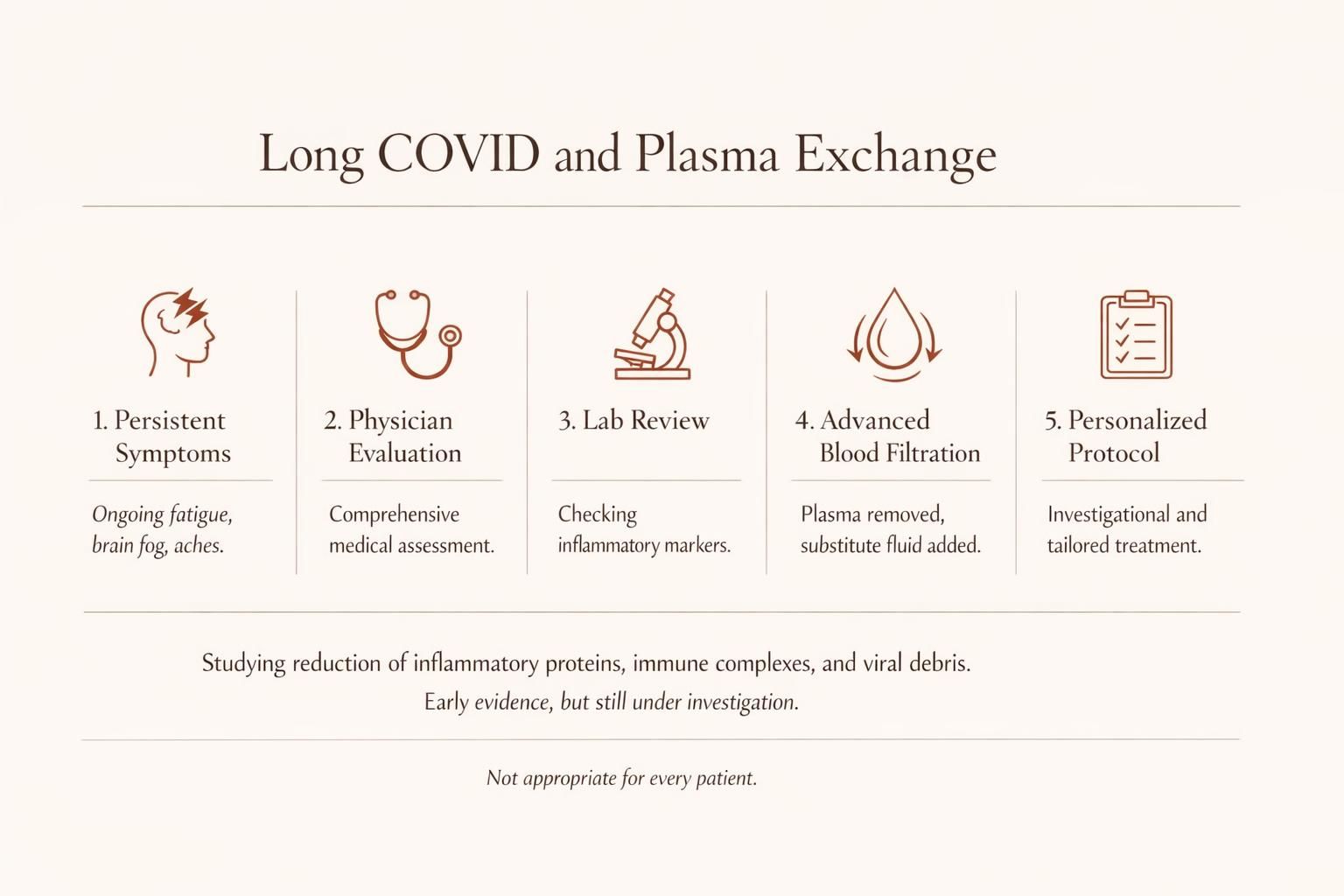
Plasma exchange, also called plasmapheresis or therapeutic plasma exchange, is a blood filtration procedure that removes plasma from the body and replaces it with a substitute fluid. Some researchers and clinicians are exploring whether this approach may help patients with long COVID by reducing circulating inflammatory proteins, viral debris, and immune complexes that may contribute to persistent symptoms. Early evidence is emerging, but this therapy remains investigational for long COVID and is not appropriate for every patient. A physician evaluation is required to determine whether any advanced blood filtration approach may be suitable for your specific situation.
Why Patients with Long COVID Are Looking Beyond Standard Care
Long COVID, also called post-acute sequelae of SARS-CoV-2 or post-COVID syndrome, affects a significant number of people who had COVID-19. Many patients continue to experience debilitating symptoms weeks or months after the initial infection has resolved.
Common persistent symptoms include extreme fatigue, cognitive difficulties often called brain fog, joint and muscle pain, shortness of breath, sleep disturbances, and cardiovascular irregularities. For many patients, these symptoms do not respond fully to rest, standard medications, or conventional rehabilitation.
This frustration has led many patients to research more advanced options, including plasma exchange, in hopes of finding a pathway to meaningful recovery.
What Is Plasma Exchange and How Does It Work?
Plasma exchange is a clinical procedure in which blood is drawn from the patient, the plasma portion is separated from the blood cells, and the plasma is replaced with a substitute. The remaining blood cells are then returned to the patient.
The goal of this process is to remove harmful substances circulating in the plasma. These may include inflammatory cytokines, autoantibodies, immune complexes, and other molecules that may drive ongoing inflammation or immune dysregulation.
In long COVID, researchers have identified elevated inflammatory markers, persistent microclots, autoantibodies, and possible viral remnants in the bloodstream of some patients. Some clinicians hypothesize that reducing this burden may help calm the overactive immune response and support recovery.
It is important to note that plasma exchange is not a new technology. It has been used for decades in established medical conditions such as myasthenia gravis, Guillain-Barré syndrome, and certain autoimmune disorders. Its application to long COVID, however, remains an area of active research and should not be interpreted as a standard or proven treatment for this condition.
What Does the Current Evidence Suggest?
Several early-stage studies and case reports have examined plasma exchange in long COVID patients, with some reporting improvements in fatigue, cognitive function, and inflammatory markers. However, large-scale, randomized controlled trials are still limited.
The hypothesis driving this interest is biologically plausible. Long COVID may involve a sustained inflammatory state, immune dysregulation, and circulating harmful proteins. Removing these through plasma filtration could theoretically reduce the physiological burden on the body.
That said, results vary significantly between patients. Not every individual with long COVID has the same underlying biology, and not every patient responds the same way to blood filtration approaches. This is why physician-guided evaluation and personalized protocols matter so much in this space.
Advanced Blood Filtration Approaches in a Regenerative Protocol
At Cellular Institute in Cancún, we approach patients with post-COVID syndrome from a comprehensive, personalized perspective. We do not offer a single injection or a one-size-fits-all solution. Instead, our team evaluates each patient’s inflammatory status, immune history, symptom profile, and medical background to design a protocol that makes clinical sense for their situation.
One of the advanced blood-based therapies we offer is EBOO therapy in Cancún, which stands for Extracorporeal Blood Oxygenation and Ozonation. EBOO is a blood filtration approach that combines ozone therapy with extracorporeal circulation to support the removal of inflammatory byproducts and oxidative stress from the blood.
For patients dealing with systemic inflammation, high oxidative burden, and immune dysregulation, EBOO may serve as part of a broader protocol designed to support recovery. You can read more about how EBOO therapy and systemic inflammation relate to each other in our dedicated educational resource.
This approach is complementary to other modalities we may incorporate into a long COVID recovery protocol, including peptide therapy to support immune modulation and tissue repair, exosome therapy to promote cellular communication and recovery signaling, and recovery technologies such as hyperbaric oxygen, red light therapy, and PEMF.
Our medical team, including Dr. Roni Moya, Immunologist, evaluates patients with chronic inflammatory and immune-related conditions to determine which combination of therapies may be most appropriate. Immune health evaluation plays a central role in how we design protocols for patients with post-COVID syndrome.
Who May Be a Candidate for Advanced Blood Filtration in Long COVID?
Patients who may benefit from a physician evaluation for advanced blood filtration approaches include those who:
- Have experienced persistent symptoms for three months or longer after a confirmed COVID-19 infection
- Have not achieved satisfactory improvement with standard medical care
- Show elevated inflammatory markers or immune dysregulation on laboratory testing
- Are medically stable and do not have active infections or uncontrolled acute conditions
- Are willing to engage in a comprehensive evaluation before beginning any protocol
It is equally important to identify patients for whom this approach may not be appropriate. Candidacy depends on detailed medical review.
Who May Not Be a Candidate
Not every patient with long COVID will be a candidate for blood filtration or advanced regenerative protocols. Patients with active infections, certain clotting disorders, severe cardiovascular instability, or other contraindications may need to pursue different support strategies first.
This is precisely why Cellular Institute requires a thorough medical evaluation before recommending any protocol. Responsible care begins with understanding the patient, not with recommending a procedure.
Questions to Ask Before Choosing a Clinic
If you are exploring advanced therapies for long COVID, the clinic you choose matters enormously. Here are questions worth asking before you commit to any program:
- Does a licensed physician evaluate every patient individually before recommending a protocol?
- What laboratory testing do you use to assess inflammatory burden and immune status?
- How do you personalize the protocol for each patient?
- What complementary therapies are included, and how are they selected?
- What follow-up support do you provide after treatment?
- What are your regulatory credentials and licensing in Mexico?
For patients considering how to choose a stem cell clinic in Mexico or any advanced regenerative clinic, these questions apply broadly to any provider offering blood-based or regenerative therapies.

Frequently Asked Questions
Is plasma exchange the same as EBOO therapy?
No, they are not the same, though both involve extracorporeal blood processing. Plasma exchange removes plasma and replaces it with a substitute fluid. EBOO combines blood filtration with ozone exposure and oxygenation. Both approaches aim to reduce the burden of harmful substances in the blood, but they use different mechanisms. A physician evaluation helps determine which approach may be more appropriate for your situation.
Is there scientific proof that plasma exchange works for long COVID?
Early case reports and small studies suggest potential benefits in some patients, particularly those with elevated inflammatory markers and persistent symptoms. However, large randomized controlled trials are still limited. The science is promising but evolving. Any clinic offering this therapy should communicate realistic, evidence-informed expectations rather than guaranteed outcomes.
How does Cellular Institute approach long COVID patients?
Cellular Institute evaluates each patient individually. Our physician team reviews laboratory results, symptom history, inflammatory burden, and medical background before designing a personalized protocol. Protocols may include advanced blood filtration, peptide therapy, exosome therapy, hyperbaric oxygen, and other recovery technologies depending on what the evaluation suggests is appropriate for each patient.
Can I combine plasma exchange or EBOO with other regenerative therapies?
In many cases, blood filtration approaches are most effective as part of a broader protocol rather than as a standalone intervention. Combining therapies such as EBOO, peptide support, exosome therapy, and recovery technologies may provide a more comprehensive foundation for recovery. This is a clinical decision that your physician should guide based on your individual health profile.
Final Thoughts
Plasma exchange for long COVID represents a biologically plausible and increasingly discussed approach for patients who have not recovered with standard care. The rationale, reducing circulating inflammatory proteins, viral debris, and immune complexes, aligns with emerging research on what may drive persistent post-COVID symptoms.
At Cellular Institute in Cancún, we take a physician-guided, protocol-first approach to patients with post-COVID syndrome. We combine advanced blood filtration technologies like EBOO, immune-supportive modalities, and regenerative medicine in Cancún into personalized programs designed around each patient’s clinical picture.
We also understand that traveling for treatment is a significant decision. Our team provides full coordination support for international patients, from evaluation through recovery. If you want to learn more about what to expect, our guide on medical tourism in Mexico is a helpful starting point.
If you or someone you care for is living with persistent long COVID symptoms and has not found adequate relief, we invite you to start with a conversation. Schedule a discovery call with our team to share your history, ask your questions, and learn whether you may be a candidate for an advanced, personalized recovery protocol.
Medical Disclaimer
This article is for educational purposes only and does not replace medical advice, diagnosis, or treatment. Regenerative therapies are not appropriate for every patient, and outcomes vary. A licensed physician must evaluate your medical history, goals, and candidacy before any treatment can be recommended.