
Written by: Cellular Institute Editorial Team
Medical reviewer: Dr. Matilde Rodríguez – CP 12651081
Laboratory reviewer: Biotecnóloga Diana Navarrete – CP 15029468
Quick Answer
Stem cell therapy and surgery serve different purposes and suit different patients. Surgery physically repairs or removes damaged tissue. Stem cell therapy takes a regenerative approach, aiming to support the body’s own healing processes at a cellular level. Neither option works for every patient or every condition. A physician must evaluate your medical history, imaging, labs, and goals before recommending either path. Many patients explore stem cell therapy as a less invasive alternative when surgery carries significant risk or when they want to pursue conservative options first.
What Patients Should Know Before Comparing Options
Most patients searching for this comparison are not looking for a debate. They want honest, practical guidance. They may be living with joint pain, a musculoskeletal injury, or a chronic condition. Their surgeon has recommended an operation. They want to know if a less invasive option exists.
That is a reasonable question, and it deserves a clear answer.
Stem cell therapy and surgery are not direct substitutes. They approach the body differently. Understanding those differences helps patients make more informed decisions alongside their medical team.
Surgery: What It Involves and What to Expect
Surgery physically intervenes in the body. A surgeon removes, repairs, reconstructs, or replaces tissue, bone, cartilage, or other structures. For some conditions, surgery remains the most appropriate and evidence-supported option.
Potential Benefits of Surgery
- Direct structural correction of damaged tissue
- Well-established outcomes for many orthopedic conditions
- Often covered by insurance
- Predictable procedural steps
Risks and Recovery Considerations
- General or regional anesthesia carries inherent risks
- Risk of infection, blood clots, or nerve damage
- Recovery may require weeks to months of limited activity
- Physical therapy and rehabilitation are often required
- Some patients experience incomplete recovery or long-term complications
- Repeat surgery may be needed in some cases
Recovery timelines vary widely depending on the procedure, the patient’s age, overall health, and how well they follow post-operative protocols.
Stem Cell Therapy: What It Involves and What to Expect
Stem cell therapy takes a different approach. Rather than physically altering tissue, it introduces biologic material that may support the body’s own repair processes. The goal is to modulate inflammation, support tissue recovery, and promote cellular signaling in the affected area.
At Cellular Institute, regenerative cell therapies are administered under physician supervision as part of a personalized protocol. The therapy itself is only one component of a broader clinical strategy.
Potential Benefits of Stem Cell Therapy
- Minimally invasive compared to surgical procedures
- No general anesthesia required in most cases
- Shorter procedural time
- May support inflammation modulation and tissue recovery
- Can often be combined with complementary regenerative tools
- Recovery downtime is typically less intensive than surgery
Risks and Limitations to Understand
- Not appropriate for all patients or all conditions
- Results vary significantly by patient, condition severity, and biologic quality
- Clinical evidence continues to evolve
- Not a structural repair for severe anatomical damage
- Product quality, dosing, and delivery method affect outcomes
- Physician evaluation and candidate screening are essential
Patients considering stem cell therapy should ask detailed questions about the source of the cells, how they are processed, and what quality documentation the clinic provides. Learn more about what certified stem cells involve and why those standards matter.
Recovery Time: A Practical Comparison
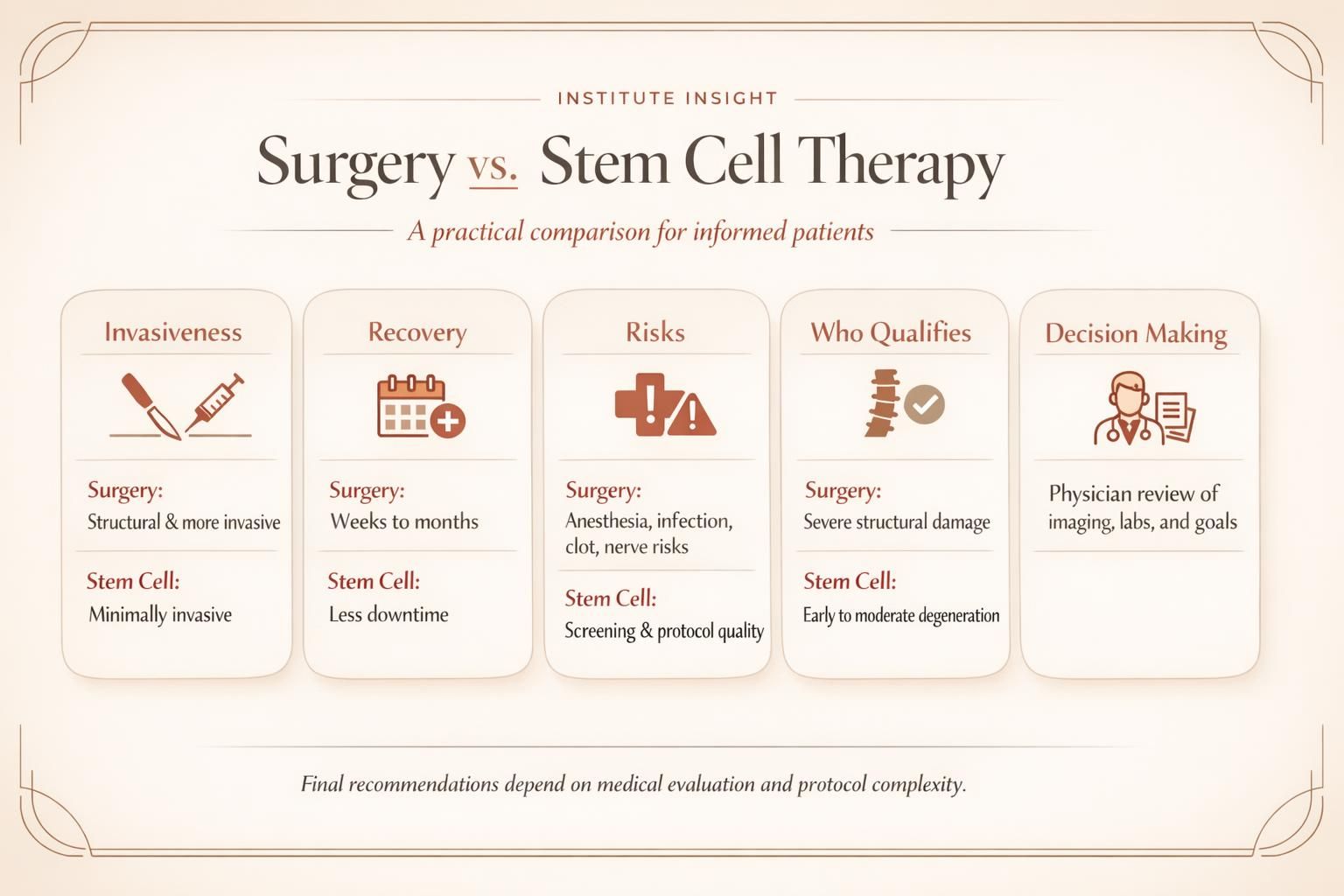
Recovery time depends heavily on the specific procedure or protocol, the patient’s baseline health, and how the body responds.
In general terms, surgical recovery often involves days to weeks of limited mobility, wound care, and structured rehabilitation. Some surgeries require three to six months before a patient returns to full activity.
Stem cell therapy typically involves less recovery time. Most patients resume light activity within a day or two. The cellular response, however, unfolds over weeks to months. Patients should maintain realistic expectations about when they may notice changes. Understanding how long stem cell therapy results may last is an important part of setting responsible expectations before treatment.
Who May Be a Candidate for Stem Cell Therapy Instead of Surgery
Stem cell therapy may be worth exploring for patients who meet certain clinical criteria. A physician evaluation determines candidacy in every case.
Patients who may benefit from a regenerative medicine consultation include those who:
- Have early to moderate joint degeneration without severe structural loss
- Want to explore conservative options before committing to surgery
- Face elevated surgical risk due to age, cardiovascular status, or other health factors
- Have not responded fully to physical therapy, medications, or injections
- Are managing chronic inflammation that may be contributing to their symptoms
- Are motivated to support recovery with an integrated protocol
At Cellular Institute, orthopedic evaluations are conducted by experienced physicians including Dr. Wajid Burad, who brings specialized knowledge in musculoskeletal conditions and regenerative orthopedics.
Who May Not Be a Good Candidate for Stem Cell Therapy Alone
Transparency matters here. Stem cell therapy does not replace surgery in every situation.
Patients who may require surgery first include those with:
- Complete tendon or ligament tears requiring structural reattachment
- Severe joint destruction requiring replacement
- Fractures needing stabilization
- Spinal cord compression requiring decompression
- Conditions where delayed surgical intervention poses significant health risk
The goal is never to discourage surgery when it is clinically necessary. The goal is to help patients understand when regenerative medicine may be a reasonable first step and when it is not.
How Cellular Institute Approaches This Decision
Cellular Institute does not offer a one-size-fits-all recommendation. Every patient begins with a medical evaluation. The physician reviews labs, imaging, health history, inflammatory markers, and treatment goals before designing a protocol.
When stem cell therapy is appropriate, the protocol often includes complementary tools such as recovery technologies, peptide therapy, or advanced blood therapies to support the regenerative process. These tools work together to create a more complete clinical environment for healing.
The biologics used at Cellular Institute come through Cellgenic, the clinic’s affiliated in-house lab ecosystem. This means greater traceability, quality control, viability testing, sterility documentation, and xeno-free processing standards. Many clinics outsource their biologics with limited transparency. Cellular Institute takes a different approach, one grounded in lab quality and transparency.
For international patients considering treatment in Cancun, the team also provides structured coordination, bilingual support, and a guided patient journey. Learn what to expect from regenerative medicine in Cancún before you travel.
Questions to Ask Before Choosing Between Surgery and Stem Cell Therapy
- Has a physician reviewed my imaging and labs to confirm which option is appropriate?
- Am I a surgical candidate, and what are the specific risks for my age and health status?
- Have I exhausted conservative options before surgery?
- If I pursue stem cell therapy, where do the cells come from and how are they processed?
- Does the clinic provide quality documentation such as a certificate of analysis?
- What does the full protocol include beyond the injection or procedure?
- What are realistic expectations for recovery and results in my specific case?

Frequently Asked Questions
Can stem cell therapy replace surgery for a torn meniscus or knee arthritis?
It depends on the severity. Patients with partial tears or early to moderate arthritis may be candidates for a regenerative approach. Those with complete structural failure or bone-on-bone degeneration may still require surgical intervention. A physician evaluation with current imaging is essential to determine the right path.
How does recovery from stem cell therapy compare to recovery from knee replacement surgery?
Stem cell therapy typically involves much less downtime than knee replacement surgery. Most patients resume light activity quickly after a regenerative session. Knee replacement recovery often involves weeks of rehabilitation and months before full function returns. However, results from stem cell therapy vary by patient and condition, and a regenerative approach may not produce the same structural outcome as a replacement in advanced cases.
Is stem cell therapy in Mexico a safe alternative to surgery?
Safety depends on the clinic, the quality of the biologics, the physician’s evaluation process, and how well the patient is screened. Not every clinic in Mexico operates at the same standard. Patients should ask about COFEPRIS-recognized licensing, biologic sourcing, quality documentation, and physician oversight. Cellular Institute provides detailed guidance on stem cell therapy safety in Mexico to help patients make informed decisions.
How do I know if I am a candidate for stem cell therapy instead of surgery?
Candidacy requires a formal medical evaluation. No reputable clinic should recommend stem cell therapy without reviewing your labs, imaging, medical history, and goals. At Cellular Institute, the process begins with a discovery call and a physician-led evaluation to determine whether regenerative medicine may be appropriate for your case.
Final Thoughts
The decision between stem cell therapy and surgery is not always simple. For some patients, surgery remains the right choice. For others, a regenerative medicine protocol may offer a meaningful and less invasive path worth exploring before committing to an operation.
What matters most is getting an honest, physician-guided evaluation based on your specific condition, health status, and goals. At Cellular Institute, that evaluation is where every patient journey begins.
If you want to explore whether stem cell therapy may be appropriate for your situation, schedule a discovery call with our team. We will help you understand your options, set responsible expectations, and determine whether you are a candidate for a personalized regenerative protocol.
Medical Disclaimer
This article is for educational purposes only and does not replace medical advice, diagnosis, or treatment. Regenerative therapies are not appropriate for every patient, and outcomes vary. A licensed physician must evaluate your medical history, goals, and candidacy before any treatment can be recommended.